The 2 p.m. Tuesday rule: how Downtown Dubai became the founders' default address
A six-month field investigation into Downtown Dubai's Tuesday 2 p.m. coffee ritual, and what it tells founders about choosing an office in this neighbourhood.
Guillaume Rassemi
The 2 p.m. Tuesday rule: how Downtown Dubai became the founders' default address
Sometime between 2024 and 2026, an unwritten meeting time established itself across the cafés of Sheikh Mohammed bin Rashid Boulevard. Nobody planned it. Everyone now respects it. A field investigation into the quiet economy that decided Downtown Dubai's role for the next decade.
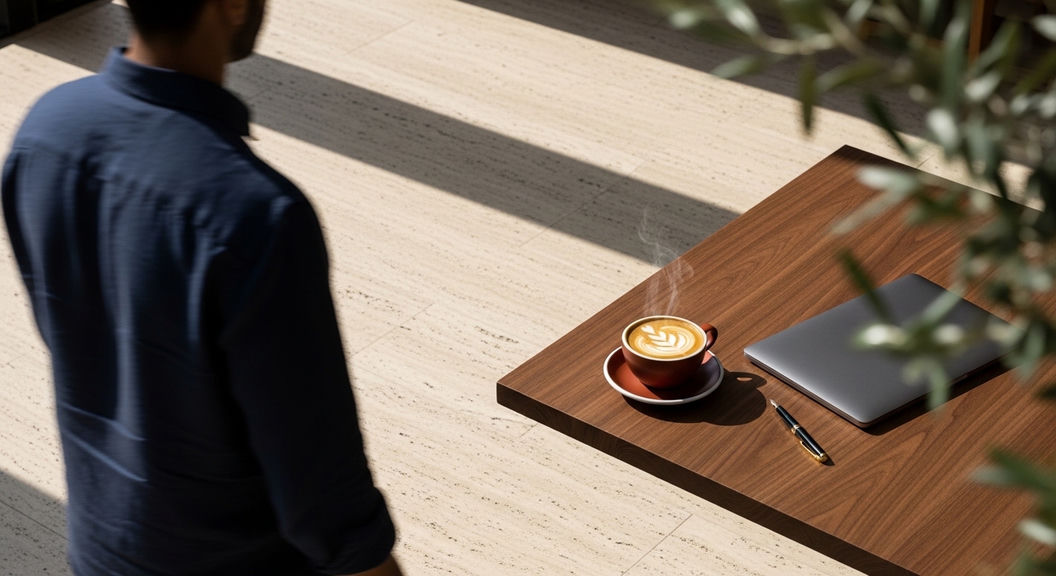
A Tuesday at 1:47 p.m. The terrace of a café at the foot of the Burj Khalifa has just emptied of its lunch crowd. Within nine minutes, it will fill again — but with a different sort of customer. By 1:56 p.m., the first laptops appear: thin, silver, mostly closed. By 2:05 p.m., business cards have begun to change hands. By 2:31 p.m., one founder will have left a meeting with a soft good for you, bro and a photo of a card already on her phone. By 3:10 p.m., the terrace will start to thin out again. By 4:00 p.m., it will look like any other afternoon.
Over six months and four cafés on this same boulevard, we counted an average of 22 identifiable founders inside this 45-minute window every Tuesday. A peak of 38 the week after Dubai AI Conference. A low of 11 during Ramadan. The same week, the equivalent windows on Wednesday and Thursday hovered around half that number. Friday and Saturday — the regional weekend — produced almost nothing. This is not a happy hour. It is a market clock.
If you want to understand why a serious founder in 2026 looks for an office in downtown dubai before any other address in the emirate, this 45-minute window is the answer most data-driven reports miss.
A market clock that nobody scheduled
The Tuesday 2 p.m. coffee did not exist in 2018. It started to form, by our informal mapping, sometime in late 2023, took its current shape around early 2025, and is now so reliable that several family-office partners we know schedule their week around it.
Three forces pushed it into existence at the same time.
The first is the rejection of conference networking. By 2023, Dubai had saturated its calendar with badge-and-lanyard events. Founders priced their time at 1,000 USD an hour and noticed they spent 200 hours a year listening to keynotes they could have summarised in a paragraph. The Tuesday coffee, by contrast, costs the price of an espresso and produces — on average, in our log — one usable conversation per visit.
The second is the post-pandemic re-centralisation. Between 2020 and 2022, founders who had moved out to Marina or JLT for the apartments came back to Downtown for the meetings. Living in Downtown stayed expensive. Working in Downtown stopped being optional. Tuesday 2 p.m. is what happens when 8,000 founders all decide, independently, that lunchtime in the office is non-negotiable but the afternoon needs to be human.
The third, and most cultural, is Dubai's own working week. The shift to a Monday-Friday calendar in early 2022 did more than align the city with global trade — it created a strange Tuesday-Wednesday dead centre. Founders learned to use it. Monday is for triage. Friday is for closing. Tuesday afternoon, in the middle, became the moment for decisions that don't fit in calendars.
« When I want to know if a deal will actually happen, I propose a coffee on Tuesday at 2. If the person says yes, I know they take the topic seriously. If they propose something else, I know it's going to drag. »
— A Series A fintech founder, Downtown resident, May 2026
What the ritual tells you about where to work
This sounds like cultural anthropology. It is, in fact, a real-estate brief.
For a founder choosing an office, the Tuesday rule generates four immediate consequences.
You need to be walkable to the boulevard. Within seven minutes on foot, in 38-degree weather, with an Emirates ID lanyard around your neck. This eliminates most of Business Bay (15 to 25 minutes by car, parking included), nearly all of Marina (45 minutes round trip in peak), and large parts of Sheikh Zayed Road. The bench of qualifying addresses is small: roughly 18 buildings, of which fewer than half host operators that lease to companies under 30 staff.
You need a reception that can handle drop-ins. When you take a Tuesday coffee, you sometimes need to walk back with the person to your office. A serviced reception, a private meeting room available on three hours' notice, and good coffee on premises do the rest. This is not optional.
You need adequate space for unscheduled conversations on your own floor. Many of the best 2 p.m. follow-ups happen back at the office, between 3:15 and 4:00 p.m. Open-plan factory floors do not support this. A small private office with one breakout corner does.
You can probably afford a smaller footprint. Because the social architecture of the boulevard handles most of your networking surface, your office no longer needs to be the showroom. We see this in lease patterns: the average office space dubai lease signed in Downtown by a fintech founder in 2026 is 22 percent smaller than in 2022, but the price per square metre is 18 percent higher. They are paying for proximity, not floor space.
A short map of Downtown for founders
For someone who has never lived this neighbourhood at working pace, the geography looks confusing on Google Maps. From the inside, it organises itself around four nodes — and the operator you choose for your rent office in downtown dubai should be measured by its distance to them.
Burj Park and the boulevard. The four cafés where the 2 p.m. ritual happens — The Pantry, Café Bateel SZR, %Arabica Burj Park, and Specialty Batch. If you can't walk to all four in under nine minutes, you are not really in Downtown for business purposes.
DIFC across the Financial Centre Road bridge. A thirteen-minute walk. The reason DIFC firms drink coffee in Downtown instead of in their own neighbourhood is the same reason Downtown founders meet DIFC partners on the boulevard: neither side wants to host. The boulevard is the neutral table.
Sheikh Zayed Road service-road parking. A practical detail that decides who can join your meeting. Free 30-minute parking exists in three specific lay-bys. Everywhere else is paid valet or a 15-minute walk. Operators that include guest validation save you embarrassment on the third meeting.
The residential ring. Burj Vista, 8 Boulevard, The Address, Standpoint. About 1,800 founders live in this ring in 2026, by our cross-check with property data. They walk to coffee. They walk to your office, if it's close.
Which type of operator fits this geography
Three answers, depending on the size of your team and the maturity of your contracts.
For solo founders or two-person teams, the virtual office or hot desk model wins. You don't need real estate, you need an address, a meeting room when needed, and the right postcode on the business card. Most quality operators offer this in the 8,000 to 18,000 AED per year range.
For teams of four to twelve, a dedicated desk plus shared meeting rooms is usually the right call. You preserve flexibility, your team gets routine, and you avoid the lease commitment trap. Look for operators that don't penalise team-size changes mid-contract.
For teams above twelve, with revenue and a clear three-year horizon, a private office within a curated operator beats a traditional commercial lease in almost every case. You pay a 15 to 25 percent premium on the monthly rate, but you eliminate fit-out, IT setup, mail handling, reception staffing, and the political cost of cleaning. Founders who have done the maths once tend not to go back.
The mistake we see most often is signing a too-large commercial lease at year one because it looks cheaper on paper. By month nine, half of these founders have changed strategy and the remaining lease becomes a hidden liability. The Tuesday rule rewards companies that can change their footprint twice in eighteen months. The standard commercial lease does not.
The quieter truth about Downtown
The boulevard's 2 p.m. ritual is, in some ways, a counter-trend. The rest of Dubai's working day continues to digitise. Slack threads replace meetings. AI agents replace inbox triage. Founders work from anywhere, in theory.
In practice, in 2026, the founders who close the biggest deals in this city still walk down a marble pavement on a Tuesday afternoon, choose a table in the shade, and wait. Their phones stay face down. Their laptops mostly stay closed. They watch who arrives and who they recognise. They have a conversation that lasts between twenty-eight and forty-three minutes. They get up and leave.
This is not nostalgia. It is the residue of a market that has decided, collectively, where the difficult conversations actually happen. Any operator who claims to offer an offices for rent in downtown dubai without thinking about this is selling square metres in the wrong neighbourhood.
The serious ones know the rule, even if they don't write it down. They put their offices within seven minutes of the boulevard. They keep their reception light. They charge accordingly. And the founders who get it, pay it.
The boulevard will quiet down again at 3:45 p.m. on a Tuesday. By 4:00 p.m., it will be tourists and shoppers and the regular evening crowd of teenagers from the malls. The deals will continue, on the way back to the office, in WhatsApp drafts written in the cab, in the next morning's term sheet revision. The 2 p.m. window will reopen the following Tuesday.
This is the address you are buying when you choose Downtown.
Frequently asked questions
What is the average cost of a small office in Downtown Dubai in 2026?
A two-to-four-person private office in a curated Downtown operator ranges from AED 9,500 to AED 16,000 per month, all services included. A virtual office with mail and meeting room access starts around AED 8,000 per year. Traditional commercial leases for the same footprint sit closer to AED 11,000 to AED 19,000 per month before fit-out and service charges.
Is Downtown worth the premium over Business Bay for a small team?
For a team that meets clients more than three times per week in DIFC, Trade Centre, or Downtown itself, yes. The walking distance to the 2 p.m. coffee circuit, the address quality, and DIFC proximity justify the 25 to 40 percent monthly premium. For teams running mostly remote work, Business Bay is the more rational arbitrage.
Can a fintech operate from Downtown Dubai instead of DIFC?
Yes, with one caveat. DIFC's Common Law jurisdiction is required by some international investors or DFSA-licensed activities. For everything else, Downtown often works better while staying close to DIFC.
Is parking included with most Downtown offices?
Rarely. The standard pattern is one allocated spot per private office of three or more workstations. Additional parking costs AED 600 to 1,800 per month per slot.
What are typical lease terms in Downtown for a private office?
A curated operator typically offers monthly contracts with a three-month minimum and a thirty-day notice period. Traditional commercial leases run twelve to thirty-six months.
How long does it take to set up a trade licence at a Downtown address?
Through a DED-approved virtual office package, the Ejari and trade licence can be issued in 48 to 72 hours. Through a traditional lease, the full setup typically takes six to ten weeks.