Updated May 2026 — by the Oh My Desk team, Downtown Dubai & Business Bay.
The fastest way to lose a month setting up a business in Dubai in 2026 is to do the right steps in the wrong order. We see it every week: founders pay for a trade licence before they have a registered address, apply for a visa before Emirates ID biometrics are scheduled, or open a bank account in week one only to be told they need a stamped Emirates ID first.
This guide gives you the exact order of operations that works in 2026, based on what we run for incoming founders every month at Oh My Desk (we issue Ejari in-house and walk members through DET and free-zone trade licence applications). No marketing fluff — just the sequence that gets you operational in the shortest possible time.
If you only remember one thing: the address comes before the trade licence, the trade licence comes before the visa, the visa comes before the bank account, and the bank account comes before serious invoicing. Mess with that order and you will pay for it in weeks of waiting.
The 2026 Dubai setup flow at a glance
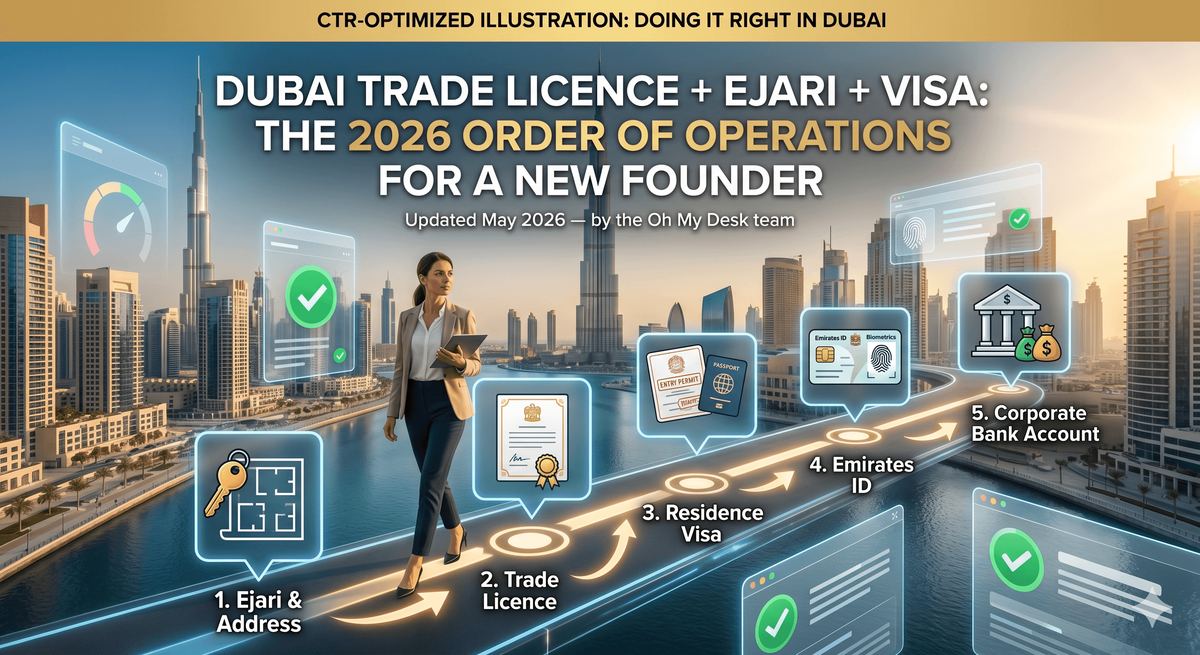
Here is the full sequence, top to bottom. Each step depends on the previous one being clean.
Decide mainland vs free zone. Picks your regulator, your address rules, and your client reach.
Secure your registered address and Ejari. The single most common bottleneck. Without this, no licence.
Issue the trade licence. DET for mainland, free-zone authority for free zone. Usually 24-48 hours after Ejari.
Apply for the establishment card and residence visa. Entry permit → status change → medical → biometrics → visa stamping.
Get the Emirates ID. Triggered by visa stamping. 5-10 days after biometrics.
Open the corporate bank account. Needs trade licence, Ejari, Emirates ID, and a basic business plan.
Match your workspace to your real routine. Hot desk, dedicated desk, private office, or stay virtual.
Realistic total: 3 to 6 weeks from kickoff to "I can invoice clients and accept incoming payments." Done in this order, you do not redo any step.
Step 1: Choose your free zone vs mainland
This is a strategic decision, not a tax-optimisation puzzle. The question is: who are your clients and what activities will you run?
Pick mainland (DET) if
You want to sign contracts directly with UAE government, semi-government, or any mainland UAE company without a local agent.
Your activity is consulting, agency work, retail, food and beverage, or anything that touches the local market regularly.
You want maximum flexibility on activities and number of branches.
Pick a free zone if
You serve mostly international clients and invoice cross-border.
You want a specific cluster benefit — DIFC for finance, DMCC for trading and crypto, IFZA or Meydan for low-cost generic setups, Dubai Media City for media, RAK ICC for offshore holding.
You prefer a slightly simpler annual renewal process.
Since 2021, mainland mostly allows 100% foreign ownership, which closed the historical "free zones own you 100%, mainland needs a local sponsor" gap. The decision today is mostly about where your clients are, not who owns the shares.
For most founders we host at Oh My Desk in Downtown Dubai and Business Bay, the answer is mainland DET. The mainland trade licence gives you optionality you cannot easily add later.
Step 2: Trade licence + Ejari (yes, in this order)
This step is where 80% of delays happen, and it's because founders try to issue the licence before they have a real address. Don't.
Why Ejari comes first
For mainland DET licences, the system literally requires a registered address before it will print the licence. The address must be backed by Ejari (the official tenancy registration). Free zones have their own equivalent — a "lease attestation" or "facility agreement" — but the principle is the same: no address, no licence.
What Ejari actually costs
Virtual office + Ejari (Oh My Desk): 8,000 AED/year — includes business address, mail handling, meeting room access at 120 AED/hour.
Dedicated desk + Ejari: 19,000 AED/year for the desk plus the Ejari bundle. Best for solo founders working full-time in the space.
Private office + Ejari (2-10 people): from 6,000 AED/month, Ejari included.
Traditional commercial lease: Ejari fee is ~220 AED, but the actual rent for a small fitted office starts around 80,000 AED/year and adds DEWA, fit-out, deposit, and broker fees.
The 8,000 AED/year virtual office is the cheapest legal path to a Dubai trade licence in 2026. We issue Ejari in-house within 48 hours of signing — see the virtual office Dubai page for the full inclusions.
What the trade licence costs
DET mainland commercial licence (standard activity): ~12,000-19,000 AED/year.
Trade name reservation: ~620 AED.
Initial approval: ~120 AED.
MOA drafting and notarization: 1,500-3,000 AED.
Chamber of Commerce fee: ~1,200 AED.
Establishment card (if hiring or self-sponsoring visa): ~650 AED.
Full year-one DET total for a single shareholder with virtual office + Ejari: roughly 23,000-32,000 AED. Free zones can be slightly cheaper but limit your ability to invoice mainland clients directly.
Timeline if you do it right
Day 0: sign the membership and tenancy agreement.
Day 1-2: Ejari issued.
Day 2: submit DED application with Ejari, trade name, activity codes, shareholder docs.
Day 3-4: initial approval, MOA signed, licence fee paid.
Day 4-5: trade licence printed.
Most of our founders complete this end-to-end in their first 48 to 72 hours on the ground.
Step 3: Visa stamping and Emirates ID
With the trade licence in hand, you can apply for an investor or partner residence visa. The 2026 process is mostly digital but still has physical steps you cannot skip.
The sub-steps
Establishment card from the Ministry of Human Resources and Emiratisation (MOHRE) for mainland, or the free-zone equivalent. Required before any visa application.
Entry permit issued under your new company. If you are outside the UAE, this lets you fly in; if you are already inside, it lets you change status without leaving.
Status change from tourist or other visa to "in-country residence application."
Medical fitness test (chest X-ray + blood test). Same-day or next-day result.
Emirates ID biometrics at an ICP centre — fingerprints and photo.
Visa stamping in the passport (or e-visa equivalent). Issued 2-5 days after biometrics.
Emirates ID delivery — physical card arrives 5-10 days after biometrics.
Total realistic timeline: 7 to 14 days from "I have my trade licence" to "I have a stamped visa and Emirates ID in hand." Premium fast-track services can compress this to 4-6 days for an extra 2,000-4,000 AED.
Common visa types for new founders
Investor / partner visa: tied to your trade licence. 2 or 3 years depending on the issuing authority.
Golden Visa: 10 years, requires qualifying property, salary, or business profile. Worth applying for if you qualify — see our Golden Visa 2026 guide.
Family visas: apply after your own visa and Emirates ID are issued.
Step 4: Bank account (Wio, Mashreq NeoBiz, ENBD)
Wait until your Emirates ID is in hand before applying. UAE banks have tightened KYC since 2024, and incomplete applications get rejected — costing you another 2-4 weeks.
What every bank will ask for
Trade licence (original and copy).
Memorandum of Association (MOA).
Ejari certificate.
Passport copies of all shareholders.
Emirates ID of the authorised signatory.
Short business plan (1-2 pages) explaining activities, expected turnover, source of funds.
Proof of address (DEWA bill, tenancy contract, or Ejari).
Sometimes: bank reference letter from your previous country.
2026 starter-bank shortlist
Wio Business. Digital-first, very fast onboarding (5-10 working days with clean documents). Best for SaaS, agencies, consultants, e-commerce. Lower minimum balance requirements.
Mashreq NeoBiz. Strong digital banking, decent international transfers, suits tech and trading. Onboarding 7-14 days.
Emirates NBD (ENBD). Traditional bank, slower (3-6 weeks) but accepted by every UAE counterparty. Best if you plan to take large ticket sizes, government contracts, or trade finance.
RAKBank. Mid-tier option, often easier for non-resident founders during the first weeks.
ADCB. Strong corporate offer, slower onboarding, better for established businesses.
Many founders open Wio or Mashreq NeoBiz first (to start operating) and add ENBD or ADCB later (for credibility and credit). That double-banking strategy is normal in Dubai.
Step 5: Workspace that matches your licence
By now you have a trade licence backed by an address and an Ejari. The last operational decision is what your day-to-day workspace looks like. The mistake here is over-buying space in week one because the licence office encouraged you to.
What fits the average new founder
Months 1-3: virtual office + Ejari. 8,000 AED/year at Oh My Desk. You have the address, the licence, and meeting room access. Work from home, a café, or a partner's office.
Months 3-6: add a dedicated desk. 1,500 AED/month. You now have a permanent seat, locker, and quiet zone. Same address, no Ejari change required.
Months 6-12: upgrade to a private office if you hire your second person, or if you handle confidential work that does not belong on a shared floor. From 6,000 AED/month for a 2-10 person office.
Hot desks at 950 AED/month suit founders who travel a lot or only need the address occasionally. Compare formats on the coworking Dubai and dedicated desk Dubai pages.
Crucial point: your workspace can change without changing your trade licence, as long as the registered Ejari address stays valid. So under-buy in month one and upgrade based on real routine rather than aspirational headcount.
Common mistakes: when people do the steps out of order
Most of the founders we onboard come to us after one of these mistakes. Avoid them and you save real time.
Mistake 1: paying for a trade licence before securing the address
You cannot finalise a DET licence without a registered Ejari address. Founders sometimes pre-pay licence fees through a corporate-services agent and then discover their "office" is a non-DED-approved address. The licence fails approval and the agent charges to redo it.
Mistake 2: opening the bank account before Emirates ID
UAE banks ask for the physical Emirates ID of the authorised signatory at the in-person KYC interview. Applying before you have it leads to rejection. Wait 7-10 days after biometrics.
Mistake 3: choosing a free zone for the price, then realising you can't invoice mainland clients
A cheap IFZA or Meydan licence saves a few thousand AED in year one, but if 80% of your clients are UAE-based mainland companies, you will need a local distributor or a service-agent setup that costs more than the savings. Pick the licence type based on client geography, not headline cost.
Mistake 4: signing a yearly commercial lease before the trade licence is approved
If the activity codes you applied for need an external approval (medical, education, financial services), the licence can take 4+ weeks instead of 4 days. Meanwhile you are paying full commercial rent. Start with a virtual office or coworking address — the Ejari is valid for licensing and your downside is capped. Moving out of a commercial lease later has its own bill: the licence amendment, the building move permit and a twenty-business-day tax deadline are priced in our guide to what an office relocation costs in Dubai.
Mistake 5: skipping the establishment card
Some founders try to apply for the residence visa without the establishment card thinking the licence is enough. It isn't. MOHRE (or the free-zone equivalent) requires the establishment card to authorise any visa under your company. 5 minutes of paperwork, 24-48 hours of processing — do it before the visa application.
Mistake 6: assuming the virtual office is "less legitimate"
A DED-recognised virtual office with Ejari is functionally identical to a traditional lease for licensing, visa, and banking purposes. UAE banks accept it for KYC. DET accepts it for licence renewal. Where it differs: you can't host a 20-person team in a virtual office. For solo or small teams in year one, it is the smart default.
Quick 2026 setup checklist
Decide mainland or free zone — based on client geography, not price.
Sign coworking / virtual office membership, get Ejari (48 hours).
Submit DED or free-zone licence application — issued in 2-4 days.
Apply for establishment card — 24-48 hours.
Apply for entry permit, do status change, medical, biometrics — 7-14 days.
Receive visa stamping and Emirates ID — 5-10 days after biometrics.
Apply for Wio or Mashreq NeoBiz account — 5-10 working days.
(Optional) apply for ENBD or ADCB as second bank — 3-6 weeks.
Upgrade your workspace from virtual to dedicated desk or private office as the team grows.
Realistic full setup, end to end: 3 to 6 weeks. Cheaper than most agents quote, faster than most founders expect, and avoidable on the redo.
How Oh My Desk fits into the 2026 setup flow
We are not corporate-services agents. We are a coworking and private office operator that happens to issue Ejari in-house and walks members through the DET and free-zone licence applications because we do it every week.
Specifically:
Ejari issued in 48 hours, included with virtual office, dedicated desk, or private office plans.
Trade licence support — we partner with vetted PRO service providers who handle the DET and free-zone paperwork at honest rates.
Two DET-approved locations in central Dubai: Al Fattan Downtown (32nd Street) and Bay Square Building 12 (Business Bay).
Same pricing in both buildings: 950 AED/month hot desk, 1,500 AED/month dedicated desk, from 6,000 AED/month for a private office, 8,000 AED/year for the virtual office + Ejari bundle.
If you want to talk through your specific setup, call +971 4 304 4222 or visit ohmydesk.com. We can usually get you through steps 1, 2, and the start of 3 in your first visit.
FAQ: Dubai trade licence + Ejari + visa in 2026
How long does it take to get a Dubai trade licence in 2026?
With complete documents and a DED-approved address, 2 to 4 working days for the licence itself. Most delays come from activity codes requiring external approvals or missing shareholder paperwork.
Can I get a trade licence without renting a real office?
Yes for most non-regulated activities. A virtual office + Ejari at a DET-approved coworking is sufficient. Regulated activities (medical, education, certain industrial) require inspected physical premises.
How much does the whole setup cost in year one?
For a single-shareholder mainland LLC with virtual office, no employees: roughly 23,000-32,000 AED in year one including all fees. Free zones can range from 15,000 to 35,000 AED depending on the authority.
Do I need a local sponsor for a mainland Dubai trade licence?
Generally no — since 2021, most activities allow 100% foreign ownership. A small list of strategic activities still requires a UAE national agent; check with DET for your specific activity code.
Can I do all of this remotely from outside the UAE?
Up to a point. You can apply for the entry permit, sign Ejari and licence paperwork via PoA, and have everything ready to fly in. But medical fitness, Emirates ID biometrics, and bank KYC require your physical presence in Dubai. Plan for at least 5-7 days in-country.
What if my plans change and I want to close the company?
Mainland deregistration takes 4-8 weeks and costs roughly 3,000-6,000 AED in fees plus settling any outstanding obligations. Free zones range from 2,500 to 9,000 AED. Cancelling a coworking-based virtual office is straightforward — usually 30 days notice.
Written by the Oh My Desk team in May 2026. Government fees and processes are subject to UAE regulatory updates; always confirm current requirements with DET, your chosen free zone, or your bank before paying any fees.