What does district cooling cost in Dubai in 2026?
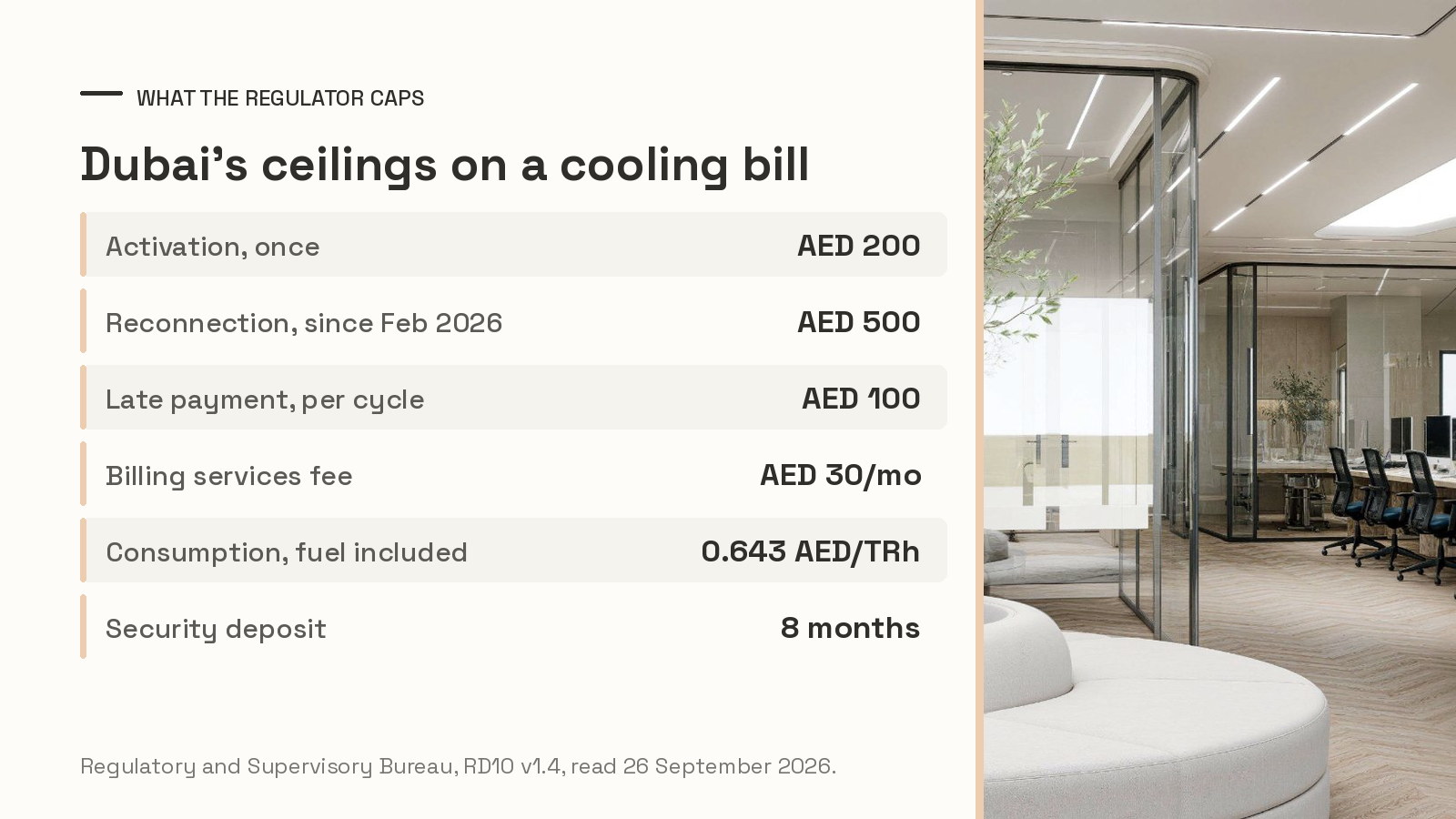
Empower, the largest provider in Dubai, charges AED 750 per refrigeration ton a year for capacity plus AED 0.568 per ton-hour for what you actually use — and Dubai’s regulator caps sixteen separate charges that can sit on top of those two. The two that hurt are the ones you never see quoted: a security deposit of up to eight months of capacity charges, which works out at AED 500 for every contracted ton at Empower’s rate, and a reconnection fee the regulator raised from AED 100 to AED 500 on 6 February 2026.
That last one is the only number Dubai changed this year. The Regulatory and Supervisory Bureau publishes every charge a cooling company may bill, in a document called RD10. Version 1.3 was issued on 17 September 2025; version 1.4 followed on 6 February 2026, and its amendment history says exactly one thing: “Adjusting the reconnection fee”. Every other cap is identical, line for line, to the 2025 version. Being cut off in Dubai became five times more expensive, quietly, in February.
What are the three charges behind every cooling bill?
Capacity, consumption, and a flat monthly fee for being billed at all. Everything else is an event charge that only appears when something happens.
The capacity charge — Empower calls it the demand charge, Emicool the declared load charge — is rent on cold air you have reserved. It is calculated on the tons allocated to your unit, not the tons you use, and it is billed whether the flat is occupied, empty or locked for the summer. At AED 750 a ton a year, that is AED 62.50 a ton a month before anybody switches anything on.
The consumption charge is metered, in ton-hours. Empower publishes AED 0.568 per RT-hour, Emicool 0.56. The regulator’s ceiling is 0.643 AED/TRh including the fuel surcharge, and the surcharge itself is capped at 0.075. Do the addition: 0.568 + 0.075 = 0.643. Empower’s published rate plus the maximum surcharge lands exactly on the cap, to the fils. There is no headroom left in that line.
The billing services fee is a flat monthly charge for producing the invoice, capped at AED 30 a month. Empower bills meter maintenance at AED 30 a month, or AED 50 a quarter.
What changed on 6 February 2026, and what did not?
One cap moved. Fifteen did not. Here is the whole comparison, read from the two published PDFs:
| Charge, for a unit | RD10 v1.3 · 17 Sep 2025 | RD10 v1.4 · 6 Feb 2026 |
|---|---|---|
| Re-connection fee | AED 100 | AED 500 ← the only change |
| Activation fee | AED 200 | AED 200 |
| Late payment fee | AED 100 per cycle | AED 100 per cycle |
| Deposit | 8 months of capacity charges | 8 months of capacity charges |
| Consumption tariff | 0.643 AED/TRh | 0.643 AED/TRh |
| Single-building consumption | 0.80 AED/TRh | 0.80 AED/TRh |
| Fuel surcharge | 0.075 AED/TRh | 0.075 AED/TRh |
| Billing services fee | AED 30 / month | AED 30 / month |
| Meter tampering penalty | 10% + cost of repair | 10% + cost of repair |
The document also renamed the line, from “Re-connection Charge” to “Re-connection Fee”. That matters more than it sounds, and we come back to it below.
How big a deposit can a cooling provider hold?
Eight months of your capacity charges, and not a dirham more without separate approval. That is the cap in RD10, and it is expressed in months rather than dirhams, which is why nobody quotes it: you have to do the multiplication yourself.
At Empower’s AED 750 a ton a year, eight months of capacity charges is exactly AED 500 per contracted ton. At the top of Emicool’s published band — its FAQ states that its annual declared-load rate “ranges from AED 750 to AED 888 per ton per year” — the same eight months come to AED 592 per ton.
Now compare that with what is charged. Gulf News reported, on 3 July 2024, an Empower deposit of AED 2,000 for a flat and AED 3,000 for a villa. Divide 2,000 by 500 and you get 4: a flat AED 2,000 is the regulated ceiling for a unit contracted at four tons — at the cap for a large two-bedroom, and above it for a two-ton studio, where eight months come to AED 1,000. A small unit with a flat deposit is a question worth putting in writing.
RD10 adds a rule that is easy to miss: a deposit already held may only be adjusted “on change or renewal of ownership or rental agreement”. It cannot be re-priced mid-tenancy.
How do you work out your own cooling cost in two minutes?
You do not need to guess your tonnage, and you should not: the regulator obliges your bill to print it. RD06, the metering and billing regulation, requires every monthly bill to carry the contracted capacity in tons alongside the meter serial and the billing period. Find that number, and the rest is multiplication.
| Contracted capacity | Capacity charge / year | Capacity charge / month | Deposit ceiling (8 months) |
|---|---|---|---|
| 1 ton | AED 750 | AED 62.50 | AED 500 |
| 2 tons · small studio | AED 1,500 | AED 125 | AED 1,000 |
| 3 tons | AED 2,250 | AED 187.50 | AED 1,500 |
| 5 tons | AED 3,750 | AED 312.50 | AED 2,500 |
| 8 tons | AED 6,000 | AED 500 | AED 4,000 |
| 12 tons · small office floor | AED 9,000 | AED 750 | AED 6,000 |
| 20 tons | AED 15,000 | AED 1,250 | AED 10,000 |
Every figure there is Empower’s AED 750 rate multiplied out, before consumption, the AED 30 billing fee and 5 % VAT. The column that surprises people is the third: an eight-ton unit owes AED 500 a month for capacity it may never call on.
What do Empower and Emicool actually publish?
Between them, the running rates and almost nothing about joining. We read both pages on 26 September 2026.
| Charge | Empower, published | Emicool, published | RSB cap |
|---|---|---|---|
| Capacity / declared load | AED 750 / ton / year | AED 750–888 / ton / year | per approved schedule |
| Consumption | AED 0.568 / RT-hour | 0.56 / RTh | 0.643 AED/TRh |
| Meter maintenance | AED 30 / month | not published | AED 30 / month |
| Meter testing, meter found sound | AED 160 | not published | per approved schedule |
| Voluntary disconnection request | AED 150 per instance | not published | — |
| Disconnection | AED 500 | not published | — |
| Registration / connection | heading only, no figure | not published | per approved schedule |
| Security deposit | not published | not published | 8 months of capacity |
The heading with nothing under it
Empower’s registration FAQ carries a section headed “What are the registration charges applicable?”. When we opened it on 26 September 2026 the space beneath that heading was still blank — the same blank we found a week earlier while pricing what it costs to switch a Dubai flat on. Two providers, two public pages, not one joining figure. So ask for the registration charge and the deposit in writing, by email, before you sign the tenancy.
One line, two units
Empower’s own page prices consumption as “AED 0.568 fils per RT per hour”. AED and fils are different units, and 0.568 fils would be a thousandth of the rate intended. The figure that reconciles with the regulator’s cap is AED 0.568, and that is the reading we have used — but a tariff page that mixes two currencies in five words is a fair warning about how much of this was written for the reader.
What must a Dubai cooling bill show?
More than most of them do. RD06, version 1.1 of 11 September 2024, sets a minimum content list, and every item on it is a thing you can check tonight:
- Billing material in English and Arabic, issued monthly.
- The contracted capacity in tons, the meter serial number, the billing period, the invoice date and the due date.
- Both meter readings, with dates, and the consumption in kWh and in ton-hours.
- Any estimated figure marked with an “E” and a key explaining it.
- The four tariffs applied, each with its unit: AED/TR/year, AED/TRh, the DEWA surcharge and the monthly billing fee.
- In the bill or the portal: consumption charted since the start of your contract, a comparison against similar units, a phone number and an email address — and the value of the security deposit held.
That last one carries the deadline nobody quotes. RD06 states the deposit “must be returned within 5 working days of concluding the service”. Not thirty days, not on clearance of the final bill. Five working days.
Which charges is a provider not allowed to bill you?
RD10 is unusually blunt about this. Clause 1(d): “Only the tariffs, charges and fees expressly identified and authorised in this RD shall be permitted. No other charges may be levied by Permit Holders.” Here is that list in full, with the cap that applies to a residential or office unit:
| # | The 16 charges RD10 allows | Unit | Cap for a unit |
|---|---|---|---|
| 1 | Capacity tariff | AED / TR / year | per approved schedule; no indexation |
| 2 | Consumption tariff, with a capacity tariff | AED / TRh | 0.643, fuel surcharge included |
| 3 | Composite tariff, no capacity tariff | AED / TRh | per approved schedule |
| 4 | Consumption tariff, single-building system | AED / TRh | 0.80, and no capacity charge allowed |
| 5 | Fuel surcharge | AED / TRh | 0.075 |
| 6 | Connection charge | AED / TR | per approved schedule |
| 7 | Inefficient building penalty (low delta-T) | AED | never billed to a unit |
| 8 | Billing services fee | AED / month | 30 |
| 9 | Activation fee | AED | 200, once |
| 10 | Meter verification fee | AED | per approved schedule |
| 11 | Re-connection fee | AED | 500 ← raised from 100 on 6 Feb 2026 |
| 12 | Late payment fee | AED | 100 per cycle, capped at 100% of the debt |
| 13 | Default payment fee | AED | per approved schedule |
| 14 | Deposit | months of capacity charges | 8 months |
| 15 | Excess demand fee | % of capacity tariff | 120%, buildings only |
| 16 | Meter tampering penalty | % | 10% + cost of repair |
Four consequences follow from it, all of them checkable:
- The low-delta-T penalty may never appear on a unit bill. Clause 6(c) says inefficient building penalties “may not be applied in the bills charged to Units under any circumstances”. It is a building-level charge, and it stays there.
- Common-area cooling may not be pushed onto occupants. RD06 clause 9 bills it to the provider’s customer and forbids a billing agent from redistributing it to unit occupants, except through the service charge.
- Capacity may not be allocated by the size of your equipment. Clause 6(b) requires each unit’s capacity charge to be its strict allocated share of the building’s contracted capacity, and prohibits discriminatory or inconsistent allocation between units.
- The excess demand fee is for buildings only, capped at 120 % of the capacity tariff, and only when average demand exceeds contracted capacity over a four-hour period.
Which brings us back to the renaming. That list of sixteen includes a re-connection fee and no disconnection fee. Empower’s charges page states that a “Disconnection Fee of AED 500 shall be applied to both residential and commercial units”, and prices a voluntary disconnection request at AED 150. Two AED 500 figures under two names may well be the same fee — but a customer reading both cannot tell, and clause 1(e) requires charges to be “clearly disclosed”. If you are billed for one, ask which line of clause 7 it is.
How do you register for district cooling, and how long does it take?
One to three working days, and the cooling goes live the day the registration completes. That is Empower’s own published turnaround. The account can be opened by whoever appears on the tenancy contract or title deed — owner or tenant, individual or company.
| You are | Documents Empower asks for |
|---|---|
| Tenant, individual | Tenancy contract, Ejari, copies of visa and Emirates ID (front and back) |
| Tenant, company | Tenancy contract, Ejari, trade licence, and the authorised person’s passport, visa and Emirates ID (front and back) |
| Owner, individual | Title deed or sale and purchase agreement, passport copy |
| Owner, company | Title deed or SPA, trade licence, authorised person’s passport copy |
The company row is the one founders trip over: a cooling account for a company office needs a tenancy contract, a registered Ejari and a trade licence before the meter changes name — the same three documents the landlord, the bank and the visa file all want. Payment comes later, online, through a link sent once the documents are approved. You will not know the amount until that message arrives.
What happens if you pay late or get cut off?
The late payment fee for a unit is capped at AED 100 per billing cycle, with one sensible limit: accumulated late fees “shall not exceed one hundred percent of the aggregate outstanding charges”. You cannot be charged more in penalties than you owe in cooling.
Reconnection is where 2026 bites. At the old cap, being cut off and restored cost AED 100 — an annoyance. At AED 500 it is eight months of capacity charges on a one-ton unit, the same AED 500 the regulator sets as the deposit ceiling for that unit. A single missed invoice can now cost AED 600 in fees — AED 100 late, AED 500 to come back — before a dirham of cooling is billed.
And if you want the regulator to act, know what you are asking for. Executive Council Resolution No. 6 of 2021 fines a provider AED 3,000 for breaching RSB rules, AED 50,000 for breaching its permit terms and AED 65,000 for supplying cooling with no permit; repeats within a year double, to a ceiling of AED 200,000. Article 18 sends every dirham to the Public Treasury of the Government of Dubai. A complaint can correct your bill; the fine is not compensation.
Why does none of this reach a serviced office desk?
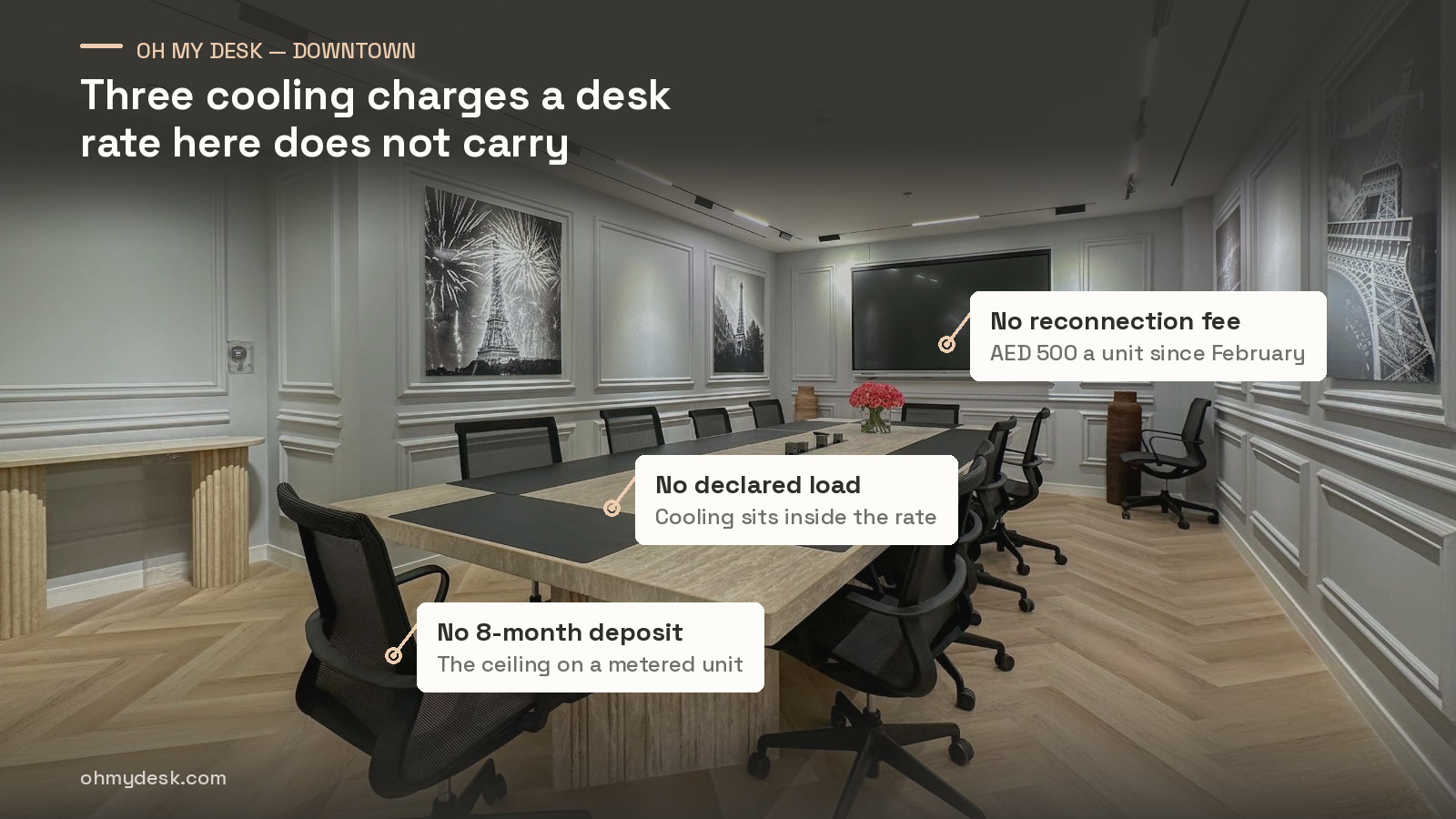
Because the capacity is contracted by the building, not by you. Every line above — the declared load, the eight-month deposit, the AED 200 activation, the AED 500 reconnection, the AED 30 billing fee — exists because somebody signed for a metered unit. In a serviced office, that somebody is the operator.
It is the same arithmetic that makes a fit-out quote misleading: building out your own 1,000 sq ft buys the space and then hands you a utility account, a deposit and a capacity charge that runs through August whether anyone is in the room. At Oh My Desk a hot desk is AED 950 a month and a day pass AED 120, cooling included; a private office starts at AED 6,000 a month with six hours of meeting room — one invoice, no ton-hours on it. For running costs across operators, see the cheapest coworking spaces in Dubai, compared; for Downtown, what parking there costs.
How did we check these numbers?
Every cap here was read on 26 September 2026 from the Regulatory and Supervisory Bureau’s own PDFs — RD10 version 1.4, RD10 version 1.3 and RD06 version 1.1 — not from a summary. The February change is quoted from version 1.4’s amendment history, the AED 100 it replaced from version 1.3’s charge table. Operator rates come from Empower’s charges explanation page and Emicool’s FAQ, read the same day. The AED 2,000 deposit is Gulf News reporting of July 2024, not an operator publication, and is treated as such. Forty-three arithmetic checks were re-run by script; all forty-three reconciled.
One thing we could not source, and will not invent: neither provider publishes a registration charge or a deposit figure. Every deposit number here is either a ceiling we multiplied out or a press figure we have dated.
A note on the questions below. Google Search Console records zero impressions to this site on the cooling vocabulary — nothing for “cooling”, “empower”, “chiller” or “electricity” across two consecutive 28-day periods — so there are no real queries of ours to draw on. The ten below are built from keywords measured in Semrush’s UAE database on 26 September 2026, and we would rather say so than pretend.
FAQ: 10 quick answers
1. How much is Empower in Dubai per month? Empower bills AED 750 per refrigeration ton a year for capacity, which is AED 62.50 a ton a month, plus AED 0.568 for every ton-hour you consume and about AED 30 a month for the meter. A unit contracted at three tons therefore owes AED 187.50 a month before it uses any cooling at all, and 5 % VAT is added to each line.
2. What is the Empower security deposit? Empower does not publish one. Dubai’s regulator caps any district cooling deposit at eight months of the unit’s capacity charges, which at the AED 750 rate is AED 500 per contracted ton. Gulf News reported a flat AED 2,000 for an apartment and AED 3,000 for a villa in July 2024 — figures that sit at the regulated ceiling for four and six tons respectively.
3. How much is the Empower reconnection fee? Up to AED 500 for a unit since 6 February 2026, when the Regulatory and Supervisory Bureau raised the cap from AED 100 in version 1.4 of regulation RD10. It was the only figure changed in that amendment. Guides published before February still quote AED 100, and they are out of date.
4. How do I register with Empower Dubai? Apply through Empower’s e-services portal with your tenancy contract, Ejari and copies of your visa and Emirates ID, front and back. A company tenant adds its trade licence and the authorised person’s passport. Registration takes one to three working days, payment is made online through a link sent by SMS or email once the documents are approved, and cooling is activated the same day the account completes.
5. When do I get my Empower deposit refunded? Within five working days of closing the service. RD06, the Dubai metering and billing regulation, requires the value of the deposit held to appear on your bill and states that it “must be returned within 5 working days of concluding the service”. If it has not arrived by then, quote that clause.
6. What are chiller charges in Dubai? Chiller charges are the district cooling bill: a capacity charge on the tons reserved for your unit, a consumption charge on the ton-hours you use, and a small monthly billing fee. They are separate from your electricity and water account and arrive from a different company — Empower, Emicool or Tabreed, depending on the building.
7. What does chiller-free mean in a Dubai listing? It means the landlord pays the cooling bill rather than the tenant, so the rent already carries the capacity and consumption charges. It does not mean the building has no district cooling. Ask which charges are included, because a landlord may cover capacity and still pass consumption on.
8. Can a cooling company bill me when the flat is empty? Yes, for capacity. The capacity charge is levied on the tons contracted to the unit, not on what passes through the meter, so it runs through a vacant month exactly as through a busy one. Only the consumption line falls to zero when nobody is there.
9. What is the maximum late payment fee on a Dubai cooling bill? AED 100 per billing cycle for a unit, and accumulated late fees may never exceed 100 % of the charges outstanding. That second half is the useful part: however long a dispute runs, the penalties cannot grow larger than the bill they are attached to.
10. Is district cooling cheaper than a split air conditioner? It depends entirely on how much you use, because district cooling front-loads a fixed capacity charge that a split unit does not have. A lightly used flat can pay more on district cooling than it would on its own compressor; a heavily used one usually pays less. The figure that decides it is your contracted tonnage, printed on every bill by law.
What to do next
Three things, and the first takes a minute. Find the contracted capacity in tons on your latest cooling bill — it has to be there — then multiply it by 750 for what you owe before using anything, and by 500 for the largest deposit anyone may hold. Second, if you are signing a tenancy this month, ask for the registration charge and the deposit in writing: no public page gives either. Third, check your last bill for a low-delta-T or common-area line. Neither belongs on a unit invoice.
And if you would rather not run a utility account at all, that is a legitimate answer. A hot desk at Oh My Desk is AED 950 a month; a private office in Business Bay starts at AED 6,000 with six hours of meeting room included; and a Virtual Office with Ejari gives a company the registered address the cooling form asks for. Book a free tour at Downtown or Business Bay — and our Dubai Design District address opens on 1 October 2026.