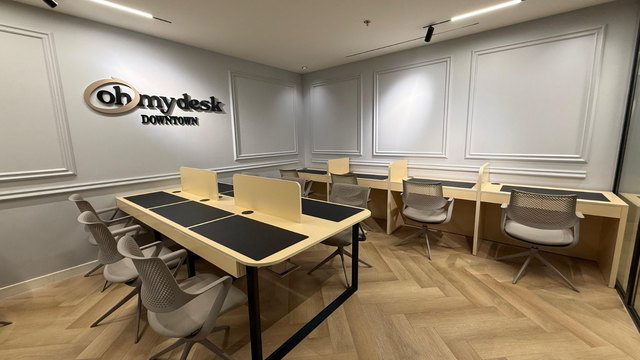
How much does Dubai’s remote work visa cost in 2026?
Between AED 300 and about AED 1,054 in published government fees, depending on which of the three official doors you walk through — and the salary you have to prove is either USD 3,500 or USD 5,000 a month, depending on that same choice. Everything else — the medical fitness test from AED 250, health insurance, the Emirates ID — sits on top of that figure.
That sentence is longer than it should be, and that is the point of this article. There is no single “Dubai remote work visa”: there are three official routes to the same one-year residency, and they do not agree on the price or on the salary. Each figure below was read on its own government page on 14 September 2026.
| Route | Who issues it | Salary you must prove | Published government fee |
|---|---|---|---|
| Virtual work residence | ICP, federal — every emirate | USD 3,500 / month | AED 300 |
| Virtual work visa + residence permit | GDRFA Dubai | USD 3,500 / month | AED 470 (AED 230 + AED 240) |
| Dubai virtual working programme | Dubai, via u.ae | USD 5,000 / month | USD 287 ≈ AED 1,054 |
Fees as published on ICP, GDRFA Dubai and u.ae, read 14 September 2026. Dollar figures converted at the dirham’s fixed peg of AED 3.6725 to USD 1.
Which remote work visa are you actually applying for?
Nothing on any of these pages is called a digital nomad visa. The phrase has no legal existence in the UAE; it is a label guides put on two different government products. Knowing which one you are in front of is the whole game, because the salary gate moves.
The federal route, run by ICP
ICP — the Federal Authority for Identity, Citizenship, Customs and Port Security — publishes a service called Issuance of Visa Virtual Work Residence (Virtual Work Employee). One transaction, AED 300: an application fee of AED 100, an issuance fee of AED 100 and smart services fees of AED 100. It works for any emirate, quotes two days, and states that “the presence of the service beneficiary inside the country is not required for visa issuance”.
The Dubai route, run by GDRFA
If you are landing in Dubai, the General Directorate of Residency and Foreigners Affairs runs the same thing as two separate transactions — the single most common source of confusion in the totals you see online. First Visa Issuance (Virtual Work): AED 200 plus 5% VAT, plus AED 10 of Knowledge Dirham and AED 10 of Innovation Dirham. Then Issuance of the virtual work residence permit: AED 200, the same two dirhams, and AED 20 of delivery. Both quoted at 48 hours.
The Dubai virtual working programme, which is not the same thing
Separately, u.ae describes Dubai’s virtual working programme, for “people who live and work outside the UAE, entrepreneurs and start-up companies”. The fee is “USD 287 per person”, plus medical insurance and processing fees, and the page carries a warning worth quoting: “paying the processing fee does not guarantee approval”. It is “valid for one year, renewable upon re-application”.
Is the salary threshold USD 3,500 or USD 5,000?
Both, on the same government portal. This is not a good source contradicting a bad one — it is two different products, each with its own gate, published a few clicks apart on u.ae.
The federal page asks for a “salary certificate of a minimum of 3,500 (three thousand five hundred) US dollars or equivalent in foreign currency”, and GDRFA repeats it on both service pages. The Dubai virtual working programme page asks instead that employees “earn a minimum salary of USD 5,000 per month”, evidenced by a salary slip and three months of bank statements; owners must show “an average monthly income of USD 5,000 per month”.
The gap is USD 1,500 a month — USD 18,000 a year of gross salary, or 43% more income for the same twelve months of residency. At the dirham’s fixed peg that is AED 12,853.75 a month against AED 18,362.50. If your salary sits between the two, and a great many mid-career remote salaries do, the route is not a matter of convenience: one door is open and the other is shut.
What does each route cost, fee by fee?
Every line each authority publishes, nothing added, nothing rounded.
| Line | ICP, federal | GDRFA Dubai |
|---|---|---|
| Application fee | AED 100 | — |
| Visa / permit issuance fee | AED 100 | AED 200 + AED 200 |
| VAT on the visa fee | — | 5% → AED 10 |
| Smart services fee | AED 100 | — |
| Knowledge Dirham | — | AED 10 × 2 |
| Innovation Dirham | — | AED 10 × 2 |
| Delivery | — | AED 20 |
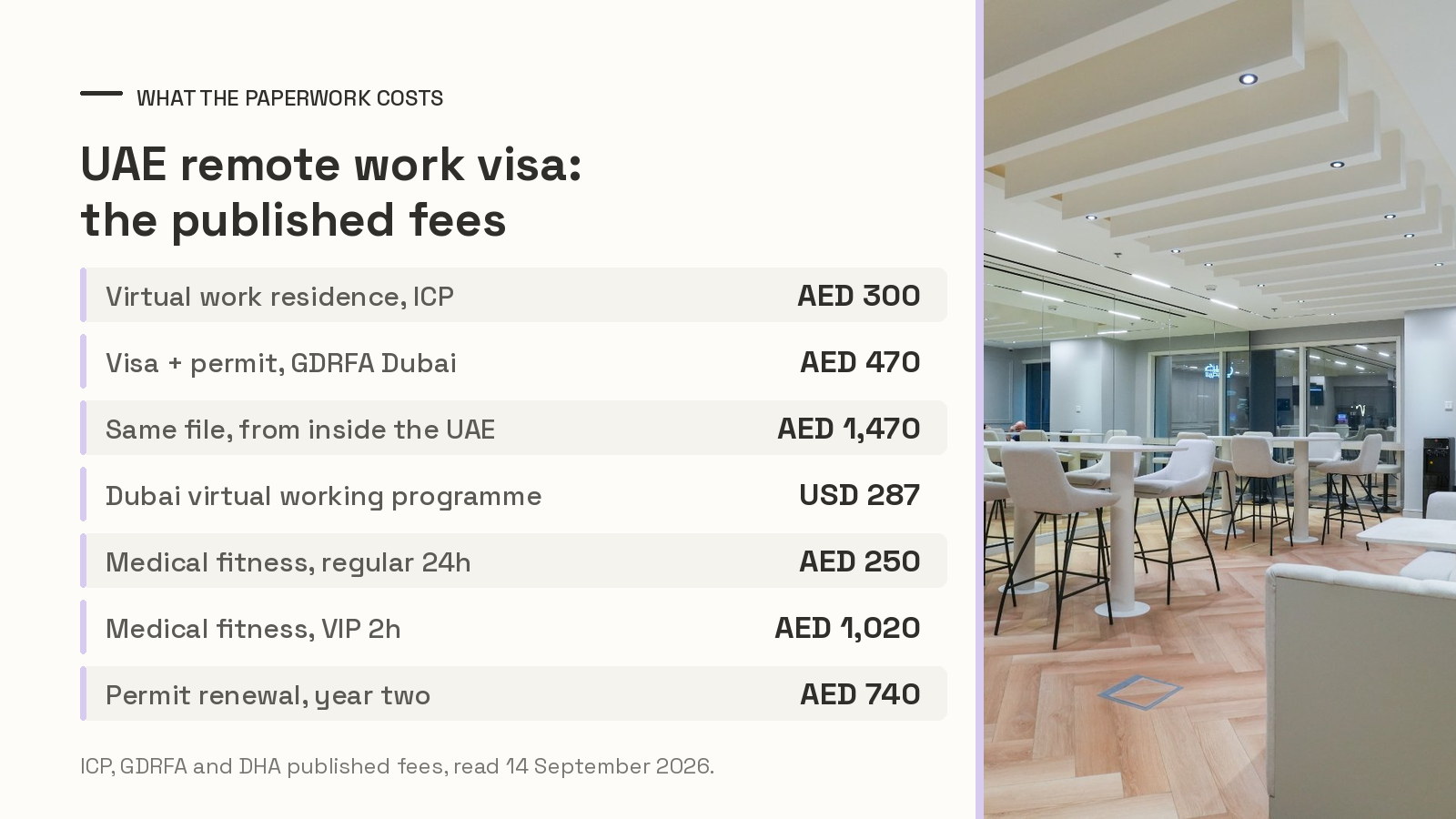
| Total, applying from outside the UAE | AED 300 | AED 470 |
| Fee inside the country / status adjustment | AED 500 | AED 500 × 2 |
| Total, applying from inside the UAE | AED 800 | AED 1,470 |
The AED 500 line that triples the bill
Both authorities charge extra if you are already on UAE soil when you apply. ICP calls it “Status Adjustment: 500 AED”; GDRFA calls it “Fee inside the country: AED 500” — and because GDRFA splits the process in two, it lands twice. A Dubai file opened from a hotel room on a tourist visa costs AED 1,470 instead of AED 470: three times the price, same residency.
Renewal costs three times the first permit
The renewal page lists AED 200 for the permit, AED 10 of Knowledge Dirham, AED 10 of Innovation Dirham, AED 500 inside the country and AED 20 of delivery: AED 740. A renewal is by definition filed from inside, so the AED 500 is unavoidable — your second year costs AED 740 where the first permit cost AED 240.
Why do three guides give three different answers?
Because almost every English-language guide blends the two products into one. We opened three of the most visible on 14 September 2026 and compared them with the government pages.
| Page read on 14 September 2026 | Salary it states | Total it states | What is off |
|---|---|---|---|
| Citizen Remote | “At least USD $3,500 per month” | “between USD $1,400 and $2,000” for year one | Quotes the federal threshold with the Dubai programme’s $287 fee |
| Emirabiz | “$3,500/month net”, six months of statements | “AED 2,858, excluding health insurance” | Names GDRFA and ICP correctly, then prices them as one |
| digitaldubai.ai | “Minimum: $5,000/month” | “AED 1,535 total cost” for visa and Emirates ID | Uses the Dubai programme’s threshold for every route |
Three pages, three salary gates, three totals, and not one of them says there is more than one product. One asks for six months of bank statements where u.ae asks for three; another converts USD 5,000 to “~AED 18,375”, AED 12.50 off the fixed peg — a sign the figure was estimated rather than read. The instruction that follows is free and takes a minute: open the government page.
What documents does the application need?
The three pages ask for broadly the same file, with one difference at the end that catches people out.
- A passport valid for at least six months — stated by ICP, GDRFA and u.ae alike.
- A recent colour photograph on a white background.
- Proof of remote employment with an entity outside the UAE.
- A salary certificate at the threshold of your chosen route, or a salary slip plus three months of bank statements for the Dubai programme.
- A valid health insurance document with UAE coverage.
- A medical fitness test result, required at the residence-permit stage.
- The ID receipt, on the GDRFA permit file.
The condition people miss: the contract has to have a year left
u.ae asks the Dubai programme applicant for “proof of employment (with one-year valid contract)” or proof of company ownership “one year or longer”. A rolling contract with three months to run does not satisfy it, and neither does one that ends inside the visa year: if you are on a fixed term, get the extension signed before you file. Owners are read differently from employees — instead of a salary slip, three months of company bank statements.
How long does it take, and what does going faster cost?
The visa itself is quick: GDRFA quotes “48.0 Hour(s)” for both transactions, ICP two days. What sets your timeline is the medical fitness test — the second price spread of this article.
| Medical fitness package, Dubai | Turnaround | Fee |
|---|---|---|
| Regular | 24 working hours | AED 250 |
| Express | 6 working hours | AED 700 |
| Smart Salem centre | results in 30 minutes | AED 700 |
| VIP | 2 working hours | AED 1,020 |
Published in the DHA medical fitness centres service catalogue, read 14 September 2026. The catalogue notes that “the mentioned fees do not include typing fees”.
The same certificate, for the same file, costs AED 250 or AED 1,020 depending on how long you are willing to wait: a factor of 4.08 bought with twenty-two hours. It is the same pattern we found at the RTA, where the same driving licence card is billed at two different prices depending on which route you came in through — see what a Dubai driving licence really costs.
What the medical test actually screens for
u.ae states that the examination covers “all forms of communicable diseases” including HIV and tuberculosis. A TB finding does not automatically end the application: the portal says such applicants receive “a conditional fitness certificate and be issued residence visa for one year” and “will then have to undergo treatment in the UAE”. Budget 40 minutes at the centre, plus the report.
Is a remote work visa the same as a Dubai freelance visa?
No, and mixing them up is expensive. The distinction is not where you sit but who pays you, and under whose licence.
| Virtual work residence | Freelance permit | Employment work permit | |
|---|---|---|---|
| Who pays you | An employer or company outside the UAE | Your own clients, under a UAE licence | A UAE employer |
| Who sponsors you | You do — self-sponsored | You do, through the free zone | The employer |
| Who issues it | ICP or GDRFA | A free zone authority | MoHRE |
| Can you invoice UAE clients? | No | Yes | No, you are an employee |
Keep a foreign salary and simply move your desk, and the virtual work route is yours. Bill clients here and you need a licence: the numbers are in our costing of the freelance visa route in Dubai. And if a UAE company hires you, none of this applies — your file is a MoHRE work permit, priced between AED 250 and AED 3,450 for the identical document depending on the employer’s classification, which we took apart in the real cost of a Dubai work permit.
Do you pay tax in the UAE on a salary paid abroad?
The Federal Tax Authority sets two conditions before a natural person falls inside UAE corporate tax: they must conduct a business in the UAE, and it must turn over more than AED 1,000,000 a year. Three categories of income are explicitly outside that scope: “Wages”, “Personal Investment Income” and “Real Estate Investment Income”.
A salary paid by a foreign employer is wages. On the UAE side, a remote employee on a virtual work residency is therefore not registering for corporate tax, and the UAE levies no personal income tax on individuals.
This describes what the Federal Tax Authority publishes, read 14 September 2026. It says nothing at all about the country that pays you, which may continue to tax you on residence, citizenship or source rules of its own. We are not tax advisers: before you move, ask a qualified one in the country you are leaving.
Where do you work once the visa is stamped?
The part the visa guides skip, and the part you live with for twelve months. A virtual work residency gives you no office, no address and no meeting room: self-sponsored means self-equipped.
| What you take | Price | Meeting room included | Where |
|---|---|---|---|
| Day pass, hot desk | 120 AED / day | — | Downtown · Business Bay |
| Coworking, hot desk | 950 AED / month | 1 hour a month | Downtown · Business Bay |
| Dedicated desk | 1,500 AED / month | 4 hours a month | Downtown only |
| Private office | from 6,000 AED / month | 6 hours a month | Downtown · Business Bay |
| Meeting room, up to 8 people | 120 AED / hour | — | Downtown · Business Bay |
Oh My Desk rates, excluding VAT; 5% is added at payment. The meeting-room hours belong to the monthly memberships, not to day passes.
The arithmetic is short: a monthly hot desk at 950 AED costs less than eight day passes at 120 AED, which is 960. Leave the flat more than seven working days a month — on a foreign contract you will — and the membership is already cheaper.
The hours nobody checks until week two
Dubai runs on UTC+4 all year with no daylight saving, so the offset to your employer shifts twice a year without anything moving here. At our Downtown address as at Business Bay, member access is 24/7 on a badge while reception is staffed Monday to Friday, 9am to 6pm. Two different things, and which one matters depends on the payroll you are on.
| Your employer’s 9am–5pm | In Dubai time | Hours overlapping a 9–6 reception |
|---|---|---|
| Paris or Berlin, summer (UTC+2) | 11:00 – 19:00 | 7 of 8 |
| London, summer (UTC+1) | 12:00 – 20:00 | 6 of 8 |
| London, winter (UTC+0) | 13:00 – 21:00 | 5 of 8 |
| New York, summer (UTC−4) | 17:00 – 01:00 | 1 of 8 |
| New York, winter (UTC−5) | 18:00 – 02:00 | 0 of 8 |
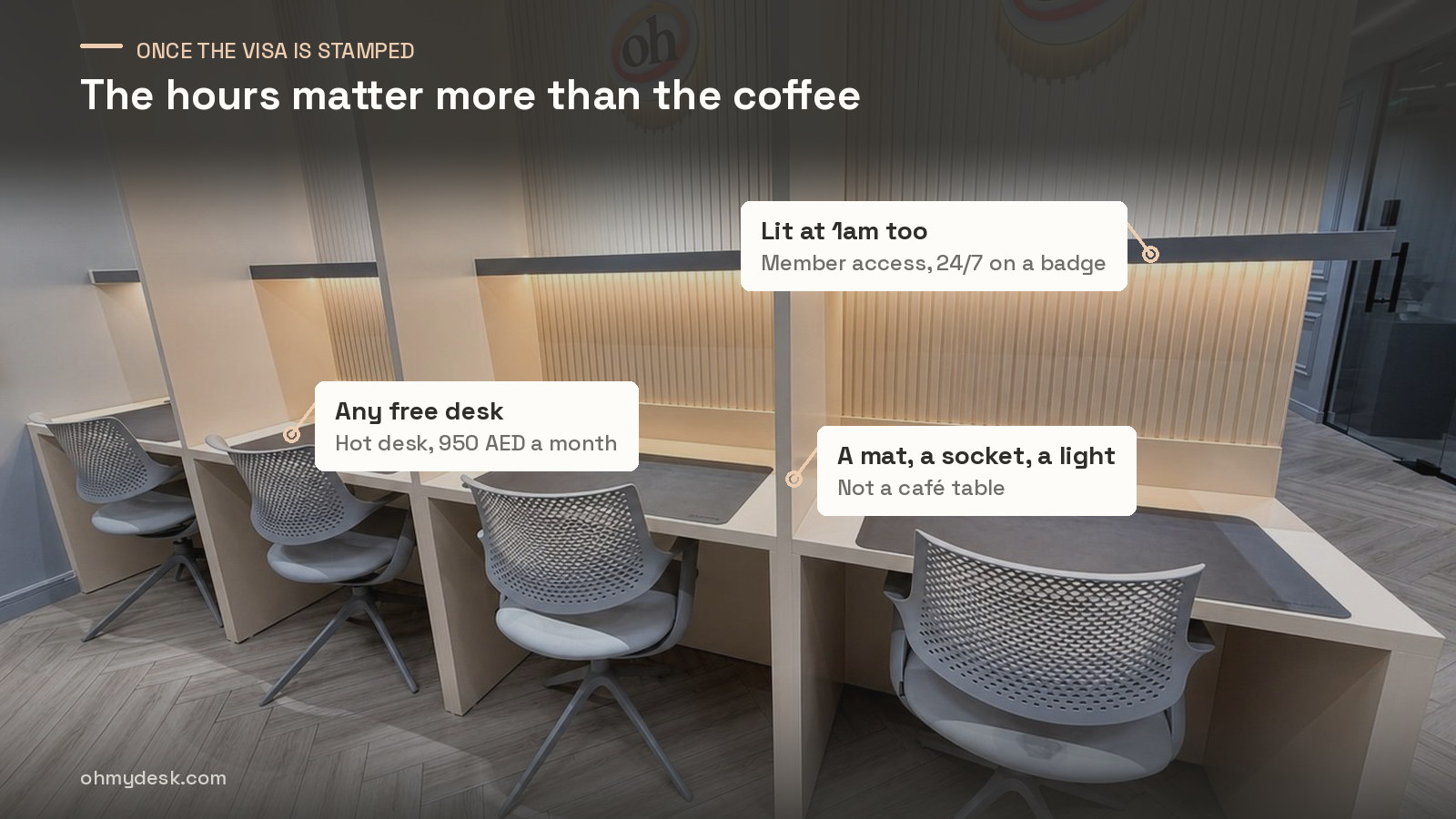
Read the bottom two rows again if you are moving with a US contract in your pocket. A workspace that locks at 6pm is not a workspace for you at all: you would be paying for a room you are never in. The badge is the specification, not the coffee. A European contract is the opposite case — almost the whole day sits inside staffed hours, and a meeting room at 120 AED an hour is bookable when you need one. One thing lines up by itself: the UAE working week has run Monday to Friday since 2022, so your weekend is your employer’s weekend.
Does the remote work visa need an Ejari?
Not according to the published document lists. Neither GDRFA’s two service pages nor ICP’s asks for a tenancy contract or an Ejari registration — they ask for a passport, a photo, proof of remote employment, a salary certificate, health insurance and a medical fitness result.
An Ejari becomes relevant afterwards, for other things: a registered residential tenancy is what utilities, school registration and some bank onboarding ask for. That is a contract signed with a landlord, and no coworking membership substitutes for it. We are explicit because the confusion is common — our Virtual Office with Ejari at 8,000 AED a year is a commercial address used to licence and domicile a company. It is not a home address and it does not support a residence application.
If you set up a UAE entity later — a fair number of remote employees do — learn the vocabulary first: what a flexi desk actually is covers the desk-plus-licence packages free zones sell, and how Ejari works in Dubai covers the registration.
What does the first year cost, all in?
The honest version: the fees we could read on a government page, then, separately, what we could not price from an official source. We are not inventing the second group to make the table look finished.
| Item | Cheapest we could source | Most expensive we could source |
|---|---|---|
| Visa and residence permit | AED 300 (ICP, from abroad) | AED 1,470 (GDRFA, from inside) |
| Dubai virtual working programme, instead | USD 287 ≈ AED 1,054, at the USD 5,000 threshold | |
| Medical fitness test | AED 250 (regular, 24h) | AED 1,020 (VIP, 2h) |
| Sourced government total | AED 550 | AED 2,490 |
| Emirates ID | no official page we could reach publishes the figure | |
| Health insurance | mandatory, no published figure — quoted by your insurer | |
| Typing / centre fees | excluded from the DHA catalogue by its own note | |
| Workspace, if you take one | 11,400 AED a year for a hot desk, before VAT | |
What we could not price, and why we are saying so
The Emirates ID is the gap. ICP’s residency page splits its fees into AED 100 of application, AED 100 of issuance per year and AED 100 of smart services, but we found no official page stating the Emirates ID card fee for a one-year residency on its own. The guides fill the hole: digitaldubai.ai says “Emirates ID Fee: AED 465”, Citizen Remote says USD 165, both read 14 September 2026. Third-party figures, repeated as such. Ask the centre that types your file.
So the floor, for a file opened from abroad through ICP with a regular medical test, is AED 550. The sourced ceiling, for the same residency filed from inside Dubai with a VIP medical, is AED 2,490 — 4.5 times more, bought with two decisions: which authority, and whether you were already in the country.
FAQ: 10 quick answers
On this subject Search Console gives us almost nothing to work with: nine queries and twenty-five impressions in twenty-eight days, none of them phrased as a question. The ten below are therefore taken from the wording the government service pages themselves use, and from the points on which the three guides we read contradict each other. We are saying so rather than presenting invented questions as measured ones.
1. How much does a remote work visa in Dubai cost? AED 300 through ICP or AED 470 through GDRFA Dubai if you apply from outside the country, and USD 287 — about AED 1,054 — for Dubai’s virtual working programme. Applying from inside the UAE adds AED 500 per transaction, taking the GDRFA route to AED 1,470. A medical fitness test from AED 250, health insurance and the Emirates ID are extra.
2. What salary do you need for Dubai’s remote work visa? USD 3,500 a month for the federal virtual work residence, and USD 5,000 a month for Dubai’s virtual working programme. Both figures are published on u.ae, a few clicks apart, for two different products. At the dirham’s fixed peg that is AED 12,853.75 against AED 18,362.50 a month — a gap of USD 18,000 a year.
3. Is the Dubai digital nomad visa the same as the virtual working programme? There is no visa called a digital nomad visa in the UAE. The phrase is used by guides to describe two different things: the federal virtual work residence issued by ICP or GDRFA at USD 3,500 a month, and Dubai’s virtual working programme at USD 5,000 a month. Check which one a page is pricing before you trust its total.
4. How long is the UAE remote work visa valid? One year. u.ae states the virtual working programme is “valid for one year, renewable upon re-application”, and GDRFA describes “a one-year, extendable period of residence from the date of issuance”. Family members can be sponsored for the same period. Renewal is a separate transaction, priced at AED 740 on the GDRFA page.
5. Can you apply for the remote work visa from inside the UAE? Yes, and it costs more. ICP adds a “Status Adjustment” fee of AED 500; GDRFA charges a “Fee inside the country” of AED 500 on each of its two transactions, so a Dubai file rises from AED 470 to AED 1,470. ICP also notes that your presence in the country is not required for the visa to be issued.
6. How long does a UAE virtual work visa take? GDRFA quotes 48 hours for both the visa and the residence permit, and ICP quotes two days. The real variable is the medical fitness test: DHA publishes a 24-working-hour regular service at AED 250, a six-hour express at AED 700, a 30-minute Smart Salem service at AED 700 and a two-hour VIP at AED 1,020.
7. Do you need a medical test for the remote work visa? Yes, at the residence-permit stage. GDRFA lists medical fitness test results as a mandatory document for both issuance and renewal. u.ae states the examination screens for communicable diseases including HIV and tuberculosis; applicants found to have TB are given a conditional fitness certificate and a one-year visa, with treatment in the UAE.
8. Is a remote work visa the same as a Dubai freelance visa? No. The virtual work residence is for people paid by an employer or company outside the UAE and does not let you invoice UAE clients. A freelance permit is issued by a free zone, comes with a licence, and exists precisely so you can bill clients here. Different authority, different file, different price.
9. Do you pay income tax in the UAE as a remote worker? The UAE levies no personal income tax on individuals, and the Federal Tax Authority places a natural person inside corporate tax only if they conduct a business in the UAE with turnover above AED 1,000,000 a year, with “Wages” explicitly excluded. This says nothing about the country paying you, which may still tax you. Take advice before you move.
10. Where can you work in Dubai outside office hours? On a membership with badge access rather than a staffed desk. At Oh My Desk (that’s us) member access runs 24/7 while reception is staffed Monday to Friday, 9am to 6pm. On a New York contract a 9-to-5 falls between 5pm and 1am Dubai time in summer, so the badge, not the reception, is what you are buying.
What to do next
Start with the salary certificate, because it decides everything else. At USD 5,000 a month or more, both doors are open and you pick on convenience. Between USD 3,500 and USD 5,000, the federal virtual work residence through ICP or GDRFA is your route and the Dubai programme is not — whatever a guide told you the fee was. Below USD 3,500, neither is available. Then file from outside the country if you can: that one decision is worth AED 500 through ICP and AED 1,000 through GDRFA, for an identical residency.
When the stamp is in, the workspace question is one of hours, not price. Look at both addresses before committing: a day pass at 120 AED buys a full day to test whether the room works at the hours your contract actually runs, and if it does, the 950 AED monthly membership costs less than eight of them. If you would rather ask a person, the team answers within two working hours, in English, French or Arabic.