
What does a UAE work permit actually cost in 2026?
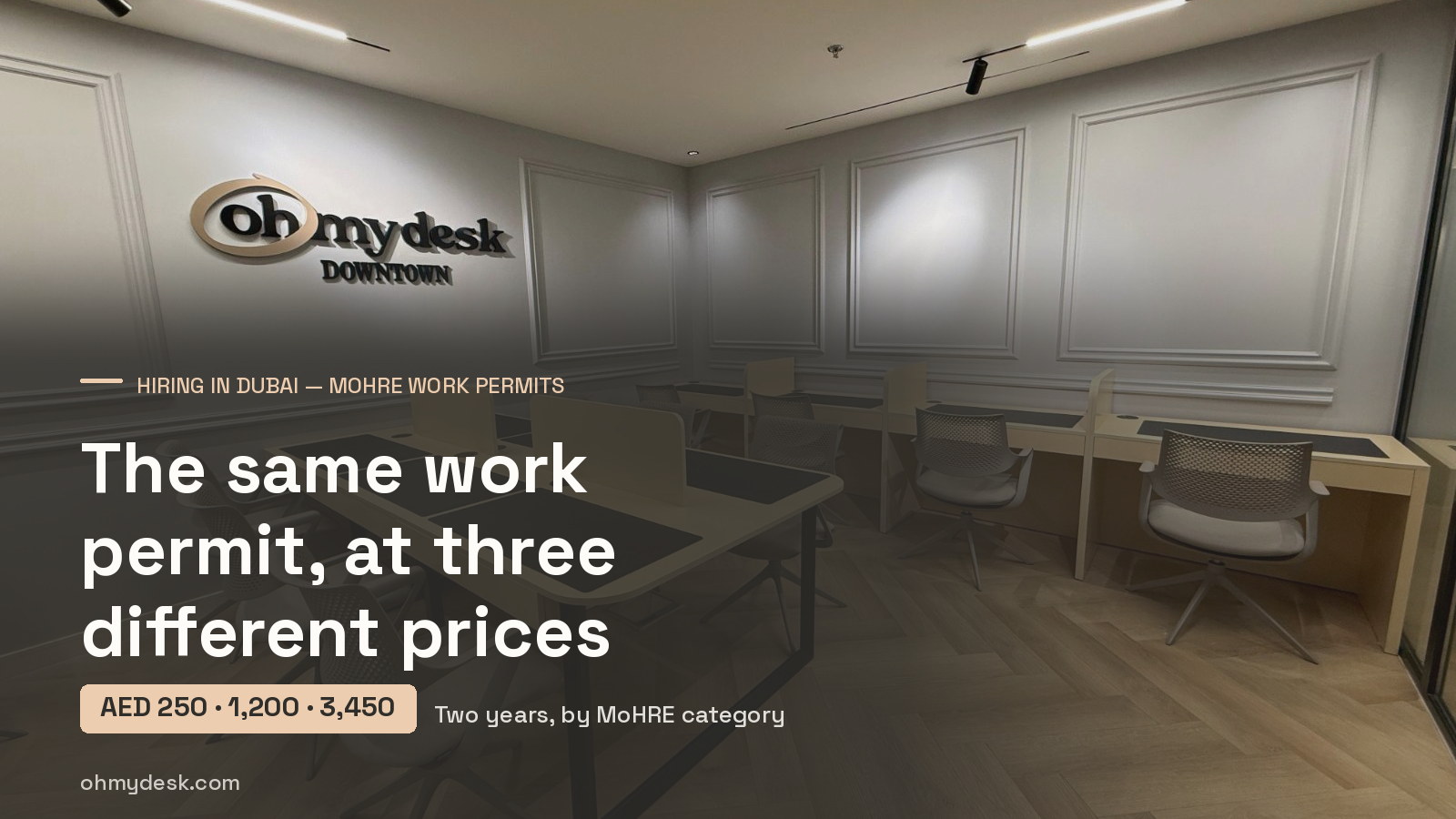
A two-year MoHRE work permit is priced at AED 250, AED 1,200 or AED 3,450 — the same permit, for the same person, doing the same job. Which of the three you pay is decided by your company's classification at the Ministry of Human Resources and Emiratisation, and most small Dubai companies sit in the middle band at AED 1,200, plus a AED 50 federal application fee on top.
That is a spread of 13.8 times between the cheapest and the dearest band, and nothing about the employee explains it. Not their salary, not their nationality, not their job title. Your own compliance record does.
Every figure below was read on a government page on 9 September 2026: MoHRE for the permit, the UAE government portal for the rules, GDRFA Dubai for the visa. Where no authority publishes a number — and there is one important case — that is said plainly rather than filled in from a consultant's blog.
| MoHRE band | Work permit, two years | Per month | Who lands here |
|---|---|---|---|
| Category 1 (u.ae calls it class A) | AED 250 | AED 10.42 | Compliant and meets one extra condition — see below |
| Category 2 (class B) | AED 1,200 | AED 50.00 | Ordinary compliant companies — the default |
| Category 3 (class C) | AED 3,450 | AED 143.75 | Companies in breach of labour rules |
| Federal application fee | AED 50 | — | All three bands |
Source: the MoHRE service card for issuing a new work permit and the ministry's own announcement of the classification, both read on 9 September 2026. MoHRE adds that the published fees “do not include tax and collection charges” and that a business centre may add a commission “capped at 72 dirhams per service”.
Why does the same permit cost AED 250 or AED 3,450?
Because the fee is not a price but a lever on employer behaviour, and the ministry says so openly: Category 1 companies get their MoHRE fees cut “by up to 80%”. Run the published numbers and the promise is exact — AED 250 against AED 1,200 is a 79.2% reduction.
The three bands came into force in June 2022 under Cabinet Resolution 37 of 2022, replacing a system that priced permits by the worker's skill level. The variable moved from the employee to the employer — which is why two companies in the same tower, hiring identical accountants in the same week, can pay AED 1,250 and AED 3,500 for the same paperwork.
What Category 1 actually demands
Compliance alone does not buy the cheap band. MoHRE requires commitment to the labour law and one of four extra conditions: an Emiratisation rate at least three times the target, training more than 500 UAE citizens a year with Nafis, being a youth-owned venture, or operating as a training and employment centre.
Read that list as a founder with four staff and Category 1 is plainly not a discount you apply for — it is a policy reward aimed at companies large enough to move the Emiratisation needle. For almost every coworking-sized business in Dubai, AED 1,200 is the real number, and the planning question is not how to reach 250 but how to avoid 3,450.
What drops you into Category 3
The third band is a penalty band. MoHRE lists the triggers: failing to observe labour policies, violating worker protections, human-trafficking convictions, unpermitted recruitment, breaches on wages, housing or safety, and what it calls “fake Emiratisation”. Wage breaches are the one that catches ordinary companies, because paying late through the Wage Protection System is a wage breach, not an accounting delay.
Slipping costs AED 2,250 per permit, every hire and every renewal. A company with six staff in Category 3 pays AED 13,500 more over two years than the same company one band up — a whole budget line, decided by a payroll file.
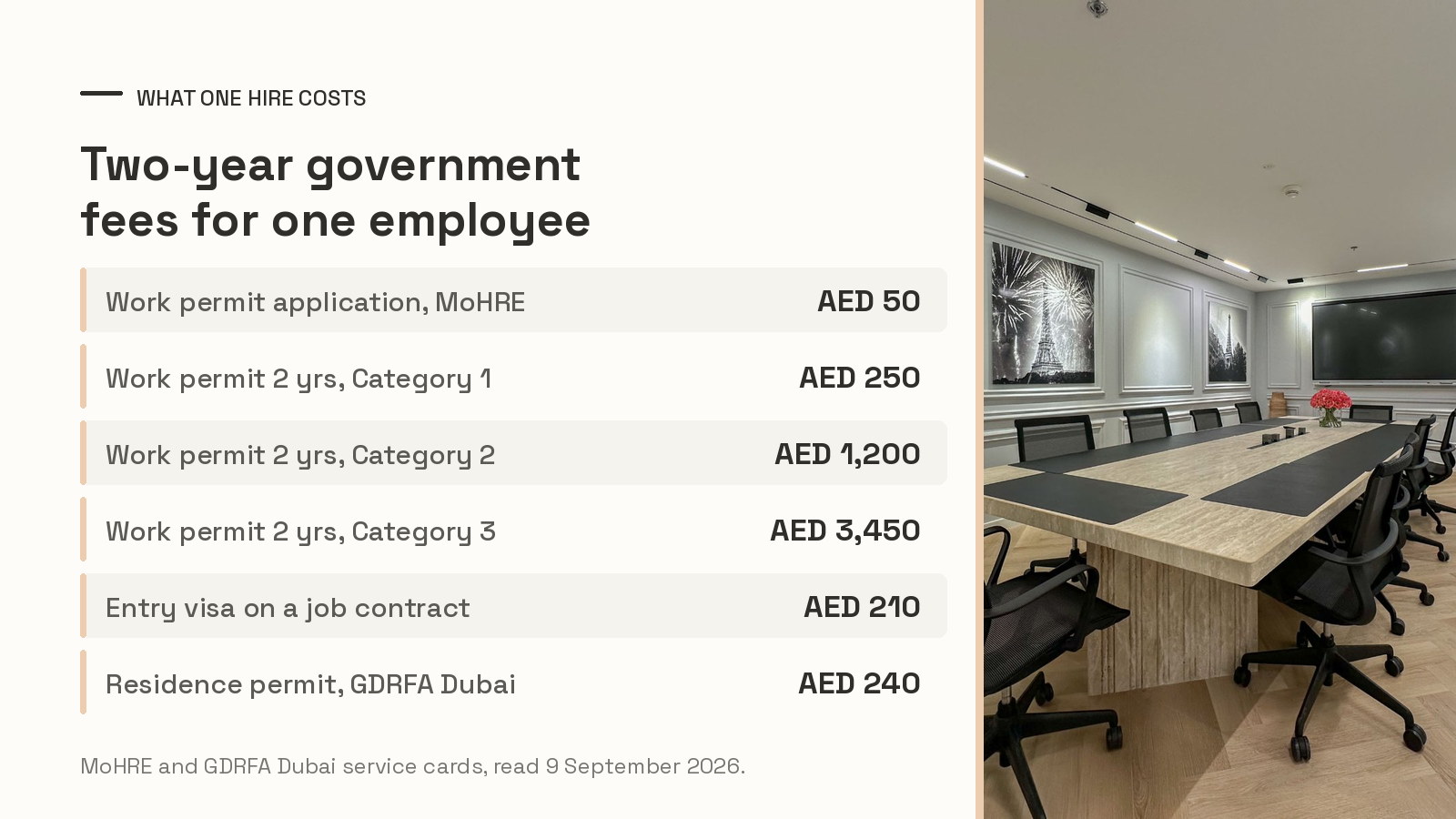
What does one hire cost, from job offer to Emirates ID?
The permit is roughly half the government bill. The other half sits with Dubai's General Directorate of Residency and Foreigners Affairs, which publishes its fees line by line. Two service cards matter.
The entry visa for a foreigner linked to a job contract is AED 200 plus 5% VAT — AED 210 — and lets the person stay 60 days from entry while the residency file is completed. The private-sector residence permit is AED 200 plus a AED 10 Knowledge Dirham, a AED 10 Innovation Dirham and AED 20 delivery, and runs two years, renewable. Both are quoted at 48 hours.
| Line | Authority | Amount | Applies |
|---|---|---|---|
| Work permit application | MoHRE | AED 50 | Always |
| Work permit, two years, Category 2 | MoHRE | AED 1,200 | Ordinary compliant company |
| Entry visa on a job contract | GDRFA Dubai | AED 200 + 5% VAT = AED 210 | Always |
| Residence permit, private sector | GDRFA Dubai | AED 240 (200 + 10 + 10 + 20) | Always |
| Two-year total, Category 2 | — | AED 1,700 | Before the in-country lines below |
| Same total, Category 1 | — | AED 750 | |
| Same total, Category 3 | — | AED 3,950 |
Fee lines read on the MoHRE and GDRFA Dubai (entry visa, residence permit) service cards, 9 September 2026. GDRFA states that “the total amount of the visa may vary depending on the circumstances surrounding the sponsored person”.
So for a normal Dubai company hiring one person from abroad, the government bill is about AED 1,700 across two years — roughly AED 71 a month. Far less than the packages setup consultancies quote, because those bundle their own service fee, the medical, the Emirates ID, insurance and often a slice of the trade licence.
Is it cheaper to hire someone already in Dubai?
No — and this is the finding that surprised us. Both GDRFA service cards carry a “fee inside the country” of AED 500. On the entry visa card it comes as an add-on block, listed with a AED 10 Knowledge Dirham and a AED 10 Innovation Dirham for when the sponsored person is already inside the country. On the residence permit card the AED 500 appears in the fee list itself.
Taken at face value, hiring a candidate already in the UAE and switching their status costs AED 1,020 more in government fees than flying someone in — two AED 500 lines plus one pair of dirhams. A real premium on the most convenient hire.
| Route, Category 2 company | MoHRE | GDRFA | Two-year total |
|---|---|---|---|
| Recruited from overseas | AED 1,250 | AED 450 | AED 1,700 |
| Already in the UAE, status change | AED 1,250 | AED 1,470 | AED 2,720 |
| Difference | — | AED 1,020 | +60% |
One honest caveat. GDRFA states the condition on the entry visa card — the block applies “if sponsored person is within the country” — but lists the same AED 500 on the residence permit card without repeating when it bites. That could not be resolved from a published page on 9 September 2026, so budget the range: AED 1,700 to AED 2,720 per hire over two years, Category 2. Ask your typing centre which lines your file carries, in writing.
What do you need before you can apply for a single permit?
You cannot walk up to MoHRE with a candidate. The government portal sets the order for a mainland company, and the first two steps have nothing to do with the person you want to hire.
The employer first requests an eSignature card for the firm from MoHRE; only then can it apply for pre-approval work permits. Separately it requests an establishment card from its emirate's residency directorate. MoHRE issues permits “to establishments registered with them”, so an unregistered company has a quota of zero whatever its trade licence says. Then comes the part almost no guide mentions.
How does your office size limit how many people you can hire?
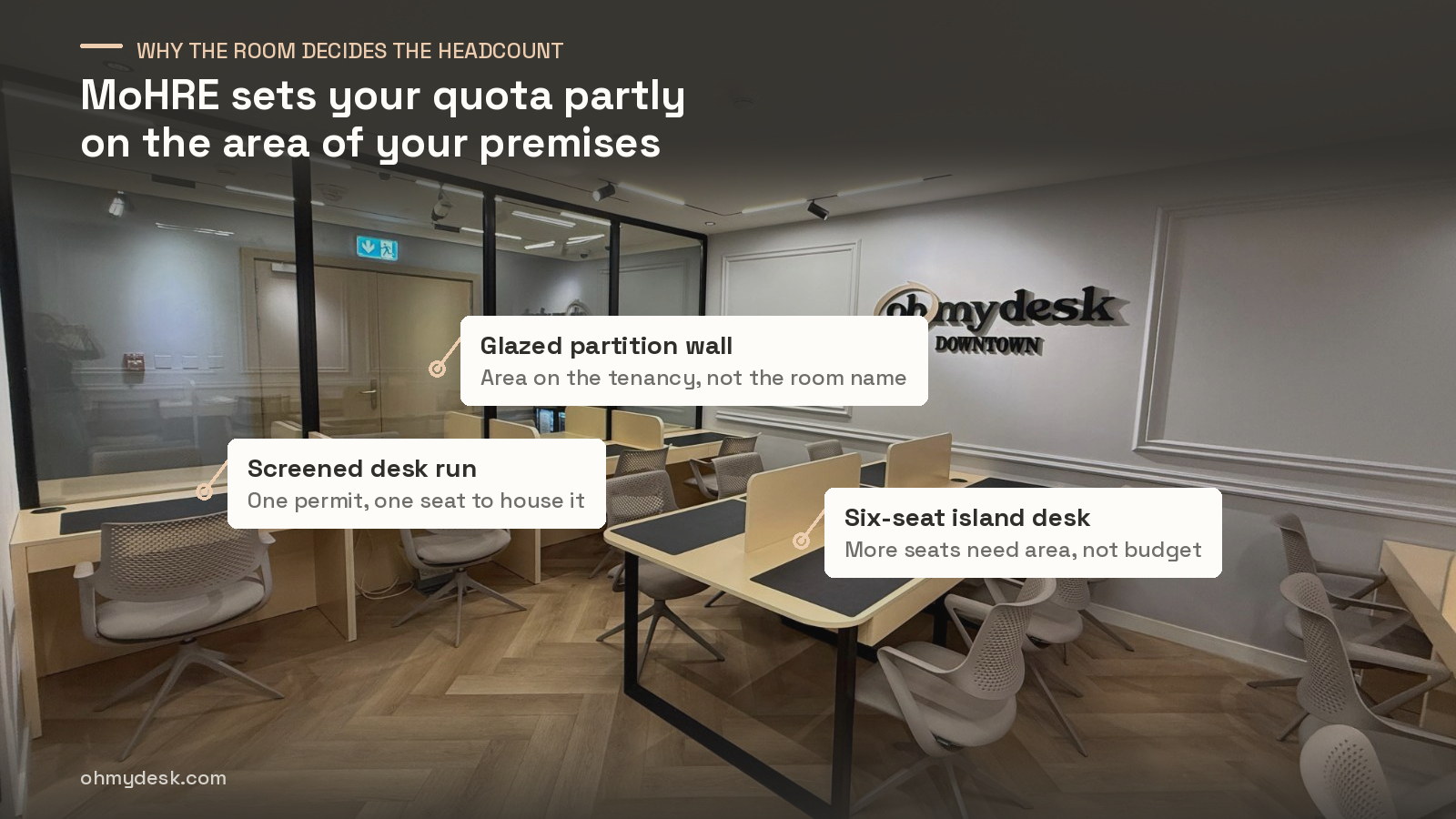
Your hiring quota is not a number you choose. The government portal states that the ministry sets it “according to the legal form of the company, the area of the premises, the projects involved and the demand of the work operation”. Four inputs, and one of them is your floor space.
A company that outgrows its address does not merely feel cramped; it hits a ceiling it cannot pay its way through, and the fix is a bigger registered space, not a bigger budget.
This is where a flexible workspace stops being a cost line and becomes a compliance line. What a flexi desk actually is covers the smallest version of a licensed desk address, and how Ejari works in Dubai covers the tenancy registration underneath it. At Oh My Desk a registered address with Ejari is 8,000 AED a year, and a private office starts at 6,000 AED a month with six hours of meeting room included in the subscription.
How many types of work permit are there, and which one do you need?
MoHRE issues 13 types, and the differences are not cosmetic. Recruiting from overseas, transferring a worker already in the UAE, hiring a resident on family sponsorship, a UAE or GCC national, a Golden visa holder, part-time, temporary, one-mission, juvenile, student-training and national-trainee schemes each have their own permit.
The one you almost certainly need is the standard two-year permit, and both it and the employment residence visa run two years. That alignment is worth noticing: freelance permits do the opposite, renewing the licence annually against a two-year visa, which is what makes those budgets slippery. The freelance visa route in Dubai sets out the other side of the arithmetic.
And one case needs no MoHRE permit at all: someone who stays employed by a company outside the UAE and simply moves to Dubai. They sponsor themselves on a virtual work residency, at a published government fee from AED 300 — the two routes and their two salary thresholds are set out in our guide to the Dubai remote work visa.
Part-time is a permit, not an arrangement
Someone two days a week needs a specific MoHRE permit, not a private clause in a contract. Hiring part-time without it is unpermitted recruitment, which sits on the Category 3 trigger list — the cheap flexible arrangement that costs AED 2,250 more per permit afterwards.
What documents does MoHRE ask for, and which depend on the job?
The permanent list is short: a clear colour photograph on a white background, a passport copy valid six months, and the job offer form signed by both parties. Two items depend on the person and the post.
Academic certificates are required by skill level. The UAE assigns every position a level from 1 to 5, 1 being the lowest, and jobs at levels 1, 2 or 3 require attested academic certificates. Attestation is the slow step in the whole file, and it happens in the employee's home country, not in Dubai. A professional licence is required where the occupation carries one, and national ID copies for workers from Pakistan, Afghanistan, Iraq and Iran.
MoHRE quotes two working days for the permit, free of charge through its website and app. That is the ministry's clock, not the file's: the attestation before it and the medical after it are where the weeks go.
What happened to the AED 3,000 bank guarantee?
It is gone, and this is the one line in the file that got dramatically cheaper. Employers used to lodge a mandatory bank guarantee of AED 3,000 per worker at recruitment. It was replaced by an insurance policy covering the worker's legal entitlements up to AED 20,000, with premiums from AED 105 for domestic workers to AED 250 for high-risk establishments, valid 30 months.
At the top of that range the employer puts up AED 250 where AED 3,000 used to be locked away — a twelfth of the capital, for nearly seven times the worker's protection. Across five hires that is AED 15,000 of working capital no longer frozen at a bank. The policy explicitly excludes health insurance, which stays a separate legal obligation; what that costs, and why the cheapest advertised plan is closed to most people, is in what health insurance really costs in Dubai.
What does the employment contract have to say?
Since the current labour law took effect, unlimited contracts no longer exist. The decree-law required that unlimited employment contracts be converted into fixed-term contracts within one year of its effective date, so every private-sector contract in the UAE today is a fixed-term contract on a MoHRE model.
The probation rules are strict and asymmetric, and they are the ones founders get wrong.
| Situation | Notice required | Who gives it |
|---|---|---|
| Maximum probation period | 6 months, not extendable | — |
| Employer ends probation | 14 days, written | Employer |
| Employee leaves for another UAE job | 1 month, written | Employee |
| Employee leaves the UAE | 14 days, written | Employee |
Note the asymmetry: you can release someone in 14 days, but an employee moving to a competitor down the road owes you a month. Six months is a ceiling, not a default, and cannot be extended by agreement.
Wages then run through the Wage Protection System, and late payment is the breach most likely to move a compliant company into Category 3. Our HR and payroll page covers how the file is submitted; the point here is that WPS is not an administrative nicety, it is the mechanism that prices your next permit.
When does Emiratisation start applying to you?
Sooner than founders expect, and the threshold is headcount, not revenue. MoHRE sets two lines: companies with 50 or more employees must achieve 2% annual growth of Emirati employees in skilled positions, and companies with 20 to 49 employees in specified economic activity sectors must recruit at least one UAE national and retain those already employed.
Twenty is one floor of private offices, and a business hiring steadily through 2026 can cross it without anyone flagging the date. Emiratisation also feeds back into the classification that sets your permit fee: the headcount that triggers the obligation is the headcount that multiplies the cost of getting it wrong.
What it costs to be on the wrong side of that line has moved since: the contribution for a 2026 shortfall is AED 10,000 a month per unfilled position, and we set it out in full in what Emiratisation costs a Dubai employer in 2026, alongside the 14 sectors and the two half-year deadlines.
What does Dubai not publish, and what should you budget anyway?
Two costs in this file have no official price tag, and pretending otherwise would be the easiest way to make this guide wrong.
The first is the Emirates ID. The UAE government portal's own visa fees page publishes no amounts at all: charges “are stated on each service card on the websites of ICP and GDRFA-D”, and it links out. Checked again on 9 September 2026, there is no consolidated official tariff. Every Emirates ID figure in circulation comes from consultants, not a government page, so we are not repeating one.
The second is the medical fitness test, which every applicant aged 18 and over must pass. DHA-approved centres publish their own catalogues, and the same screening sells across a wide range depending only on how fast you want the result — a spread set out with the DHA figures in our two-year freelance budget. Budget the fast tier if a start date is agreed.
One last curiosity. The MoHRE service card calls the bands first, second and third category; the UAE government portal, describing the identical AED 250 to AED 3,450 range, calls them “class A, B or C”. Two federal pages, three tiers, two naming systems, both live on 9 September 2026. If a consultant quotes a class and your MoHRE portal shows a category, it is the same thing.
FAQ: 10 quick answers
1. How much does a work permit cost in Dubai? AED 250, AED 1,200 or AED 3,450 for two years, plus a AED 50 application fee, depending on your company's MoHRE classification. A normal compliant company pays AED 1,200. The fee is set federally by Cabinet Resolution 37 of 2022 and does not change with the employee's salary, nationality or job title.
2. What is a labour card in the UAE, and do I still get one? “Labour card” is the old name for what MoHRE now issues as a work permit. The ministry issues 13 types of permit, the standard one runs two years, and the worker's data lives on the Emirates ID rather than a separate plastic card. If a service provider quotes you for a labour card, ask which of the 13 permits they mean.
3. How long does a UAE work permit last? Two years for the standard permit, and MoHRE quotes two working days to issue it. The employment residence visa also runs two years and is renewable for the same period. The permit and the visa are on the same clock, which is not true of freelance permits, where the licence renews annually.
4. What is the difference between a work permit and an employment visa? Different authorities, different documents. MoHRE issues the work permit, which is the right to employ that person in that job. GDRFA in Dubai issues the entry visa and the residence permit, which are the right to live in the country. You need both, and MoHRE comes first.
5. How much does an employment visa cost in Dubai? GDRFA Dubai publishes AED 200 plus 5% VAT for the entry visa on a job contract, and AED 200 plus a AED 10 Knowledge Dirham, a AED 10 Innovation Dirham and AED 20 delivery for the private-sector residence permit. An extra AED 500 “fee inside the country” applies when the person is already in the UAE.
6. Can I hire someone on a freelance visa instead? Only if they genuinely work for themselves and invoice you. A freelancer sponsors their own permit and visa, so you pay no MoHRE fee and carry no quota, but you also get no exclusivity, no notice period and no gratuity relationship. Treating an employee as a freelancer to avoid the permit is unpermitted recruitment.
7. What must a MoHRE employment contract include? It must be a fixed-term contract on a ministry model, because unlimited contracts were abolished and converted by law. Probation cannot exceed six months and cannot be extended. Wages must then be paid through the Wage Protection System, and a late file is a wage breach, not a bookkeeping delay.
8. How long is the probation period in the UAE? Six months maximum, and it cannot be extended for a further term. During probation the employer must give 14 days' written notice to terminate. An employee leaving for another UAE employer must give one month's written notice, and one leaving the country 14 days. The asymmetry is deliberate.
9. Do I need an office to sponsor an employee? Effectively yes. MoHRE only issues permits to registered establishments, and it sets your quota partly on the area of your premises, alongside the legal form of the company, its projects and its operations. The address on your tenancy is an input to how many people you may employ.
10. What is WPS, and when does it start applying? The Wage Protection System is the federal channel through which private-sector salaries must be paid, and it applies from your first employee. Its relevance to this article is direct: wage breaches are on MoHRE's list of Category 3 triggers, and Category 3 costs AED 2,250 more per permit than Category 2.
How these questions were chosen: Search Console holds almost no employment or work-permit queries for this site — a filtered sweep of the 28 days to 8 September 2026 returned none on work permit, labour card or employment contract, which is precisely why this ground was free to write on. The ten above are therefore built from the keywords Semrush measures on the UAE database — labour card uae, employment contract uae, work permit dubai and employment visa dubai cost — and from the questions the two ministries answer on their own pages. None is invented.
What this means if you are hiring your first employee in Dubai
Budget AED 1,700 to AED 2,720 in government fees for a two-year hire, assume Category 2 until MoHRE says otherwise, and treat payroll discipline as a pricing decision rather than a back-office chore — AED 2,250 per permit is what the third band costs. The AED 3,000 bank guarantee is history, and the two genuinely unpublished costs are the Emirates ID and the medical.
Do one thing after reading this: find out which category MoHRE has you in, before you plan the hire rather than after. It is the single number that moves your cost by nearly three. And price the other end of the contract while you are at it: every hire accrues 21 days of basic pay a year in end-of-service gratuity, on the wage they are earning when they leave.
One cost sits outside every figure above, because MoHRE does not charge it: if the role needs an attested qualification, that stamp is billed by the Ministry of Foreign Affairs and the chain starts in the country that issued the diploma. We priced it in what degree attestation costs in the UAE.
And if the quota is what stands in the way, the area on your tenancy is where to look first. Book a tour of the three addresses — Downtown, Business Bay, and the Design District. The visit is free, coworking starts at 950 AED a month with an hour of meeting room included, and a private office starts at 6,000 AED with six. Prices are before VAT, added at payment.