How much does car insurance cost in Dubai in 2026?
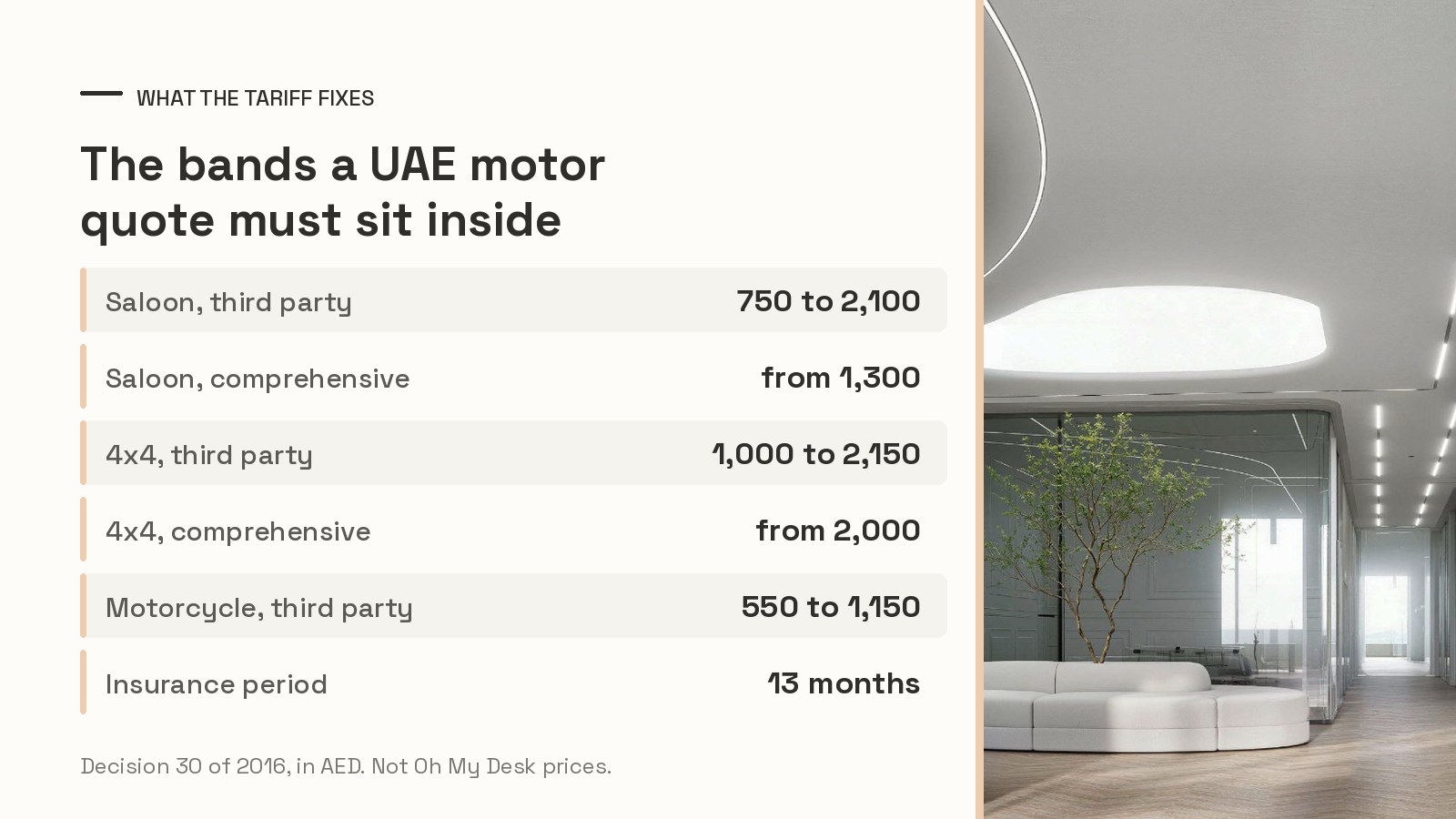
It costs whatever your insurer decides, inside a band it is not allowed to leave. The 2016 tariff decision that governs motor insurance in the UAE prints two tariff tables, and every row carries a minimum premium and a maximum. For third-party liability on a private saloon that band runs from AED 750 to AED 2,100, depending on how many cylinders the engine has. A quote below the floor is not a bargain, it is outside the tariff.
What the table does not do is pick a price for you. Floor to ceiling is 62% to 79% on every saloon row: two insurers quoting the same car can both sit inside the regulation and differ by two thirds.
| Third-party liability, 13-month period | Minimum | Maximum | Width of the band |
|---|---|---|---|
| Saloon, private, 4 cylinders | AED 750 | AED 1,300 | +73% |
| Saloon, private, 6 cylinders | AED 850 | AED 1,400 | +65% |
| Saloon, private, 8 cylinders | AED 950 | AED 1,600 | +68% |
| Saloon, private, more than 8 cylinders | AED 1,300 | AED 2,100 | +62% |
| Four-wheel drive, private, 4 cylinders | AED 1,000 | AED 1,750 | +75% |
| Four-wheel drive, private, more than 8 cylinders | AED 1,200 | AED 2,150 | +79% |
| Motorcycle, up to 200 cc | AED 550 | AED 1,150 | +109% |
Table (1), read on 7 November 2026. Commercial saloons share the same floors and carry slightly higher ceilings. The width column is our arithmetic.
Who sets the price, and when was it last changed?
The instrument is Insurance Authority Board of Directors’ Decision No. (30) of 2016, the Regulation for Motor Vehicle Insurance Tariffs, in force since 1 January 2017 and now administered by the Central Bank of the UAE. Its Rulebook page is marked In-Force and says you are viewing the latest version, amended twice: by Decision No. (41) of 2017, effective 1 January 2018, and Resolution No. (17) of 2020, effective 22 April 2020.
Neither amendment touched the car bands. The 2017 one changed the motorcycle minimum and built the discount architecture; the 2020 one added a list of categories entitled to half off, a refund tied to the pandemic, and the right to price by the kilometre. The Rulebook’s own list of revisions for the past year runs to fourteen items, and not one is motor. The quote a Dubai driver reads in November 2026 sits inside a band set in 2016 and last touched in 2020, while the decision’s preamble still cites the 1995 traffic law rather than the federal decree-law in force since 29 March 2025.
What does comprehensive cover cost?
Table (2) governs the combined policy — loss and damage plus third-party liability — and is built differently. Each row gives a minimum premium as an amount and a maximum as a percentage: for a saloon, AED 1,300 and 5%; for a four-wheel drive, AED 2,000 and 7%.
And here the regulation goes quiet at the one point where it matters. The column is headed simply “Maximum”, and the decision does not say, in that table, what the percentage is a percentage of. The only place it names a base is the taxi and rental exception, where the rate “shouldn’t exceed (6.5%) of the value of the vehicle”. Read across, 5% of an AED 80,000 saloon would be AED 4,000 — but the table does not say it is the vehicle’s value, so neither will we.
| Comprehensive policy, 13-month period | Minimum premium | Maximum |
|---|---|---|
| Saloon | 1,300 | 5% |
| Four-wheel drive | 2,000 | 7% |
| Pickup and van up to 3 tons | 1,550 | 7% |
| Heavy, more than 3 tons | 2,000 | 9% |
| Equipment | 2,750 | 7% |
| Motorcycle, up to 200 cc / above 200 cc | 800 / 850 | 5% |
Table (2), read on 7 November 2026. The minimum-premium column carries no currency symbol: the only “(AED)” on that table sits above its last two columns, which add a driver at AED 120 and a passenger at AED 30 — the passenger line applying “only to individuals who work for the insured”.
Why does AED 1,300 appear three times?
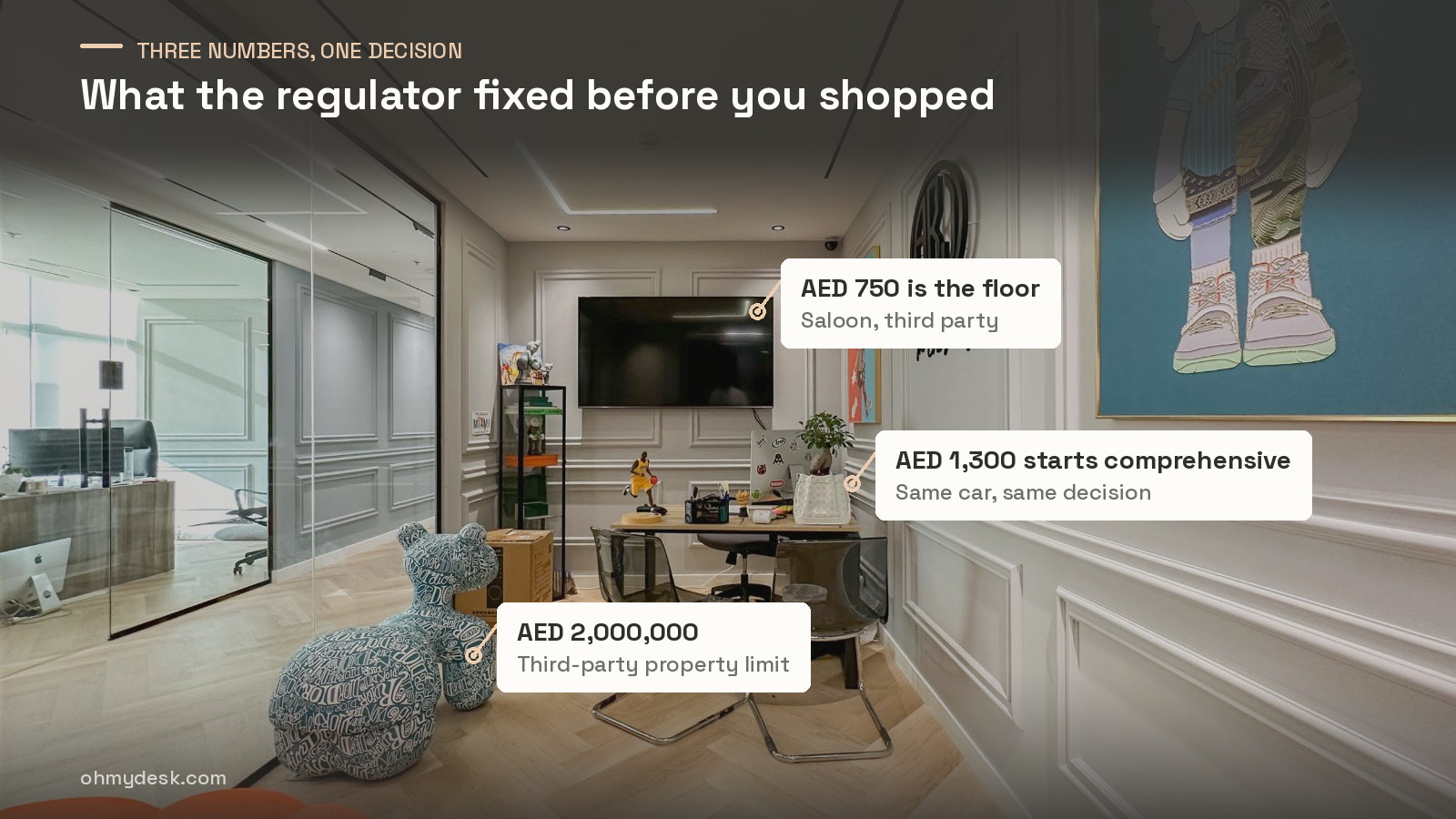
Read the two tables side by side and the same number comes back three times, in three roles. It is the maximum third-party premium for a 4-cylinder private saloon. It is the minimum third-party premium for a saloon of more than eight cylinders. And it is the minimum premium for comprehensive cover on any saloon at all.
The consequence is worth a minute. A driver of an ordinary 4-cylinder saloon quoted at the third-party ceiling is being asked exactly the floor price of a comprehensive policy on the same car — at which point third-party-only buys nothing comprehensive would not. The two figures live in two tables of the same decision, and no comparison page we found prints them together.
Does a no-claims discount come off your quote?
No. It comes off the minimum premium, which is usually a much smaller number. The decision grants an applicant with a claim-free record “10% of the minimum premium” after one insured year, 15% after two and 20% after three, plus 10% of it as a loyalty reduction at renewal with the same company.
Put dirhams on it. Three claim-free years on a 4-cylinder saloon third-party policy are worth 20% of AED 750, that is AED 150, whatever you were quoted. If your quote sits at the AED 1,300 ceiling, that AED 150 is 11.5% of what you pay, not 20%.
| Reduction | Calculated on | 4-cyl saloon, third party (min 750) | Saloon, comprehensive (min 1,300) |
|---|---|---|---|
| One claim-free year, 10% | the minimum premium | AED 75 | AED 130 |
| Two claim-free years, 15% | the minimum premium | AED 112.50 | AED 195 |
| Three claim-free years, 20% | the minimum premium | AED 150 | AED 260 |
| Loyalty at renewal, 10% | the minimum premium | AED 75 | AED 130 |
| Listed categories, 50% | the minimum premium | AED 375 | AED 650 |
| Fleet of five or more, up to 30% | the minimum premium | up to AED 225 | up to AED 390 |
Our arithmetic: the percentages the decision prints, applied to the floors in Tables (1) and (2).
Can two reductions be added together?
The decision contains exactly one sentence on it — “when there is more than one reason for reduction, only the highest rate of reduction shall apply” — and it sits inside the paragraph about gas and electric vehicles. It does not say whether it reaches the claim-free, loyalty or fleet reductions. An insurer refusing to stack two of them is relying on a sentence written about something else.
Who gets 50% off, and why is that clause still in force?
Resolution No. (17) of 2020 granted 50% of the minimum premium, on renewal or on a new policy, to six groups: medical-sector workers, members of the Armed Forces and Police, Civil Defence members, people of determination, people over 60, and individual applicants with an accident-free record. That last line is the broad one: an ordinary driver who has never had an at-fault accident sits in the same bracket as the five named services.
Now read the resolution’s own Article 3. It is effective “from the date of issuance and until the end of the period of Coronavirus”, and it was issued in April 2020. Six and a half years later the consolidated tariff is still In-Force with those six categories inside it, and with the clause beside them that lets an insurer refund part of a premium “in proportion to the periods of application of the national sterilization system”. A driver over 60 renewing in Dubai this month is claiming a discount created for a pandemic, under a resolution that expected to expire with it. No end date has been published.
What else that amendment allows
An insurer may, at the insured’s request, base the premium on kilometres driven, “provided that the insurance premium does not exceed the maximum specified in the tariffs”: pay-as-you-drive is legal here and almost nobody sells it. And from the 2017 amendment, up to 30% of the minimum premium off for a fleet of five or more vehicles owned by one person, and up to 25% at renewal for a gas or electric vehicle. If your company has reached five cars, the fifth changes the price of the other four.
Can a broker charge a fee on top of the premium?
Not without a decision from the regulator. The tariffs are stated to include “all coverages set out in the two policies as well as all administrative charges and expenses, and commissions”, plus the ambulance premium. The company, agent or broker “shall not be entitled to impose or receive any amount or additional sum” without a resolution from the Authority, and a sentence to the same effect is printed under both tariff tables.
Which makes a policy issuance fee or an administration charge on a motor quote a second bite at a cost the tariff has already priced.
Why does the policy run 13 months and not 12?
Because the regulation says so: “The insurance period shall be (13) months.” Both tariff tables are headed for a 13-month rate, and the unified loss-and-damage policy repeats it in its definitions. The third-party liability policy, oddly, carries no term clause at all.
Two consequences. Thirteen months against a twelve-month registration year is a month of overlap built into the product, which is why a renewal counter can ask for cover that outlives the registration card; we have priced registration renewal itself separately, and this article does not repeat its figures. And the premium is collected for fractions of the period “on a proportionate basis”: a quote of AED 1,300 is AED 100 a month over thirteen months, not AED 108.33 over twelve.
What does third-party cover actually pay?
More than most drivers assume on injury, and nothing at all on their own car. The unified third-party policy caps property damage at AED 2,000,000 for one accident “regardless of the number of the persons whose properties are damaged”, and refuses to cap death or bodily injury: the maximum is “the value judicially awarded without any limit whatsoever”. The exception is a close relative, where the policy names a figure.
| Unified third-party policy | What it pays |
|---|---|
| Property damage, one accident | AED 2,000,000, whatever the number of owners |
| Death or bodily injury to a third party | the value judicially awarded, with no limit |
| Death of a spouse, parent or child | AED 200,000 per deceased person |
| Ambulance and medical transport | AED 6,770 per injured person |
| Substitute vehicle for a private-car owner | up to AED 300 a day, up to fifteen days |
| Anyone driving with your permission | cover extends to “every licensed driver” |
| Use outside the UAE | “This Policy does not apply outside the State.” |
| Time limit to sue on the policy | three years from the event |
Read on the Rulebook on 7 November 2026. Fifteen days at AED 300 is AED 4,500 — our arithmetic, not a figure the policy prints.
What do you still pay after a claim?
A deductible — and the schedule that sets it is printed as a maximum rather than a fixed charge, so an insurer may go lower. Schedule (3) of the loss-and-damage policy caps the basic deductible for a private vehicle of up to nine passengers at AED 350, 700, 1,000, 1,200 or 1,400 by value band, and runs to AED 4,500 for the other categories. On a total loss, none applies.
| Deductible | What the policy allows |
|---|---|
| Basic, private vehicle up to 9 passengers | maximum AED 350, 700, 1,000, 1,200 or 1,400 by value band |
| Basic, other categories in the schedule | maximum AED 1,500, 1,700 or 4,500 |
| Driver under 25, taxi or public transport | additional, maximum 10% |
| Sports or modified cars | additional, maximum 15% |
| Modified outside the factory, or rental | additional, maximum 20% |
| Total loss | no deductible |
One defect to name rather than smooth over: in the printed schedule the value bands above AED 250,000 and above AED 500,000 overlap, so a car in that range reads against two rows at once.
When can you insist on repair at the agency?
The loss-and-damage policy answers half the question. It covers repair at “repair shops approved by the Company”, then says that if the insured wishes to repair the vehicle “inside the Agency workshops after the lapse of the first three years”, the company may accept and set a premium “not exceeding the maximum tariff limit”. It says nothing about what happens during those three years — the clause every new-car buyer in Dubai actually wants is the one that is not written.
If the price is capped, why did premiums jump 40%?
On 12 June 2025 the question reached the Federal National Council, where Adnan Hamad Al Hammadi put it to the Minister of State for Financial Affairs. The newspaper report of the session said premiums had “surged by more than 40 per cent in some cases”, with some companies charging double for third-party cover. The Central Bank replied in writing that all companies must operate within a unified pricing framework with minimum and maximum thresholds.
Both statements are true at once, and that is the whole answer. A band running from AED 750 to AED 1,300 permits a 73% increase without anyone leaving the regulation. Prices rising inside a fixed band is a market walking from the floor towards the ceiling, not a market breaking a rule — and the ceiling has not been raised since the tables were written.
One part of the complaint does not fit the bands, and it is worth saying so. You cannot double a third-party premium inside Table (1): the saloon rows are 62% to 79% wide, not 100%. You can double a comprehensive premium, because that ceiling is a percentage of a base the table does not name. If premiums doubled anywhere, the arithmetic points at the table with the unnamed base.
What does the federal government publish about car insurance?
Almost nothing, and the shape of the silence is instructive. The only federal page we could reach that touches vehicle insurance is the federal road-safety page, last updated 1 October 2026. Summarising the traffic decree-law, it says insurers must provide full civil liability coverage and may not reduce compensation for death, injury or property damage caused by a vehicle.
That is a duty on the insurer. The page does not state that insurance is compulsory for the driver, does not name third-party or comprehensive cover, publishes no figure, and does not name the Central Bank as the regulator. The decree-law itself serves its dates — 30 September 2024, in force 29 March 2025, Official Gazette 784 — and no article text.
| Question | Where the answer actually is | What the federal portal publishes |
|---|---|---|
| What a policy may cost | Tables (1) and (2) of the 2016 tariff decision | nothing |
| What third-party cover pays | the unified policy, Decision No. 25 of 2016 | nothing |
| How long the policy runs | 13 months, Article 3 of the tariff decision | nothing |
| Who regulates motor insurance | the Central Bank of the UAE | not named |
| Whether insurance is compulsory | not stated on the pages we could read | not stated |
Read on 7 November 2026. We have deliberately not printed a fine for driving uninsured: the federal fines table did not serve to us today, and that side of the paperwork is already priced in our registration renewal guide.
FAQ: 10 quick answers
Search Console records zero impressions for our site on any query containing “car insurance”, across two consecutive 28-day periods, so there are no real queries of our own to mine. These ten come instead from the keywords we measured on 7 November 2026: car insurance dubai (6,600 searches a month), car insurance uae (3,600), cheapest car insurance dubai (480), car insurance dubai cost (390), motor insurance uae and motor insurance dubai (320 each) and four longer tails between 90 and 170.
1. How much is car insurance in Dubai? Third-party cover on a private saloon costs between AED 750 and AED 2,100 for a 13-month policy, depending on the engine and on where in the band your insurer prices you. A 4-cylinder saloon runs AED 750 to AED 1,300, and comprehensive on the same car cannot start below AED 1,300. The national tariff sets both ends.
2. What is the cheapest car insurance legally available in Dubai? AED 750 for a 4-cylinder private saloon, third party only, and AED 550 for a motorcycle up to 200 cc. Nothing below the floor in Table (1) is a legal price, so a cheaper quote is a reason to check which vehicle category the insurer has filed you under.
3. Is third-party cover enough in Dubai? It pays other people, not you: property damage up to AED 2,000,000 per accident, bodily injury with no limit at all, nothing for your own car. The decision is arithmetic rather than principle, because at the top of the third-party band for a small saloon you are already paying the comprehensive floor.
4. What does comprehensive car insurance cost in the UAE? It starts at AED 1,300 for a saloon and AED 2,000 for a four-wheel drive, and is capped at 5% and 7% respectively. The regulation does not state, in that table, what the percentage applies to, so the ceiling cannot be turned into dirhams from the published text alone.
5. How much is motor insurance for a 4x4 in the UAE? Third-party cover on a private four-wheel drive runs from AED 1,000 to AED 2,150 depending on cylinders, and comprehensive starts at AED 2,000 — about a third more than a saloon at the floor, by the tariff rather than by an insurer’s judgement.
6. Does a no-claims discount reduce my premium? It reduces the minimum premium, not your quote. Three claim-free years earn 20% of the floor — AED 150 on a 4-cylinder saloon third-party policy. Loyalty at renewal is another 10% of the floor, and six listed categories, including anyone with an accident-free record, get 50% of it.
7. How long does a UAE car insurance policy last? Thirteen months. The tariff says so in terms, both tables are headed for a 13-month rate, and the loss-and-damage policy defines the period as running to the end of the thirteenth month. Part-periods are charged proportionately, so divide an annual quote by 13 rather than 12.
8. Can my insurer or broker charge a fee on top? Not without a resolution from the regulator. The tariff is stated to include all administrative charges, expenses and commissions, and the decision says the company, agent or broker may not impose or receive any additional amount. The same sentence is printed under both tariff tables.
9. What will I pay out of my own pocket after an accident? A deductible, capped rather than fixed: AED 350 to AED 1,400 at most for a private vehicle of nine passengers or fewer. An insurer may add a percentage deductible, capped at 10% for a driver under 25, 15% for sports or modified cars and 20% for cars modified outside the factory. Total loss carries none.
10. Does my UAE car insurance work outside the country? The third-party policy states that it does not apply outside the State, and the loss-and-damage policy excludes damage outside its geographical territory unless a rider extends it. Cross-border cover is an add-on to request before you drive.
What to do next
Before you compare quotes, write down two numbers: the floor for your vehicle category and the ceiling. Everything a comparison page shows you is a position between them. Ask where in the band the quote sits, ask for the reductions in dirhams rather than percentages, and ask whether any line on the invoice is not already inside the tariff. If you are over 60, have an accident-free record or run five or more vehicles, say so before the price is set.
We write these because our members ask them between meetings, not because we sell insurance. What we do is the desk the paperwork gets done at: Downtown, Business Bay and Dubai Design District, with coworking from 950 AED a month, a dedicated desk at 1,500 AED in Downtown and private offices from 6,000 AED. If the file needs a registered address rather than a seat, that is Virtual Office + Ejari at 8,000 AED a year, and you can start it online. Prices are before VAT; reception is open Monday to Friday, 9am to 6pm, members have their badge 24/7.
Still working out what the car itself costs you? We have priced a Dubai driving licence, mapped what the Salik gates charge, counted parking in Downtown Dubai, explained why the headline health premium is never yours and mapped the freelance visa route in Dubai. Or tell us where you have got to.