What does one Salik crossing cost in Dubai in 2026?
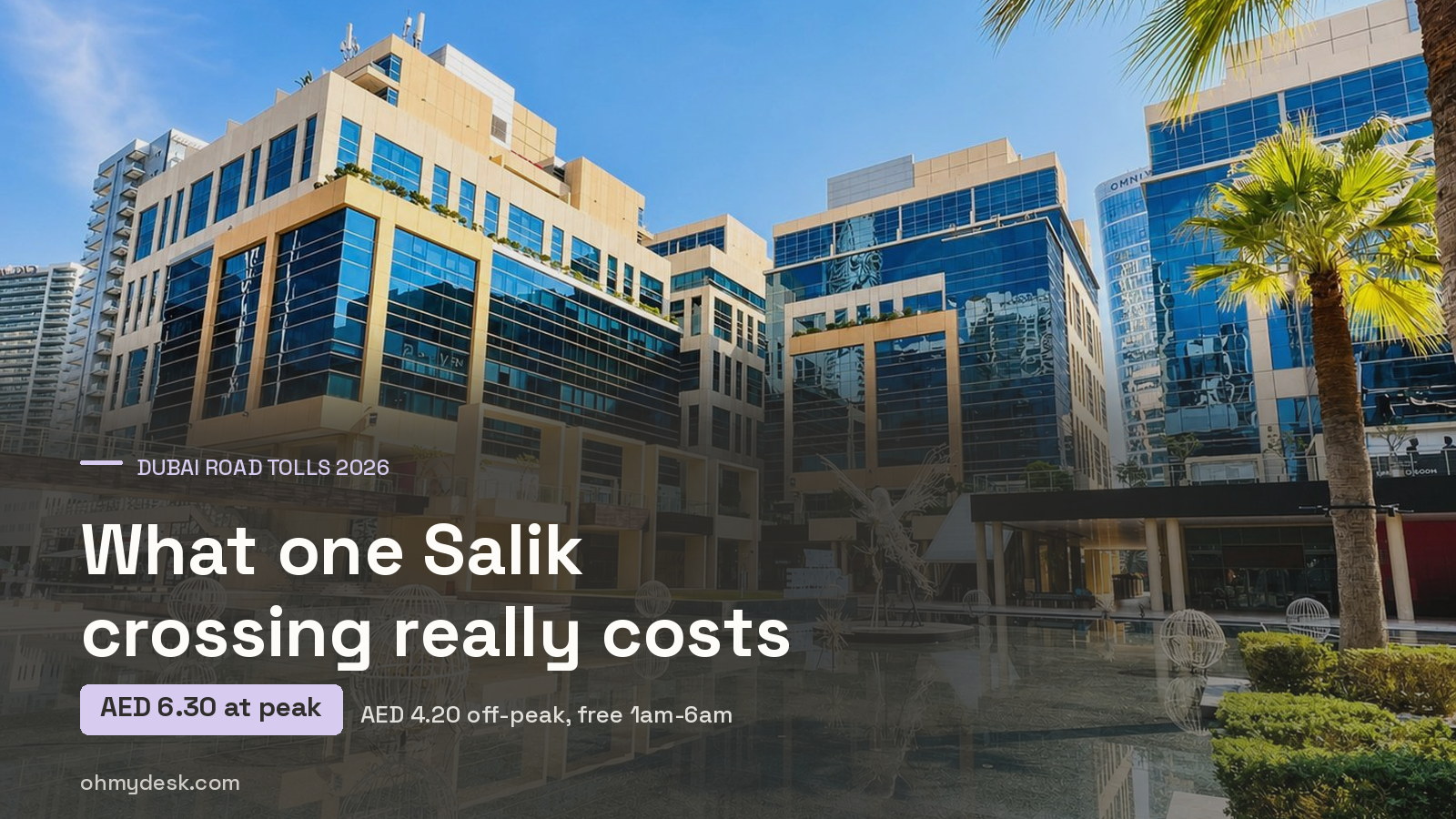
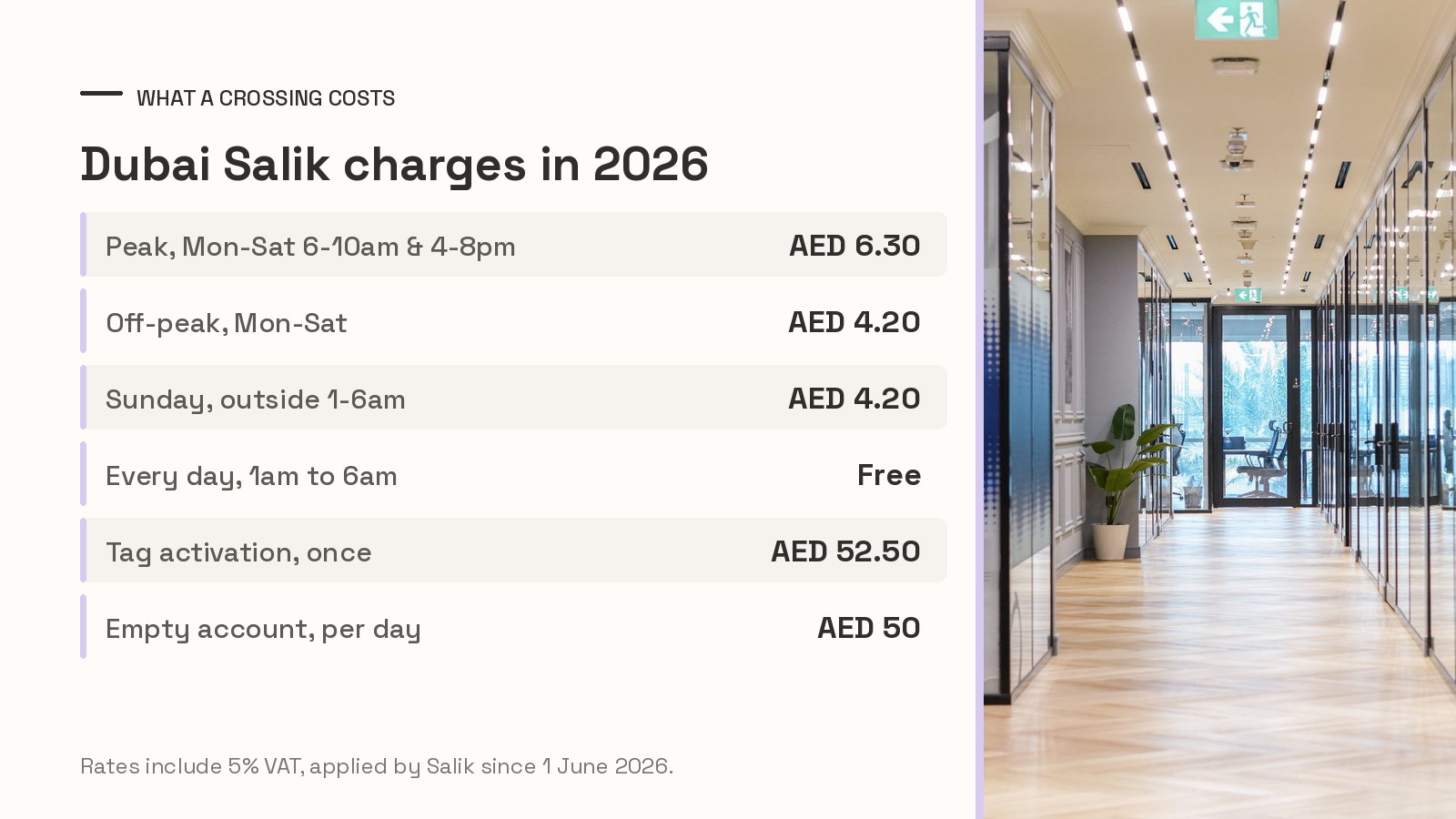
AED 6.30 at peak, AED 4.20 off-peak, AED 4.20 all day on Sunday, and nothing between 1am and 6am. Those four figures include the 5% VAT that Salik started applying on 1 June 2026; before that date the same crossings were AED 6 and AED 4, which is why most pages you will find still print the older pair.
| When you cross | Toll before VAT | What you pay now |
|---|---|---|
| Monday–Saturday, 6am–10am and 4pm–8pm | AED 6 | AED 6.30 |
| Monday–Saturday, 10am–4pm and 8pm–1am | AED 4 | AED 4.20 |
| Sunday, all day outside the free window | AED 4 | AED 4.20 |
| Every day, 1am–6am | — | Free |
| Tag activation fee, once | AED 50 | AED 52.50 |
The peak and off-peak bands and the free window are published by the Dubai Government portal on its road toll page, last modified 3 April 2026. The VAT-inclusive amounts come from the operator’s own announcement of 22 May 2026, reported with a line-by-line table by Gulf News. Peak applies Monday to Saturday — which matters, because the Dubai working week has been Monday to Friday since 2022. Saturday morning is a day off charged at the working-day rate.
Why does the same crossing cost AED 6.30, AED 4.20 or nothing?
Because Dubai stopped charging for distance and started charging for timing. Until late January 2025 every gate cost a flat AED 4 whenever you passed it. Variable pricing replaced that with three bands: a peak rate meant to push traffic out of the morning and evening rush, a standard rate for the rest of the day, and a free overnight window.
What the bands are actually buying
The gap is AED 2.10 a crossing — exactly 50% more at peak than off-peak. On a single gate crossed twice a day that is small change. On two gates each way, five days a week, it is the difference between a rounding error and a line on the budget, and the arithmetic is in the monthly table further down.
One point to be clear about: the free window runs 1am to 6am, which is not a commuting hour for anybody. It takes deliveries, airport runs and shift work out of the paid bands. It does not help you get to a desk.
What changed on 1 June 2026, and why has no official page caught up?
From 1 June 2026, 5% VAT applies to Salik gate usage fees and to tag activation fees. The operator announced it on social media in May 2026; the legal basis is Federal Decree-Law No. 8 of 2017 on Value Added Tax, as amended, together with its Executive Regulations, as set out by the tax firm Crowe. Public parking tariffs took the same treatment on the same date.
Three official sources, three different years
This is the part worth knowing before you budget anything. On 3 October 2026 we read all three:
| Official source | What it says about the toll | How current it is |
|---|---|---|
Federal portal, u.ae | “a toll of AED 4 when they pass through the toll gates” | No peak rate, no free hours, no VAT |
Dubai portal, dubai.ae | AED 6 peak, AED 4 off-peak, free 1am–6am | Last modified 3 April 2026 — before VAT |
Roads and Transport Authority, rta.ae | “No content found” | The Salik page linked from its own footer is empty |
The authority that sets the toll does not publish it; the emirate’s portal predates the VAT
change by two months; the
federal portal
predates variable pricing altogether. The operator’s own site, salik.ae, refuses
automated reading — 403 to every attempt on 3 October 2026 — so we have named it and left it
out rather than quote it second-hand.
Secondary sources leaning the same wrong way is a familiar problem. This is the inverse and it is worse: the primary sources are each frozen at a different date, and a reader who checks the federal page gets a number that was last right in 2024.
Where are the ten Salik gates, and which ones sit around a working day?
There are ten. Eight have been running for years — Al Mamzar North, Al Mamzar South, Al Garhoud Bridge, Al Maktoum Bridge, Airport Tunnel, Al Safa, Al Barsha and Jebel Ali. Two more were activated on 24 November 2024: Business Bay Crossing, on Al Khail Road, and Al Safa South, on Sheikh Zayed Road between Al Meydan Street and Umm Al Sheif.
The two that decide a Dubai office commute
Four of the ten sit on Sheikh Zayed Road, the spine every Downtown and Business Bay commuter drives: Jebel Ali and Al Barsha to the south, then the Al Safa pair just before the Water Canal. Business Bay Crossing catches traffic off Al Khail Road. Al Garhoud Bridge, Al Maktoum Bridge and Airport Tunnel cover the creek crossings from Deira and Bur Dubai; the Al Mamzar pair covers the Sharjah border.
Which gates you cross is a question about your home, not your office. Our three addresses sit inside that ring: a drive in from Jumeirah meets the Al Safa pair, one up from the south adds Al Barsha, one from Deira meets a creek crossing. Parking is the separate bill at the other end — we costed that in our guide to parking in Downtown Dubai.
When does a second gate cost you nothing?
At Al Safa and at Al Mamzar, two gates inside one hour are charged once. The Dubai Media Office announced the rule with the new gates: there is “a one-time toll fee applicable for trips between the North and South Al Safa toll gates within a one-hour period”. The same single-charge treatment applies to the Al Mamzar pair, which press guidance describes as applying when both are crossed in the same direction within the hour.
The practical effect is that the drive up Sheikh Zayed Road through Safa costs one toll, not two. It also means a stop of more than an hour between the two gates costs you the second one — a coffee that runs long is the only way to pay AED 12.60 for a journey that should cost AED 6.30.
Where sources diverge we have left the figure out. One guide reports a gate-specific exemption at Al Maktoum Bridge on Sundays and overnight; another says every gate follows the network timetable. The page that would settle it is the one that will not be read. If your route uses that bridge, read your own statement for a month.
What does a month of commuting actually cost?
Twenty-two working days, two crossings a day per gate. Everything below is the VAT-inclusive 2026 rate multiplied out — no estimates, no averages of anybody else’s driving.
| Gates on your route, each way | All at peak | All off-peak | Difference |
|---|---|---|---|
| One gate | AED 277.20 | AED 184.80 | AED 92.40 |
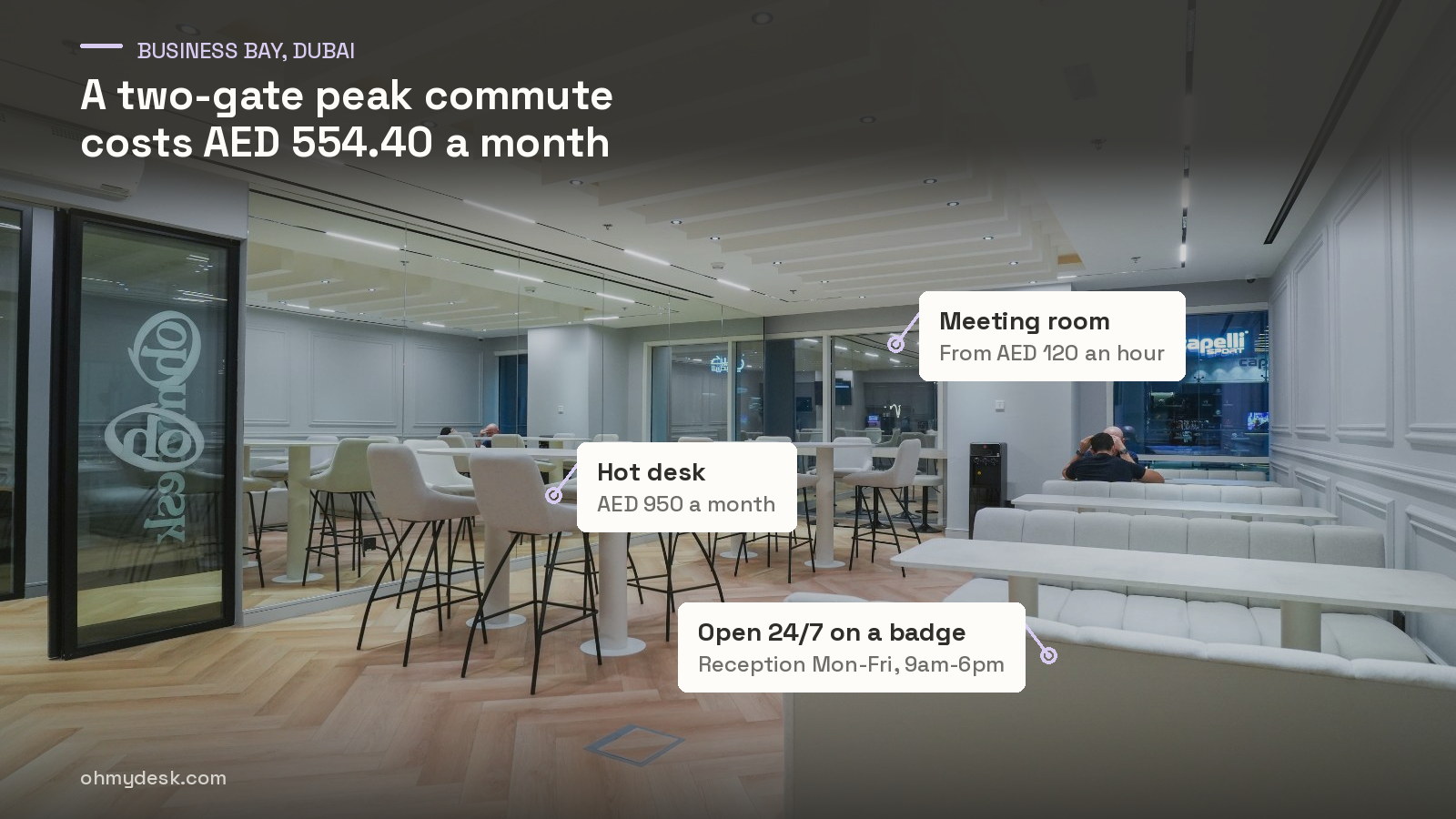
| Two gates | AED 554.40 | AED 369.60 | AED 184.80 |
| Three gates | AED 831.60 | AED 554.40 | AED 277.20 |
| Two gates, over a year | AED 6,652.80 | AED 4,435.20 | AED 2,217.60 |
The number that stops people is the second row. AED 554.40 a month of tolls, for a two-gate route driven at rush hour, is 58% of what a hot desk costs at Oh My Desk — AED 950 a month, which buys the desk, the address and an hour of meeting room. The toll buys the road. Neither figure includes fuel, parking or the hour.
How much does arriving one hour later save?
AED 184.80 a month on a two-gate route, and AED 2,217.60 a year. That is the whole of the difference column above, and it is bought with nothing but a clock. Peak ends at 10am and restarts at 4pm. Cross at 10:05 and leave at 3:45 and every crossing in that day is billed at AED 4.20.
The catch, and it is a real one
Almost nobody can do this from a fixed desk in a leased office: the lease does not care what time you arrive, but your employer and your meetings do. It is a saving available to people whose working day is theirs to place — founders, freelancers, remote employees, anyone whose office is a membership rather than a commute slot.
If you only need to be in Dubai some days the shape changes again: a day pass is AED 120, and four of those a month with off-peak crossings costs less in tolls than one month of rush-hour driving. The membership maths is side by side in our guide to the cheapest coworking spaces in Dubai, compared.
What does the Salik tag itself cost?
AED 100 for the tag, of which AED 50 is credit on the account — so the activation fee is AED 50, and with VAT since 1 June 2026 that fee is AED 52.50. Buying online adds a further AED 20 handling charge. The tag goes on the inside of the windscreen and is read as you pass; nothing is paid at the gate itself.
Two things about the balance catch people out. It is not refundable and not transferable, so topping up heavily before selling a car is money left behind. And it sits on the account for up to five years, long enough to forget it exists.
On an arrival checklist the tag is one of the cheap items. The expensive one is the licence itself, costed in our guide to a Dubai driving licence; this article repeats none of its figures.
What are the Salik fines, and why is AED 50 the dangerous one?
Because it is charged per day, not per offence. Pass a gate without enough balance, fail to top up within the grace period, and the fine is AED 50 — one violation per day, per vehicle, until you fix it. Thirty days of not noticing is AED 1,500, which is nearly three times the two-gate monthly toll it was meant to cover.
| Violation | Fine | How it is counted |
|---|---|---|
| Insufficient balance, not topped up in time | AED 50 | One per day, per vehicle |
| No registered tag, first offence | AED 100 | One per day, per vehicle |
| No registered tag, second offence | AED 200 | One per day, per vehicle |
| No registered tag, third and after | AED 400 | One per day, per vehicle |
| Tampering with a tag, or damaging Salik equipment | AED 10,000 | Per offence |
The grace period is where the sources part company, and we would rather say so than pick the comfortable one. Both government portals say the account must be recharged within five days; two Dubai newspapers say five working days, which on a Monday-to-Friday week is up to seven calendar days. Budget on five. A new vehicle has ten days from its first trip to carry a registered tag before the AED 100 starts.
Can a business reclaim the VAT on Salik?
In principle yes, on the usual conditions. Input VAT is recoverable where the expense was incurred in the course of making taxable supplies, where proper supporting evidence exists, and where no specific restriction applies — the general test, not a Salik-specific concession. On a two-gate peak commute the VAT component is AED 26.40 a month: real, but not a reason to redesign anything.
The documentation is the harder half. A Salik account statement is not automatically a tax invoice, and a toll crossed in a private car on a private errand is not a business expense however it was paid. Whether your own records clear that bar is a question for whoever files your returns, not for a blog — we are not tax advisers and this is not tax advice. The wider machinery of UAE invoicing, and the dates attached to it, we covered in our guide to UAE e-invoicing; none of its figures are repeated here.
What do Salik’s own numbers say about who pays?
The operator is listed and reports every quarter, so the split between the two rates is public. In the first quarter of 2026 — the most recent published quarter, and the last one before VAT — 53.7 million crossings were charged at AED 6 and 75.9 million at AED 4, out of 197.2 million trips through the gates in total. Revenue was AED 728.9 million and net profit AED 369.3 million, on 2.8 million active registered accounts.
Three things fall out of those lines, and nobody publishes them:
| What the published lines give | Q1 2026 |
|---|---|
| Crossings billed at one of the two rates | 129.6 million |
| Share of billed crossings at the cheaper rate | 58.6% |
| Toll value of those two lines | AED 625.8 million |
| Average billed crossing | AED 4.83 |
| Trips not billed at either rate | 67.6 million — 34.3% |
One trip in three through a Salik gate is not billed at either rate. Across the whole of 2025 the same two published lines give 639.1 million chargeable trips out of 852.7 million, so roughly one in four. The free window, the one-hour pairs and the exemptions are not a rounding error on this network; they are a third of it. Which is the strongest argument in this article for moving an arrival time: the people already doing it are the majority of the billed traffic.
How did we check these numbers?
Every tariff, rule and fine here was read on 3 October 2026, and we have said where each one came from rather than blending them.
- Read and used: the Dubai Government road toll page for the bands and the free window; the federal portal for its own, older figure; the Dubai Media Office for the two 2024 gates and the Al Safa one-hour rule, and for the Q1 2026 and FY 2025 operator results; a tax firm’s note for the VAT legal basis; two Dubai newspapers for the VAT-inclusive amounts and the fines.
- Named and excluded:
salik.ae, which returned 403 to every automated read, so no figure in this article is taken from it; and the RTA’s own Salik page, which renders “No content found”. - Left out on purpose: the Al Maktoum Bridge exemption, because two sources disagree; any parking tariff, any driving licence fee and any e-invoicing figure, all of which live in the three articles linked above.
All arithmetic here is multiplication of published figures, checked by script. Where a number is ours rather than an authority’s — AED 554.40, AED 4.83, 34.3% — its inputs are in the sentence beside it.
FAQ: 10 quick answers
Ten questions taken from the Salik keywords measured on the Semrush ae database on
3 October 2026. Our own Search Console carries no toll queries at all — zero impressions on
salik and toll across two consecutive 28-day periods — so none of these come from
our traffic, and we would rather say so than pretend otherwise.
1. How much is Salik in Dubai in 2026? AED 6.30 at peak and AED 4.20 the rest of the day, VAT included. Peak runs Monday to Saturday, 6am to 10am and 4pm to 8pm; everything outside those bands on those days is the lower rate, and Sunday is AED 4.20 all day. Before 1 June 2026 the same crossings were AED 6 and AED 4, which is why older pages still print that pair.
2. What are the Salik peak hours? 6am to 10am and 4pm to 8pm, Monday to Saturday. Those are the two bands charged at AED 6.30; 10am to 4pm and 8pm to 1am are charged at AED 4.20. Sunday has no peak band at all. Note that peak covers Saturday even though the Dubai working week has run Monday to Friday since 2022.
3. Are Salik gates ever free? Yes, between 1am and 6am every day, at every gate. That window is the only network-wide free period; Sunday is cheaper than a weekday peak but it is not free. Two gate pairs also charge only once if you cross both within an hour, which makes the second crossing free rather than the first.
4. How much does a Salik tag cost? AED 100, of which AED 50 is credit loaded onto the account, so the activation fee itself is AED 50 — AED 52.50 with VAT since 1 June 2026. Ordering online adds a further AED 20. The balance is neither refundable nor transferable and stays on the account for up to five years.
5. How many Salik gates are there in Dubai? Ten. Eight older gates — Al Mamzar North, Al Mamzar South, Al Garhoud Bridge, Al Maktoum Bridge, Airport Tunnel, Al Safa, Al Barsha and Jebel Ali — plus Business Bay Crossing on Al Khail Road and Al Safa South on Sheikh Zayed Road, both activated on 24 November 2024.
6. Is Salik charged on Sunday? Yes, at a flat AED 4.20 for the whole day outside the free overnight window. Sunday has no peak band, so a Sunday crossing never costs AED 6.30. This is a change from the old system, under which the day carried different treatment at some gates.
7. What happens if your Salik account runs out? You are fined AED 50, and the fine repeats once a day per vehicle until the account is topped up. Both government portals give five days to recharge before it starts; two Dubai newspapers say five working days. Thirty days of not noticing is AED 1,500, well above the toll it was covering.
8. Do you pay twice at Al Safa North and Al Safa South? No, not if you cross both within one hour. The Dubai Media Office set out a one-time toll fee for trips between the two Al Safa gates inside an hour, and the same single-charge treatment applies to the Al Mamzar pair. Stop for longer than an hour between them and the second crossing is billed.
9. Is there VAT on Salik? Yes, 5%, since 1 June 2026, on gate usage fees and on tag activation fees. The legal basis is Federal Decree-Law No. 8 of 2017 on Value Added Tax, as amended, with its Executive Regulations. Public parking tariffs took the same treatment on the same date.
10. Can you claim Salik back as a business expense? The VAT on it may be recoverable on the normal conditions — incurred for taxable supplies, proper evidence held, no specific restriction — but a Salik statement is not automatically a tax invoice and a personal trip is not a business expense. On a two-gate peak commute the VAT component is AED 26.40 a month. Ask whoever files your returns; we are not tax advisers.
What to do next
Three things to do with this. Work out how many gates your actual route crosses, not how many exist — most Dubai commutes meet one or two, and the Al Safa pair counts as one. Multiply by 44 crossings a month and by AED 6.30 or AED 4.20, and you have a real number instead of a vague sense that tolls add up. Then look at the AED 2.10 gap: if your day is yours to place, moving your arrival past 10am and your departure before 4pm is worth AED 2,217.60 a year on a two-gate route, and costs nothing.
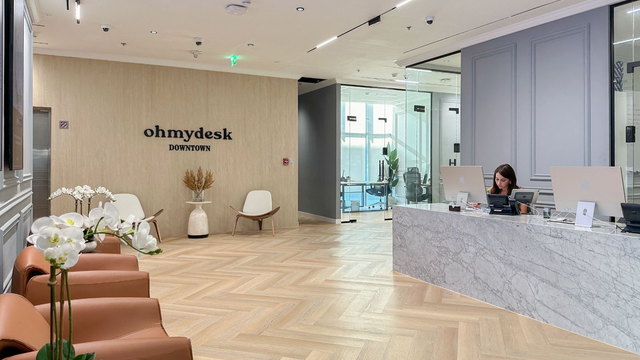
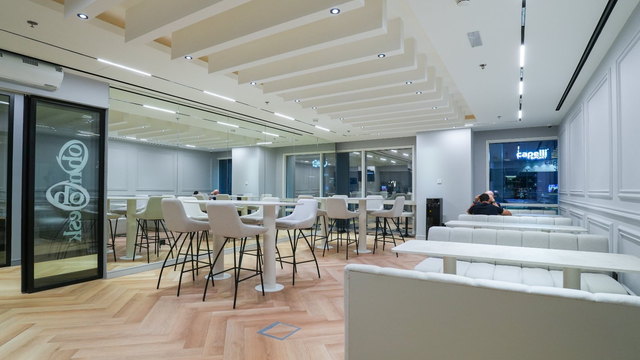
That last move needs somewhere to work that does not mind what time you walk in. Ours do not: a hot desk is AED 950 a month with an hour of meeting room, access is 24/7 on a badge, and reception is open Monday to Friday, 9am to 6pm. If you drive in only occasionally, a day pass is AED 120. Book a free tour at Downtown or Business Bay — and our Dubai Design District address has been open since 1 October 2026.