
How much does health insurance cost in Dubai in 2026?
The cheapest legal cover you can actually buy in Dubai is published at AED 630 to AED 826 a year — and only people earning AED 4,000 a month or less may buy it. Everyone else starts near AED 1,209 for the same AED 150,000 limit, and a comprehensive individual plan is quoted between AED 3,000 and AED 12,000. The famous AED 320 package is real, but it is not a Dubai product.
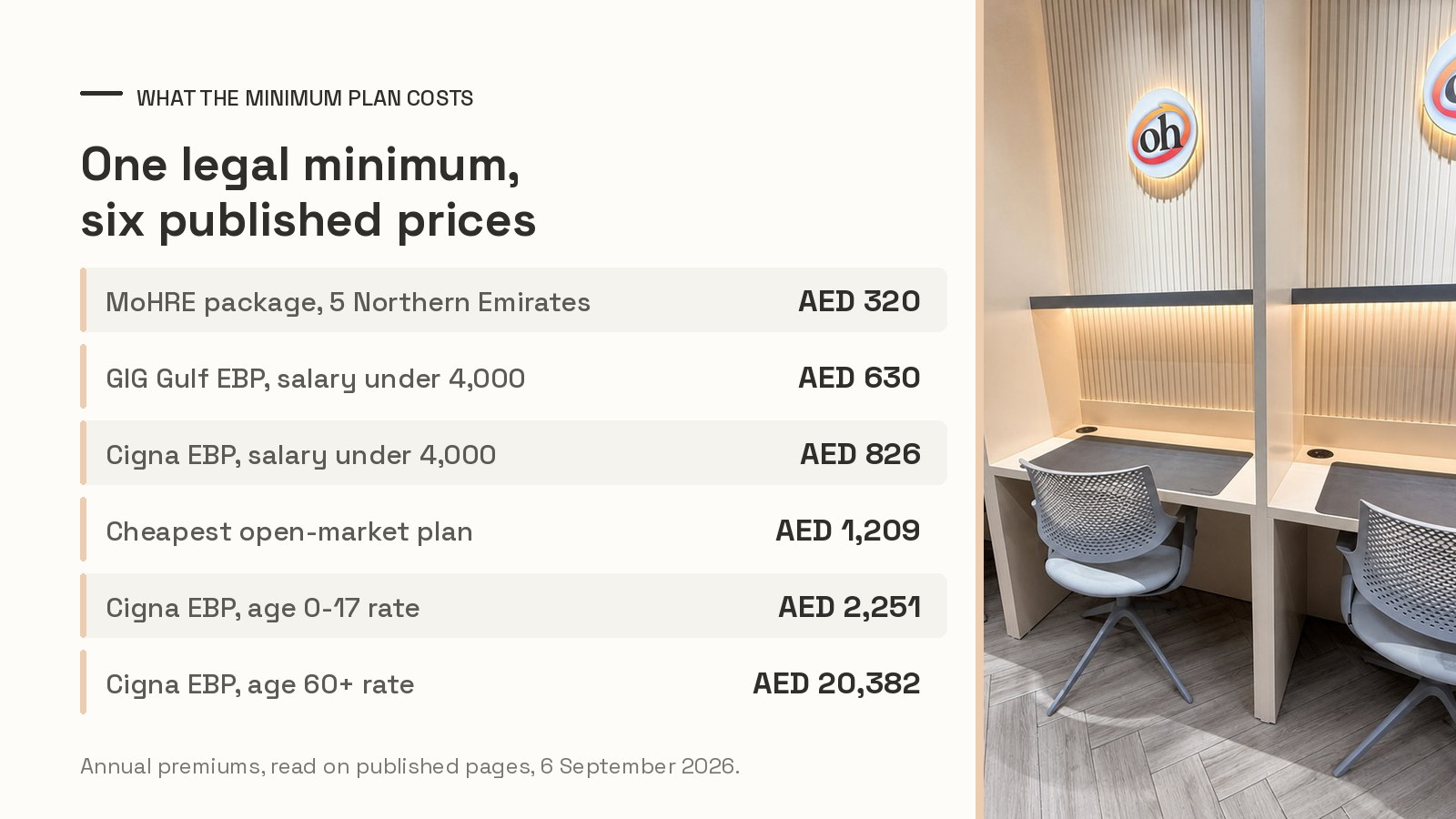
That is the whole problem with this question. Dubai has one legally defined minimum — the Essential Benefits Plan — and no single price for it. The same table of benefits is published at AED 320, AED 630, AED 826.25 and, on one insurer's own rate card, AED 20,382.60. Nothing about the cover changes across that range. What changes is who you are: your emirate, your salary band, your age, and who signs your visa.
Every figure below was read on a published page on 6 September 2026. Three people ask this question — an employee, a founder, a freelancer sponsoring themselves — and get three different answers.
| Minimum-cover plan | Who can buy it | Annual limit | Published price |
|---|---|---|---|
| MoHRE basic package | Private-sector staff and domestic workers in the five Northern Emirates | not published | AED 320 / year |
| GIG Gulf Essential Benefits Plan | Dubai visa, salary AED 4,000 or less | AED 150,000 | AED 630 / year, before VAT and levies |
| Cigna Essential Benefits Plan, lower salary band | Dubai visa, salary AED 4,000 or less | AED 150,000 | AED 826.25 / year, VAT included |
| Cigna Essential Benefits Plan, age 0–17 rate | anyone on the age-banded card | AED 150,000 | AED 2,251.20 / year |
| Cigna Essential Benefits Plan, age 60+ rate | anyone on the age-banded card | AED 150,000 | AED 20,382.60 / year |
Prices read on the providers' own pages, 6 September 2026. The bottom three rows are the same plan and the same limit.
Read the last three rows again. One plan, one limit, one table of benefits, and a factor of 24.7 between its cheapest and dearest version. Against the AED 320 package the spread is 63.7 times. Dubai health insurance is priced by who is asking, not by what it covers.
Why is the AED 320 basic package not a Dubai price?
Because it was built for the other five emirates. The Ministry of Human Resources and Emiratisation describes its own scheme as a basic package at AED 320 per year for private-sector employees and domestic workers in Sharjah, Ajman, Fujairah, Ras Al Khaimah and Umm Al Quwain, starting 1 January 2025. Dubai and Abu Dhabi are not on that list: both already ran mandatory schemes of their own, Dubai's since 2014.
The federal portal puts the same fact the other way round. From 1 January 2025, it says, "employers are required to purchase health insurance policy as a prerequisite for applying for the issuance or renewal of residency permits", and the system "is implemented on a mandatory basis in Abu Dhabi and Dubai, and will extend to" the five others. The obligation is now federal. The AED 320 answer to it is not.
It is worth knowing what AED 320 buys, because it sets the floor of the market: a network of 7 hospitals, 47 clinics and 44 pharmacies for the entire country, against the "250+ hospitals and clinics" a mid-market Dubai plan advertises. Two government pages even give different counts for it — 46 clinics and 45 pharmacies federally against 47 and 44 at the ministry — which tells you how small it is either way.
One line matters to anyone already here: the mandate "does not apply to employees with work permits issued before 1 January 2024 that remain valid, but will become mandatory when their residency permits are due for renewal."
What is the Essential Benefits Plan, and what does it actually pay for?
It is Dubai's legal floor: the minimum table of benefits every employer must offer. The Dubai Health Authority calls it "the minimum level of coverage that must be offered by all employers" and applies it to "all expatriate workers employed by entities licensed to trade in the Emirate of Dubai or any of its Free Zones". It is not a brand: every licensed insurer sells the same one, and the regulator republishes the table by circular — currently GC 03/2024.
Its annual limit is AED 150,000, which sounds generous until you read the co-payments. Cigna publishes the piece most people miss: the inpatient co-payment carries an aggregate cap of AED 1,000 a year, and the ministry caps the pharmacy co-payment at AED 1,500 a year.
| What you use | You pay | Capped at, per visit | Capped at, per year |
|---|---|---|---|
| Inpatient treatment | 20% | AED 500 | AED 1,000 |
| Outpatient consultation | 20–25% | AED 100 | no cap published |
| Medication | 30% | — | AED 1,500 |
| Emergency | 0% | — | — |
| Dental | 30% | — | AED 500 of cover |
| Maternity, normal delivery | 10% | — | AED 10,000 of cover |
Co-payment rules as published by GIG Gulf, Cigna and MoHRE for the minimum plan, read 6 September 2026. Ranges appear where two providers publish different figures for the same line.
One clause deserves reading before you sign. Chronic conditions carry a six-month waiting period on the commercial version — except, GIG Gulf specifies, for members previously insured in the UAE. The ministry's package applies no waiting period at all. Same legal floor, opposite answer on the clause most likely to affect you.
Who is allowed to buy the Essential Benefits Plan?
Almost nobody reading this. Both insurers publish the same gate: GIG Gulf sells it to "individuals holding a Dubai visa and earning AED 4,000 or less" and asks for a labour contract proving it; Cigna prices its lower salary band for people "earning AED 4,000 or less" and asks for "the employee contract of a sponsor who earns less than AED 4,000".
Two consequences follow. The first is that the cheap number is a salary test, not a product test. If you earn AED 12,000 a month, no insurer will sell you the AED 826 version; you will be quoted the same table of benefits at your age-banded rate, the AED 2,251.20 to AED 20,382.60 column on the same page.
The second is that a labour contract is part of the test. A founder on a partner or investor visa does not have one, and neither does a freelancer sponsoring themselves. Neither can buy the cheapest legal plan whatever they earn — which is why the price a founder is quoted has almost nothing to do with the figures circulating on expat forums. Our guide to the freelance visa route in Dubai sets out where insurance sits in the sequence.
What does the same minimum plan cost if you earn more than AED 4,000?
Individual cover in Dubai starts at AED 1,209 a year and climbs to about AED 15,000. Here is what the largest UAE comparison site quoted on 6 September 2026, with each plan's annual limit beside it — the limit is the only thing that makes two premiums comparable.
| Insurer and plan | Annual cover | From |
|---|---|---|
| Takaful Emarat — ECARE BLUE | AED 150,000 | AED 1,209 |
| Orient Takaful — Plan 5 | AED 1,000,000 | AED 1,561 |
| RAK Insurance — Nextcare RN3 | AED 1,000,000 | AED 1,617 |
| Orient Insurance — Health Plus Plan 5 | AED 1,000,000 | AED 1,617 |
| Dubai Insurance — Value N4 | AED 250,000 | AED 2,114 |
| Adamjee — NAS WN | AED 1,000,000 | AED 2,509 |
| Cigna — Healthguard Regional | AED 2,750,000 | AED 11,634 |
| Sukoon by Bupa — Select | AED 6,239,000 | AED 14,967 |
Annual premiums, quoted as "starting from", read on PolicyBazaar UAE on 6 September 2026. A starting price assumes the youngest, healthiest applicant.
Every one of those is a "from" price — the quote for the healthiest twenty-something in the pool. Cigna's age card shows what the curve does to it: AED 2,251.20 at ages 0–17 against AED 20,382.60 at 60 and over, on the identical plan. Age, not cover, is the dominant variable in a Dubai quote, and no comparison table shows it until you enter a date of birth.
Does more cover always cost more?
No, and the published prices say so flatly. Dubai Insurance's Value N4 gives AED 250,000 of cover from AED 2,114. Orient Takaful's Plan 5 gives AED 1,000,000 — four times as much — from AED 1,561, 26% less money. Same market, same day, and the smaller plan is the dearer one. Divide each premium by the cover it buys and the ranking inverts.
| Plan | Annual cover | From | Cost per AED 1,000 of cover |
|---|---|---|---|
| Orient Takaful — Plan 5 | AED 1,000,000 | AED 1,561 | AED 1.56 |
| RAK — Nextcare RN3 | AED 1,000,000 | AED 1,617 | AED 1.62 |
| Sukoon by Bupa — Select | AED 6,239,000 | AED 14,967 | AED 2.40 |
| Cigna — Healthguard Regional | AED 2,750,000 | AED 11,634 | AED 4.23 |
| Essential Benefits Plan, lower salary band | AED 150,000 | AED 826.25 | AED 5.51 |
| Takaful Emarat — ECARE BLUE | AED 150,000 | AED 1,209 | AED 8.06 |
| Dubai Insurance — Value N4 | AED 250,000 | AED 2,114 | AED 8.46 |
Our arithmetic, from the published premiums and limits in the table above. Read 6 September 2026.
The best value per dirham insured is the AED 1,000,000 plan mid-list, at AED 1.56 per thousand against AED 8.46 at the bottom — a spread of 5.4 times. The limit is not what you are paying for. You are paying for the network, the co-payment table, the direct-billing list and the waiting periods, none of which appears in a headline price.
Who has to pay: your employer, your sponsor, or you?
Dubai answers this in one sentence and quietly leaves half the household out of it. The employer covers the employee; the sponsor covers everyone else. If you are the employee and the sponsor — most people who move a family here — you pay twice.
If you are employed in Dubai
Your employer must provide cover meeting at least the Essential Benefits Plan — in stages since October 2014 for companies of 1,000 or more, July 2015 for 100 to 1,000, and June 2016 for everyone else. Your employer may not bill you for it: charging a beneficiary the cost of enrolment carries AED 10,000 per beneficiary, plus a refund.
If you sponsor a spouse or children
This is the gap. Employers are encouraged but not required to cover dependants, and "as their sponsor it will be your responsibility to arrange cover". A family of four on one salary usually means one policy paid by a company and three paid by you — the three priced on the age-banded card.
If you employ someone at home
A domestic worker's cover is the sponsor's responsibility, in the same words — the case the AED 320 package was designed for, and the one where the emirate changes the number most.
If you are a freelancer or self-sponsored founder
Nobody else will do it. You are your own sponsor, you have no labour contract, and the salary-band plan is closed to you. Budget the individual rate for your age. If your address and licence are still being arranged, the Ejari and address package lands before the visa file moves — our guide to how Ejari works in Dubai sets out the order.
What do the co-payments really add to the bill?
They roughly triple the cost of the cheapest plans, and the caps let you calculate how much. On the ministry's AED 320 package, a bad year costs the premium plus the AED 1,000 inpatient cap plus the AED 1,500 pharmacy cap: AED 2,820 before a single outpatient co-payment. The premium is 11.3% of that. On the Cigna lower-band plan the same arithmetic gives AED 3,326.25, four times its premium.
| Minimum plan | Premium | Inpatient cap | Pharmacy cap | Worst case |
|---|---|---|---|---|
| MoHRE basic package | AED 320 | AED 1,000 | AED 1,500 | AED 2,820 |
| Essential Benefits Plan, lower salary band | AED 826.25 | AED 1,000 | AED 1,500 | AED 3,326.25 |
Our arithmetic, from the caps published by MoHRE and Cigna. Outpatient co-payments are on top: they are capped per visit, not per year.
That is the honest way to compare a cheap plan with an expensive one: work out your worst case, not your premium — the exercise we ran on the annual cost of a desk in Dubai, where the monthly price is also not the bill.
What happens if nobody buys the policy?
Dubai fines the sponsor AED 500 for every month of delay, per uninsured person, with any part of a month rounded up to a whole one. It is not folklore: it is violation 6 of Schedule 2 of Executive Council Resolution No. (7) of 2016, on the emirate's own legislation portal.
| What went wrong | Fine |
|---|---|
| Failing to enrol a person in the scheme | AED 500 per month of delay, per person |
| Charging the insured person the cost of their enrolment | AED 10,000 per beneficiary, plus a refund |
| Denying a beneficiary access to their policy | AED 50,000 |
| Providing health benefits illegally | AED 5,000, plus the cost of the benefits |
Selected fines from Schedule 2 of Executive Council Resolution No. (7) of 2016, read on the Dubai Legislation portal, 6 September 2026.
Twelve months uninsured is therefore AED 6,000 in fines with nothing to show for it — twice the AED 3,000 floor of a comprehensive plan, five times the AED 1,209 minimum one. The arithmetic fails before anyone falls ill. And the enforcement point is simpler than the fine: since January 2025 a valid policy is a prerequisite for issuing or renewing the residence permit. Without it, the file stops.
What does a family of four pay in Dubai?
Between AED 6,200 and AED 28,000 a year on the published bands, against AED 3,000 to AED 12,000 for one comprehensive adult. Four people cost roughly two to two and a half times one, not four times, because children are priced far below adults — ages 0–17 at AED 2,251.20 against AED 20,382.60 at 60 and over, on Cigna's identical plan.
Two notes for anyone budgeting a move. The basic band in Dubai runs from AED 725 to AED 5,945, a very wide definition of "basic": the word tells you nothing, the table of benefits tells you everything. And the same band in the Northern Emirates starts at AED 340 — that gap is the AED 320 scheme showing through. If your employer is licensed in Sharjah and you live in Dubai, ask which scheme your policy sits in before you assume anything about your network.
School is the other bill that lands in the same quarter as a move, and we priced it separately in what a year of Dubai school actually costs in 2026-27.
When do you actually need the policy in hand?
Before the residence file is submitted, not after. Since 1 January 2025 the policy is a prerequisite for issuing or renewing the permit, which puts it alongside the medical fitness test, not at the end with the Emirates ID card.
The medical test is a separate obligation and insurance does not waive it. Everyone aged 18 and above must be screened and be free of communicable diseases such as HIV and tuberculosis, and some occupations carry extra tests — nursery staff, domestic workers, food handlers, salon staff and health-club staff must also test negative for syphilis and hepatitis B. Abu Dhabi requires a chest X-ray for tuberculosis screening; Dubai does not.
The practical order is entry permit, then medical test and insurance in parallel, then Emirates ID and stamping. Insurance is the one piece you can arrange from abroad, and the one most people leave until last.
How do you keep the bill down without breaking the rule?
Three things, in the order they save the most money.
Do not let cover lapse between two jobs. The six-month waiting period on chronic conditions is waived for members previously insured in the UAE. A one-month gap can cost you six months of exclusions on the exact condition you bought the policy for. It is the most expensive mistake on this page.
Compare per dirham of cover, not per premium. The table above shows a 5.4-fold spread on that measure, and the worst ratio is not on the cheapest plan.
Ask for the table of benefits before the price. Every insurer selling the legal minimum sells the same table, so a lower quote there is a lower quote on an identical product. A lower quote on a comprehensive plan usually means a smaller network or a harder co-payment. The two look the same on a comparison page and are not.
FAQ: 10 quick answers
1. How much does health insurance cost in Dubai? The cheapest legal plan is published at AED 630 to AED 826.25 a year, but only for people earning AED 4,000 a month or less. Above that salary the same minimum cover starts near AED 1,209, and a comprehensive individual plan is quoted between AED 3,000 and AED 12,000 by age and network. Each is a "starting from" price for the youngest applicant.
2. Is health insurance mandatory in Dubai? Yes, and it has been since 2014 for employees of any entity licensed to trade in Dubai or its free zones. Since 1 January 2025 the rule is federal too: a valid policy is a prerequisite for issuing or renewing a residence permit. Work permits issued before 1 January 2024 and still valid sit outside the mandate until renewal.
3. What is the AED 320 health insurance package? It is MoHRE's basic package for private-sector employees and domestic workers in Sharjah, Ajman, Fujairah, Ras Al Khaimah and Umm Al Quwain, launched on 1 January 2025. It is not sold in Dubai or Abu Dhabi, which already had their own mandatory schemes. Its network is 7 hospitals, 47 clinics and 44 pharmacies nationwide.
4. What is the Essential Benefits Plan in Dubai? It is the legally defined minimum cover every Dubai employer must provide, with an annual limit of AED 150,000. Every licensed insurer sells the same table of benefits, republished by the regulator as circular GC 03/2024. The premium varies by insurer, salary band and age; the cover does not.
5. Who pays for health insurance in Dubai, the employer or the employee? The employer pays for the employee and may not bill them for it — charging a beneficiary the cost of enrolment carries AED 10,000 per beneficiary plus a refund. Dependants are different: employers are encouraged but not required to cover them, so the sponsor pays for a spouse and children.
6. Does my employer have to insure my wife and children? No. The Dubai Health Authority states that employers are encouraged but not obliged to cover dependants, and that as their sponsor the responsibility is yours. In practice a family of four on one salary usually means one company-paid policy and three paid privately, at age-banded rates.
7. What is the fine for not having health insurance in Dubai? AED 500 per month of delay, for every uninsured person, with part of a month rounded up to a full month. It comes from Schedule 2 of Executive Council Resolution No. (7) of 2016. A full year uninsured is AED 6,000, about five times the cheapest compliant plan on the open market.
8. Can a freelancer or self-sponsored founder buy the cheap plan? No. Both insurers that publish the Essential Benefits Plan require a labour contract showing a salary of AED 4,000 or less, and a self-sponsored resident has no labour contract. You buy on the individual market at your age-banded rate, which is why quotes from friends on company visas will not match yours.
9. Do I still need a medical fitness test if I have insurance? Yes, they are separate requirements. Everyone aged 18 and above must be screened and must be free of communicable diseases such as HIV and tuberculosis, and several occupations carry extra tests for syphilis and hepatitis B. Abu Dhabi requires a chest X-ray for tuberculosis; Dubai does not.
10. Does a bigger annual limit cost more in Dubai? Not reliably. On prices published in September 2026, a AED 1,000,000 plan starts at AED 1,561 while a AED 250,000 plan starts at AED 2,114 — four times the cover for 26% less money. Compare the cost per AED 1,000 of cover, then compare the networks and co-payment tables, which is where the real difference sits.
How these questions were chosen: Search Console holds no health-insurance queries for this site — a filtered sweep of the 28 days to 4 September 2026 returned none — so the ten above are built from the keyword Semrush actually measures on the UAE database, health insurance dubai cost at 590 searches a month, and from the questions the regulators answer on their own pages. None is invented.
The short version of what health insurance costs in Dubai
One legal minimum, no single price. The Essential Benefits Plan is the same table of benefits for everyone in Dubai, published at AED 630, AED 826.25 and AED 20,382.60 by salary band and age, while the AED 320 package everyone quotes belongs to five other emirates. Above the AED 4,000 line the market opens near AED 1,209, and the best value per dirham insured sits mid-range, not at the bottom.
Do one thing after reading this: work out your worst case — premium plus the AED 1,000 inpatient cap plus the AED 1,500 pharmacy cap — before comparing two quotes. And if you are still assembling the rest of the file, come and see where you will work while you do it. Book a tour of the three addresses — Downtown, Business Bay, and the Design District. The visit is free, coworking starts at 950 AED a month with an hour of meeting room included, and a private office starts at 6,000 AED. If the address is what your file waits on, the Ejari package is 8,000 AED a year. And if the policy you are pricing is for a domestic worker rather than yourself, the permit conditions are in our guide to the Dubai maid visa.