Does Dubai require every business to install CCTV?
No. The obligation Dubai writes down falls on a named list of activities, on the building as a whole, and on public events — not on every holder of a trade licence. Article 24(a) of the Implementing Bylaw of Law No. (12) of 2016 says “Vital Sectors, Major Compounds, and Public Events must satisfy the security requirements” set out in the Preventive System Manual. Those three terms are defined, and they are the whole of the duty.
The sentence most often repeated about CCTV in Dubai is the opposite one. Of the three commercial guides we opened on 26 October 2026, one says compliance is “mandatory for all businesses in Dubai”, a second that “every commercial building must install a SIRA-approved CCTV system”, the third that the rules “apply across commercial Dubai”. None quotes article 24, and whether its list covers you decides whose budget line this is.
Which premises does Dubai actually name?
Article 24(b) names the Vital Sectors one by one, and the list is long, specific and striking for what it leaves out. It runs from hotels to banks, gold dealers to shooting ranges, warehouses to restaurants, taking in SIM card shops, internet outlets, fuel stations and places of worship on the way. The word “office” does not appear in it.
| Named in the Bylaw | Named in the Bylaw | Named in the Bylaw |
|---|---|---|
| Hotels and lodging | Banking and financial institutions | Precious metals and gem dealers |
| Shopping and entertainment centres | Large and diverse retail stores | Luxury goods outlets |
| Warehouses | Fuel stations | Vehicle rental shops |
| SIM card shops | Internet outlets | Electronic gaming venues |
| Shooting ranges and hunting shops | Armoured-vehicle workshops | Places of worship |
| Labour accommodation | Nightlife venues | Restaurants |
The Agency may designate other sectors, so the list is not frozen; but it is a list of activities, and reading it is the test. If what you do is on it, the rules are yours. If not, the only route to you is the second term, Major Compound: “a compound of residential or office units, including buildings, towers, and villa compounds”.
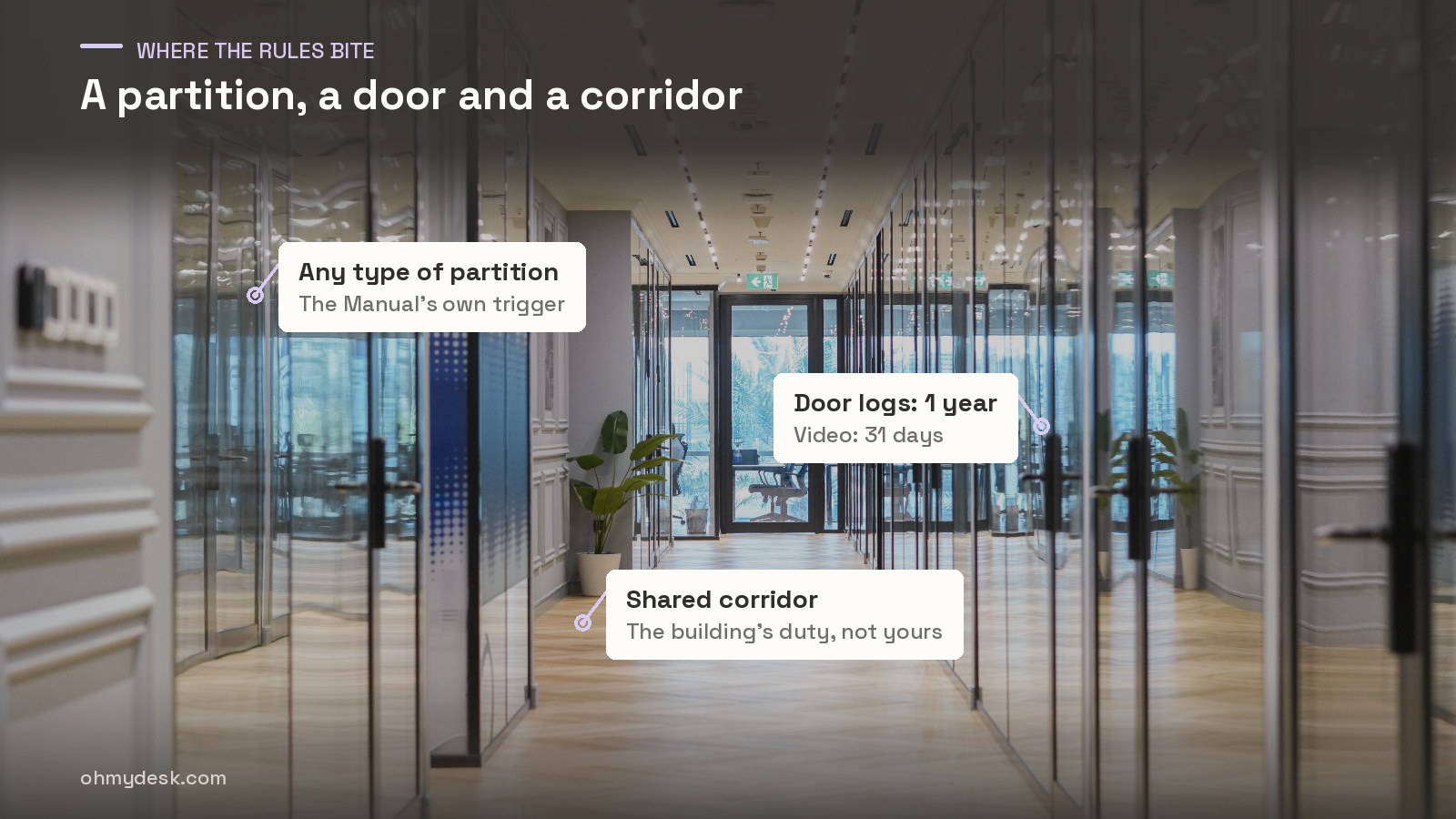
That is the building, not the tenant. SIRA's Security Conditions and Requirements of the Important complexes, version 4.0 of 14 February 2022, reads that way throughout: cameras at entrances, lobbies, reception desks, inside the lifts with “an angle that shows the floor number”, in corridors and car parks; a 24/7 guard mandatory for commercial and mixed-use buildings, with an office and a toilet provided for him. Those are landlord duties, and the camera at your lift door is not yours to buy.
What does the Manual say about flexible offices and business centres?
It names flexible offices, virtual offices and business centres in those words, and tells them they have no security requirements provided they hold nothing valuable. The passage is on page 74 of the Manual approved by Administrative Resolution No. (13) of 2025 of 14 April 2025, in the chapter on the precious metals trade. Three conditions: no exhibits kept, no safe used for valuables, no valuables stored. Then the verdict: “There are no security requirements if the above requirements are adhered to.” The business-centre entry repeats both.
Two further sentences deserve attention. The trigger: “If the offices are separated by any type of partition, the above office requirements apply.” Any partition — the Manual does not qualify it — moves a flexible office out of the nil-requirement box. And the switch the other way: keep or display precious metals and “the requirements for commercial stores apply”.
Be careful how far the carve-out travels. We read it where the Manual states it, in a chapter about one trade, and the Manual runs to 140 pages our tooling could not read whole. What is beyond argument is narrower and still useful: Dubai's rulebook knows flexible offices and business centres exist, and conditions their obligations on what is kept on the premises rather than on holding a licence.
From a coworking desk or a private office inside an operator's floor the chain is simple: the building answers for the building, the operator for its floor, you for whatever you install inside the space you rent. At our Business Bay, Downtown and Dubai Design District addresses the corridor cameras are ours and the building's.
Does Dubai require 4K cameras?
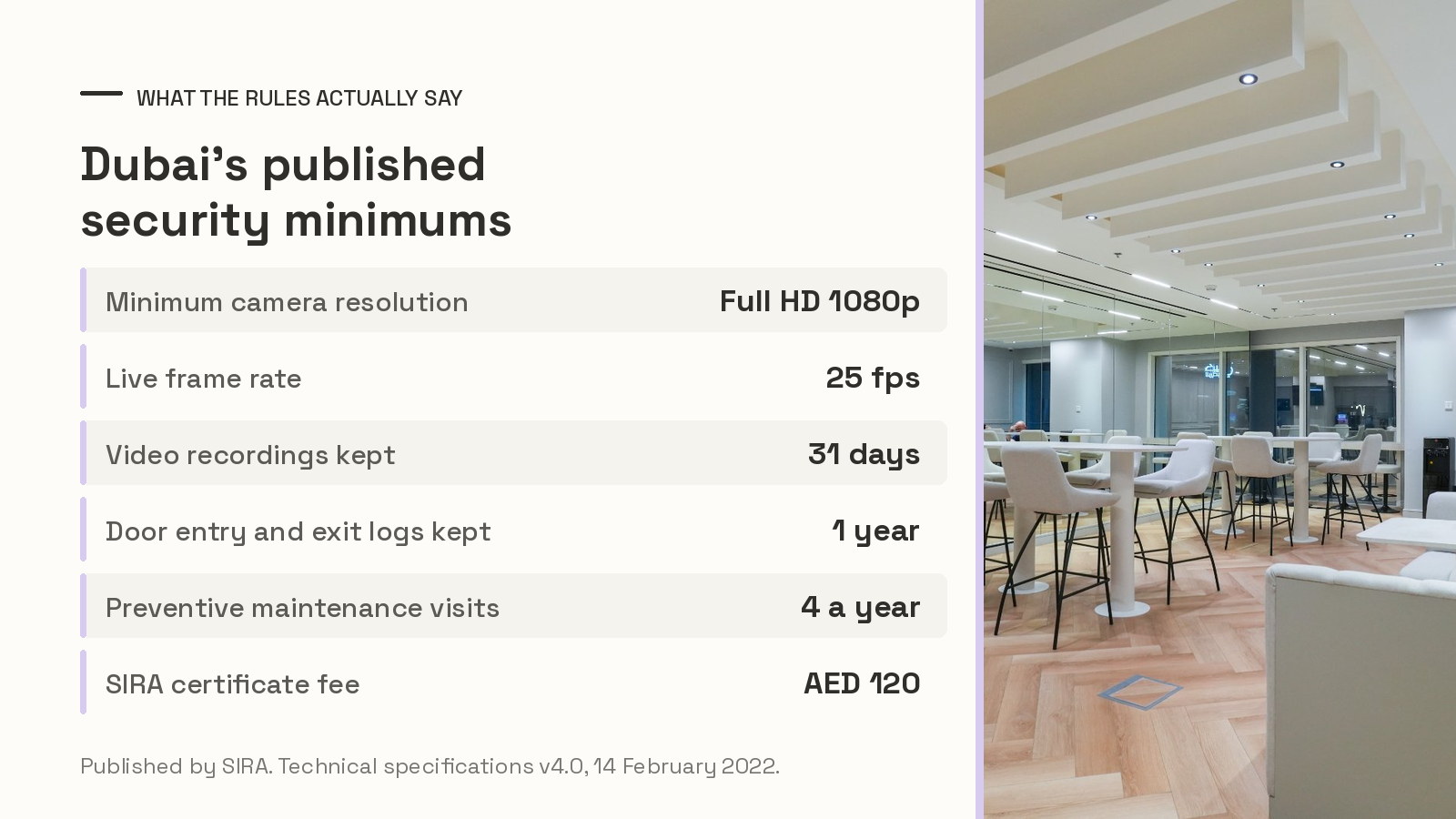
No. The published specification asks for Full HD 1080p as the minimum for both analogue and IP cameras, and 4K appears nowhere in it as a floor. The document is SIRA's Standard and Technical Specifications of the Security Systems, version 4.0, released 14 February 2022, written against Law No. 12 of 2016 and the 2018 Implementing Regulation. It is free to download.
One guide tells businesses to “use minimum 4K cameras”, at 3840 × 2160: 8.3 megapixels against the 2.1 the specification asks for — four times the pixel count on every camera, with the storage and bandwidth that follow. The same document says a car park requirement “can be decreased by installing 4 MP cameras at height of 6 meters”: higher resolution buys you out of a requirement, it is not the requirement.
What it polices closely is not sharpness but what the picture lets you do: seven viewing categories set by the share of screen a person occupies — identification at 120% and 300 pixels per metre, recognition at 50%, detection at 10% — each with a capped angle. A 4K camera at the wrong angle fails; a 1080p camera placed correctly passes.
How long must footage be kept, and what else does the specification fix?
Not less than 31 days for video, and at least one year for the door logs — the entry and exit records outlive the pictures by eleven months. Both numbers sit in the same technical specification, a few pages apart, and we have not seen the second quoted anywhere.
| Requirement | Published minimum |
|---|---|
| Camera resolution, analogue and IP | Full HD 1080p |
| Live frame rate | 25 fps per camera |
| Frame rate while recording an event | 10 fps per camera |
| Video recordings kept | not less than 31 days |
| Recording duty cycle | not less than 70% of the day, per camera |
| Pre-event recording | at least 10 seconds before the event |
| Spare storage and network capacity | 20% above the computed need |
| Outdoor camera housing | at least IP66 |
| Access control entry and exit logs kept | at least one year |
| Recorder power backup | UPS for at least 30 minutes |
| Preventive maintenance | not less than 4 visits a year |
| Control-room monitors | at least two per operator, 21 inches or more |
The 31 days is the one number all three guides get right. What none says is where it comes from: not the Law, not the 2018 Bylaw — between them they set no retention period at all — but the technical specification. One guide adds 90 days for high-risk premises; we could not find that figure in the documents we read, so we do not publish it.
The quiet entries matter most. A 70% duty cycle rules out motion-only recording as a way of saving disk, and the one-year door log settles an argument about who opened a door in March, long after the video of it has gone.
What does SIRA charge to certify a security system?
AED 120, and two business days. SIRA's page for New Security System Certification publishes the breakdown as a service fee of AED 100, a knowledge fee of AED 10 and an innovation fee of AED 10. The Security Plans Certification that must precede it costs the same AED 120 and takes three business days. End to end, the government's share of a compliant security system is AED 240 and five business days.
| SIRA service | Service fee | Knowledge fee | Innovation fee | Total | Published time |
|---|---|---|---|---|---|
| Security Plans Certification | AED 100 | AED 10 | AED 10 | AED 120 | 3 business days |
| New Security System Certification | AED 100 | AED 10 | AED 10 | AED 120 | 2 business days |
| Both, for one premises | AED 200 | AED 20 | AED 20 | AED 240 | 5 business days |
The renewal rhythm sits elsewhere. Article 8 of the Bylaw gives a company licence one year, renewable at least 30 days before expiry; article 16 gives an individual's licence two years on the same notice. One guide says “a SIRA CCTV operator licence is typically valid for two years” — the individual's card, not the company's. Follow it and you renew your supplier's paperwork half as often as the Bylaw requires.
Why do three licensed companies stand between you and that certificate?
Because SIRA will not issue it until a security plan has been stamped by two licensed companies and a third has audited the result. The certification page is explicit: the application needs an “Approved Security Plan Certificate (SPC)” and a “Successful Security Audit Report”, and the plan “must be stamped by both the security consultancy company and the security systems installation company”.
Article 3(a) lists 23 licensable security activities; consultancy, installation and inspection are three separate lines. Article 3(b) forbids combining “security system inspection” with any other listed activity except consultancy. Dubai has written the separation of duties into the licence itself: the company that checks your system may not be the one that sold it.
For a tenant that is an ordering problem. Design before installation, installation before audit, audit before certificate — and SIRA adds that the activity “must not begin until a successful security audit report is obtained”. The sequence belongs in the fit-out programme: see what a Dubai office fit-out costs and what moving an office costs.
How big are the fines, and why do they stop at AED 30,000?
The published table runs from AED 1,000 to AED 30,000 across 32 violations and four repeat tiers — and the Law it serves sets a floor of AED 10,000 and a ceiling of AED 500,000. The two do not agree, and the Bylaw explains why.
| Violation, as published | First | Second | Third | Fourth |
|---|---|---|---|---|
| Using the services of an unlicensed security provider | AED 6,000 | AED 12,000 | AED 18,000 | AED 30,000 |
| Using surveillance, recording or eavesdropping devices illegally | AED 10,000 | AED 15,000 | AED 20,000 | AED 30,000 |
| Failure of the user to provide required security measures for vital commercial sectors | AED 15,000 | AED 30,000 | AED 30,000 | AED 30,000 |
| Failure of the user to complete all security requirements for vital commercial sectors | AED 10,000 | AED 20,000 | AED 30,000 | AED 30,000 |
| Failure to comply with using security systems as required | AED 4,000 | AED 8,000 | AED 12,000 | AED 24,000 |
| Failure to record or retain security records | AED 3,000 | AED 6,000 | AED 9,000 | AED 18,000 |
| Failure to renew the certificate of compliance | AED 2,000 | AED 4,000 | AED 6,000 | AED 12,000 |
| Highest figure anywhere in the 32-line table | — | — | — | AED 30,000 |
Article 21(a) of Law No. (12) of 2016 fines a breach “no less than ten thousand Dirhams” and no more than AED 500,000, doubled on repetition within a year, capped at AED 1,000,000. Twenty-four of the 32 first-tier fines SIRA publishes sit below that statutory floor, and the largest figure in the table, AED 30,000, is a sixteenth of the Law's ceiling.
Article 31(b) of the 2018 Bylaw explains it in one clause: SIRA keeps charging fees and collecting fines under the 2008 bylaw — the one that same article repeals — until new ones are approved. The schedule in force predates the floor it is meant to respect. The third guide's “AED 5,000 to AED 50,000” matches neither document.
Can you be fined for your installer's licence?
Yes — violation number 8 is “using the services of an unlicensed security provider”, and it costs the customer AED 6,000 the first time. It doubles to AED 12,000, then AED 18,000, then AED 30,000. The list of 32 violations is on SIRA's own site, free to read, and this is the line a tenant is most likely to meet.
Checking a supplier is self-defence, and cheap: SIRA publishes a searchable directory of licensed providers. Article 2(a) is the rule behind the fine — no person may provide security services in the Emirate without a licence — and article 3(a) is where you check the licence covers what you are buying.
Two other lines target the occupier: failure “of the user to provide required security measures for vital commercial sectors” at AED 15,000, and failure “to complete all security requirements” at AED 10,000. Both are written for the Vital Sectors of article 24(b), which is why that list is worth reading twice.
One oddity, reproduced as published: violation 20 charges AED 18,000 at the third tier and AED 16,000 at the fourth. The fourth offence costs less than the third.
Do you need permission to put a camera inside your own office?
Sometimes, and this is the rule that surprises people most. Article 23(a) lists the activities needing a special licence from SIRA each time, and one is using security devices “in private places, except in private residences” to document evidence of offences. Article 23(b) adds that anyone doing so must also obtain approval from the competent judicial authority or relevant entity. A home is carved out; a workplace is not.
The same article restricts something people do casually: sharing data or images from a security system with anyone not legally authorised to receive them. Forwarding a clip to a landlord, an insurer or a group chat is the behaviour that line is written against, and it sits on the fines table at AED 10,000.
What do the CCTV guides get wrong?
They agree on the one number that is easy to copy and diverge on everything a reader would act on. All three publish 31 days. None publishes a SIRA fee. None mentions the one-year door-log rule, the partition trigger, the nil requirement for flexible offices, or article 3(b)'s separation of inspector and installer.
| Question | Guide A | Guide B | Guide C | What the published texts say |
|---|---|---|---|---|
| Who must install? | “almost any commercial premises” | “mandatory for all businesses in Dubai” | “every commercial building”, offices named | Vital Sectors, Major Compounds and public events (art. 24) |
| Minimum resolution | not stated | not stated | 4K, 3840 × 2160 | Full HD 1080p |
| Retention | 31 days | 31 days | 31 days, 90 for high risk | not less than 31 days |
| Frame rate | not stated | not stated | 25 fps | 25 fps live, 10 fps on event |
| Fine range | “fines”, no figure | “hefty fines” | AED 5,000 to 50,000 | AED 1,000 to 30,000 published; AED 10,000 floor in the Law |
| Licence validity | not stated | not stated | two years | one year for a company, two for an individual |
| Door-log retention | not stated | not stated | not stated | at least one year |
We name the guides A, B and C rather than by brand for one reason: all three sell CCTV installation. A reader who takes the 4K line, the AED 5,000-to-50,000 range and the two-year licence as given over-specifies the hardware, under-estimates the exposure and renews the paperwork at half the required rate. It is the shape we found in Dubai's signage rules two weeks ago.
How did we check these numbers?
Every figure above was read on 26 October 2026 from a primary source, linked where it is used: Law No. (12) of 2016 and its Implementing Bylaw of 2018 on the Dubai Legislation portal; SIRA's Standard and Technical Specifications and Important complexes requirements, both version 4.0, and its Preventive Systems Manual of April 2025; its certification and security plans pages for fees, and its list of violations for fines.
Three things we could not do. The Manual is 140 pages and our tooling read it in sections, so the flexible-office passage is quoted from the chapter where we found it. Two SIRA service pages — equipment and devices certification, and modification of a system certification — returned “page not found” on the day, so no figure here comes from them. And one trade claim, that a connectivity report is demanded at licence renewal, appears on no SIRA page we could read.
One absence is informative. The federal portal's page on security systems describes police technology and says nothing about what a business must install, keep or certify.
FAQ: 10 quick answers
A note on where these come from. Our search data carries zero impressions on cctv, camera, surveillance, sira or alarm across two consecutive 28-day periods, so there are no queries of ours to mine. The questions below come from the keywords measured in the UAE market, led by cctv installation dubai at 720 a month.
1. Is CCTV mandatory for all businesses in Dubai? No. Article 24 of the 2018 Implementing Bylaw puts the duty on named Vital Sectors, on Major Compounds — buildings, towers and villa compounds — and on public events. An ordinary office is on none of those lists, and a building's obligations are performed by the building.
2. How long must CCTV footage be kept in Dubai? Not less than 31 days. The figure is in SIRA's Standard and Technical Specifications, version 4.0 of 14 February 2022 — not in the Law or the Bylaw, neither of which sets a retention period. Access control entry and exit records must be kept at least one year.
3. Does Dubai require 4K CCTV cameras? No. The published minimum is Full HD 1080p for analogue and IP cameras alike. 4 MP cameras appear in the specification as a way of reducing a car park coverage requirement, not as a floor. A guide that calls 4K the minimum asks for four times the pixels the rule does.
4. What does SIRA charge to certify a security system? AED 120 — a AED 100 service fee, a AED 10 knowledge fee and a AED 10 innovation fee — in two business days. The security plan certification that must come first costs another AED 120 over three business days, so the government's total is AED 240.
5. What is the fine for a CCTV violation in Dubai? SIRA's published table of 32 violations runs from AED 1,000 to AED 30,000 across four repeat tiers. Law No. (12) of 2016 sets a higher range, AED 10,000 to AED 500,000, because the table in force is the one inherited from the 2008 bylaw under article 31(b).
6. Can I be fined for hiring an unlicensed CCTV company? Yes. “Using the services of an unlicensed security provider” is violation number 8 and costs the customer AED 6,000 the first time, AED 30,000 on the fourth. SIRA publishes a directory of licensed providers, and the licence must cover the activity you are buying.
7. Do coworking spaces and flexible offices need CCTV in Dubai? The Preventive Systems Manual names flexible offices, virtual offices and business centres, and states there are no security requirements provided no exhibits are kept, no safe is used for valuables and no valuables are stored. Any type of partition between offices switches the office requirements back on.
8. Who installs the cameras in a Dubai office building? The building. SIRA's requirements for important complexes put cameras at entrances, lobbies, lift lobbies, reception desks, inside lifts, in corridors and car parks, and make a 24/7 guard mandatory for commercial and mixed-use buildings. Those are common parts, so the duty is the building's.
9. Can I put a camera inside my own office in Dubai? Using security devices in private places other than private residences, to document evidence of offences, needs a special licence from SIRA under article 23 plus approval from the competent judicial authority or entity. Sharing images with anyone not authorised to receive them is separately restricted.
10. How often must a Dubai security system be maintained? The maintenance contract must provide not less than four preventive visits a year. A company licence in the security industry lasts one year, renewable at least 30 days before expiry; an individual's licence lasts two years on the same notice.
The bottom line
The published version of Dubai's security rules is narrower and more precise than the trade's. The duty is scoped by a list of activities and by the building. The specification asks for 1080p and 31 days. The state's fee is AED 120. The fines in force stop at AED 30,000, under a Law whose floor is AED 10,000.
For a tenant the question usually reduces to one line of the Manual: a flexible office or business centre keeping nothing valuable has no security requirements, and any kind of partition changes that. Find out which sentence describes your floor, and ask your building for its certificate rather than duplicating it.
If you would rather not own the question at all, that is a reasonable answer too. Coworking at Oh My Desk is AED 950 a month and private offices start at AED 6,000 a month, before tax, with member access 24 hours a day and the building's arrangements already in place. Tell us what you are planning. Three neighbouring guides may save a step: what a Dubai shopfront sign permit costs, since sign and camera are permitted by different authorities; what a flexi desk actually is, the category the Manual uses by name; and what a private office costs in Dubai, since the partition is what changes the rules. For the address that comes first, see how Ejari works in Dubai.