Does a business in Dubai have to put a sign on its shopfront?
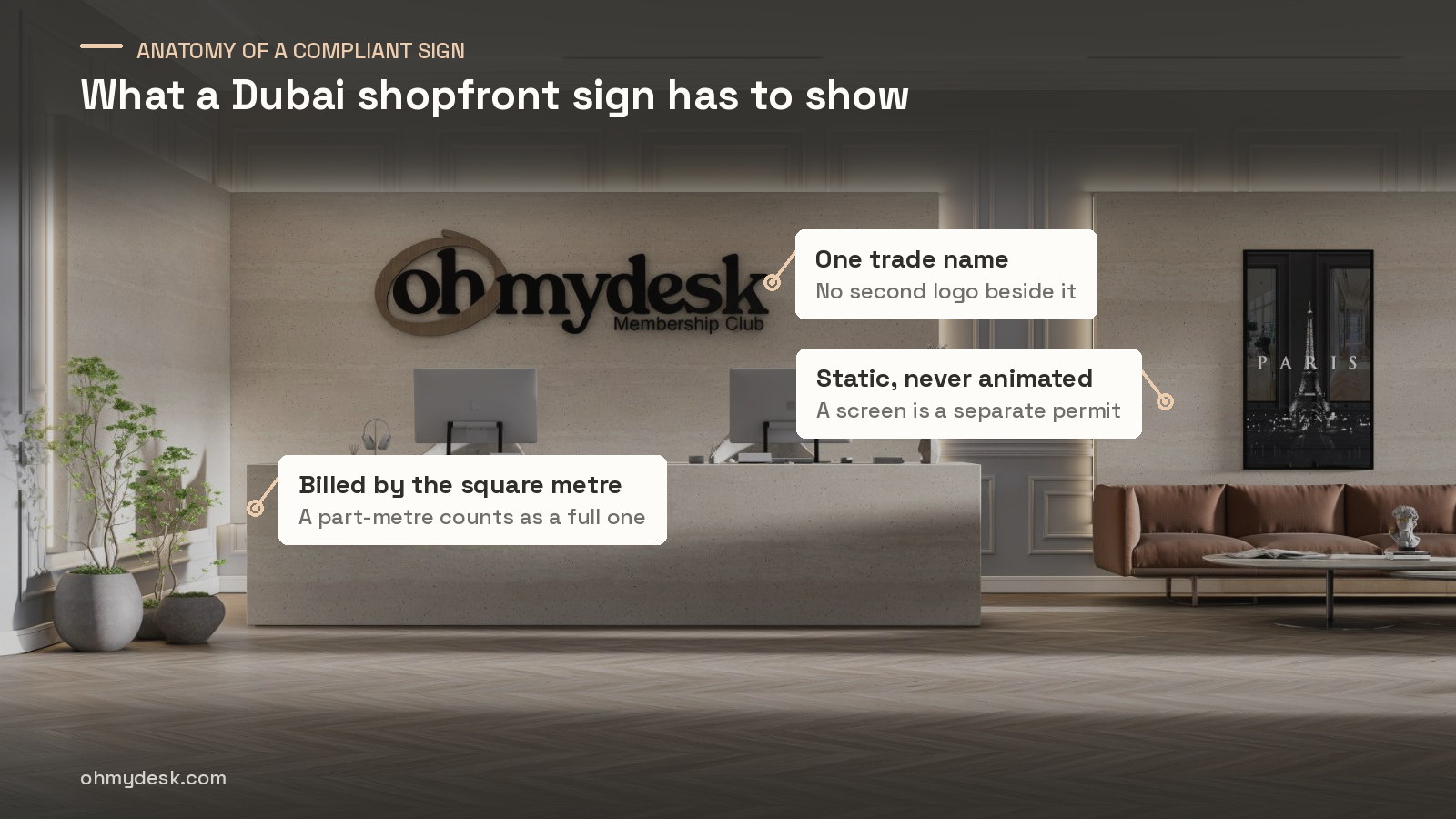
Yes. Article 4(b) of Decree No. (6) of 2020 says a person who conducts an economic activity in Dubai "must display an Advertisement" on the façade of their premises, "stating the type of his activity and his trade name". Article 4(a) adds that no advertisement may be displayed "without first obtaining a Permit". You are required to put the sign up, and to get permission for it.
The decree, issued on 14 February 2020, defines an advertising medium as "boards, fences, pillars, balloons, aircraft, Vehicles, Maritime Vessels, stickers, maps, leaflets, and any other medium", excluding newspapers, websites, radio, television and cinema. A fascia over a door is inside that definition, and so is a sticker on your window. The only relief is on fees, not on the permit: article 16(b) waives fees for national, religious and charitable advertisements proved not to be for profit.
What does a shopfront sign permit cost in Dubai?
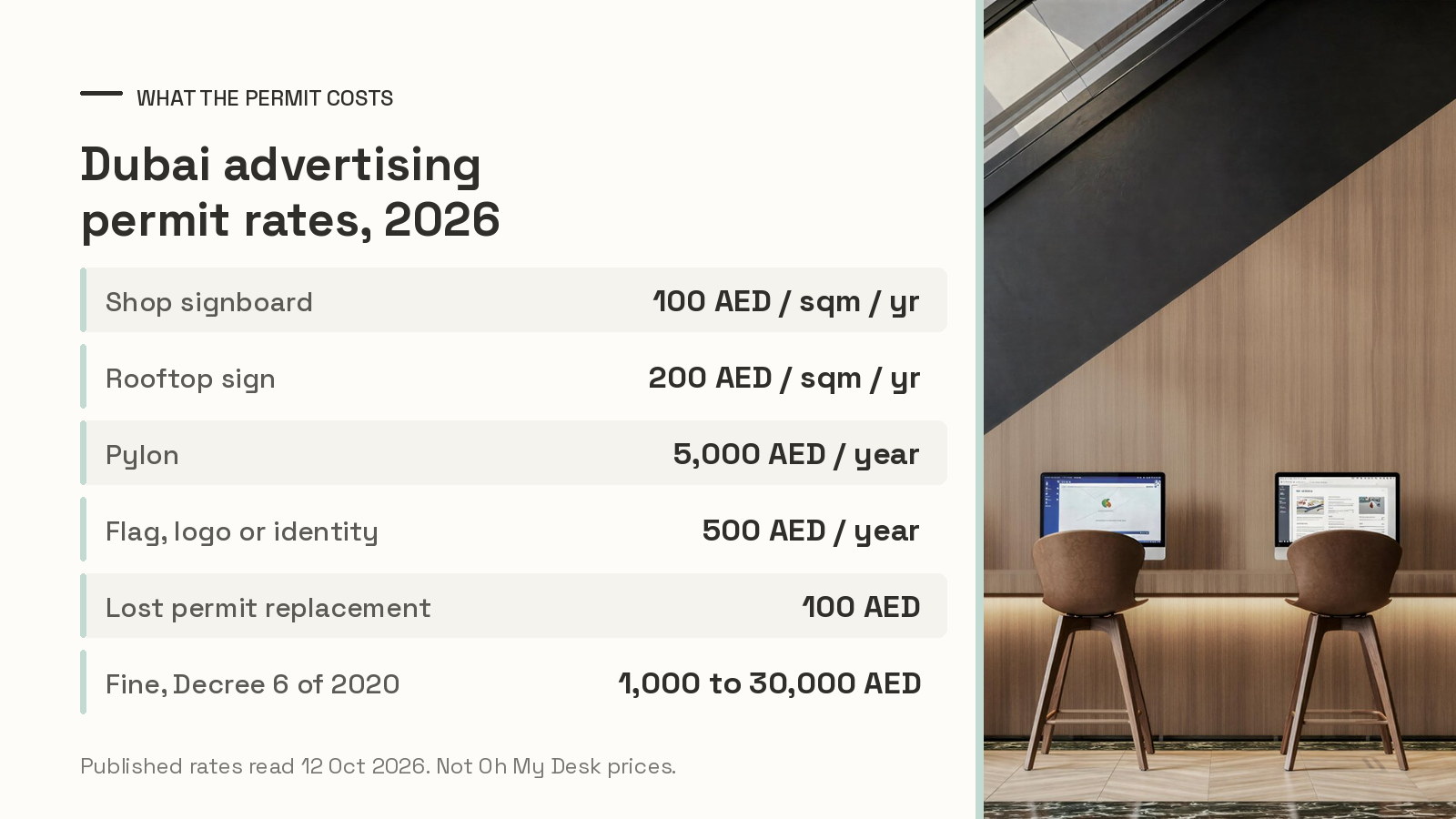
The published rate for the permit covering ground-floor shop signage — the projected signboard — is AED 100 per square metre per year. A rooftop sign on the same building is AED 200, exactly twice as much per metre. Both sit on the service pages of Mada Media, the company Dubai established by law in 2024 to manage advertising spaces and issue permits, and both are annual.
| Permit line | Published rate | Basis |
|---|---|---|
| Projected signboard (ground-floor shop signage) | AED 100 | per sqm, per year |
| Rooftop sign | AED 200 | per sqm, per year |
| Fixed trade-name plate, parking shade stands | AED 500 | per sqm, per year |
| Pylon | AED 5,000 | per year |
| Project sign board | AED 2,000 | per board, per year |
| Logo or trade name on a construction fence | AED 2,000 | per location, per year |
| Flag, logo or identity | AED 500 | per flag, per year |
| Bench or sunshade | AED 2,000 | each, per year |
| Temporary directional board | AED 250 | per board, per week |
| Campaign amendment to an existing board | AED 150 / 300 / 600 | small / medium / large |
| Replacing a lost permit | AED 100 | per occurrence |
These numbers are published and free to read, and almost never quoted: the guides that rank for signage dubai price the aluminium and the LEDs, then leave the permit as a vague range. It is the part that recurs every year.
One caution. Mada Media's index page for building advertising lists six permit types and publishes no fee at all for any of them. The rates above live one level down, on the individual permit pages: the summary is silent, the detail is not.
Who issues the permit, and why do the guides name three different bodies?
Six authorities issue advertising permits in Dubai, and which one is yours depends on where the sign hangs, not on who you are. Article 5 splits them line by line — which is why three guides read on the same morning named three different offices.
| Where the advertisement is displayed | Issuing authority |
|---|---|
| On the façade of a commercial outlet or in a commercial centre, showing its name and trade mark | The Department of Economic Development |
| Inside a free zone or a Special Development Zone | The authority supervising that zone |
| On vacant land, a building, a coastal area, a water body or a desert area | Dubai Municipality |
| In the right of way, on public transport, or on any vehicle | The Roads and Transport Authority |
| Aerial — aircraft, drones, balloons, lasers in the sky | Dubai Civil Aviation Authority |
| On a maritime vessel, excluding public passenger transport | Dubai Maritime City Authority |
Read the first row again. The sign over a shop door — the one article 4(b) obliges you to install — goes to the economic department, not the municipality. Two of the three guides put it with the municipality, and so does Mada Media's own building index, which names Dubai Municipality for all six types including the projected signboard.
The free-zone row matters locally. A business in Dubai Design District, where our third address opened on 1 October 2026, sits in a Special Development Zone, so the permit runs through that zone's authority. Mada Media's own page confirms the detour: a signboard over three metres high on Dubai Development Authority land needs initial approval from the Advertisement Section, then the DDA's Building Activities Control Department for the structural plan and the completion certificate. Two departments, one sign.
How much of a Dubai sign has to be in Arabic?
At least 50% of the advertising medium, in the upper section or on the right-hand side, with Arabic as the main language and no grammatical or spelling mistakes. That is article 11(7), word for word, and it is the most precise design rule in the instrument. Other languages may sit beside Arabic; none may displace it.
Three things follow that nobody writes down. The rule is about size, not word count. The position is prescribed, which on a horizontal fascia puts the Arabic above the Latin line. And the Arabic must be spelled correctly: a transliteration of a brand name is not a translation, and a sign is fabricated once.
Because the permit is billed by surface, the Arabic half is not free: on a five-square-metre fascia at AED 100 per square metre per year, the Arabic you are obliged to display accounts for AED 250 of the AED 500 annual permit.
How do the rounding rules change what you pay?
Two sentences on the permit page do more to the bill than the rate itself: a part of a year counts as a full year, and a part of a metre counts as a full metre. Neither appears in any guide we read.
A permit taken for six months or less is charged for twelve, so a shop trading one season pays the same as one trading all year — doubling the effective rate to AED 200 per square metre of display. The metre rule stops short: "a part of a metre counts as a full metre" does not say whether the rounding lands on the billed area or on each side first.
| Sign as measured | True area | Area rounded up | Each side rounded up | Annual fee, low to high |
|---|---|---|---|---|
| 3.2 m × 0.6 m | 1.92 sqm | 2 sqm | 4 sqm | AED 200 – 400 |
| 5.4 m × 0.75 m | 4.05 sqm | 5 sqm | 6 sqm | AED 500 – 600 |
| 8.5 m × 1.2 m | 10.2 sqm | 11 sqm | 18 sqm | AED 1,100 – 1,800 |
On the small sign the two readings are a factor of two apart; on the large one the gap is AED 700 a year. We have not guessed which applies — we have written both, and the safe move is to ask for the calculation in writing before fabrication.
Can a company apply for its own shopfront sign permit?
For the projected signboard — the permit covering ground-floor shop signage — no. The page lists two kinds of applicant: advertising companies, and governmental or semi-governmental entities. A shop owner is neither. The rooftop permit, for a far larger sign, lists four, adding citizens and residents. The small sign you are obliged to display is harder to apply for than the large one you are not.
Why an advertising company is necessary
The wiring is in the definitions. Article 1 defines an "Establishment" as "A company or sole proprietorship authorised to conduct the activity of advertising for others in the Emirate" — a licensed advertising business, not the shop that wants the sign.
What that means for a budget
The permit fee is never the whole invoice, because somebody has to be paid to file it. A contractor's quotation and the authority's tariff are two documents, and only one is published. When a signage company quotes a permit price, ask which part is the AED 100 per square metre and which part is the submission.
How long does a signage permit last?
It expires with your landlord's no-objection certificate, and never runs beyond one year. Both permit pages say validity "depends on the expiry date of the land owner's NOC, provided that it doesn't exceed 1 year". Three documents are required: the NOC, a design of the proposed location showing the content, and a design proposal. The first is the one you do not control.
Article 13(a) is worth reading before spending five figures on fabrication. A competent entity may revoke a permit, shorten its term, move the medium or remove it where that is required by planning rules, traffic safety, "or is required for preserving the aesthetic appearance of the Emirate". Article 13(b) then gives a replacement space free of charge or a pro-rata refund of the fee. The refund covers the permit, not the sign. Article 12(a) adds that on expiry or revocation you remove the medium and restore the site at your own expense.
What does an unpermitted sign cost?
Between AED 1,000 and AED 15,000 under article 17(a), doubled if the same violation recurs in the same space within a year, and capped at AED 30,000. On a five-square-metre shop sign paying AED 500 a year, the minimum fine is two years of permit and the maximum is sixty.
| Measure | Article | Amount or effect |
|---|---|---|
| Fine | 17(a) | AED 1,000 to AED 15,000 |
| Same violation, same space, within a year | 17(a) | Fine doubled, never above AED 30,000 |
| Removal by the authority after you fail to | 14 | Cost of removal plus 25%, minimum total AED 2,000 |
| Removal at the violator's expense, permit revoked, system access suspended | 17(c) | Administrative |
| Suspension of the establishment's business | 17(c) | Up to six months |
The removal line is the one to watch: it is the only charge in the decree with a floor rather than a ceiling. If the authority takes your sign down it adds a quarter of the cost, and the total cannot be less than AED 2,000 — four years of permit on that same fascia. Mada Media offers to split fees and fines into instalments, up to twenty-four months.
Have the official rates moved since 2013?
Most have doubled, one has gone up fivefold, and two have not moved in thirteen years. Dubai's billboard tariff was approved by Executive Council Resolution No. (18) of 2013, issued on 26 June 2013, and its Schedule 2 is still the version on the legislation portal. Several of its lines carry names that appear word for word on Mada Media's 2026 pages.
| Item | Resolution 18 of 2013 | Published rate, 12 October 2026 | Change |
|---|---|---|---|
| Pylon advertisement | AED 1,000 per year | AED 5,000 per year | ×5 |
| Advertisement on a bench | AED 1,000 per bench, per year | AED 2,000 each, per year | ×2 |
| Umbrella shelter / sunshade | AED 1,000 per shelter, per year | AED 2,000 each, per year | ×2 |
| Advertisement on a flag banner | AED 250 per flag, per year | AED 500 per flag, per year | ×2 |
| Advertisement on a balloon | AED 1,000 per week | AED 2,000 per week | ×2 |
| Advertisement on top of a building | AED 200 per sqm, per year | AED 200 per sqm, per year | unchanged |
| Replacing a lost permit | AED 100 | AED 100 | unchanged |
Two lines have held their 2013 price: the rooftop rate per square metre, and the AED 100 for losing a piece of paper. The schedule is worth reading for what Mada Media does not publish: an unlit advertisement on a light pole was AED 6,000 a year and a lit one AED 12,000, so the light alone doubled the price. Article 2 also allows up to 10% extra on the first thirteen lines by district classification, at a percentage we could not find published.
One honest caveat: we cannot establish from the portal whether the 2013 schedule has been superseded for the items now priced differently, and no later instrument says so. Law No. (20) of 2024, in force on 4 September 2024, lets competent entities "outsource all or any of their functions related to Advertisements and issuance of Permits" and transfers the RTA's and the municipality's advertising functions to Mada Media — without ever using the word exclusive. Read the two tariffs as two published documents that disagree.
What do the signage guides get wrong?
Of the three guides ranking for Dubai signage that we opened on 12 October 2026, not one published an official permit fee, and all three named a different authority. One calls its own figures "indicative market ranges".
| Guide | Authority named for a shop sign | Official fee published | Arabic rule stated | Time quoted |
|---|---|---|---|---|
| Signex | Dubai Civility Committee and DET | none | "at least 50% of the visual space", but its own FAQ says "equal or greater" | 4–10 working days |
| Noble Core Ventures | Dubai Municipality | none — "indicative market ranges" | Arabic and English on the artwork, no proportion | 1–2 weeks for a fascia |
| Metroplus | Dubai Municipality, "most of the city" | none | "equal or greater prominence to English" | 4–8 weeks |
Three readings of one paragraph, and two are wrong: article 11(7) sets a floor of 50% of the size of the medium, while "equal or greater prominence" is a vaguer test. The quoted timelines run from four working days to eight weeks, a factor of ten. The authority column is the costly one: a business that files with the municipality for a shop fascia has gone to the office the decree does not name for that sign.
What do coworking and flexi-desk members do about a sign?
They have no façade, so there is nothing to permit and nothing to pay. Article 4(b) attaches its obligation to "the façade of his premises", and both permit pages require a no-objection certificate from the land owner for a specific frontage. A shared-workspace member holds neither. If a licensing authority raises a signboard anyway, ask it in writing.
What a company in that position needs is what a sign is a proxy for: an address a registrar accepts, and somebody who answers the door. Our Virtual Office with Ejari is AED 8,000 a year before tax at a Downtown Dubai address, registration included, and you can start it online. For desks rather than an address, coworking is AED 950 a month and a private office starts at AED 6,000, with member access around the clock and reception staffed Monday to Friday, 9am to 6pm. Private office members get six hours of meeting room a month, coworking members one. Prices are before tax; 5% VAT is added at checkout.
Weighing a shared address against a frontage of your own? Two guides cover either side: what a private office costs in Dubai, and how Ejari works, the document that proves the frontage is yours. Our third address, in Dubai Design District, is in a Special Development Zone — the table row where the permit does not go through the municipality.
How did we check these numbers?
Every legal quotation comes from the Dubai Legislation Portal, read 12 October 2026: Decree No. (6) of 2020, Resolution No. (18) of 2013, Law No. (20) of 2024 and Resolution No. (180) of 2025. The rates come from the operator's own pages for the projected signboard, the rooftop sign and temporary outdoor advertising. Dubai Economy & Tourism's commercial permit page prices a banner at AED 100 to AED 2,000 "depending on the area and conditions of the advertisement" — a twentyfold spread with no unit, from the authority the decree puts in charge of shop façades. The guides compared are Signex, Noble Core Ventures and Metroplus.
Two gaps are worth naming. Article 1 of the 2025 resolution says the Manual "is published on the Dubai Municipality's website" and that it sets "procedures, conditions, requirements, specifications, and time frames" — nearly everything a sign maker needs. We could not find it there on 12 October 2026. And Mada Media's pages refuse an automated request while reading perfectly in a browser. We compared no signage contractors: these are permit tariffs, not ours.
FAQ: 10 quick answers
A note on where these come from. Our own search data carries zero impressions on signage, signboard, banner or nameplate across two consecutive 28-day periods, so there are no queries of ours to mine. The questions below come from keywords measured in the UAE market: signage dubai (880 a month), signage companies in dubai (720), signboard dubai (390) and signage uae (320).
1. How much does a signboard permit cost in Dubai? The published rate for a projected signboard, the permit covering ground-floor shop signage, is AED 100 per square metre per year; a rooftop sign is AED 200. Both are annual charges, not one-off fees, and a part of a year is billed as a full year.
2. Is a shop sign compulsory in Dubai? Yes. Article 4(b) of Decree No. (6) of 2020 requires anyone conducting an economic activity in Dubai to display an advertisement on the façade of their premises stating the type of activity and the trade name. Article 4(a) separately forbids any advertisement without a permit.
3. How much Arabic must a Dubai sign carry? Arabic must be the main language and occupy at least 50% of the size of the advertising medium, in the upper section or on the right-hand side, free of grammatical and spelling mistakes. That is article 11(7). Other languages may appear beside Arabic but may not displace it.
4. Who issues a signage permit in Dubai? One of six, depending on where the sign hangs: the Department of Economic Development for a commercial outlet's façade, the supervising authority inside free zones, Dubai Municipality for buildings and land, the RTA for the right of way, Dubai Civil Aviation Authority for aerial advertising, and Dubai Maritime City Authority for vessels.
5. Can I apply for my own shopfront signboard permit? Not for the projected signboard permit as published: the applicant list names advertising companies and governmental or semi-governmental entities only. The rooftop permit also accepts citizens and residents. In practice a licensed advertising company files for you, and that submission is charged separately from the tariff.
6. What is the fine for a sign without a permit in Dubai? Article 17(a) sets fines from AED 1,000 to AED 15,000, doubled where the same violation recurs in the same advertising space within a year, and capped at AED 30,000. Article 17(c) adds removal at the violator's expense and suspension of the business for up to six months.
7. How long is a Dubai signage permit valid? It is tied to the expiry date of the land owner's no-objection certificate and cannot exceed one year; both building permit pages state the same rule. On expiry or revocation, article 12(a) requires the holder to remove the sign and restore the site at their own expense.
8. What happens if the authority removes my sign? Article 14 lets the competent entity remove a medium the holder failed to take down and charge the cost plus 25%, with a minimum total of AED 2,000 — four years of permit fee on a five-square-metre shop sign. Article 13 also lets an authority revoke or move a permit.
9. Do signage companies in Dubai publish the official fees? None of the three guides we read on 12 October 2026 published an official permit tariff, and one called its own figures indicative market ranges. The three named three different authorities for a shop sign and quoted timelines from four working days to eight weeks.
10. Does a coworking or flexi-desk member need a signage permit? No, because there is no façade to sign. Article 4(b) attaches the obligation to the façade of the premises, and an application requires a no-objection certificate from the land owner for a specific frontage, which a shared-workspace member does not hold.
The bottom line
Dubai asks three things of a shopfront sign and publishes all three. It must exist, under article 4(b). It must be at least half Arabic, in the upper or right-hand part, spelled correctly. And it must be permitted by whichever of six authorities owns the place it hangs — for a shop façade, the economic department, not the municipality.
The money is smaller than the fabrication quotation and far more persistent: AED 100 per square metre per year, twice that on a roof, part-years billed as full years, with a fine range of AED 1,000 to AED 30,000 behind it. None of it is secret — it is simply published across four documents, two of which disagree.
If your Dubai business has no façade of its own yet, the sign question is premature and the address question is not. Our Virtual Office with Ejari is AED 8,000 a year before tax, at a Downtown Dubai address with registration included. Tell us where you are and we will say which parts of this guide apply. Three neighbouring guides may save a step: what a Dubai office fit-out costs, since the sign is the last line on that quotation; what moving an office costs, since a new frontage means a new permit; and what a company P.O. Box costs. For the licence that comes first, see what a flexi desk actually is and the order of operations for a new founder.