How much does one Dubai Metro trip cost in 2026?
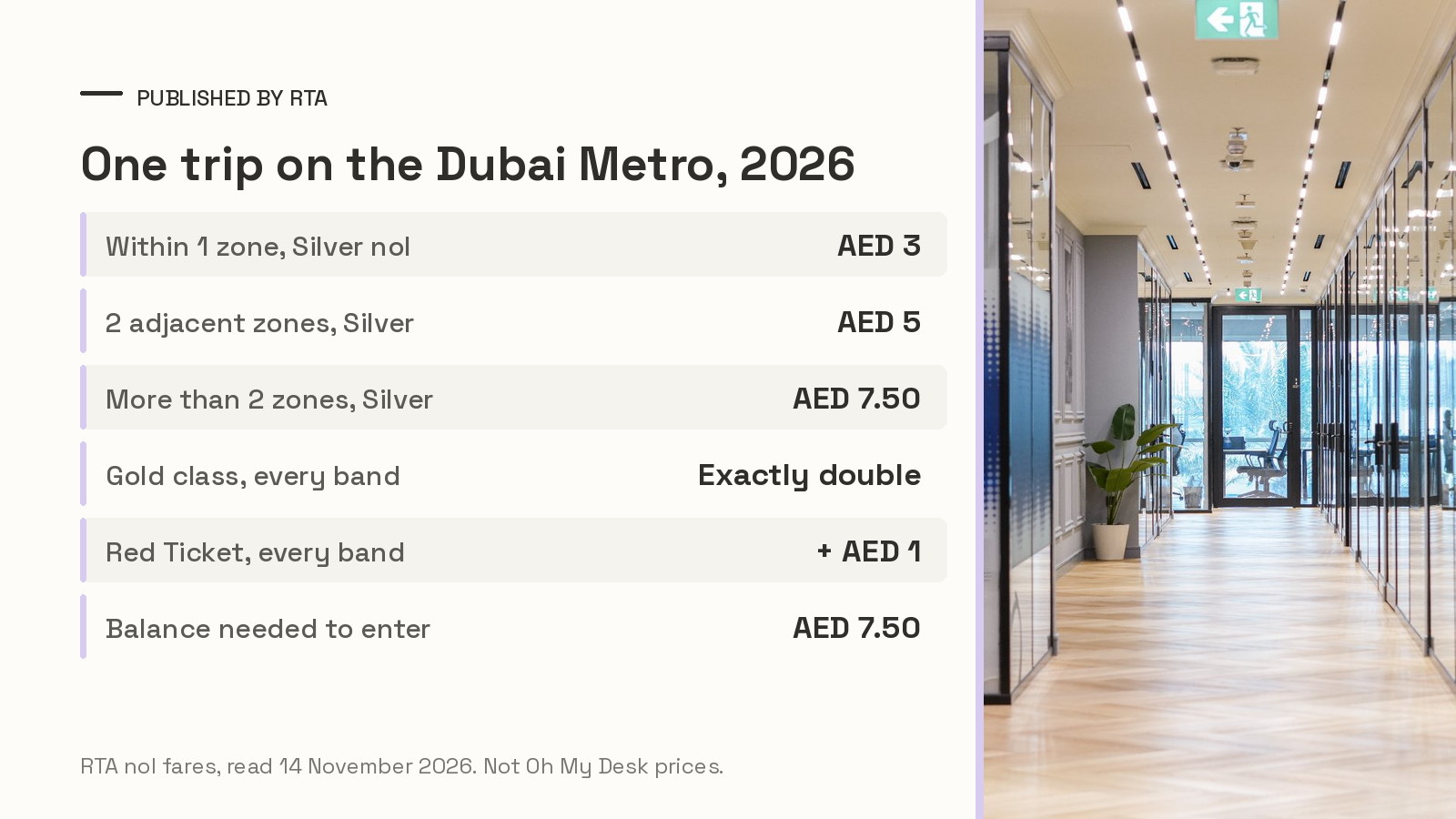
It costs AED 3, 5 or 7.50 on a Silver nol card. RTA sells transport in three price bands, not by distance and not by station count: within one fare zone, across two adjacent zones, or across more than two. The nol fares page prints the same three numbers for the metro, the tram and the bus, so a bus ride across one zone costs what a metro ride across one zone costs.
Two things move it. Gold class doubles the fare, and the paper Red Ticket — the one a visitor buys because it costs AED 2 — charges one dirham more per trip in every band.
| One trip | Within 1 zone | 2 adjacent zones | More than 2 zones |
|---|---|---|---|
| Silver nol, standard class | AED 3 | AED 5 | AED 7.50 |
| Personal (blue) nol, standard rate | AED 3 | AED 5 | AED 7.50 |
| Gold nol, Gold class | AED 6 | AED 10 | AED 15 |
| Red Ticket, standard class | AED 4 | AED 6 | AED 8.50 |
| Red Ticket, Gold class | AED 8 | AED 12 | AED 17 |
| Student, senior Emirati, Social Affairs | 50% off, blue card only | ||
| People of determination | Free, blue card only | ||
Children travel free on every card, under five or shorter than 90 cm.
How does RTA decide which band you pay?
By zone — and the zone map is the hardest number here to find. RTA's rail network map key runs from Zone 1 to Zone 7, so Dubai has seven. What none of the RTA pages we could read does is say which zone a given station sits in.
The 3 km exception nobody quotes
The RTA metro and tram guide defines the bands as tiers, and the first one carries an exception: Tier 1 covers travel within one zone or across two zones when start and finish are less than 3 km apart. A trip that looks like a two-zone AED 5 on the map can be an AED 3 trip because it is short. Tier 2 is one zone into its neighbour; Tier 3 is three zones or more.
That exception is why the zone map matters, and why its absence is awkward: one third-party fare calculator publishing a zone-by-zone table states plainly that its zone assignments are estimates taken from Wikipedia.
What a transfer costs
Nothing extra, inside the rules. RTA allows transfers between modes within 30 minutes, up to 3 transfers, with a maximum journey of 180 minutes, and charges the lot as one journey priced on the total zones crossed. Board a bus within half an hour of leaving the metro and you pay one fare. Miss it and you pay two.
Which nol card should you buy, and what does it cost?
Every nol card bundles a card fee with stored credit, and the shelf price never separates them. The Choose nol page and the nol home page print the bundle; the subtraction is left to you.
| Card | Price | Credit included | Card fee | Max balance | Validity |
|---|---|---|---|---|---|
| Red Ticket (paper) | AED 2 | none | AED 2 | 10 trips or 5 day passes | 90 days or 10 trips |
| Silver | AED 25 | AED 19 | AED 6 | AED 1,000 anonymous, 5,000 registered | 5 years |
| Gold | AED 25 | AED 19 | AED 6 | AED 1,000 anonymous, 5,000 registered | 5 years |
| Personal (blue) | AED 70 | AED 20 | AED 50 | AED 5,000 | 5 years |
| nol Travel | AED 100 | AED 19 | AED 81 | AED 1,000 anonymous, 5,000 registered | 5 years |
The AED 30 that only appears in a PDF
Registering a Silver or Gold card protects the balance and is the condition for any pass longer than seven days: RTA's fares page states that anonymous cards qualify for the 7-day product only. Registration carries a one-time AED 30 fee that appears in the metro and tram guide and on none of the three nol pages — which makes a first monthly pass AED 380, not 350.
You also cannot enter with an empty card: the minimum e-purse balance is AED 7.50 — exactly the most expensive single fare in the table.
Why is the Red Ticket the most expensive way to travel?
Because the AED 2 you save on the card you pay back at one dirham a trip, and then keep paying. The Red Ticket is AED 4, 6 or 8.50 where the Silver is AED 3, 5 or 7.50 — a flat AED 1 premium in every band, for the same seat on the same train.
Run them side by side on a three-zone trip and they cross on the fourth ride: the Silver's AED 6 of plastic is four dirhams more than the Red Ticket's AED 2, and the Red Ticket hands one back on every journey.
| Three-zone trips | Red Ticket, cumulative | Silver nol, cumulative | Difference |
|---|---|---|---|
| 1 | AED 10.50 | AED 13.50 | Red cheaper by 3.00 |
| 2 | AED 19.00 | AED 21.00 | Red cheaper by 2.00 |
| 3 | AED 27.50 | AED 28.50 | Red cheaper by 1.00 |
| 4 | AED 36.00 | AED 36.00 | identical |
| 5 | AED 44.50 | AED 43.50 | Silver cheaper by 1.00 |
| 8 | AED 70.00 | AED 66.00 | Silver cheaper by 4.00 |
Four trips is two days of commuting, and the paper ticket stops anyway at 90 days or ten journeys. The "AED 6 red ticket" some guides quote is not a different product — it is AED 2 of paper plus exactly one one-zone trip.
Is Gold class exactly double, on every product?
Yes, with no exception we could find. Gold is not a surcharge in dirhams, it is a multiplier of two: AED 3, 5 and 7.50 become 6, 10 and 15; the Red Ticket's 4, 6 and 8.50 become 8, 12 and 17; the 7-day all-zones pass goes from AED 110 to AED 220, the 30-day from 350 to 700, the 365-day from 2,670 to 5,340. Every pair doubles.
Two conditions narrow it. The surcharge applies on the metro and tram only, so a Gold card on a bus pays the regular fare; and RTA's own example states that a passenger who pays it for a zone on the tram does not pay it again for that zone on the metro.
One thing is missing from the penalty list, and it is the penalty you would expect. RTA's fines page has rows for an expired card, an invalid card, a counterfeit card and somebody else's card. It has no row for riding in the Gold cabin on a standard card.
Who gets 50% off, and what does the discount cost up front?
Students of all nationalities, senior Emirati citizens and Social Affairs beneficiaries pay half fare; people of determination travel free. The discount exists only on the Personal (blue) card, the only one carrying the holder's photo.
That card costs AED 70 and arrives with AED 20 of credit, so the entitlement itself costs AED 50 before it saves anything — and recovering it depends on how far you travel.
| Band | Standard fare | Concession fare | Saved per trip | Trips to recover AED 50 |
|---|---|---|---|---|
| Within 1 zone | AED 3 | AED 1.50 | AED 1.50 | 34 |
| 2 adjacent zones | AED 5 | AED 2.50 | AED 2.50 | 20 |
| More than 2 zones | AED 7.50 | AED 3.75 | AED 3.75 | 14 |
A student crossing the city recovers the card in seven days of term; one living a zone from campus needs seventeen. Both are quoted the same AED 70.
Does a 30-day travel pass save a commuter anything?
No — not a Monday-to-Friday one, in any band, in any month of 2026. A travel pass is priced in trips, and it needs more trips than a month has weekdays.
| Pass | 1 zone | 2 zones | All zones | Gold, all zones | Concession, all zones |
|---|---|---|---|---|---|
| 7 days | AED 50 | AED 80 | AED 110 | AED 220 | AED 55 |
| 30 days | AED 140 | AED 230 | AED 350 | AED 700 | AED 175 |
| 90 days | AED 330 | AED 550 | AED 830 | AED 1,660 | AED 415 |
| 365 days | AED 1,060 | AED 1,770 | AED 2,670 | AED 5,340 | AED 1,335 |
Divide each 30-day pass by the single fare it replaces and the break-even lands in the same place in all three bands.
| 30-day pass | Price | Single fare | Trips to break even | Commuting days | 22-day month, paid per trip |
|---|---|---|---|---|---|
| 1 zone | AED 140 | AED 3 | 47 | 24 | AED 132 — pass costs 8 more |
| 2 zones | AED 230 | AED 5 | 46 | 23 | AED 220 — pass costs 10 more |
| All zones | AED 350 | AED 7.50 | 47 | 24 | AED 330 — pass costs 20 more |
Now count the weekdays. In 2026 the fullest months — July and December — hold 23; most hold 21 or 22, and February 20. Two of the three passes need 24 commuting days and the third needs 23 exactly, before a single public holiday or day of leave comes out, and December's 23 weekdays carry the National Day holidays. There is no month of 2026 in which a five-day commuter reaches the break-even of a 30-day nol pass.
The 7-day pass is worse: at AED 110 all-zones it needs 14.67 trips, or 7.33 return journeys, inside a window that contains seven days. And a first 30-day pass carries the AED 30 registration on top, because an anonymous card cannot buy one.
A pass is not a bad product — it is one for somebody who also travels at weekends, makes mid-day trips, or shares a card across a household. For a door-to-desk commute, paying per trip wins.
When does the annual pass start paying for itself?
On the 178th commuting day — the one pass a full-time commuter actually reaches. At AED 2,670 the all-zones 365-day pass buys 356 three-zone trips, or 178 return journeys, and a UAE employee works near 205 days a year once leave and public holidays come out of roughly 250 weekdays.
The gap is wider than either headline suggests: twelve consecutive 30-day passes cost AED 4,200, and the 365-day pass covering the same year costs AED 2,670 — AED 1,530 less, or 36% off, for the same travel.
The concession version is AED 1,335, exactly half; the Gold version AED 5,340, exactly double. Across four durations and three bands, no product breaks the rule.
Is there a daily cap on Dubai Metro fares?
Not one that RTA publishes. The nol fares page prints no cap, no maximum daily spend and no minimum balance; the only daily product in RTA's documents is a one-day pass at AED 20 standard and AED 40 Gold, valid until midnight on the day of travel. At three-zone fares it beats paying per trip on the third trip of the day, not the second: two trips cost AED 15, three cost AED 22.50.
This is where the public record falls apart. We read three guides that all publish 2026 Dubai fares, all updated within six weeks, all transcribing the same RTA page.
| Question | Guide A, 3 Nov 2026 | Guide B, 29 Oct 2026 | Guide C, 30 Oct 2026 | RTA |
|---|---|---|---|---|
| Daily cap | not mentioned | AED 14 Silver, AED 20 Gold | "There is no daily fare cap" | none published |
| One-day pass | AED 22 / AED 42 | not published | AED 20 / AED 40 | AED 20 / AED 40 in the guide PDF |
| 30-day, all zones | AED 350 | not published | AED 350, and AED 300 lower down the same page | AED 350 |
| Blue card fare | full fare | half fare only | both, with the condition | full fare, with a separate 50% row |
| Single fares | 3 / 5 / 7.50 | 3 / 5 / 7.50 | 3 / 5 / 7.50 | 3 / 5 / 7.50 |
Two pages published four days apart disagree on whether a rule exists: one prints a daily cap with two figures, the other says no such cap appears on RTA's page at all. A third contradicts itself on a monthly pass inside one article. The single fares — the one thing RTA states plainly in a table — are the only line all four agree on.
The federal portal does not settle it either. The u.ae public transport page, updated on 28 October 2026, mentions the nol card exactly once — in the tram section — and publishes no fare, no zone, no pass and no fine for the metro at all.
What does it cost to get the fare wrong?
AED 200, for almost everything that touches the fare. RTA's fines page applies it to entering or leaving a fare zone without paying, to failing to present your card, to using somebody else's and to using an expired one. The guide adds the same AED 200 for failing to tap in or out — the one most commuters will meet.
| What you did | Fine | In three-zone trips |
|---|---|---|
| Entered or left a fare zone without paying | AED 200 | 27 |
| Failed to tap in or tap out | AED 200 | 27 |
| Could not present your card on request | AED 200 | 27 |
| Ate or drank where it is not allowed | AED 100 | 14 |
| Slept in a passenger shelter | AED 300 | 40 |
| Overstayed in a metro park-and-ride | AED 100 a day, up to AED 1,000 | 14 a day |
| Used a counterfeit card (metro or tram) | AED 500 | 67 |
Sleeping in a shelter costs AED 300 and not paying costs AED 200, so the quietest offence is the dearer one. The fare-evasion fine is worth 27 three-zone trips — nearly four weeks of commuting, lost in one tap.
Then there is the line that contradicts itself. On one page, in two tables, RTA prices the same two offences in opposite directions: on a bus, using an invalid card is AED 500 and using a fake one is AED 200; on the metro and tram, an invalid card is AED 200 and a counterfeit one is AED 500. Same authority, same page, two amounts swapped between modes. We print both as published.
Does the metro reach every Dubai business district?
No, and the gap is worth knowing before you sign a lease. RTA's metro and tram stations map lists two metro lines and eleven tram stops. Business Bay is R26 and Burj Khalifa / Dubai Mall is R25 — one stop apart on the Red Line, which is why the two districts behave as a single commute. Dubai Design District has no metro station at all: no entry on either line carries its name, so d3 is a bus or a taxi at one end.
Station counts are where RTA disagrees with itself again. The guide states 29 stations on the Red Line and 18 on the Green, for 47 in total; the live map lists more than that on both. The guide carries no publication date and its latest internal reference is to 2019 — a reminder that the only RTA document explaining how the fare system works is also its oldest.
If the commute is what you are optimising, the car side is already priced: we have counted parking in Downtown Dubai, mapped what the Salik gates charge, and shown why a car insurance quote is capped at both ends. Offices near a station are a separate question, and we have mapped those too.
Is the nol card you buy today about to be replaced?
The system behind it is, on a published timetable. On 5 July 2026 the Dubai Media Office announced that 72% of the nol upgrade to account-based ticketing was complete, with all phases scheduled for the end of the first quarter of 2027: QR ticketing first, then a new generation of nol cards, then fares paid by bank cards and digital wallets. The contract was awarded in January 2024 at AED 350 million.
What neither official release says is what happens to the 30 million cards already issued: no pilot, no replacement date, no migration. A commercial outlet has printed AED 550 million for the same project where the Media Office printed AED 350 million, and a travel news site reported this month that a nol card co-badged with the national Jaywan scheme would be piloted in November, citing an RTA announcement we could not read. We name that report rather than repeat its figures.
Practically: buy the card the journey needs. A Silver card's AED 25 buys five years of validity; the system behind it has a published end date far closer.
FAQ: 10 quick answers
Our own search data carries no query at all on this subject — zero impressions over two consecutive 28-day periods — so these questions come from the keywords we measured before writing: dubai metro fare, nol card top up, dubai metro zones, dubai metro ticket price, dubai metro monthly pass, nol card price, nol blue card, gold class dubai metro, dubai metro day pass and dubai bus fare.
1. How much is a Dubai Metro ticket in 2026? AED 3, 5 or 7.50 on a Silver nol card, depending on whether you stay in one fare zone, cross into the next, or cross more than two. A Red Ticket costs one dirham more in each band, and Gold class is exactly double in all three.
2. How much does a nol card cost? A Silver or Gold card is AED 25, of which AED 19 is travel credit, so the card itself is AED 6. The Personal blue card is AED 70 with AED 20 of credit, making the card AED 50. A paper Red Ticket is AED 2. Plastic cards last five years.
3. How do you top up a nol card? At ticket offices and vending machines in metro stations, at authorised sales agents, in the Public Transport app or on nol.ae. RTA publishes no minimum top-up on its nol pages. It does publish the minimum needed to pass a gate: AED 7.50, the price of the most expensive single fare.
4. Is a Dubai Metro monthly pass worth it? Not for a five-day commute. The 30-day all-zones pass is AED 350, which buys 47 three-zone trips, or 24 commuting days. No month of 2026 holds 24 weekdays once public holidays come out, so paying per trip costs less. The pass suits people who also travel at weekends.
5. How many fare zones does Dubai have? Seven. RTA's rail network map key runs from Zone 1 to Zone 7, and the fare is set by how many a journey crosses, not by distance or station count. RTA does not publish, on any page we could read, which zone a station belongs to.
6. What does Gold class cost on the Dubai Metro? Exactly double the standard fare: AED 6, 10 or 15 for one, two or more than two zones. The doubling holds on every nol product, including the Red Ticket and all four pass durations. The surcharge applies on the metro and tram only.
7. What is a nol blue card and who can get one? It is the Personal card, the only one carrying the holder's photo and the only one on which the 50% concession fare exists. Students of any nationality, senior Emirati citizens and Social Affairs beneficiaries pay half fare; people of determination travel free. It costs AED 70 including AED 20 of credit.
8. Is there a Dubai Metro day pass? Yes — AED 20 standard class, AED 40 Gold, valid until midnight on the day of travel. It is not a cap: RTA publishes no automatic daily maximum. At three-zone fares it only beats paying per trip from the third journey, since two trips cost AED 15 and three cost AED 22.50.
9. How much is a Dubai bus fare? The same as a metro fare in the same band: AED 3, 5 or 7.50 on a Silver card. Buses have no Gold cabin, so a Gold card pays the standard rate. A bus boarded within 30 minutes of leaving the metro counts as one journey, charged on the total zones crossed.
10. What is the fine for travelling without a valid nol card? AED 200, for entering or leaving a fare zone without paying the exact fare. The same AED 200 applies for failing to present your card, for using someone else's, for an expired card and for failing to tap in or out. A counterfeit card is AED 500 on the metro and tram.
What this means for your commute
Three decisions follow from the tables above. Buy a Silver card rather than a Red Ticket if you expect more than four trips — two days. Buy the blue card only if you qualify for the concession, and expect 14 to 34 trips to recover its AED 50. And skip the 7-day and 30-day passes unless you travel beyond the commute: on weekdays alone, the only product that beats paying per trip is the 365-day pass.
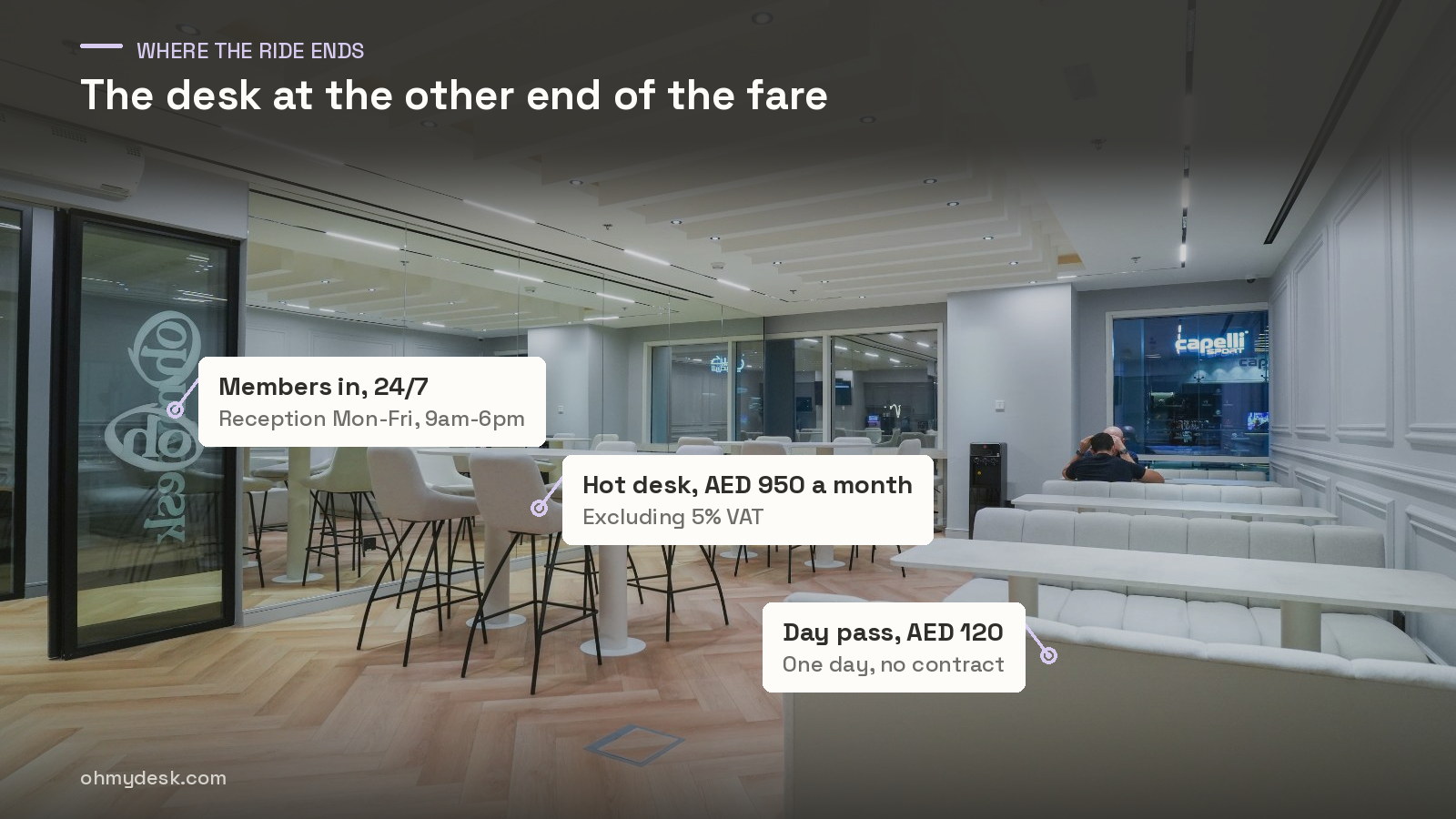
Then check the end of the journey, because the fare stops at the gate. We write these guides because members ask them between meetings, not because we sell tickets — what we sell is the desk at the other end: Downtown and Business Bay sit one Red Line stop apart, with coworking from 950 AED a month and a dedicated desk at 1,500 AED in Downtown. To test the commute before committing to it, a day pass is 120 AED. Prices are before VAT; reception is open Monday to Friday, 9am to 6pm, and members have their badge 24/7.
Still costing out the move? We have priced a Dubai driving licence and mapped the freelance visa route. Or tell us where you have got to.