

Who does UAE e-invoicing actually bind, and when?
Every person conducting business in the UAE, on business-to-business and business-to-government transactions, whether or not they are registered for VAT. The dates depend only on revenue: AED 50 million or more means appointing a service provider by 30 October 2026 and issuing electronic invoices from 1 January 2027; below AED 50 million means 31 March 2027 and 1 July 2027.
That is the whole answer, and it is the part most summaries get wrong — by treating e-invoicing as a large-company problem, or by tying it to VAT registration. Below: the six official dates, the scope as the Ministry of Finance words it, the fines already written into a Cabinet Decision, and what a small Dubai company should do with the eighteen months in between. Every figure was read on a government page on 26 August 2026 and is linked to it.
What are the six e-invoicing deadlines for 2026 and 2027?
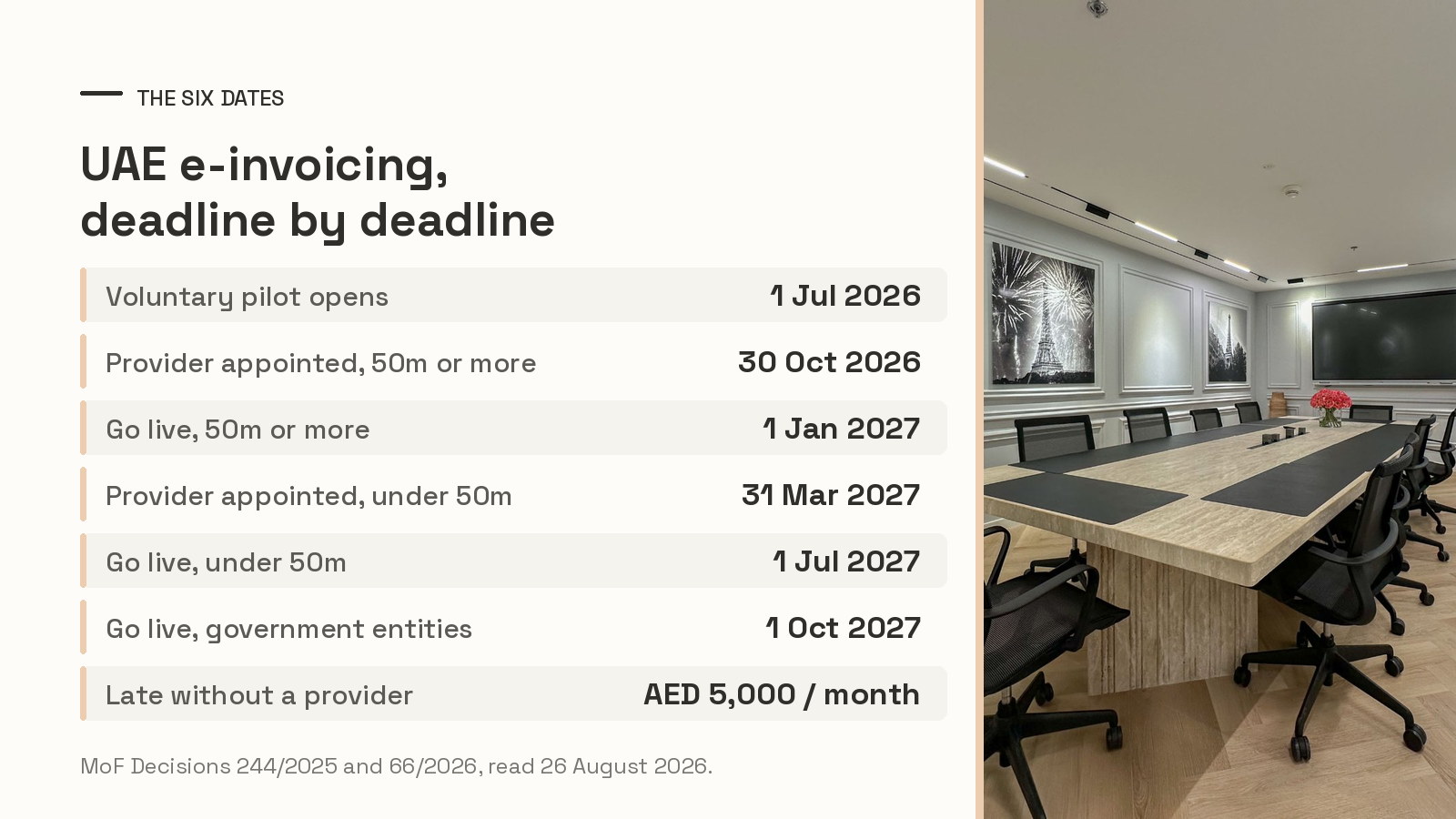
Six dates run the whole programme, and four are still ahead. They come from Ministerial Decision No. 244 of 2025, as amended for the first business phase by Ministerial Decision No. 66 of 2026.
| Date | Who | What has to be true that day |
|---|---|---|
| 1 July 2026 | A selected group of taxpayers | Voluntary pilot opens |
| 30 October 2026 | Revenue ≥ AED 50,000,000 | Accredited Service Provider appointed |
| 1 January 2027 | Revenue ≥ AED 50,000,000 | Electronic invoicing live |
| 31 March 2027 | Revenue < AED 50,000,000, and government entities | Accredited Service Provider appointed |
| 1 July 2027 | Revenue < AED 50,000,000 | Electronic invoicing live |
| 1 October 2027 | Government entities | Electronic invoicing live |
Ministerial Decision No. 244 of 2025, Article 5, as amended by Ministerial Decision No. 66 of 2026. Read on mof.gov.ae on 26 August 2026.
Two things are easy to miss there. The appointment date and the go-live date are different obligations, two to three months apart: you are late the day you have no provider, not the day an invoice fails. And revenue — not VAT registration, not headcount — decides which row you are in.
How revenue is measured
The decision defines Revenue as gross income earned during the most recent accounting period, evidenced by financial statements or other documentation acceptable to the Federal Tax Authority. The text we read on 26 August 2026 fixes no single calendar reference date, so a business close to AED 50 million should treat the threshold as a question for its accountant, not a self-assessment.
Why did the first deadline move from 31 July to 30 October 2026?
Because the Ministry of Finance amended it on 10 May 2026, giving large businesses three more months to appoint a provider while leaving the 1 January 2027 go-live untouched. The announcement of targeted amendments to the eInvoicing decisions also loosened the accreditation criteria so that local companies can partner with international providers.
That matters for a reason unrelated to large businesses: it is a quick test of whether the guide in front of you is current. Anything written before May 2026 — and some of what came after — still carries 31 July 2026. The rule it teaches governs every number here: a date or an amount without a reading date is not a fact. Same discipline, applied to prices, in our breakdown of what a year of coworking in Dubai actually costs.
Does VAT registration decide whether you are in scope?
No. The UAE Electronic Invoicing Guidelines, version 1.1 of 1 June 2026, put it in one sentence: all persons who make a business transaction in the UAE are within the scope of electronic invoicing, notwithstanding their VAT registration status, unless specifically excluded.
Set that against the VAT thresholds and the gap opens up. Registration is mandatory only above AED 375,000 of taxable supplies and imports a year, and voluntary above AED 187,500, as both the Federal Tax Authority and the federal VAT page state. A consultant billing AED 220,000 a year from a desk in Business Bay is below both, has never filed a VAT return, and is still inside the e-invoicing system from 1 July 2027. (Our page on accounting, VAT and corporate tax in Dubai sets out the filing obligations that do follow the thresholds.)
The obligation nobody expects: getting a TIN
The Guidelines go further. A person in scope who is not required to register for any tax type must still register with the FTA to obtain a Tax Identification Number — a first contact with the tax authority for businesses that had none, and a 2027 obligation best cleared in 2026. If you work under a freelance permit, read that twice: our guide to the freelance visa route in Dubai covers the permit, and e-invoicing sits on top of it without caring how small the licence is.
What counts as an electronic invoice, and why is a PDF not one?
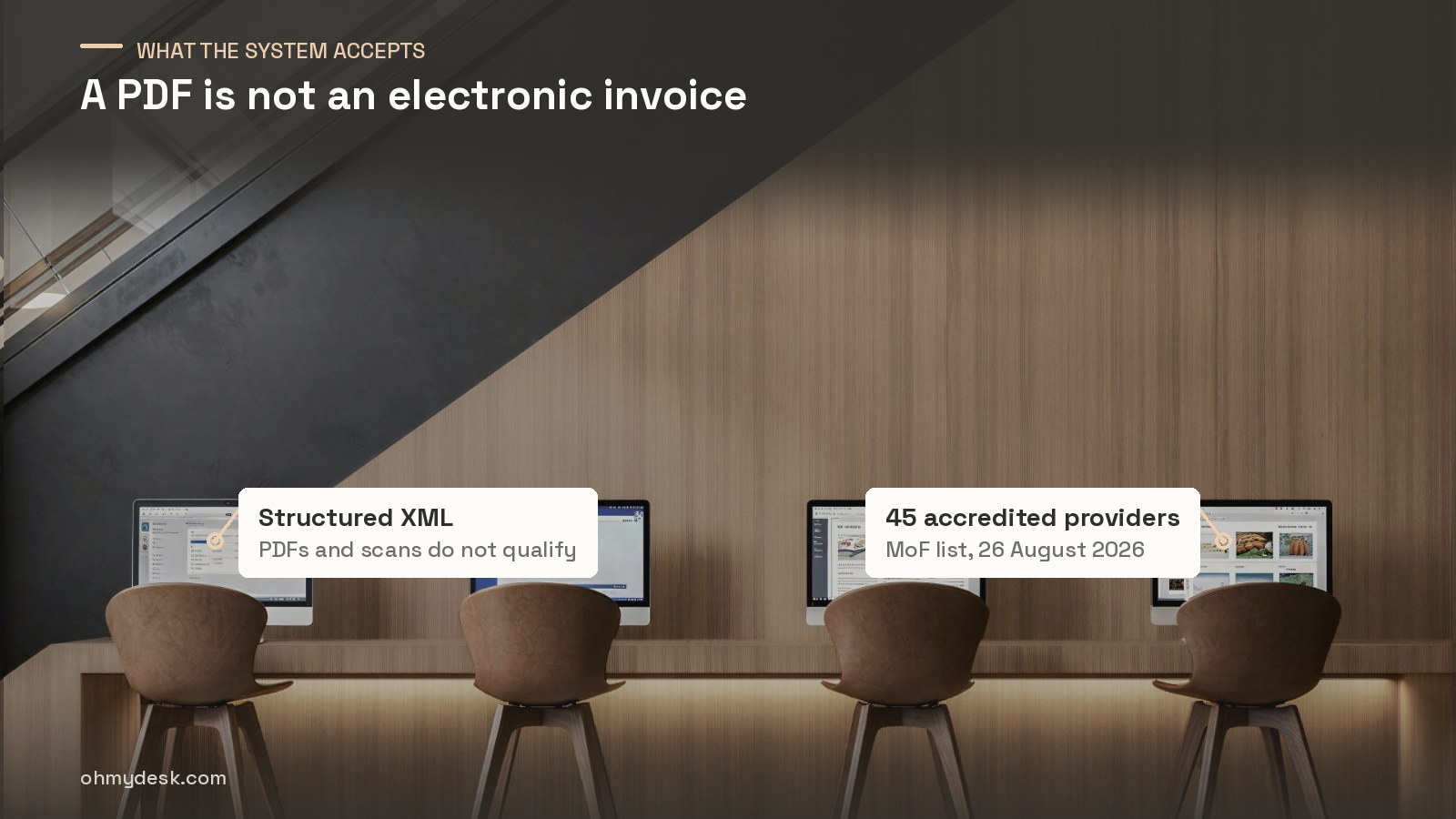
An electronic invoice is structured invoice data, issued and exchanged electronically between supplier and buyer and reported electronically to the Federal Tax Authority. The Ministry of Finance is explicit on its eInvoicing page that unstructured formats — PDFs and scanned copies — do not qualify.
This is the most expensive misunderstanding available on the subject. A business that already emails tidy PDF invoices from an accounting package feels compliant and is not. The system wants a machine-readable XML document in the UAE format, exchanged over the OpenPeppol network and reported to the tax authority in the same movement. The PDF you send the client afterwards is a courtesy, not the invoice of record.
A second consequence follows: administrative exceptions the FTA grants under the VAT Executive Regulation for tax invoices and credit notes do not carry over to their electronic equivalents.
What is an Accredited Service Provider, and how does the five-corner model work?
An Accredited Service Provider is a company approved by the Ministry of Finance to validate your invoices, convert them into the UAE standard XML, transmit them and report the tax data. You cannot connect directly: appointing one is the obligation, not an implementation choice.
The five corners
The UAE uses a Decentralised Continuous Transaction Control and Exchange model: the supplier, the supplier's provider, the buyer's provider, the buyer, and the Federal Tax Authority. The invoice travels from corner 1 to corner 4 through the two providers; in parallel the tax data goes to corner 5. Both sides therefore need a provider — the detail that makes the small-business phase matter to more people than the revenue threshold suggests.
How many providers are accredited today
On 26 August 2026 the Ministry listed 45 fully accredited providers plus 7 pre-approved, on a page last updated 24 August 2026. The count has climbed all year — the Ministry's May announcement cited 32 — so check the list rather than any summary of it, this one included.
What happens if your supplier goes live six months before you do?
Nothing breaks, because the Guidelines build a fallback for exactly this. A large supplier going live on 1 January 2027 will be invoicing customers who are not due until 1 July 2027 and have no Peppol participant identifier yet. The supplier must then put a predefined endpoint on the electronic invoice: 0235: 9900000098 for a UAE buyer not yet implemented, and 0235: 9900000099 for an export where the buyer has no Peppol ID at all. There is no reverting to a PDF.
Two readings of that. The six-month gap is anticipated and does not put a small buyer in breach. Less comfortably: from 1 January 2027, any Dubai business selling to large corporates will start being asked for its participant identifier. The deadline on paper is March and July 2027; the deadline in practice arrives with the first client who asks.
Which transactions and businesses are excluded?
Four exclusions are set out in the Guidelines, and they are narrower than most people hope. Everything not on this list is in scope.
| Excluded | Condition |
|---|---|
| Sovereign government activity | Conducted by a government entity, in a sovereign capacity, and not in competition with the private sector — all three at once |
| Business-to-consumer transactions | Supplies to or from natural persons who are not in business; out of scope until a further ministerial determination |
| VAT-exempt financial services | As defined by Article 42 of the VAT Executive Regulation |
| Certain international air transport | Passenger transport on electronic tickets and related documents; goods under airway bills have a temporary 24-month exclusion |
UAE Electronic Invoicing Guidelines V1.1, Article 7 and Chapter 6. Read on 26 August 2026.
Free zone companies are not excluded
A free zone licence does not put you outside the system. The Guidelines treat free zone entities as a scenario with an additional requirement — where the customer is a free zone entity, the invoice needs the beneficiary's details as well as the customer's. That is more work, not less. Our guide to how Ejari works in Dubai covers the mainland-versus-free-zone split on the address side.
What does getting it wrong cost?
The fines are already written. Cabinet Decision No. 106 of 2025 sets out six violations, and two of them fall on the recipient of an invoice rather than the issuer — a point almost every commercial summary skips.
| Violation | Who pays | Fine |
|---|---|---|
| Failing to implement the system or appoint a provider within the timeline | Issuer | AED 5,000 per month or part of a month |
| Failing to issue or transmit an electronic invoice within the timeline | Issuer | AED 100 per invoice, capped at AED 5,000 a month |
| Failing to issue or transmit an electronic credit note within the timeline | Issuer | AED 100 per note, capped at AED 5,000 a month |
| Failing to notify the Authority of a system failure within the timeline | Issuer | AED 1,000 per day or part of a day |
| Failing to notify the Authority of a system failure within the timeline | Recipient | AED 1,000 per day or part of a day |
| Failing to notify the service provider of a change in data | Issuer or recipient | AED 1,000 per day or part of a day |
Cabinet Decision No. 106 of 2025 on violations and administrative penalties related to the electronic invoicing system, read on mof.gov.ae on 26 August 2026. The UAE legislation portal records an issue date of 9 October 2025 and effect from 15 October 2025; the Ministry of Finance announced it on 8 December 2025.
Note the shape of the first line: AED 5,000 for each month or part of a month, triggered by not having a provider — not by sending a bad invoice. A business that lets the appointment date slide and fixes it four months later has accrued AED 20,000 without issuing one non-compliant document. And the two recipient lines mean your obligations are not limited to what you send.
What does an Accredited Service Provider cost in the UAE?
Almost nobody publishes a price. We opened the public pages of six providers on 26 August 2026 — five accredited, one pre-approved — and found exactly one published figure, on the site of the provider that is not yet fully accredited.
| Provider | Status on the MoF list, 26 Aug 2026 | Price published on its own page? |
|---|---|---|
| ClearTax (Defmacro Software DMCC) | Accredited | No — book a demo |
| Complyance Electronics L.L.C | Accredited | No — “flexible credit system”, contact sales |
| Comarch Middle East FZ LLC | Accredited | No — talk to an expert |
| Flick Network L.L.C | Accredited | No — request a callback |
| Pagero Gulf FZ-LLC | Accredited | No — book a demo |
| Zoho Software Trading LLC | Pre-approved, under final assessment | Yes — AED 50 and AED 100 a month, or AED 39 and AED 79 billed annually |
Six public pages opened on 26 August 2026. Accreditation status from the Ministry of Finance list, last updated 24 August 2026. Zoho's figures are its published UAE billing plans, excluding local taxes, not a quoted price for an accredited e-invoicing connection.
Stated plainly: five out of five accredited providers we could read published no price at all. A market in the middle of a regulatory deadline prices by conversation. So do not budget from a headline figure found in a blog post — there isn't one. Ask three providers for a written quote at your invoice volume, and ask each what the price does when that volume doubles.
One federal deadline lands long before any of these, and it is on the same desk: if your financial year ended on 31 December 2025, your corporate tax return is due on 30 September 2026 — and a business that owes nothing still has to file it. See what the UAE corporate tax return costs if you miss 30 September 2026.
What should a Dubai freelancer or small company do before 31 March 2027?
Five things, none of which needs to wait for 2027 — the provider market gets busier every month until January, and again until July.
1. Establish which phase you are in
Take the gross income of your most recent accounting period. Above AED 50 million, your appointment date was 30 October 2026. Below it, 31 March 2027. If you are nowhere near the line, this takes ten seconds.
2. Check whether you have a TIN
If you are registered for VAT or corporate tax, you already have one. If you have never registered for any tax type, the Guidelines require you to register with the FTA to obtain one in order to participate.
3. Ask your accounting software what it is doing
For most small Dubai businesses the realistic path is that their existing invoicing tool becomes, or connects to, an accredited provider — several names on the Ministry's list are accounting products, not integrators. Get the answer in writing: “we support UAE e-invoicing” and “we are an Accredited Service Provider” are different claims.
4. Get three written quotes
Since nobody publishes a price, the only way to find the market rate is to create one yourself. Ask for the annual cost at your current invoice volume and at twice that volume.
5. Clean your invoice data before you automate it
Structured invoicing is unforgiving about fields a PDF let you fudge: customer legal names, tax identification numbers, free zone beneficiary details. Keep the output too — invoices and their data must be retained 5 years after the tax period for a taxable person, 5 years from the end of the calendar year of creation otherwise, and 7 years for real estate records.
None of this replaces the rest of the file. E-invoicing changes the format and route of your invoices; it does not touch your trade licence, Ejari or visa, and it comes after them, because the system identifies you through a tax registration that follows the licence. New to the sequence? See the 2026 order of operations for a new founder — and the UAE public holidays before counting on a final week.
What does this change about where you work from in Dubai?
Nothing about e-invoicing depends on the size of your office — which is the point, because a good deal of Dubai business advice implies that compliance obligations arrive with a headcount. They do not. A one-person consultancy on a hot desk carries the same obligation, on the same schedule, as a company on three floors.
What a workspace can do is remove the adjacent problems. A registered business address with Ejari is the prerequisite for the licence the tax registration hangs off, and our Virtual Office + Ejari is 8,000 AED a year. A coworking membership is 950 AED a month with an hour of meeting room; a private office starts at 6,000 AED a month with six. Members get in 24 hours a day, 7 days a week with a badge; reception is staffed Monday to Friday, 9am to 6pm. Prices exclude VAT; 5% is added at checkout.
Our three Dubai addresses — Downtown, Business Bay, and the Design District, open since 1 October 2026 — carry the same terms. None of that makes you compliant. It just means the deadline finds you at a desk rather than in a queue.
FAQ: 10 quick answers
1. What is e-invoicing in the UAE? It is a national system in which invoices are issued as structured data, exchanged electronically between supplier and buyer through accredited service providers, and reported electronically to the Federal Tax Authority. The Ministry of Finance uses a five-corner model built on OpenPeppol. It covers business-to-business and business-to-government transactions, and PDFs do not qualify.
2. When does e-invoicing become mandatory in the UAE? On 1 January 2027 for businesses with annual revenue of AED 50 million or more, and on 1 July 2027 for everyone else, with government entities following on 1 October 2027. Before each there is an earlier date to appoint an Accredited Service Provider: 30 October 2026 for the large businesses, 31 March 2027 for the rest. A voluntary pilot opened on 1 July 2026.
3. Do I need e-invoicing if my business is not VAT registered? Yes. The UAE Electronic Invoicing Guidelines state that all persons making a business transaction in the UAE are in scope notwithstanding their VAT registration status, unless specifically excluded. VAT registration is mandatory only above AED 375,000 of taxable supplies a year and voluntary above AED 187,500, so a consultancy below both is still in scope. If you are registered for no tax type at all, you must obtain a Tax Identification Number from the FTA.
4. Is a PDF invoice an electronic invoice in the UAE? No. The Ministry of Finance states that unstructured formats, including PDFs and scanned copies, do not qualify. An electronic invoice is structured data in the UAE standard XML format, exchanged over Peppol through accredited providers and reported to the Federal Tax Authority. Emailing a tidy PDF from an accounting package is not compliance.
5. What is an Accredited Service Provider, and how many are there? An Accredited Service Provider is a company approved by the Ministry of Finance to validate your invoices, convert them to the UAE standard XML, transmit them and report the tax data. On 26 August 2026 the Ministry listed 45 fully accredited providers and 7 pre-approved, on a page last updated 24 August 2026. Both sides of an invoice need one.
6. What are the UAE invoice requirements under the new system? Invoices must be issued as structured XML in the UAE format, with the mandatory fields the Ministry of Finance has published, exchanged through accredited providers and reported to the Federal Tax Authority. Where the customer is a free zone entity, the invoice also needs the beneficiary's details. FTA administrative exceptions for tax invoices do not carry over.
7. Does e-invoicing apply to free zone companies in Dubai? Yes. A free zone licence does not exclude a company from the system. The Guidelines treat free zone entities as a scenario carrying an extra requirement, not an exemption: an invoice to a free zone customer must include the beneficiary's details as well as the customer's. The revenue threshold works the same way as on the mainland.
8. Does e-invoicing apply to invoices I send to consumers? Not for now. Business-to-consumer transactions are outside the scope of the system until a further ministerial determination, and supplies to or from natural persons who are not in business are not covered. The obligation covers business-to-business and business-to-government transactions, so a company selling to both runs two invoice paths from go-live.
9. What are the penalties for not complying with UAE e-invoicing? Cabinet Decision No. 106 of 2025 sets six administrative fines. Failing to implement the system or appoint a provider on time costs AED 5,000 for each month or part of a month. Failing to transmit an invoice or credit note on time costs AED 100 each, capped at AED 5,000 a month. Failing to notify the Authority of a system failure, or the provider of a data change, costs AED 1,000 a day — and two of the six fall on the recipient.
10. How long do I have to keep electronic invoices in the UAE? Five years following the tax period the invoice relates to if you are a taxable person, and five years from the end of the calendar year in which the document was created for everyone else. Real estate records must be kept seven years. The obligation applies to recipients as well as issuers, so an invoice you receive is one you keep as data, not as a printout.
How these questions were chosen: Search Console holds no e-invoicing queries for this site, so the ten above were built from the keywords Semrush actually measures on the UAE database in August 2026 — e invoicing uae (1,900 searches a month), e invoicing (1,300), uae einvoicing (260), tax invoice uae (90) and uae invoice requirements (30). None is invented.
The short version of UAE e-invoicing
Six dates, one threshold, one misunderstanding. The threshold is AED 50 million of revenue, and it decides only which of the two schedules you sit on. The misunderstanding is that VAT registration has anything to do with it — it does not, and the Guidelines say so in a single sentence.
If you run a small Dubai business, your dates are 31 March 2027 and 1 July 2027 — but your real deadline is the first large client who asks for your participant identifier after 1 January 2027. Between now and then: work out your phase, check whether you have a TIN, ask your accounting software what it is doing, and collect three written quotes.
Rather have that conversation in person? Come and see us at any of our three Dubai addresses. The tour is free, and the coffee is in the 950 AED.