What does an e-commerce licence in Dubai actually cost in 2026?
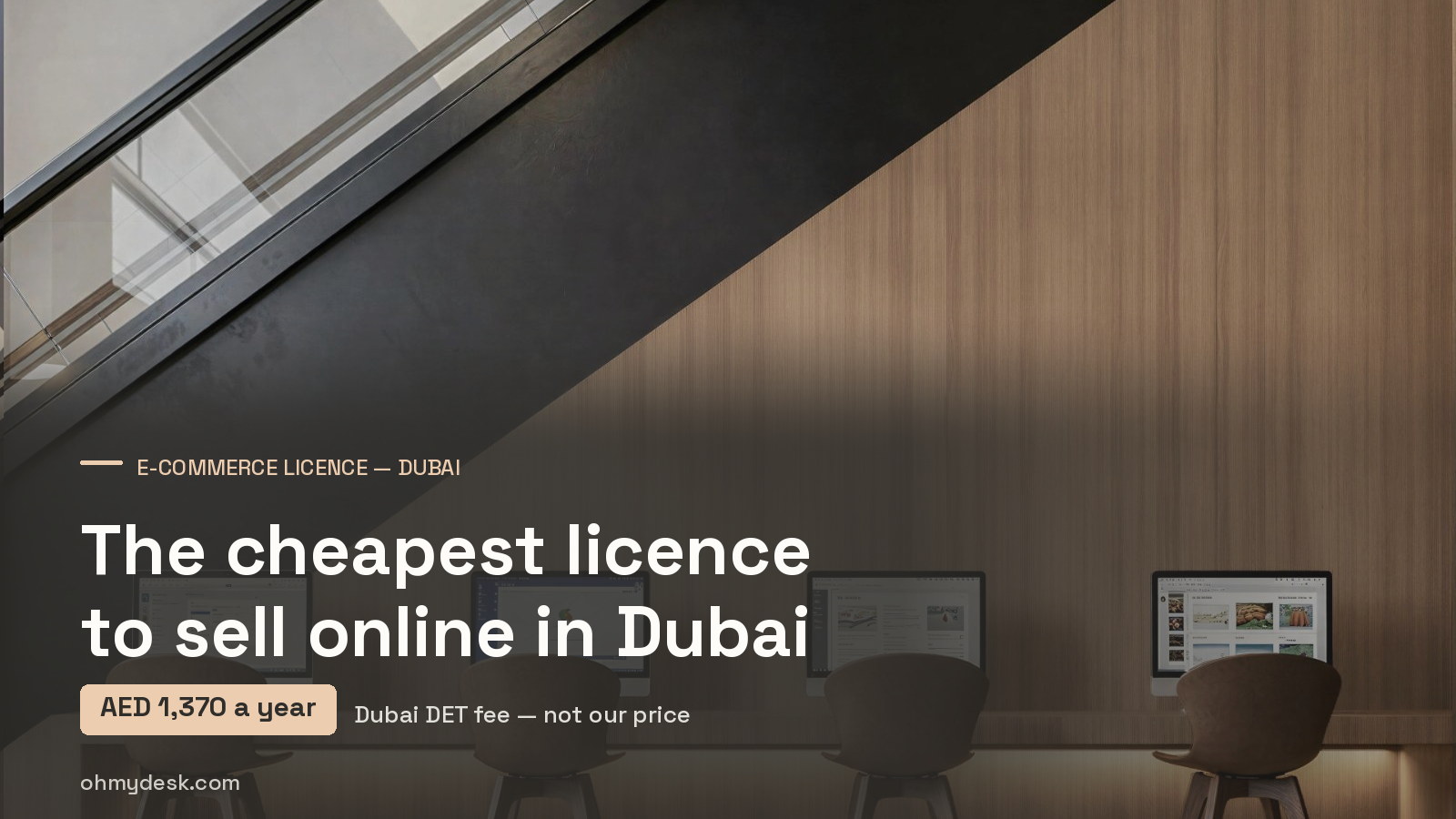
The cheapest licence Dubai publishes for selling online is AED 1,370 a year — an AED 1,070 merchant licence plus AED 300 of Dubai Chamber fees, printed as two separate lines on the Department of Economy and Tourism’s own fee list. Every mainland e-commerce licence then needs a second permit that costs nothing and that almost no guide names. The federal telecommunications regulator issues a No-Objection Certificate for practising e-activity, free of charge, in two working days — and its published conditions decide something no fee list mentions: the address of your shop.
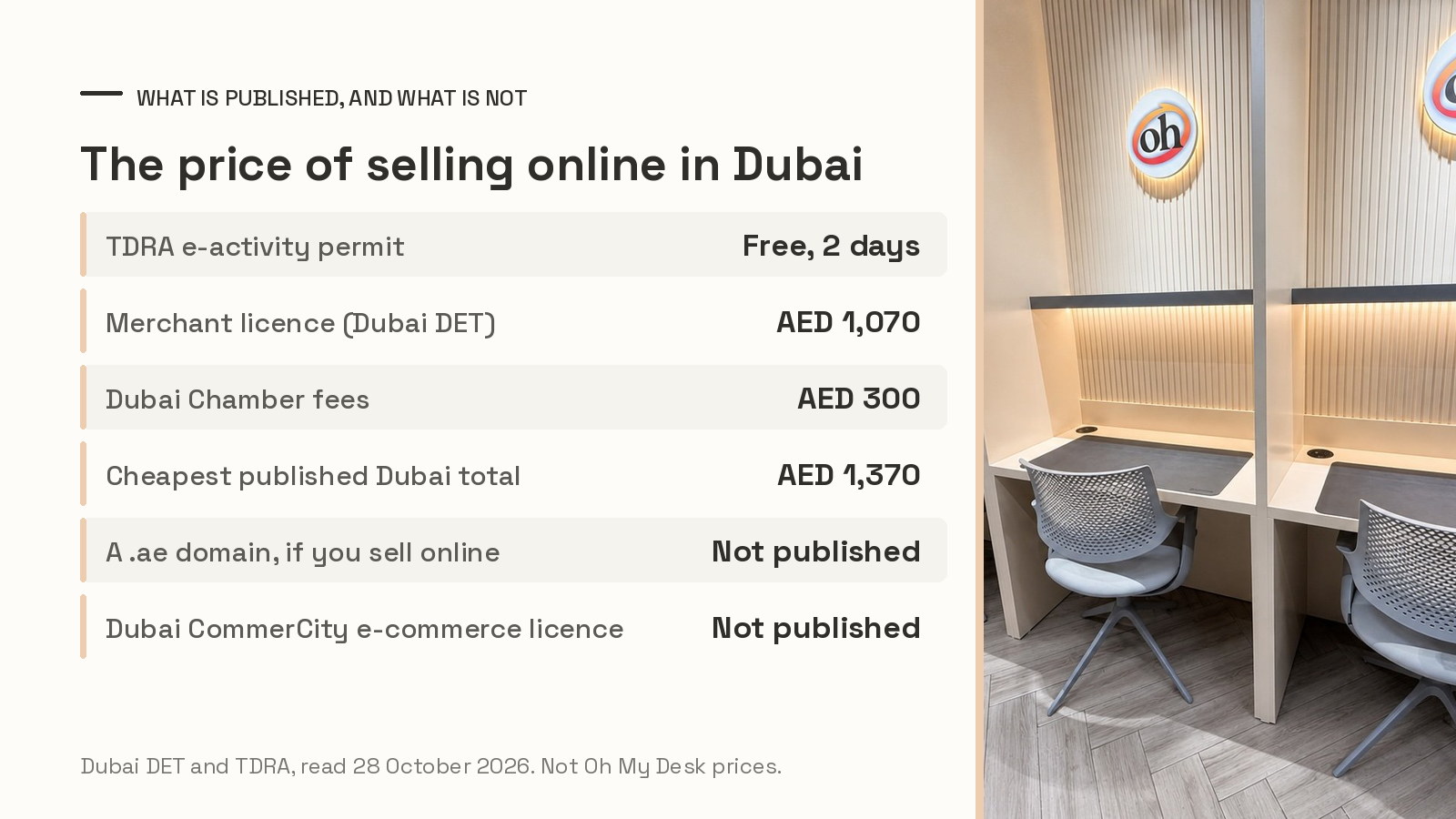
| What you actually need | Who issues it | Published price | Published time |
|---|---|---|---|
| NOC for Practising E-Activity | TDRA (federal) | Free of charge | 2 working days |
| Merchant licence | Dubai Economy & Tourism | AED 1,070 | not published |
| Dubai Chamber fees on that licence | Dubai Economy & Tourism | AED 300 | — |
| Cheapest published Dubai total | — | AED 1,370 | — |
| A .ae domain, if you sell from a website | an accredited registrar | not published | — |
| E-commerce licence, Dubai CommerCity | the free zone built for e-commerce | not published | — |
| Free-zone comparison, Shams | Sharjah Media City | from AED 5,750 | — |
Two lines say “not published”, and one belongs to the free zone Dubai built for online trade. Where the mainland prints every fee down to the AED 10 innovation dirham, the specialist free zone prints nothing.
Why is the cheapest figure AED 1,370 and not AED 1,070?
Because the Dubai Chamber line is a second line. The Department of Economy and Tourism’s request to issue a trade licence lists “Merchant License: 1,070” and, in the same entry, “plus 300 in Dubai Chamber Fees”. One of the two commercial guides read for this article publishes AED 1,070 and stops; the other publishes AED 1,370 and explains the split.
That is AED 3.75 a day, a seventh of what a hot desk costs at AED 950 a month. The cost of an online business in Dubai is not the licence.
The other lines on the same fee list
The merchant licence sits among lines that apply according to what you register:
| Line, as Dubai Economy & Tourism labels it | Published fee |
|---|---|
| License register fees | AED 600 |
| Knowledge Dirham fee | AED 10 |
| Innovation Dirham fee | AED 10 |
| Trade Name Advertisements | AED 350 |
| Service Request Form | AED 50 |
| Subtotal of the five lines everyone pays | AED 1,020 |
| Merchant License | AED 1,070 + AED 300 Dubai Chamber |
| Launch Fees | AED 1,070 |
| Foreign Trade Name Fees | AED 1,000 to 3,000 |
| General Trade Activity Fees | AED 15,000 |
| Investment Activities fee | AED 15,000 |
| Building Contracting Activities Fee | AED 10,000 |
| Business Center fee | AED 25,000 |
Two lines carry the same number — the merchant licence and the launch fee are both AED 1,070 — and the page does not say whether they stack. We publish the ambiguity rather than pick the convenient end of it. A foreign trade name adds AED 1,000 to 3,000, with no published rule for where a given name lands.
What is the free permit that almost no guide names?
It is the TDRA’s NOC for Practising E-Activity, and the federal government says plainly that every mainland e-commerce licence needs it. The UAE portal’s eCommerce page puts it in one sentence: “All eCommerce licences require the approval of Telecommunications and Digital Government Regulatory Authority (TDRA) also.”
The service card is short and unusually generous. Fees: “Free of charge.” Expected time: “2 working days.” You log in with UAE PASS and attach a commercial licence “if available”. No office visit is required, and the card lists no payment channel, because there is nothing to pay.
Of the two commercial guides read today, one names the NOC correctly. The other does not know what it is: its only mention of the regulator is “TDRA type approval” for telecom hardware — a real TDRA service, and not this one.
Does the permit really force you onto a .ae domain — and what does one cost?
Yes, and the sentence is one line long. Among the conditions printed on the NOC service card: “If the activity will be conducted through a website, it must be of a national domain name (.ae).” Neither commercial guide mentions it, nor does the federal eCommerce page. It appears on the card of the free permit and nowhere else we could read.
It is the most consequential line in the chain, because it sits upstream of everything a shop spends money on. A founder who buys a .com, builds on it for three months, then applies for the permit has built on the wrong address.
And the price of the thing the state makes mandatory is not published by anyone, including the state. The .ae registry is run by TDRA itself, and its registration page says three things in sequence: domains “can be registered by one of our Accredited Registrars or their resellers”; “The cost of .ae … registrations and renewals varies”; and “it is the decision of the Registrar what price they charge Registrants for their service.” The registry sells to registrars “at a standard price” it does not print.
So the free permit creates a purchase with no published price. A published fee list is not the same thing as a published cost.
What happens when you change your Instagram handle?
You apply again. The NOC card is explicit: if the activity runs on social media, “account names and links must be provided”, and “In case of changing the account name in the future, a new application is required.” The permit is attached to the handle, not to the business.
That turns an ordinary marketing decision into a regulatory one. Rebranding, merging two accounts or simply dropping an underscore puts the shop outside the terms it was granted under. The remedy is free and takes two working days; the catch is that nobody tells you.
Can a foreign resident hold an eTrader licence?
The two commercial guides say no. The authority’s own knowledge base attaches that restriction to a different licence. It is the sharpest disagreement on the subject, and it decides whether a reader even applies.
Guide A writes that “Foreign nationals cannot obtain an e-trader licence”. Guide B writes “UAE and GCC nationals living in Dubai, aged 21 or over”, then hedges that “Expat eligibility is limited to certain service activities”. Invest in Dubai’s own licence-type article says something else: “The E-Trader and Intelaq license types are available only when the selected legal form is Sole Establishment”; it states the nationality limit for the Intelaq and SME licences; and it adds that “The Sole Establishment legal form is available to foreign investors provided a UAE Local Service Agent is appointed.”
Read in order, those sentences put the nationality rule on the neighbour, not on the eTrader. Intelaq is the Emirati home-business licence; eTrader shares its legal form and the market has collapsed the two. And the Department of Economy and Tourism’s public FAQ does not contain the word eTrader once.
We will not resolve this in a blog post and will not pretend to. Take the question to the department rather than to a guide — and note that if the Sole Establishment route applies, a UAE Local Service Agent joins the file, a recurring annual cost no fee list carries.
Why does the first year cost five times the renewal on some lines?
Because the activity surcharges are front-loaded, and the two pages that prove it are never read side by side. Dubai Economy & Tourism publishes one fee list for issuing a licence and another for renewing one. The five base lines are identical on both — AED 600, 10, 10, 350 and 50, AED 1,020 in all. The activity lines are not.
| Activity line | At issue | At renewal | Ratio | Difference |
|---|---|---|---|---|
| General trading | AED 15,000 | AED 3,000 | 5× | AED 12,000 |
| Investment activities | AED 15,000 | AED 3,000 | 5× | AED 12,000 |
| Business centre | AED 25,000 | AED 5,000 | 5× | AED 20,000 |
| Building contracting | AED 10,000 | AED 3,000 | 3.3× | AED 7,000 |
| The five base lines | AED 1,020 | AED 1,020 | 1× | AED 0 |
Three of the four activity surcharges are exactly five times higher in year one. General trading is the line that lets a company deal in goods it has not individually registered, and it is the most expensive decision on the form: AED 12,000 more in year one than it will ever cost again. A narrow e-commerce activity avoids it.
Neither page publishes a renewal fee for the merchant licence itself, nor a late penalty. How a Dubai renewal actually runs is set out in the trade licence renewal guide, whose figures this article deliberately does not republish.
Does the free zone built for e-commerce publish its price?
No. Dubai CommerCity lists six licence types and six “Make Enquiry” links. Read on 28 October 2026, its licence types page names a trade licence, a service licence, an industrial licence, an e-commerce licence, a general trading licence and a dual licence with the Department of Economy and Tourism — and attaches a price to none.
This is not a generalist zone that happens to accept online sellers; it is the free zone the emirate built for digital commerce, and its e-commerce licence is a named product with no published price. The mainland publishes twelve fee lines, down to two dirhams of levy.
For a comparison that does publish something, Sharjah’s Shams prints “Starting from AED 5750” for its Media Package and “Starting from AED 6875” for its Standard Package on its cost calculator — and no figure at all for either package with visas, the version anyone who wants to live here actually buys.
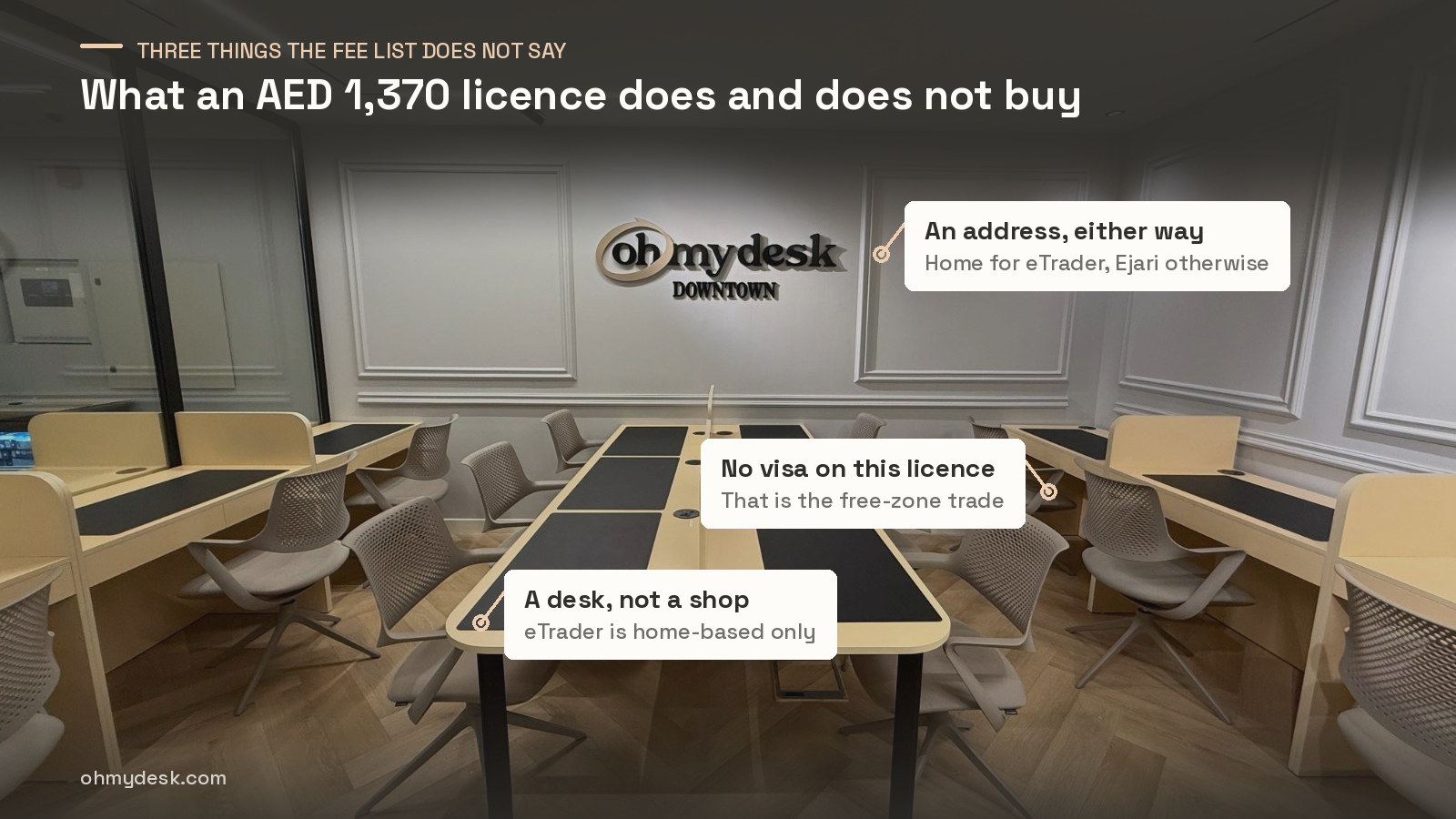
The cheapest published route is therefore the mainland one, at AED 1,370 — AED 4,380 below the cheapest published free-zone starting price, a factor of 4.2. What it does not buy is a residence visa.
What does the 2023 e-commerce law actually oblige you to do?
Federal Decree-Law No. 14 of 2023 on Modern Technology-Based Trade is short, and three of its duties are missing from every guide we read. It calls you a “Digital Trader” — “A natural or legal person who sells goods or services through modern technology” — and covers platforms and social media alike.
You must let your customers rate you, in public
Article 6(5) requires “a special field available to everyone with transparency that enables the evaluation” of the customer’s experience. A public review field is not a growth tactic here; it is a legal obligation. Article 6(9) adds that the licence data, address, contact numbers and website must be public.
You must issue an electronic invoice
Article 5(8) requires “Providing a detailed non-paper invoice through Modern Technology regarding the purchase of goods and services.” That duty belongs to the e-commerce law itself, separate from the federal e-invoicing programme covered in the UAE e-invoicing guide, whose deadlines this article does not repeat.
You cannot put an arbitration clause in a small contract
Article 9(2)(b) carries the law’s most precise number: “a digital contract of less than [50,000] fifty thousand dirhams may not include an arbitration clause.” Below AED 50,000 the courts are the forum, whatever your terms say — and most storefront templates ship with an arbitration clause by default.
Returns are narrower than the market assumes: article 7(1)(b) covers goods that are “defective, incomplete, damaged”, and the only duration in the text is for perishables, “not exceeding [3] three weeks.” There is no general cooling-off period in days anywhere in the decree-law.
Are there really fines for selling online without a licence?
Not in this law, not yet. One guide warns of “hefty fines” without a number. The decree-law contains no dirham amount at all. Article 19(1) says the Ministry shall “draw up regulations on the violations and administrative penalties”, which is the clearest possible statement that the schedule has still to be issued. Article 16 says the competent authorities “shall take legal action regarding acts committed in violation of its provisions”, and article 19(3) preserves penalties under other laws.
The law delegates its penalties, and the delegation is not exercised in the text we read. That does not make unlicensed selling safe — licensing, consumer-protection and media rules carry their own sanctions — but a number quoted as the e-commerce fine is one somebody invented.
When does VAT start to matter for an online shop?
At AED 375,000 of taxable supplies, and the trigger can be a single good month. The Federal Tax Authority publishes the two thresholds without ambiguity: “The mandatory registration threshold is AED 375,000” and “The voluntary registration threshold is AED 187,500”, the second being exactly half the first.
| Threshold | Amount | What triggers it |
|---|---|---|
| Mandatory registration | AED 375,000 | exceeded over the previous 12 months, or expected to be exceeded “in the next 30 days” |
| Voluntary registration | AED 187,500 | taxable supplies, imports or taxable expenses above the threshold |
| Monthly average that reaches the mandatory line | AED 31,250 | 375,000 divided by twelve |
| Foreign businesses | no threshold | “This threshold is not applicable to foreign businesses” |
The forward-looking limb is the one that catches online sellers. You do not have to have earned AED 375,000; you have to expect to pass it within thirty days. A campaign, a marketplace feature or a single wholesale order can create that expectation in a week — so a shop can sit below the threshold all year and still owe a registration in month four.
Do the published guides agree with the authorities?
On the licence price, roughly. On everything else, no. Two commercial guides against the pages the authorities publish:
| Question | Guide A | Guide B | What the authorities publish |
|---|---|---|---|
| Cheapest Dubai licence | AED 1,070 | AED 1,370 (1,070 + 300) | AED 1,070 + AED 300 Dubai Chamber |
| TDRA permit | named, mandatory for mainland | confused with hardware type approval | “All eCommerce licences require the approval of TDRA also” |
| TDRA permit price and time | not stated | not stated | Free of charge, 2 working days |
| .ae domain requirement | not mentioned | not mentioned | “it must be of a national domain name (.ae)” |
| New application if the handle changes | not mentioned | not mentioned | “a new application is required” |
| eTrader and foreign nationals | “cannot obtain” | expats limited to some activities | nationality limit stated for Intelaq and SME, not eTrader |
| Public review field | not mentioned | not mentioned | article 6(5), obligatory |
| Fines | not stated | not stated | no amount in the decree-law; article 19(1) defers them |
The pattern is consistent, and it is not carelessness. Both guides are precise about what they can sell you and vague about what they cannot. The .ae condition, the handle rule and the review field are obligations nobody invoices for.
What could not be read
The UAE Media Council’s fee schedule and its guide to the social-media advertising permit
both refuse automated retrieval (robots_disallowed), so this article publishes no
advertising-permit fee; a reader who promotes their shop should check whether that separate
permit applies. The invest-in-Dubai page for DMCC licence types returned a 404. Everything else cited
here was read in full on 28 October 2026.
Nor is there anything in our own search data to lean on. Over the twenty-eight days to 27 October 2026 this site recorded zero impressions on any query containing “commerce”, “trader”, “dropship”, “domain” or “tdra”, and zero across the preceding twenty-eight days. The questions below therefore come from the keywords we measured: dubai ecommerce license (1,000 searches a month), e trader license dubai (880), professional license dubai (590), commercial license dubai (390), e commerce license uae (260), social media license dubai (210) and online business license dubai (90).
FAQ: 10 quick answers
1. How much does an e-commerce licence cost in Dubai? The cheapest figure Dubai publishes is AED 1,370 a year: an AED 1,070 merchant licence plus AED 300 of Dubai Chamber fees, both printed on the Department of Economy and Tourism’s fee list. The TDRA permit every mainland licence needs is free. Free zones start at AED 5,750; Dubai CommerCity publishes no price at all.
2. What is an eTrader licence and what does it cost? It is Dubai’s home-based licence for selling through social media and online platforms, issued only under the Sole Establishment legal form, for AED 1,070 plus AED 300 of Dubai Chamber fees. It carries no shop and no residence visa, which is why it is the cheapest route rather than the complete one.
3. Do I need TDRA approval for an e-commerce licence? Yes, for a mainland licence. The UAE government portal states that “All eCommerce licences require the approval of Telecommunications and Digital Government Regulatory Authority (TDRA) also.” The NOC for Practising E-Activity is free, takes two working days and needs no office visit.
4. Does my online shop need a .ae domain? If you sell through a website, the TDRA permit conditions say yes: “If the activity will be conducted through a website, it must be of a national domain name (.ae).” Neither commercial guide mentions it, and TDRA publishes no price for .ae domains: the cost “varies” and registrars set it.
5. Can an expat get an eTrader licence in Dubai? The sources disagree and the issuing department publishes nothing. Two commercial guides say UAE and GCC nationals only; Invest in Dubai puts that limit on the Intelaq and SME licences and says the Sole Establishment form is open to foreign investors with a UAE Local Service Agent.
6. Do I need a licence to sell on Instagram in Dubai? Yes. The 2023 e-commerce law covers selling through social media platforms, and the TDRA permit asks for your account names and links, with a fresh application required if you later change the name. A separate advertising permit may apply to promotional content; its fee schedule was not readable and is not quoted here.
7. Is a mainland or a free-zone e-commerce licence cheaper? On published prices, the mainland by a wide margin: AED 1,370 against AED 5,750 at the cheapest free zone that publishes a starting figure, a gap of AED 4,380. The free-zone figure buys a route to a residence visa that the merchant licence does not.
8. What is the difference between a commercial and a professional licence? A commercial licence covers trading in goods, a professional licence covers services, and the e-commerce activity can sit on either — so the price follows what you sell, not how. Dubai Economy & Tourism’s FAQ notes that “the professional license requires a service agent”.
9. When do I have to register for VAT as an online seller? At AED 375,000 of taxable supplies and imports over the previous twelve months, or as soon as you expect to pass it “in the next 30 days”. Voluntary registration opens at AED 187,500, exactly half. The threshold “is not applicable to foreign businesses”.
10. What are the fines for selling online without a licence? Federal Decree-Law No. 14 of 2023 sets no dirham amount; article 19(1) leaves the schedule of violations and administrative penalties still to be drawn up. Any specific e-commerce fine quoted online is therefore not from this law. Licensing and consumer-protection rules carry their own sanctions.
What to do next
Do the free step first: apply for the TDRA permit before you buy a domain or choose a storefront theme, because its conditions are the only part of this process that is expensive to get wrong. Then pick the activity narrowly — general trading costs AED 12,000 more in year one than it ever will again. Then watch one number, AED 375,000, remembering that it bites on what you expect to earn in the next thirty days, not on what you have banked.
And settle the address before the licence, not after. A mainland licence needs premises; a virtual office with Ejari is AED 8,000 a year and the registration runs through our Ejari booking page, with the mechanics in the Ejari guide. If the shop grows into a team, a hot desk is AED 950 a month with one hour of meeting room included, all excluding VAT, members in at any hour, reception Monday to Friday 9am to 6pm. Founders arriving alone often compare the freelance visa route or what a flexi desk actually is first, and anyone sizing up the paperwork of a UAE address will recognise the same silences we found in the PO box guide. If this shop replaces one you are winding down, that published cost is in the company liquidation guide. Book a free tour at Downtown, Business Bay or Dubai Design District.