
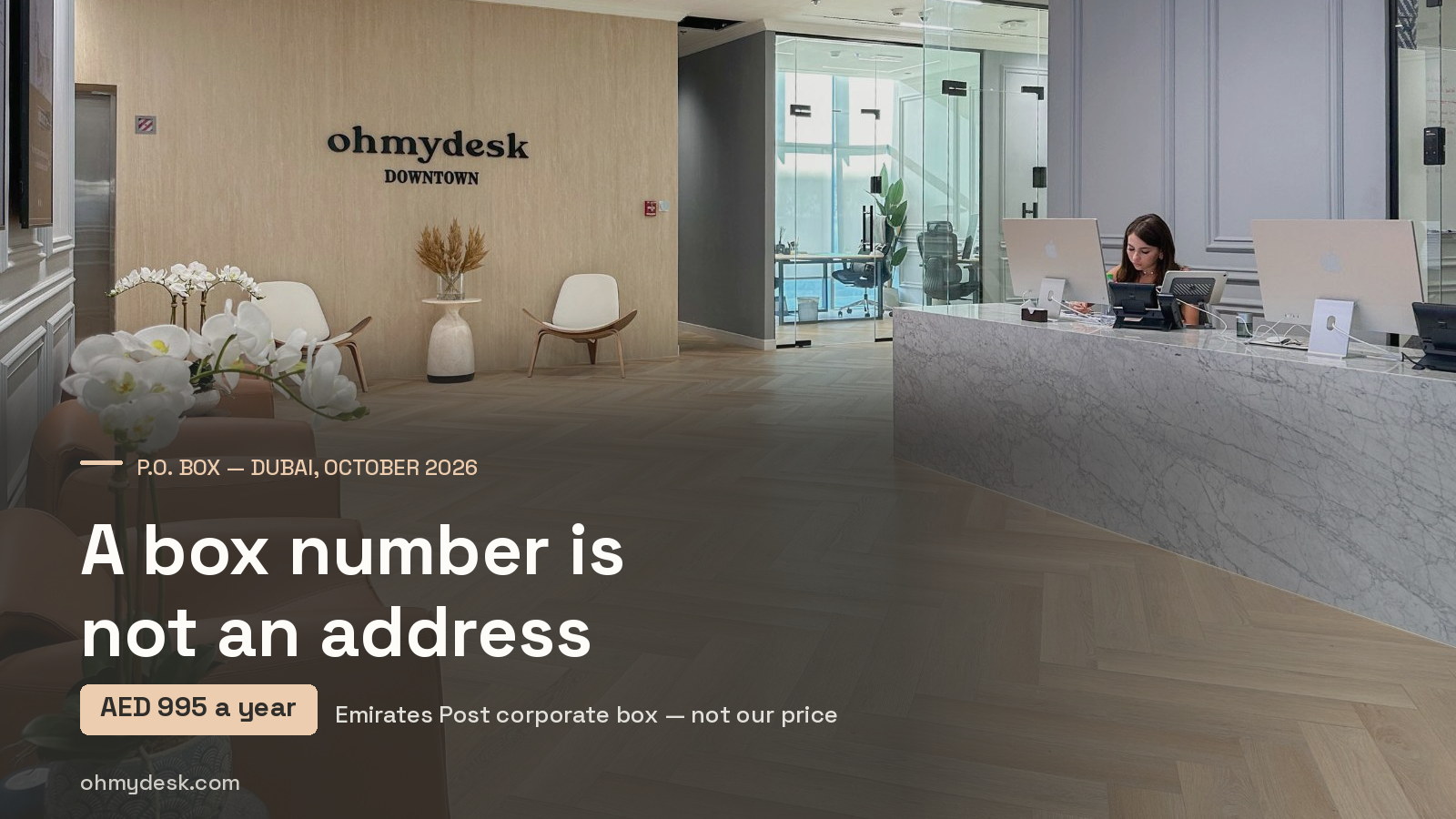
What does a company P.O. Box cost in Dubai in 2026?
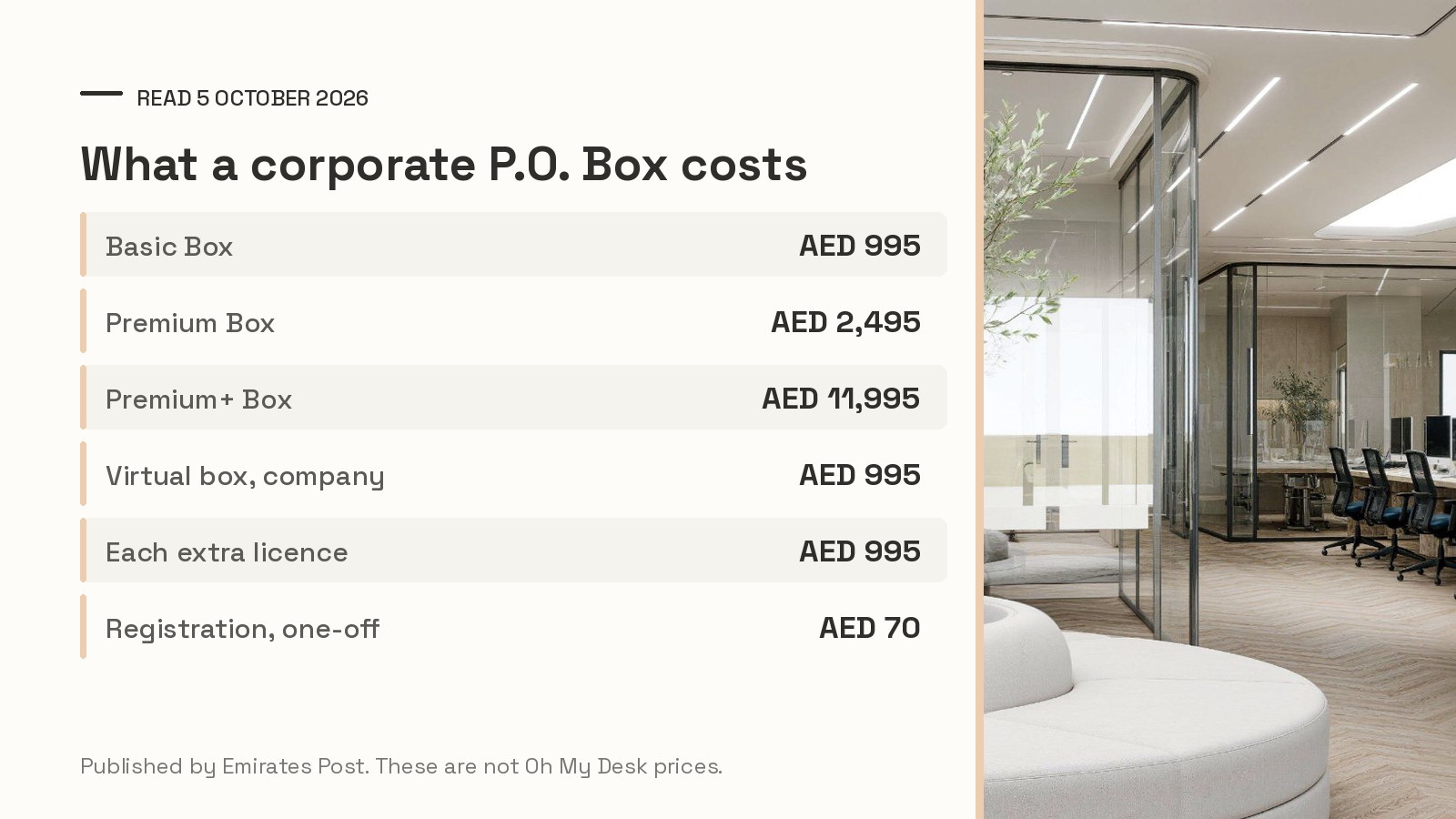
Emirates Post sells a corporate P.O. Box on three annual plans — AED 995, AED 2,495 and AED 11,995 — plus a one-off AED 70 registration fee. The cheapest and the dearest are 12.1 times apart for the same basic function: a numbered address that receives your company's post. Everything above the entry plan buys handling, not a better address.
Here is the whole list, read on its own pages on 5 October 2026.
| Line | Published price | Basis |
|---|---|---|
| Basic Box | AED 995 | per year |
| Premium Box | AED 2,495 | per year |
| Premium+ Box | AED 11,995 | per year |
| Virtual P.O. Box, commercial establishments | AED 995 | per year |
| Additional trade licence on the same box | AED 995 | per licence, per year |
| Additional postal agent | AED 100 | per agent, per year |
| Registration | AED 70 | one-off |
| Replacement key | AED 100 + 5% VAT | per key |
| Storage charge on an expired or cancelled box | AED 1,000 | when you collect mail |
Four of those nine lines are AED 995 or AED 1,000. The rest of this guide is mostly about why.
What a second trade licence adds
AED 995 a year — the entire price of the box, again. One corporate box covers one trade licence, and each additional licence attached to it is charged at AED 995 per licence per year. A founder with two companies and one box therefore pays AED 1,990 in subscriptions plus the AED 70 registration, which is AED 2,060 in year one. There is no volume discount anywhere on the list, and the second licence on an existing box costs exactly what a second box would.
Why can a company not just use a personal P.O. Box?
Because Emirates Post forbids it in writing, and the gap it defends is 3.3 times. The corporate terms state that an individual box cannot be used as a corporate box and that upgrading is mandatory, and that a box may not be sub-leased or assigned to any other person or entity. The personal entry plan, MyBox, is AED 300 a year. The corporate entry plan, Basic Box, is AED 995.
| Plan | Who it is for | Per year |
|---|---|---|
| MyBox | Individual | AED 300 |
| MyHome | Individual, weekly home delivery | AED 695 |
| MyHome Instant | Individual, next-day delivery | AED 995 |
| Basic Box | Company | AED 995 |
| Premium Box | Company, weekly on-site service | AED 2,495 |
| Premium+ Box | Company | AED 11,995 |
Read down the right-hand column and one line jumps out: the top personal plan and the entry corporate plan are the same AED 995. An individual paying AED 995 gets next-day delivery to their door, up to 60 times a year. A company paying AED 995 gets a box it has to go and open. The price is not buying service; it is buying standing. A founder who already rents a MyBox and then incorporates pays both, in the same year and the same city.
Is a P.O. Box legally required for a Dubai trade licence?
No — and the requirement runs the other way round. The Dubai Economy & Tourism service page for producing a new licence lists the documents and the fee schedule, and a P.O. Box appears nowhere in either. What does appear, on the Emirates Post side, is the opposite condition: a valid commercial licence issued by UAE authorities is required to subscribe to a corporate box.
So the order is: premises, then a registered tenancy, then a licence, then a box. Two of the three commercial guides we read on 5 October 2026 state it backwards and tell founders the box is "legally required for trade licences" or "mandatory for business registration in the UAE". A founder who believes them will try to rent a corporate box before they have a licence, and Emirates Post cannot sell them one.
That registered tenancy is the Ejari, a separate document with its own process — our guide to how Ejari works in Dubai covers it end to end, and the order of operations for a new founder sets out the rest of the chain. Only once the licence exists does the postal question open, and it opens on a distinction nobody frames properly: a P.O. Box is a number, not a place. It satisfies a bank form; it does not satisfy a courier who needs a signature.
Why does the virtual P.O. Box cost exactly the same as the physical one?
Because the physical box is priced at zero. Emirates Post lists a "virtual P.O. Box for commercial establishments" at AED 995 a year — to the dirham, the price of the Basic Box that comes with a real metal door at a branch. The difference between the two products is AED 0.
That is the most informative number on the whole price list. It says, in the operator's own pricing, that what a company buys is the number and the handling, and that the piece of furniture is thrown in. Every guide we read reproduces the AED 995 virtual price; not one puts it beside the AED 995 physical price and says what the comparison means. The practical reading: if a box number is all you need, the physical box costs nothing extra; if you need someone to receive a parcel and tell you it arrived, neither product does it.
What happens if you miss the renewal date?
You get 30 days, then the box goes — and getting your mail back carries a AED 1,000 storage charge. The corporate terms set the subscription as an annual contract of 12 consecutive months with a 30-day grace period from the expiry date, after which the box is reclaimed and uncollected mail is returned to sender or disposed of under Emirates Post's rules. The company's FAQ adds the figure nobody quotes: AED 1,000 in storage charges at the time of collecting any mail from an expired or cancelled box.
| Event | Published charge |
|---|---|
| Basic Box, one year | AED 995 |
| Grace period after expiry | 30 days, no fee stated |
| Collecting mail from an expired or cancelled box | AED 1,000 |
| Difference | AED 5 more than a full year's subscription |
A missed renewal therefore costs slightly more than the service it replaces, and the mail that triggered the charge may already have been sent back. Two further traps sit in the same terms: if the box fills up three times consecutively, the subscriber must upgrade the package or mail is returned to sender or passed to the Returns Committee; and fees already paid for the remaining rental period are not refunded on cancellation. Diary the expiry date minus a month: the grace period is the only slack in the system, and the only free part of it.
Do the published prices include VAT?
The personal page says so explicitly; the corporate page says nothing at all. Each of the three personal plans is printed with the words "VAT Inclusive" beside the price. On the corporate plans page, AED 995, AED 2,495 and AED 11,995 appear with no VAT note anywhere. Elsewhere on the same site the replacement key is quoted as "AED 100 + 5% VAT" — so the operator does mark VAT when it wants to.
We are not going to guess, because the difference is real money: if the corporate prices exclude VAT, the Basic Box is AED 1,044.75 rather than AED 995, and Premium+ is AED 12,594.75 rather than AED 11,995. Two of the guides we read filled the silence in opposite directions: 5% on top, or 5% included. Ask for the figure in writing before you budget it, and treat AED 49.75 on the entry plan as the width of the uncertainty.
What do the guides get wrong?
On a price list this short, three commercial guides managed three different answers to the same four questions. We read them on 5 October 2026 alongside the operator's own pages.
| Source | Registration fee | Grace period | VAT | Required for a licence? |
|---|---|---|---|---|
| Emirates Post (the operator) | AED 70 | 30 days | stated on personal plans, silent on corporate | a licence is required to get a box |
| A Dubai free zone's guide | "around AED 100" | not published | "5% VAT on top" | "in practice, yes" — not a licensing requirement |
| A regional business title | AED 100 | not published | "all prices include 5% VAT" | "legally required for trade licences" |
| A corporate services provider | AED 70 | "90-day grace period" | not stated | "mandatory for business registration" |
Three of those columns matter in practice. The registration fee is quoted 43% over by two of them.
The grace period is tripled by one, which is the error most likely to cost somebody a box — a founder
who believes they have 90 days has in fact lost it on day 31. And the "mandatory" column is simply
the wrong way round. One source we could not read: the Emirates Post renewal portal at
box.emiratespost.ae refuses automated reading through its robots file. Nothing here
comes from it, and we have not guessed what it says.
If the UAE has no postal code, how is an address written?
With the P.O. Box number on the line above the street address, and no code at all. Emirates Post publishes the format itself, and it has six lines: the recipient's title and name, the P.O. Box number, the physical address — building name, street name, flat number — the emirate, and a telephone number. There is no line for a postal code, because there is no postal code to put on it.
That single absence explains the whole P.O. Box economy. In a country with postcodes and street delivery, a box is a convenience. Here it is the routing instruction. The box number is not an alternative to the address; it is the part the sorting office actually reads, which is why Emirates Post prints it above the building name rather than below it.
So what goes in a "ZIP code" field?
Nothing that means anything. Foreign checkout forms that insist on a numeric code are asking for something the UAE does not issue, and the usual workarounds — the P.O. Box number, or five zeros — are conventions, not standards.
What is a Makani number, and does it replace a P.O. Box?
No — it solves the opposite problem. Dubai Municipality describes Makani as "a simple addressing system consists of only 10 digits", used "to distinguish and locate the building entrance with accuracy of 1 meter". It has also been implemented in Ajman, Umm Al Quwain and Ras Al Khaimah.
Makani tells a driver, an ambulance or a courier exactly which door to stand in front of. A P.O. Box tells the postal system which pigeonhole to drop an envelope into. One is a physical coordinate, the other a mailbox, and a company that deals with couriers and clients needs the first far more often than the second. The three get collapsed constantly: a Makani number locates a door, a P.O. Box receives post, and an Ejari-registered address is what makes an address official. Three bodies issue them, and they are not interchangeable.
What do coworking and flexi-desk members actually use for mail?
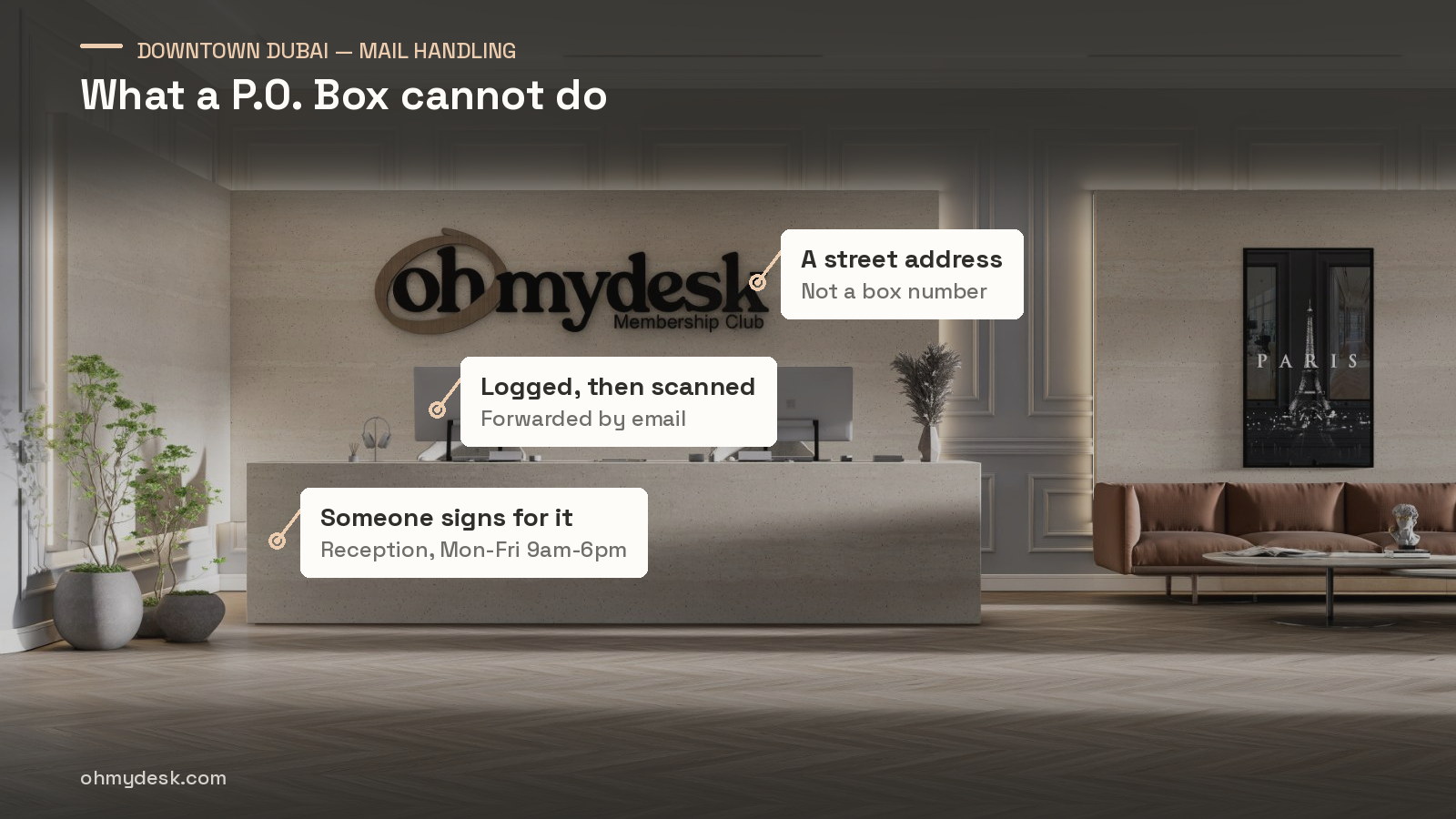
A staffed address, which does the one thing neither box product does: someone is there. A flexi-desk or coworking licence gives a company a place to work and a registered address; the postal question is then about who signs for the parcel. Our guide to what a flexi desk actually is covers how that licence category works, and it is where to start if you are choosing between structures rather than mailboxes, as is our guide to the freelance visa route in Dubai.
At Oh My Desk, mail and parcels arrive at a reception open Monday to Friday, 9am to 6pm, while members have their own access 24/7. Our Virtual Office with Ejari is AED 8,000 a year and includes a Downtown Dubai business address, the Ejari registration itself, and mail and parcels received, scanned or forwarded. A coworking membership is AED 950 a month, and a standalone Ejari booking uses the same address at our Downtown location. Prices are shown before tax; 5% VAT is added at payment. We are not a postal operator and this is not a comparison of them — for how the virtual-office category is put together, see our comparison of virtual office packages.
What should a one-licence company budget for year one?
AED 1,065 for a box and nothing else, or AED 2,060 if you have two licences. Every figure below is a published price, not an estimate.
| Situation | Lines | Year one |
|---|---|---|
| One licence, entry plan | 995 + 70 | AED 1,065 |
| One licence, entry plan, one extra agent | 995 + 70 + 100 | AED 1,165 |
| Two licences, one box | 995 + 995 + 70 | AED 2,060 |
| One licence, middle plan | 2,495 + 70 | AED 2,565 |
| If corporate prices turn out to exclude VAT, entry plan | 995 × 1.05 + 70 | AED 1,114.75 |
From year two the registration drops out and the renewal stands alone — AED 995, AED 2,495 or AED 11,995 — with the 30-day grace period as the only slack in the calendar.
How did we check these numbers?
Every price here was read on the operator's own pages on 5 October 2026: the corporate plans page, the personal plans page, the corporate terms and the Emirates Post FAQ. The licence requirements come from Dubai Economy & Tourism's new-licence service page, and the Makani wording is quoted from Dubai Municipality. The federal portal's own mail services page names Emirates Post in a sentence and does not mention P.O. Boxes, delivery or postal codes at all — worth knowing if that page is where you started.
The three third-party guides in the table were Meydan Free Zone, MENA Herald and Alfazone. We priced no removal, no licence address change and no Ejari here; those have their own published fees, in what a Dubai office relocation costs and in the UAE tax residency certificate.
FAQ: 10 quick answers
A note on where these come from. Our own search data carries zero impressions on any P.O. Box, mailbox, ZIP-code or Makani query, over two consecutive 28-day periods — this is new ground for us, so there are no real queries of ours to mine. The questions below are built from the keywords actually measured in the UAE market: po box dubai (3,600 searches a month), po box number dubai (3,600), zip code dubai (12,100), makani number (5,400), dubai postal code (2,900), uae zip code (2,900), po box renewal (880) and po box uae (260).
1. How much does a P.O. Box cost in Dubai for a company? AED 995 a year for the Basic Box, AED 2,495 for the Premium Box and AED 11,995 for the Premium+ Box, plus a one-off AED 70 registration fee. Those are the prices Emirates Post published on its corporate plans page on 5 October 2026. The same page lists a virtual P.O. Box for commercial establishments at AED 995, identical to the physical entry plan.
2. Can I use a personal P.O. Box for my business? No. Emirates Post's corporate terms state that an individual box cannot be used as a corporate box and that upgrading is mandatory, and that a box cannot be sub-leased or assigned to another person or entity. A personal MyBox is AED 300 a year against AED 995 for the corporate entry plan — 3.3 times, for the same postal function.
3. Do I need a P.O. Box to get a trade licence in Dubai? No. The Dubai Economy & Tourism page for producing a new licence does not list a P.O. Box among its requirements or its fees. The dependency runs the other way: Emirates Post requires a valid UAE commercial licence before it will sell you a corporate box, so the licence comes first.
4. What happens if I do not renew my P.O. Box? You have a 30-day grace period from the expiry date, after which the box is reclaimed and uncollected mail is returned to sender or disposed of. Emirates Post's FAQ also sets a AED 1,000 storage charge payable when you collect any mail from an expired or cancelled box — AED 5 more than a full year of the Basic Box.
5. Does the UAE have a postal code or ZIP code? No. Emirates Post's own published address format has six lines — name, P.O. Box number, physical address, emirate and telephone — and none of them is a postal code. Forms that insist on one are asking for something no UAE authority issues, so anything typed there is a convention rather than a standard.
6. What is a Makani number? A ten-digit number issued by Dubai Municipality that locates a building entrance to within one metre. Dubai Municipality describes it as "a simple addressing system consists of only 10 digits", and it has also been implemented in Ajman, Umm Al Quwain and Ras Al Khaimah. It identifies a door, not a mailbox, so it does not replace a P.O. Box.
7. Can two companies share one P.O. Box? Only by paying for it. One corporate box covers one trade licence, and each additional licence attached to the same box is AED 995 per year — the same price as a second box. Sub-leasing or assigning a box to another entity is prohibited outright by the corporate terms.
8. Do the corporate P.O. Box prices include VAT? Emirates Post does not say. Each personal plan is printed with "VAT Inclusive" beside the price, while the corporate plans page carries no VAT note at all, and the replacement key elsewhere on the site is quoted as "AED 100 + 5% VAT". If VAT is added, the Basic Box is AED 1,044.75 rather than AED 995, so ask for the figure in writing.
9. Is a virtual P.O. Box cheaper than a physical one? No — it is exactly the same price. Emirates Post lists the virtual P.O. Box for commercial establishments at AED 995 a year, the same as the Basic Box with a physical door at a branch. Neither product includes a person who signs for a parcel and tells you it arrived.
10. What does a company use instead of a P.O. Box? A staffed street address, which is what a registered office or a virtual office provides. At Oh My Desk, mail and parcels are received at a Downtown Dubai address with reception open Monday to Friday, 9am to 6pm, as part of a Virtual Office with Ejari at AED 8,000 a year before tax. A P.O. Box and a registered address answer different questions, and many companies end up holding both.
The bottom line
A corporate P.O. Box in Dubai is a small, well-documented expense with three sharp edges: it costs AED 995 where a person pays AED 300 for the same thing, a second licence doubles it, and letting it lapse costs AED 1,000 — more than the box. The widest misunderstanding is not about price at all. It is the belief that the box comes before the licence, when the operator's own terms say the licence comes first.
If what you need is an address a registrar will accept and a human being who receives your post, that is a different product from a numbered box. Our Virtual Office with Ejari is AED 8,000 a year, before tax, at a Downtown Dubai address, with the Ejari registration included and mail received, scanned or forwarded. If you would rather talk it through against your own licence situation, tell us where you are in the process and we will tell you which parts of this guide apply to you and which do not.