What does an Emirates ID cost in 2026?
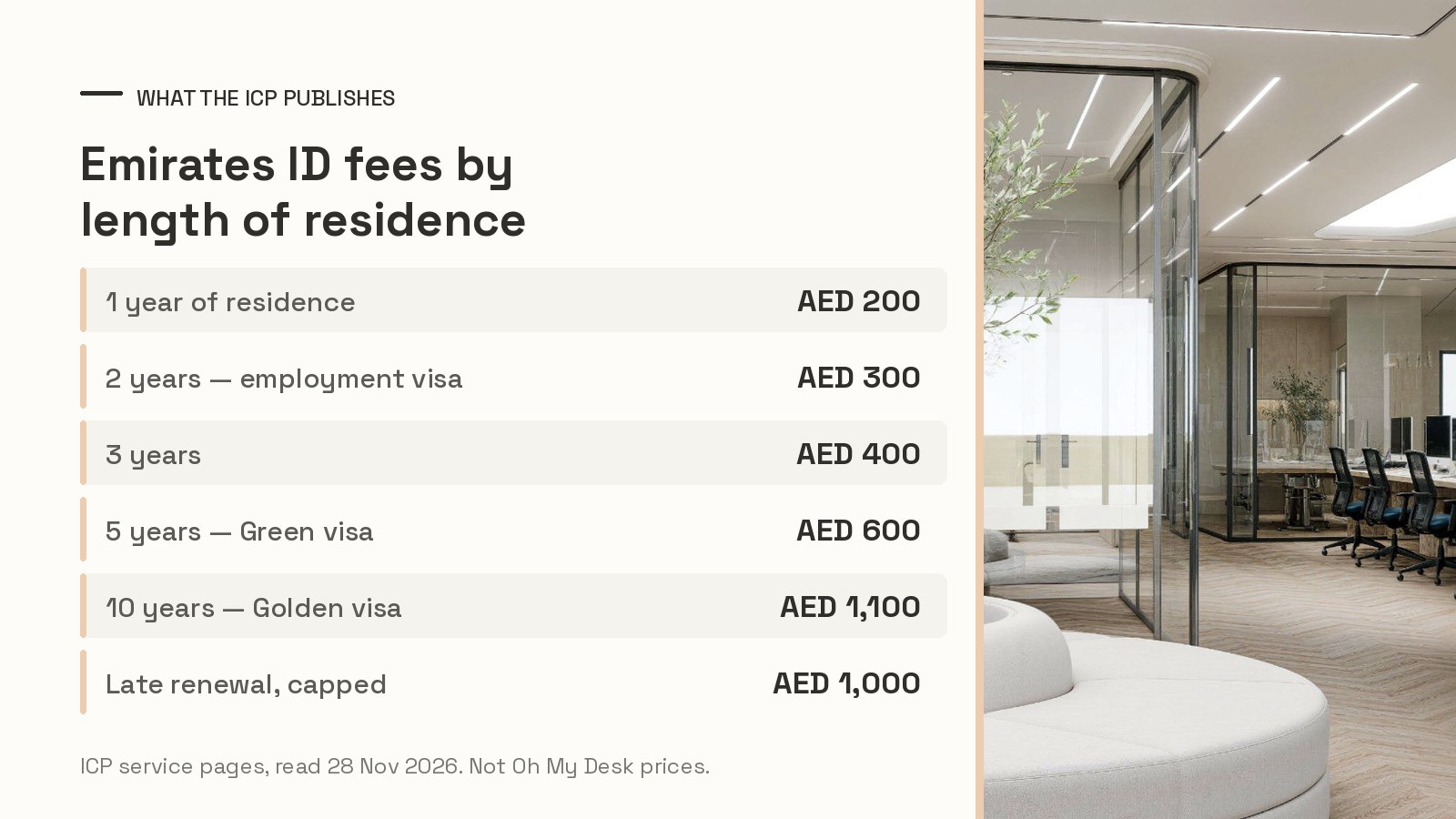
Between AED 200 and AED 1,170, and the length of your residence decides almost all of it. The Federal Authority for Identity, Citizenship, Customs and Port Security — ICP — publishes one line for residents on its New Identity Card Issuance page: “Fees for issuing a new Identity Card for residents, per year of residence — 100 AED”. Beside it sits “Smart Service Fees — 100 AED”, once per application. That is the whole published total: two years AED 300, five years AED 600, ten years AED 1,100.
Renewal is priced identically, line for line, on the Identity Card Renewal page. Nothing on either page scales with how fast you need the card or which emirate you live in. What neither page carries is the fee for the form itself — which is where almost every published budget goes wrong, and which the authority has published, just not there.
Why is the card priced as a rate and not a price?
Because the card expires with your visa, not on a calendar of its own. The federal portal says it plainly on its residence-visa page: “when the visa expires, your Emirates ID card issued by the ICP also expires”. A resident is not buying a card, they are buying coverage for a period someone else has already fixed.
So the authority meters it. Its 2011 announcement of renewal through typing offices put the rule in its clearest words: residents pay AED 100 “per each year of residence, irrespective of the remaining period of his/her residence”. You pay for the term, not for the time you will use. The 2017 denial of a fee increase adds four words the current pages dropped: “AED 100 for each year or part of the year”. A twenty-five-month permit, on that wording, is billed as three years — and no current ICP page repeats the phrase. Confirm it in writing at the counter that types your file.
What does the service page leave out of your total?
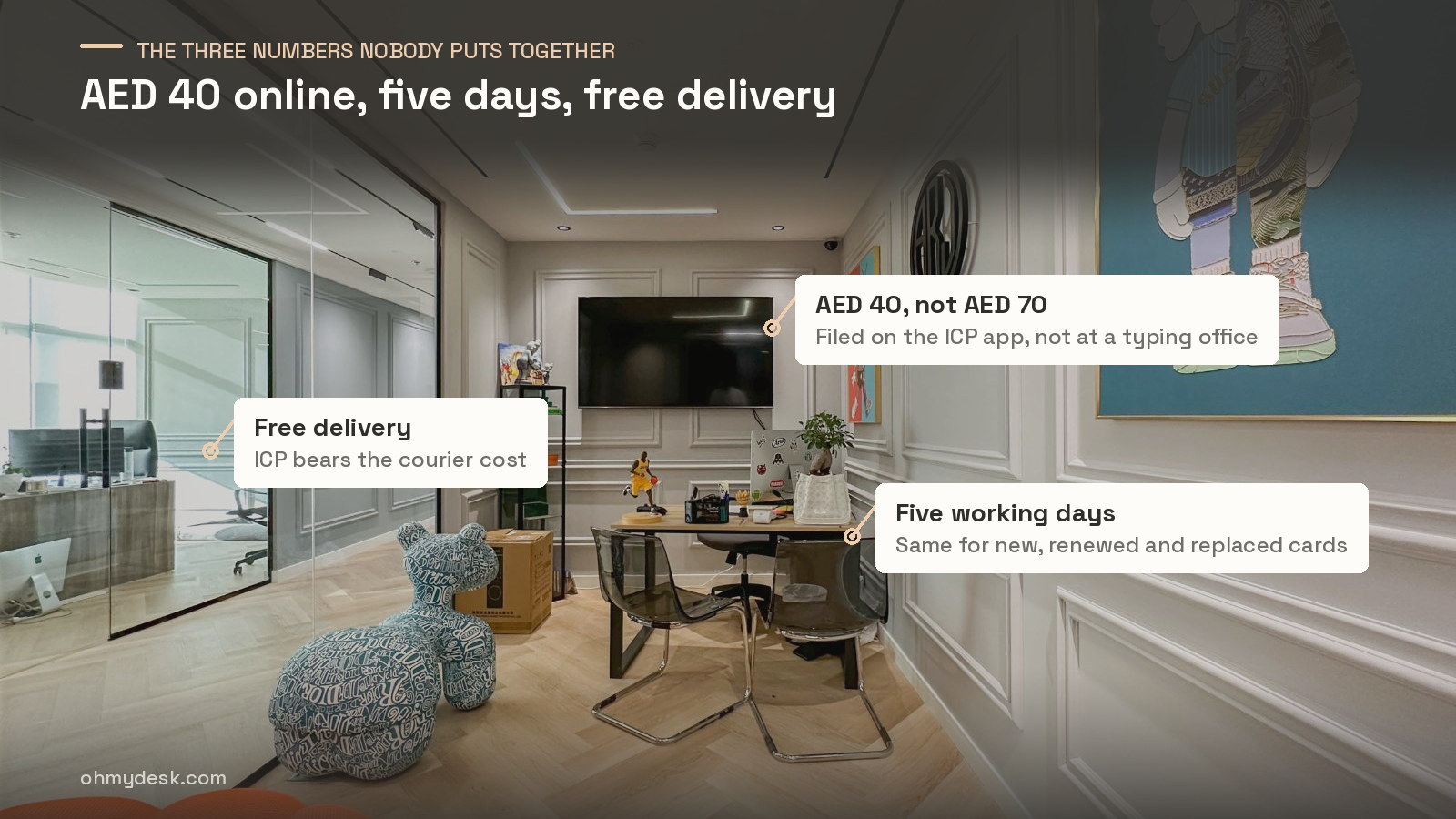
The form. Every Emirates ID application travels on a registration form, and the form is charged separately from the card. The three current service pages print no form fee at all. The authority’s 2017 statement prints two: “the electronic form fee of AED 70, which is paid at the printing offices”, falling to AED 40 “if the application is submitted via FAIC’s website or through its smart application”. That is the gap between a budget drawn from the service page and a bill at a typing centre: AED 70 on a card whose published total is AED 300.
What the AED 70 at a typing office is made of
It is itemised, and has been since 2012 — across two pages of the same authority, which is why nobody puts it together. Decision No. 3 of 2012, in the ministerial decisions on ID card fees, sets four lines; a February 2012 notice denying a delivery charge gives the split by recipient. They balance exactly.
| Line | Amount | Who keeps it | Source |
|---|---|---|---|
| Designing the registration form | AED 10 | the contracted forms company — AED 40 | Decision No. 3 of 2012 |
| Verifying the data and the attachments | AED 30 | ||
| Printing the form at the first typing centre | AED 30 | the typing centre — AED 30 | |
| Printing an amendment at any other typing centre | AED 5 | that typing centre | |
| Total paid at a typing office | AED 70 | AED 40 + AED 30 | February 2012 notice |
| Same form, filed on the ICP website or app | AED 40 | the forms company only | 2017 statement |
Why filing online saves exactly AED 30
Because AED 30 is precisely the printing line, and precisely the typing centre’s share. “The AED 70 fees paid by customers at the typing centers include AED 30 for the typing center” and “AED 40 for the company operating registration forms”, says the 2012 notice; the online price is AED 40. You are not being given a rebate, you are declining to buy the printing. It is also the only line of this bill that is yours: the card fee follows your visa, the smart service fee is fixed, the completion time is the same everywhere.
What does the card cost for each length of residence?
The arithmetic of the two published lines, across the residence lengths a Dubai resident actually holds, with the form fee in both channels. No figure here is a consultancy quotation: the first columns are the ICP service pages read on 28 November 2026, the last two add the authority’s own 2017 form fee.
| Residence | Card fee | Smart service | Published total | Filed online | At a typing office |
|---|---|---|---|---|---|
| 1 year | AED 100 | AED 100 | AED 200 | AED 240 | AED 270 |
| 2 years — standard employment visa | AED 200 | AED 300 | AED 340 | AED 370 | |
| 3 years | AED 300 | AED 400 | AED 440 | AED 470 | |
| 5 years — Green visa, property | AED 500 | AED 600 | AED 640 | AED 670 | |
| 10 years — Golden visa | AED 1,000 | AED 1,100 | AED 1,140 | AED 1,170 |
A ten-year card costs 3.7 times a two-year one, for an identical piece of plastic delivered by the same courier in the same five days. The Golden visa is the one that front-loads a decade of card fees into a single payment.
Why does a national pay AED 200 for the same ten years?
Because nationals are billed per card and residents per year, and the same renewal page carries both systems one under the other: “Fee for renewing a ten-year Emirates ID card for UAE nationals aged 21 and above — 200 AED”, against “renewal fees for the Identity Card of residents, for each year of residence — 100 AED”. Ten years of cover, AED 200 one way and AED 1,000 the other.
| UAE national, 21 and over | Resident, 10-year visa | GCC national | |
|---|---|---|---|
| How the fee is set | per card | per year of residence | per card, 5 years |
| Card fee | AED 200 | AED 1,000 | AED 100 |
| Smart service fee | AED 100 | AED 100 | AED 100 |
| Published total | AED 300 | AED 1,100 | AED 200 |
| Years covered | 10 | 10 | 5 |
| Cost per year of cover | AED 30 | AED 110 | AED 40 |
Note the oddity across the two tables: AED 200 appears twice in the same price list and means two entirely different things — ten years of a national’s card, and the bare card fee of a resident’s two-year one. It is what makes a screenshot of a fee page useless without its row label.
What happens if you renew late, and when does the fine start?
AED 20 for every day of delay, capped at AED 1,000, and it starts on day 31. The renewal page lists the penalty without a start date: “Expiration of the permitted period for renewing the identity card … with a fine imposed for each day of delay, not exceeding 1,000 dirhams — 20 AED”.
The 30-day grace period the service pages never mention
The start date lives elsewhere: in the ICP FAQ, last modified 8 October 2026 — “a grace period of 30 days from the card’s expiration date is granted to complete the renewal procedures” — and on the federal portal’s Emirates ID page: “If it is renewed after one month since expiry, a late fee of AED 20 per day will be charged, up to a maximum of AED 1,000.”
A resident who reads only the page they are paying on will believe the clock starts the day the card dies. It does not — but the page that takes the money is the one that does not say so.
Why the fine stops growing on day 80
Pure arithmetic: AED 1,000 divided by AED 20 is 50 days of fine, beginning after the 30-day grace. The cap is reached 80 days after expiry, and from day 81 waiting costs nothing more in penalty — which is not the same as costing nothing, since an expired card is an expired legal document you are required to carry.
| Day after the card expires | Fine owed | What it compares to |
|---|---|---|
| Day 1 to day 30 | AED 0 | the grace period, published in the FAQ only |
| Day 31 | AED 20 | — |
| Day 47 | AED 340 | a whole two-year card, filed online |
| Day 60 | AED 600 | the card fee of a five-year residence |
| Day 80 | AED 1,000 — the cap | the card fee of a ten-year residence, exactly |
| Day 81 and after | AED 1,000 | unchanged |
That last line is worth a second look. The maximum late fine is AED 1,000, and AED 1,000 is exactly what the card costs over ten years of residence at AED 100 a year. The penalty ceiling and the most expensive card the authority sells carry the same number. Nothing says that was deliberate — but it makes the cap easy to remember.
What does it cost to replace a lost or damaged card?
AED 300, plus the AED 100 smart service fee, whatever your nationality and age — and here is the part that stings: the replacement page states that “the new Identity Card is issued with the same validity period as the lost or damaged card”. You pay a full replacement to buy back only the time that was left — and a replacement comes to AED 400, which is exactly what a three-year renewal costs. Losing a card with two months left costs the same as renewing it for three more years.
| Line | Fee | What it buys |
|---|---|---|
| Replacement, lost or damaged | AED 300 | the remaining validity of the old card, nothing more |
| Smart service fee on the same application | AED 100 | — |
| Replacement with a data update, at an ICP centre | AED 150 | a corrected card |
| Urgent service, at ICP service centres only | AED 150 | see below — not sold to every applicant |
| Delivery of the card | AED 0 | the authority bears the courier cost |
| Replacement of a card with a manufacturing defect | AED 0 | a new card |
When a broken card is replaced free of charge
When it is not your fault. The ICP FAQ draws the line in one sentence: “If the problem is due to a manufacturing defect, such as a damaged chip, the card will be replaced free of charge”; if the damage comes from misuse, you pay. The same dead card is therefore AED 0 or AED 400, and the authority decides which — so if your chip has stopped reading and the plastic is intact, that distinction is worth arguing before you file a replacement.
When can you renew, and how long does it take?
Six months before expiry if you are a resident, one year if you are a national, and five days either way. The renewal page restricts the service to cards that have expired or where “less than six months remains before its expiry for non-UAE nationals”, and all three services carry the identical line “Service Completion Duration: 5 Days”. One more thing to plan around: the page requires a photograph that “must not be identical to the current photograph printed on the Emirates ID card”.
| Question | What the ICP service pages publish | What the ICP FAQ adds | What u.ae publishes |
|---|---|---|---|
| Card fee | AED 100 per year of residence | nothing | nothing — refers you to ICP |
| Form fee | nothing | nothing | nothing |
| Grace period | nothing | 30 days | one month |
| Late fine | AED 20 a day, cap AED 1,000 | same | same |
| Renewal window | final 6 months for residents | same | “as early as six months before” |
| Completion time | 5 days | nothing | urgent service in 24 hours |
What this guide does not price
Only the card. The residence permit, the entry permit, the establishment card and the medical fitness test are separate bills at separate authorities, costed in the investor and Green visa route and the two remote-work visa routes. Nothing here republishes a GDRFA or ICP residence fee, a DHA medical price, a degree attestation tariff or a police clearance certificate fee. The only non-ICP price below is our own Ejari line.
Can a Dubai resident buy the 24-hour service at all?
Probably not, and the AED 150 line sits on their renewal page anyway. The ICP prices an “urgent service fee (available only at the Authority’s service centers) — 150 AED” on all three services, with no category restriction beside it. The federal portal restricts it: the 24-hour service is for UAE and GCC nationals, and other expatriate residents get it “only in case of replacement of their identity cards”. So on a resident’s renewal page, AED 150 is a published line for something the other official page says is not sold to them. The one moment a resident can pay to go fast is the moment they have lost the card — which is also the moment they are already paying AED 400. Everything else is five days, and no money shortens it.
Who issues your Emirates ID if you live in Dubai?
The ICP does, federally — and Dubai is carved out of the route the ICP describes. The renewal page tells residents to apply together with the residence application “through the unified residence and identity form, in all emirates of the country except the Emirate of Dubai”. It does not then say what a Dubai resident should do instead.
Dubai’s own immigration authority does not fill the gap. On the GDRFA Dubai FAQ, read on 28 November 2026, the Emirates ID appears only as something you bring: an “Emirates ID registration form” among the residence-stamping requirements, a sponsor’s card among the visit visa documents. No service, no fee, no processing time for the card. GDRFA’s services index refused automated reading that day, and we say so rather than guess. The federal portal then closes the loop by sending you back where you started: applicants “must also pass a security check and apply for an Emirates ID card from Federal Authority for Identity and Citizenship”, and “check with the ICP if this applies to your emirate of residence”.
Three official sources, and the one category none of them routes end to end is the Dubai resident. Ask your typing office for the breakdown in writing and check it against three lines: card fee by year, AED 100 smart service, AED 40 or AED 70 of form.
What does the ICP never charge you for?
Delivery, and asking to be let off the fine. The February 2012 notice exists precisely to deny a delivery charge: the authority “does not charge any fees for delivering ID cards to their owners” and bears that cost through the postal centres. The issuance page matches it today — the standard card is “delivered through the authorized courier”.
The second is less known and more useful: the 2017 statement says the authority charges nothing “for applying for exemption from delay fines”. The application that could remove up to AED 1,000 is itself free. And once the card is issued, the FAQ notes you can view the electronic version in the ICP UAE application — which does not lift the obligation to “carry it with them at all times”, but means a card left at home is not a reason to pay AED 400.
Who can have the late fine written off
Five categories, set in 2012 and never withdrawn, and one of them is remarkable. Decision No. 2 of 2012 exempts from the delay fine people who left the UAE for more than six months, deported persons, deceased persons or people with a communicable disease, certain people not issued a card before or after obtaining a UAE passport — and delays caused by errors in the attachments, or by the authority itself, or by its typing centres.
Read that last one slowly: if the office that typed your form made the mistake that made you late, the fine is written off, and asking costs nothing. A separate 2017 list names the fee exemptions, a different thing: social security customers, people of determination, autistic patients and people over 70.
FAQ: 10 quick answers
This vocabulary barely touches our own traffic: Search Console shows three named queries on “emirates id” over the 28 days to 27 November 2026, and five over the 28 before that — thirteen impressions in all, served by our freelance visa guide. The questions below come from those real queries (emirates id fees, new emirates id fees for 2 years, how much emirates id cost, how much to renew emirates id, emirates id typing charges) and from three keywords measured on Semrush for the UAE on 31 October 2026.
1. How much does an Emirates ID cost in the UAE? AED 100 for each year of residence plus AED 100 of smart service fees, on the ICP’s own service pages: AED 300 on a two-year visa, AED 600 on a five-year one, AED 1,100 on a ten-year one. A form fee of AED 40 online or AED 70 at a typing office sits on top, printed on none of those pages.
2. How much is an Emirates ID for two years? AED 300 published — AED 200 of card fee and AED 100 of smart service — which becomes AED 340 filed on the ICP app and AED 370 at a typing centre. That is the card behind an ordinary employment visa.
3. How much does it cost to renew an Emirates ID? Exactly what it cost to issue it. The renewal page carries the same two lines, AED 100 per year of residence and AED 100 of smart application fees, and the 2017 authority statement says renewal fees “are the same as the issuance fees”.
4. What is the fine for a late Emirates ID renewal? AED 20 for every day of delay, capped at AED 1,000, starting only after a 30-day grace period. The cap is reached 80 days after expiry, so the penalty stops growing there — the obligation to hold a valid card does not.
5. Is there a grace period to renew an Emirates ID? Yes, 30 days from the card’s expiry. It is published in the ICP FAQ and on the federal portal, and absent from the renewal service page that takes the payment, which lists the daily fine with no start date.
6. What are the Emirates ID typing charges? AED 70 at a typing office, against AED 40 if you file on the ICP website or smart app. The AED 70 is AED 10 to design the form, AED 30 to verify the data and AED 30 to print it — so filing online removes exactly the printing line.
7. How long does an Emirates ID take? Five days. All three ICP services publish the same “Service Completion Duration: 5 Days”. A 24-hour urgent service exists at AED 150, but the federal portal limits it to UAE and GCC nationals, and to residents only when replacing a lost card.
8. What does it cost to replace a lost Emirates ID? AED 300 plus AED 100 of smart service fees, for a card carrying only the validity left on the one you lost. A replacement with a data update at an ICP centre is AED 150, and a card that failed through a manufacturing defect is replaced free of charge.
9. When can I renew my Emirates ID in the UAE? In the final six months before expiry if you are a resident or a GCC national, in the final year if you are a UAE national, and at any time after expiry subject to the fine. You will need a new photograph: the page refuses one identical to the current card.
10. Who issues the Emirates ID in Dubai? The ICP, federally. Its renewal page routes residents through the unified residence and identity form “in all emirates of the country except the Emirate of Dubai”, and GDRFA Dubai publishes no Emirates ID service, fee or processing time of its own.
The bottom line
Four things follow. File on the ICP website or app rather than at a counter and keep the AED 30 — the only line of this bill you control. Diarise the card six months before expiry, because that is when the renewal window opens. Treat day 31 as the real deadline and day 80 as the point where the penalty tops out at the price of a ten-year card. And if the delay came from the office that typed your file, ask for the exemption: it is written into a 2012 decision and costs nothing to request.
We write these guides because members ask them between meetings, not because we issue cards. What we run is the address at the other end of the paperwork: a Virtual Office with Ejari at 8,000 AED a year, which is bookable here, coworking from 950 AED a month, and a private office from 6,000 AED. Prices are before VAT; members badge in 24/7 and reception is open Monday to Friday, 9am to 6pm, at Downtown, Business Bay and Dubai Design District. Tell us where you have got to.