

What does a UAE police clearance certificate cost in 2026?
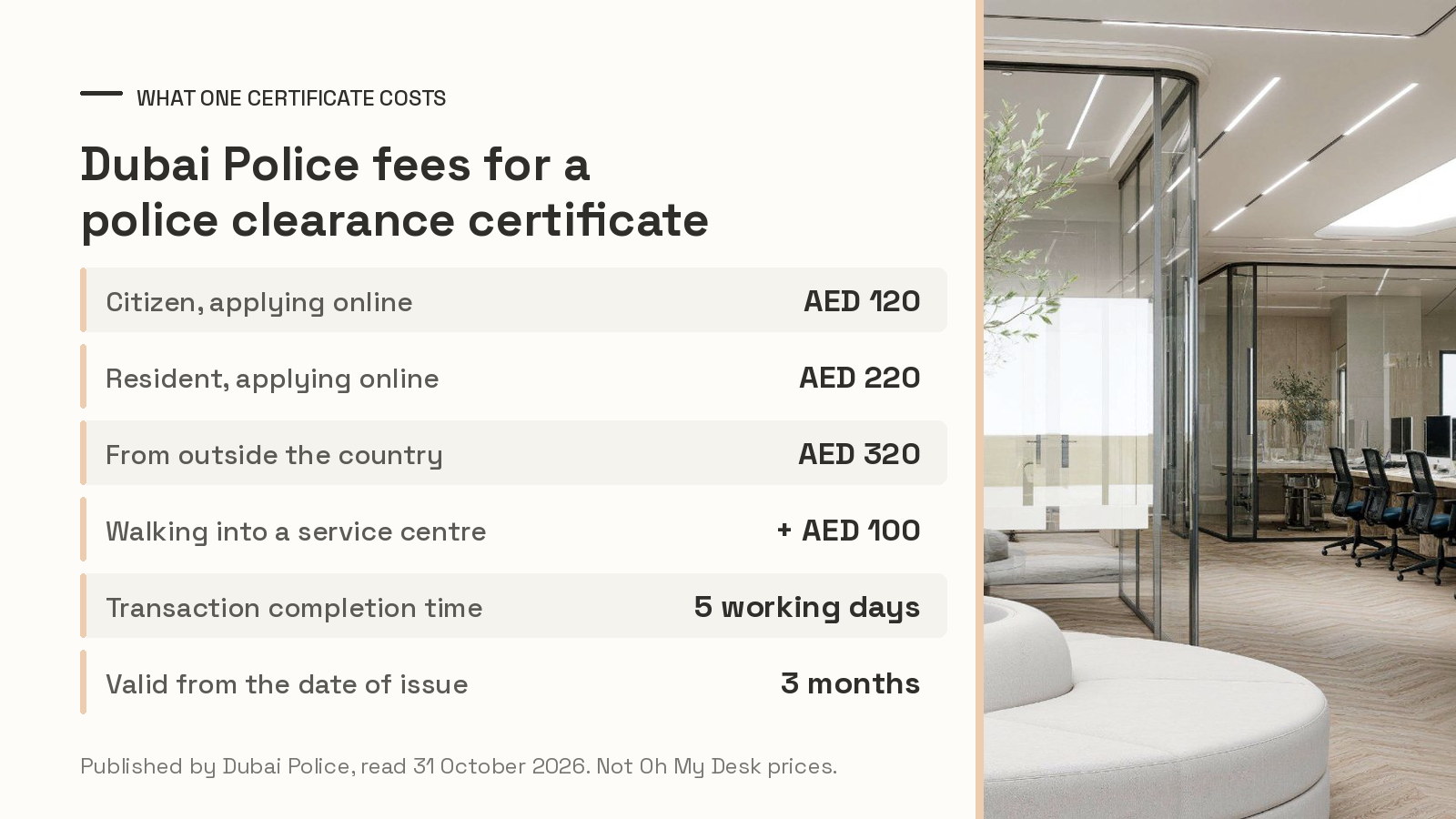
A UAE police clearance certificate costs AED 120, AED 220 or AED 320, and which one you pay depends on who you are rather than on what you ask for. The Dubai Police service page prints four fee lines for a single document: AED 100 for a citizen, AED 200 for a resident, AED 300 or $88 from outside the country, and AED 20 of Knowledge and Innovation fees on top. Add the AED 20 and the three totals are 120, 220 and 320. There is a fifth line, and it is the one people meet without expecting it: AED 100 more “if applied through service centers in person”.
Nothing suggests the document changes. Same certificate, same force, same five working days, same sentence: the holder has no criminal record in the UAE. The fees are non-refundable, which matters because the application can be refused — Dubai Police will not issue to anyone wanted by an authority.
The fee lines, as published
| Fee line, in Dubai Police’s own wording | Amount |
|---|---|
| Citizen | AED 100 |
| Resident | AED 200 |
| From outside the country | AED 300 or $88 |
| Knowledge and Innovation fees | AED 20 |
| Additional fee if applied through service centers in person | AED 100 |
Read 31 October 2026. These are Dubai Police fees, not ours.
Why are the three prices exactly AED 100 apart?
Put the totals in a column and the structure is hard to unsee. A citizen pays 120. A resident pays 220. Someone abroad pays 320. Each step up is exactly AED 100, and the surcharge for walking into a service centre is exactly AED 100 as well. The counter is therefore worth precisely one rung of the nationality ladder.
Which produces two equalities nobody prints. A citizen who walks in pays AED 220, what a resident pays on a phone. A resident who walks in pays AED 320, what someone on another continent pays on a phone. The queue costs a Dubai resident the same as being four thousand kilometres away.
As ratios rather than steps: a resident pays double a citizen, an overseas applicant triple. One authority, one document, several prices set by the status of the person asking — what is unusual is that the step is a round hundred and the channel surcharge matches it to the dirham.
| Who is asking | Online, app or website | In person at a service centre |
|---|---|---|
| UAE citizen | AED 120 | AED 220 |
| UAE resident | AED 220 | AED 320 |
| Applying from outside the country | AED 320 | AED 420 |
Totals include the AED 20 Knowledge and Innovation fee. The in-person column applies the published AED 100 service-centre surcharge.
Does the $88 option cost the same as AED 300?
The overseas line reads “AED 300 or $88”, as though the two were the same money. They are not. The Central Bank maintains a fixed rate for the dirham against the dollar and publishes both sides of it: it buys dirhams at 3.673 and sells them at 3.672. Its monthly rate sheet prints the dollar at 3.6725 for 1 September 2026.
At those rates, $88 is AED 323.14 to AED 323.18. The dirham price for the same line is AED 300. Paying in dollars therefore costs about AED 23 more, or 7.7%, for an identical PDF — a rounding choice rather than an exchange-rate risk, because the rate is fixed and has not moved.
It is a small number, worth knowing for one reason: it is the only line in the fee table with two prices at once. Everywhere else the price follows the person; here it follows the currency button.
| Rate used | $88 converted | Difference against AED 300 |
|---|---|---|
| CBUAE sell rate, 3.672 | AED 323.14 | + AED 23.14 (+7.71%) |
| CBUAE monthly sheet, 3.6725 | AED 323.18 | + AED 23.18 (+7.73%) |
How long does it take, and how long does it last?
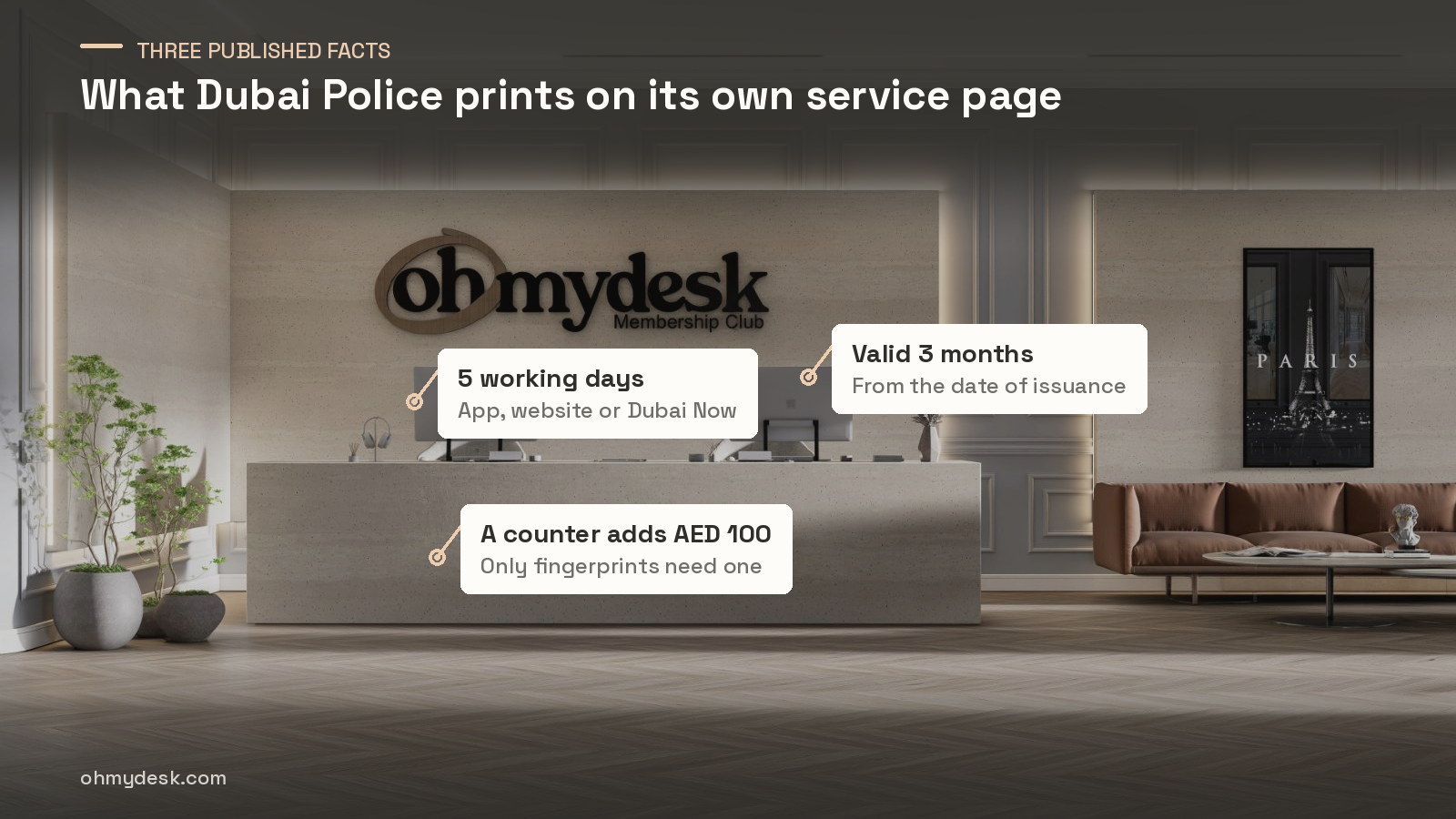
Dubai Police gives one number for speed and one for shelf life: the transaction completion time is 5 working days, and “the certificate is valid for 3 months from the date of issuance”. A few lines apart on the same page, they define the only window that matters.
Three months is not three months of usable document. Five working days come out of it before the certificate exists, and if a receiving authority wants it attested, each stamp takes more. Ask too early and it expires in a drawer; ask too late and five working days sit between you and a file that cannot be submitted. Neither failure is expensive. Both cost calendar.
The channels are not the constraint. The app, the website, Dubai Now, the 901 call centre and the Smart Police Stations all run 24/7; only police stations keep hours, 7:30am to 10:00pm, and the only reason to go to one is fingerprints. The MOHRE’s own FAQ uses the same three-month window when it licenses recruitment agencies, so the validity is not a Dubai quirk.
Who can apply from outside the UAE, and who cannot?
The overseas route has one condition that catches people out, and it is not about money: Dubai Police issues to someone outside the country only if the applicant has previously entered the UAE. The certificate attests to a record held here; if you have never been here, there is none to attest to — which is why an employer importing a brand-new hire has to look at that person’s home country instead.
Fingerprints are the real queue
Two groups cannot complete the application on a screen. Applicants with no Emirates ID at all must attend a service centre in person during working hours to be fingerprinted, at Al Qusais, Ports, Al Rashidiya or Jebel Ali police station. Applicants abroad whose ten-print fingerprints are not already on file must send a fingerprint card attested by a UAE embassy. Everyone else, including holders of an expired Emirates ID number, stays online.
The paperwork from abroad is short: a personal photo, a passport copy, a copy of the previous residence visa. The federal portal says the same in fewer words, and adds the detail that decides your price before you start: fees vary “by language, nationality and place of residence”.
Does a UAE work visa actually require one?
Yes — conditionally, and in writing. The ICP visa issuance page lists the documents for a work mission, and item nine reads, word for word: “A certificate of good conduct, duly attested as required, according to the announced categories.” It sits between a medical fitness certificate and a travel ticket, beside the passport and the employment contract.
Three things follow. The requirement is real and federal, not a rumour. It applies to some applicants, since a rule for everybody would not need categories. And the certificate must be attested, so the cost of complying is not the AED 320 above — it is a home-country certificate plus the legalisation chain, and we have priced what attestation costs separately.
What the sentence does not do is name anybody. Here is what each authority’s own page lists, read the same morning.
| Authority | Page read | Good conduct certificate? |
|---|---|---|
| Federal identity authority (ICP) | Visa issuance, work mission | Yes — “according to the announced categories” |
| Federal identity authority (ICP) | 2024 services guide, still published | Not mentioned at all |
| Dubai residency directorate (GDRFA) | Visa for foreigners linked with a job contract | No |
| Dubai residency directorate (GDRFA) | Individual residence entry permit requirements | No |
| Labour ministry (MOHRE) | Recruitment agency licensing FAQ | Yes — for the agency applicant, valid 3 months |
| Federal portal (u.ae) | Justice e-services | Describes the document, publishes no fee |
Where are the “announced categories” published?
Nowhere we can find. The phrase “the announced categories” appears on the service page and is defined neither there nor in the authority’s FAQ, and its 2024 services guide — still published on the same site — does not mention a good conduct certificate at all.
That silence is a choice, not an oversight, and the proof is one line further down the same list. Item ten reads “Copy of the personal identification document (Afghanistan / Iran / Iraq)”. The authority names nationalities in a bracket when it wants a document from particular passport holders. For the conduct certificate, on the same page, in the same list, it does not.
For an employer the consequence is simple and unpleasant: you cannot look up whether your candidate is in scope, only ask the channel that will process the file. Plan for it — assume the certificate may be asked for, start it early enough that three months still covers the submission date, and do not pay for attestation until somebody confirms it is needed.
Why does Dubai’s own immigration authority not ask for it?
This is the part that surprises people who have hired here before. The emirate’s own residency directorate, which issues the visa that lets your new employee live here, does not ask for a conduct certificate on its own service page. The list is three items: a personal photo, “a passport copy with at least a six-month validity period”, and an endorsed work permit. Completion, 48 hours.
Its residence entry permit requirements are longer — eleven items, from an attested tenancy contract to the latest water and electricity bill — and a conduct certificate is not among those either. If “do I need a police clearance for Dubai?” gets opposite answers from two people who have both done it recently, this is why: two authorities, both read correctly.
The two are not in conflict: the federal authority issues the entry permit, the emirate issues the residence file, and a document can be required upstream without appearing downstream. But the honest answer to an employer is not “Dubai requires it”. On its own published pages, Dubai does not. The requirement, where it exists, is federal.
What happened the last time this was made mandatory?
There is a precedent, short enough to remember before anyone treats a requirement as permanent. A rule obliging employment visa applicants to produce a legalised certificate of good conduct from their home country, or from a country lived in during the previous five years, took effect on 1 February 2018. The Cabinet suspended it from 1 April 2018, until further notice — an immigration alert of 3 April 2018 two days later recorded both dates.
Fifty-nine days. That is the whole life of the most-quoted version of this requirement, and guides written since have had seven years to repeat it as settled law.
| Date | What changed | Source |
|---|---|---|
| 1 February 2018 | Certificate required for employment visa applicants | Reported in immigration alerts at the time |
| 1 April 2018 | Cabinet suspends the requirement, until further notice | Immigration alert of 3 April 2018 |
| 31 October 2026 | Federal visa page lists it “according to the announced categories” | ICP service page, read today |
| 31 October 2026 | Dubai’s own employment visa page lists three documents, none of them this one | GDRFA service page, read today |
Do the published guides agree with the authorities?
They agree with each other and cite nobody. Three commercial pages read the same morning tell the same story: the federal identity authority has made the certificate compulsory for new work visa applications from 45 nationalities, phased across three dates in 2026 — 16 June, 15 August and 15 November — in groups of 23, 11 and 11.
Not one names a circular, a resolution number, a gazette reference or a government page. Their links point to their own services, or to three authority homepages. One tells readers to “check the official ICP portal” for updates — an odd instruction from a page claiming to have the list — and admits, in its own words, that “the list of nationalities and dates has been reported inconsistently”. A second contradicts itself about scope inside one page: work visas in the body, residence visas generally in the FAQ.
We are not republishing the list. A nationality list should come from the authority applying it; when the authority publishes nothing, repeating it turns three unsourced pages into four. What can be said honestly: the guides converge, convergence between secondary sources is not evidence, and the third date they all name falls a fortnight from now.
| Question | What the three guides say | What the authorities publish |
|---|---|---|
| Who requires it | ICP, for 45 nationalities | ICP, for “the announced categories”, unnamed |
| From when | 16 June, 15 August and 15 November 2026 | No date published |
| Scope | New work visas; one page says residence visas generally | Work mission document list |
| Validity | “90 days” | 3 months from the date of issuance |
| Source cited | None | — |
The validity row is the tell. Three months and ninety days are not the same length, and the number that matters is the one the issuing force prints.
Who needs one when no visa is involved?
Plenty of people need this certificate with no visa in sight, and Dubai Police says so: it is issued “for the work, study, immigration, obtaining a license or other uses”. Three of those four have nothing to do with entering the country.
The clearest worked example is in MOHRE’s own FAQ. Licensing a domestic worker recruitment agency requires a “Certificate of Good Conduct / Police Clearance Certificate valid for 3 months from the date of issue”, and the agency must separately certify that the worker it recruits has no criminal record. That is a business licensing requirement with the validity attached — more precision than the visa route gets. Sponsoring domestic help yourself is a different route, and we have costed the maid visa separately.
The other common use is outward: a resident applying for a visa, a licence or a university place abroad, asked for a certificate covering the years they lived here. That version needs attestation, and its three-month clock is the tightest.
What does the federal government publish about the price?
Nothing. The federal portal describes the certificate properly — “known also as ‘Good Conduct Certificate’”, “a proof of lack of the person’s criminal record” — names the police departments that issue it, links to the interior ministry and to Dubai Police, then declines to print a number: “Fees and time of the service are indicated in the service card.”
It does say something more useful than a figure: fees vary by language, nationality and place of residence. Nationality and residence are visible in the Dubai table above. Language is the one nobody discusses — and no readable federal page puts a number against it.
We tried. The interior ministry’s services portal refuses automated reading outright; its two pages for issuing and for authenticating a criminal record certificate served a loading screen and no content. The Abu Dhabi government portal did the same, and two of Dubai Police’s own alternate addresses returned server errors. So this article publishes no federal fee and no Abu Dhabi fee — not because none exists, but because a number you cannot read at its source is a number you should not copy. One commercial guide prints AED 50 and AED 100 for the federal route; we name that it exists and leave it unverified.
FAQ: 10 quick answers
1. How much is a police clearance certificate in the UAE? Dubai Police charges AED 120 to an Emirati, AED 220 to a resident and AED 320 from outside the country, each total including the AED 20 Knowledge and Innovation fee. Applying in person at a service centre adds AED 100 to any of those. The fees are published, and non-refundable.
2. How long does a UAE good conduct certificate take? Five working days, the transaction completion time Dubai Police prints on the service itself. The digital channels take the application 24/7 — app, website, Dubai Now, the 901 call centre, the Smart Police Stations — so the clock is the only queue.
3. How long is a UAE police clearance certificate valid? Three months from the date of issuance, in Dubai Police’s own words. The labour ministry uses the same window in writing, requiring a certificate “valid for 3 months from the date of issue” to license a recruitment agency. Five working days come out of it first.
4. Can I get a UAE police clearance certificate from abroad? Yes, but only if you have previously entered the UAE. Dubai Police takes applications from abroad for AED 300 plus the AED 20 fee, with a personal photo, a passport copy and a copy of the previous residence visa. Anyone without ten-print fingerprints on file sends a card attested by a UAE embassy.
5. Do I need an Emirates ID to apply? No, but without one you cannot stay online. Dubai Police accepts a valid or an expired Emirates ID number on the digital channels; applicants with none must attend a service centre in person to be fingerprinted, at Al Qusais, Ports, Al Rashidiya or Jebel Ali police station.
6. Is a good conduct certificate required for a UAE work visa? The federal identity authority lists one. Its visa issuance page asks a work-mission applicant for “a certificate of good conduct, duly attested as required, according to the announced categories” — a requirement that applies to some applicants and not others, with the categories named nowhere on the page.
7. Which nationalities need a police clearance certificate for the UAE? No authority publishes a list. Three commercial guides publish the same one — 45 nationalities across three dates in 2026 — and none cites a circular, a resolution number or a government page. The authority’s own page names nationalities elsewhere, for a different document.
8. Does Dubai’s immigration authority ask for a good conduct certificate? Not on the page where it would appear. The Dubai residency directorate’s employment visa service lists a personal photo, a passport copy valid at least six months and an endorsed work permit, and nothing else. Its residence entry permit list runs to eleven documents, none of them this one.
9. Was a good conduct certificate ever compulsory in the UAE? Yes, for two months. The requirement applied to employment visa applicants from 1 February 2018 and the Cabinet suspended it with effect from 1 April 2018, until further notice. Anyone quoting 2018 as settled law is quoting a rule that lived eight weeks.
10. What does a police clearance certificate prove? That you have no criminal record in the UAE, from a security and criminal point of view. The federal portal defines it as “a proof of lack of the person’s criminal record”. Dubai Police issues it for work, study, immigration, licensing and other uses, and will not issue it to anyone wanted by an authority.
What to do next
If somebody has asked you for a UAE police clearance certificate, the order is short. Confirm who is asking and for what, because the price and the attestation chain both depend on it. Apply through the app rather than a counter unless you need fingerprints taken — that one choice is AED 100. Budget AED 220 as a resident and five working days, and work backwards from the date the document must be submitted, not the date you want it in hand.
We write these because our members ask them between meetings, not because we issue certificates. What we do is the desk the paperwork gets done at: Downtown, Business Bay and Dubai Design District, with coworking from 950 AED a month, a dedicated desk at 1,500 AED in Downtown and private offices from 6,000 AED, all inclusive. If the file needs a registered address rather than a seat, that is Virtual Office + Ejari at 8,000 AED a year, and you can start it online. Prices are before VAT; reception is open Monday to Friday, 9am to 6pm, members have their badge 24/7.
Still working through the rest? We have priced what a work permit actually costs, mapped the freelance visa route in Dubai and explained how Ejari works in Dubai. Or tell us where you have got to.