What does it cost to sponsor a domestic worker in Dubai in 2026?
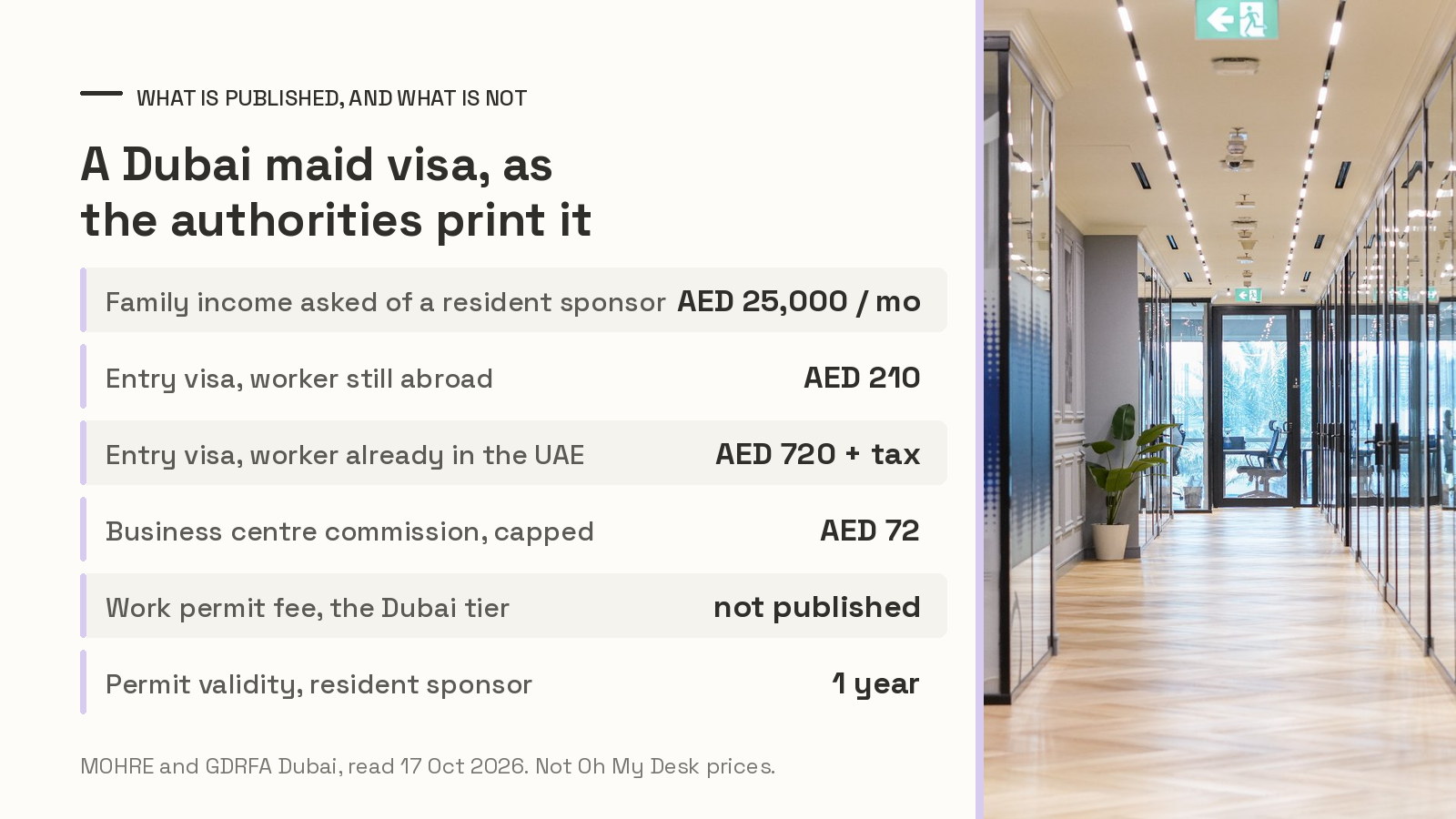
The answer is in two parts, and only one is published. Dubai’s General Directorate of Residency and Foreigners Affairs prints its side to the dirham: AED 200 plus 5% VAT for the work entry visa, and AED 520 more — a AED 500 fee inside the country, a AED 10 Knowledge Dirham, a AED 10 Innovation Dirham — if the worker is already in the UAE. The federal ministry that issues the work permit names three fee tiers on its own service page and prints no amount against any of them.
So the single number most people come looking for does not exist. What does exist is a qualifying condition that comes before all of it: a monthly family income of AED 25,000.
| Published by | Line | Amount |
|---|---|---|
| GDRFA Dubai | Work entry visa, worker abroad | AED 200 + 5% VAT = AED 210 |
| GDRFA Dubai | Fee inside the country | AED 500 |
| GDRFA Dubai | Knowledge Dirham | AED 10 |
| GDRFA Dubai | Innovation Dirham | AED 10 |
| GDRFA Dubai | Residence permit, private sector page | AED 200, plus AED 20 delivery |
| MOHRE | Work permit, all emirates except Dubai, two years | no amount printed |
| MOHRE | Work permit, all emirates except Dubai, one year | no amount printed |
| MOHRE | Work permit, the Emirate of Dubai | no amount printed |
| MOHRE | Business centre commission, capped | AED 72 |
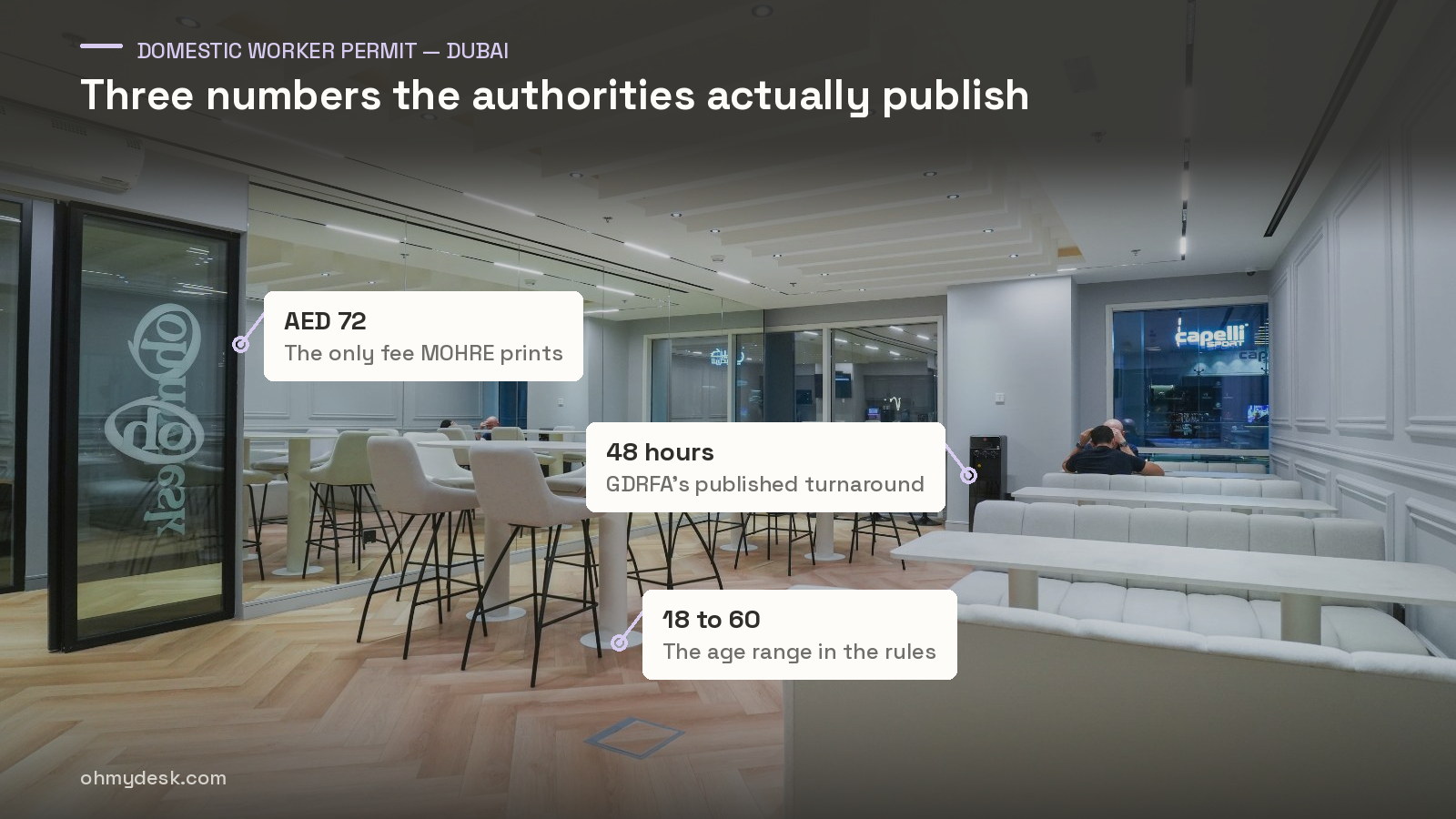
Read the bottom rows twice. The only dirham figure in the ministry’s fee section is a ceiling on what a typing centre may charge to fill in the form.
Why does MOHRE ask for AED 25,000 before it asks for a fee?
Because the condition is about the household, not the transaction. The ministry’s document list asks an expatriate sponsor for a recent salary certificate showing family income of at least AED 25,000 and, for an investor or an employer declaring a monthly income at that level, a bank statement covering the previous three months. It also asks for proof of housing — a lease or a title deed — and, where the sponsor is married, the marriage contract and the spouse’s residence visa.
Put the two halves side by side and the shape is clear: the qualifying income is roughly 34 times the whole published Dubai fee. The cheapest part of a maid visa is the visa.
One clarification, because guides get this wrong in both directions: the proof of housing here is residential. A business address is not a substitute — our own Virtual Office and Ejari package at AED 8,000 a year registers a company, not a household. For the mechanics themselves we have a complete guide to how Ejari works in Dubai, and no other Ejari tariff appears on this page.
Five workers, then you explain yourself in writing
There is a ceiling, and it is unusually explicit. An employer hiring more than five domestic workers must submit a written justification for the additional hire. Nothing says the justification is normally refused. It says it is required.
Eighteen to sixty, with one exception
The worker must be at least 18, and the ministry states an age limit of 60. One exemption is named: a worker already inside the UAE whose residence visa was cancelled by a domestic labour employer, where the termination date is no more than three months prior. Their passport must have at least three months of validity left, and they must not already hold a valid work permit.
Which fees does the federal ministry actually publish?
Three tiers and one ceiling. The service page sets out its fees as a numbered list: permits in all emirates except Dubai for two years, the same for one year, and a third line reading simply “The Emirate of Dubai”. Against each of the three, nothing. The page then says the service is free through the ministry’s website and smart app apart from federal charges, and that the fees shown exclude tax and collection charges — without a figure for either.
What it does give is that AED 72 cap on a business centre’s commission, and it is the number almost nobody quotes. If a typing office asks for more than AED 72 to submit this application on your behalf, the ministry has already said where the ceiling is.
We met this pattern pricing what it costs to get a degree attested in the UAE: a federal page that names the categories and leaves the amounts elsewhere. No attestation figure appears here; that article has them.
What does Dubai charge, to the dirham?
GDRFA Dubai publishes one service page that names domestic service workers outright: the work entry visa, which lets the worker land and stay “sixty days from the date of entry until the completion of the requirements for obtaining residency”, covering the government sector, the private sector and domestic service workers in a single line.
Its fees, as printed: “Work visa fee: AED200”, “In addition to the value-added tax (5%)”, and then, only if the sponsored person is inside the country, “Knowledge Dirham: AED10”, “Innovation Dirham: AED10”, “Fee inside the country: AED500”. Expected completion: 48 hours.
| Where the worker is when you apply | Published total | Ratio |
|---|---|---|
| Outside the UAE | AED 200 + 5% VAT = AED 210 | — |
| Already inside the UAE | AED 720 before tax, AED 730 to AED 756 with it | 3.4× |
Two things about that second row. The premium for being already in the country is AED 520 on a service whose headline price is AED 200: where a human being is standing, not the work done, more than triples the bill. And the page attaches “in addition to the value-added tax (5%)” to the AED 200 while saying nothing about the other three lines. On the AED 200 alone the total is AED 730; on the whole AED 720 it is AED 756. The uncertainty is AED 26, and it belongs to the page, not to the reader.
Then comes the residence permit, and here Dubai goes quiet differently. GDRFA has a priced page for private sector residence permits — AED 200, the same AED 10 and AED 10, AED 500 inside the country, AED 20 delivery, two years, 48 hours, the issuance fee rising “by AED100 annually whenever the residency is over two years”. It does not mention domestic workers anywhere. The only Dubai page that names them is the entry visa page.
Why is the permit one year for you and two for your neighbour?
This is the detail that changes the arithmetic most, and it is stated flatly on the ministry’s own page: the validity of a domestic worker permit depends on who the sponsor is.
| Sponsor | Permit validity |
|---|---|
| UAE citizen | Two years |
| GCC citizen, diplomat, golden visa holder | Optional, one to two years |
| Resident | One year |
Same worker, same home, same job description. A resident sponsor runs the renewal cycle twice as often as a citizen sponsor, and pays the unprinted federal charge twice as often with it. It sits awkwardly against an entitlement further down this page: the worker’s paid ticket home falls due every two years — after a resident’s permit has already been renewed once. And if you hold a golden visa, read the middle row again: the one-to-two-year choice is yours, and taking two halves your renewal count.
What does GDRFA’s own press release say each file saves?
On 16 July 2026, GDRFA Dubai announced that its Domestic Workers’ Management service had been recognised as the Best Digital City Experience under the Hamdan bin Mohammed Programme for Government Services. It describes nine services — contract, health cover, work permit, visa, residence permit, Emirates ID — merged into one journey, and publishes its own numbers.
| What GDRFA published on 16 July 2026 | Figure |
|---|---|
| Services merged into one | 9 |
| Completion steps | 11 → 6 |
| Payment channels | 6 → 1 |
| Required visits | 6 → a maximum of 2 |
| Transactions completed | 10,813 |
| Paper documents eliminated | 25,676 |
| Direct customer savings | AED 4,325,200 |
| Saving per file, 4,325,200 ÷ 10,813 | AED 400.00 |
| Paper documents per file, 25,676 ÷ 10,813 | 2.37 |
Nobody printed the bottom two rows, and they are the only per-file figures published anywhere in this subject. The division lands on exactly AED 400.00, to the dirham, which tells you something honest about its nature: a total that divides that cleanly is a flat per-file assumption multiplied out, not a measured sum. It is still the clearest public statement of what the old route cost a household — and 2.37 sheets of paper per file is a reminder that this was, until very recently, a counter-and-folder process.
Which jobs count as domestic work, and which do not?
The governing text is Federal Decree-Law No. 9 of 2022 on domestic workers, as amended by Federal Decree-Law No. 21 of 2023, with Cabinet Resolution No. 106 of 2022 as its executive regulations. It applies to 19 occupations, and the list is wider than the word “maid” suggests: housemaid, cook, nanny or babysitter, gardener, private tutor, home nurse, personal assistant, personal or family driver, housekeeper, farm worker or grower, personal trainer or coach, private agricultural engineer, guard, shepherd, sailor, jockey, tamer, falcon care-taker and worker.
Two consequences. A family driver and a private tutor are sponsored under this law, not under a company work permit, so the AED 25,000 test and the one-year resident validity apply to them too. And a role not on the list cannot be bent onto it: the law forbids changing a worker’s profession without consent or outside the listed professions. If what you need is an employee for your company rather than your home, that is a different permit, and we have priced the company route separately.
What do you owe the worker once they arrive?
The entitlements are statutory, not negotiable away in the contract, and they are the part of the cost that recurs. The contract itself must be concluded on the ministry’s approved template, with a copy given to the worker.
Every week, every month
| Entitlement | Minimum set by law |
|---|---|
| Weekly rest | One paid rest day a week |
| Daily rest | 12 hours, including at least 8 consecutive |
| Wages | Paid “within 10 days from due date” |
| Accommodation, meals, clothing | Provided by the employer |
| Medical care or health insurance | Provided by the employer |
| Identity papers | The worker keeps their own passport and ID |
That last line is the one new arrivals most often get wrong: the worker keeps their own identity papers. Holding a passport is not a sponsor’s prerogative.
The insurance duty is also a condition of the permit itself — a policy for the worker must be on the employer’s file before it issues — but the ministry names no premium and no provider. We publish none either: cover is priced in our guide to what health insurance actually costs here.
Every year, and every two years
Three further obligations run on a longer clock, and they are the ones a household forgets when it budgets monthly.
- Paid annual leave of no less than 30 days. Thirty — not twenty-two, and not quietly pro-rated down.
- Sick leave of up to 30 days a year.
- A round-trip ticket home every two years, with the employer also bearing the cost of returning the worker home at the end of the relationship.
Others have no schedule: compensation for work injuries and occupational diseases, and the wage for the month of death paid to the worker’s heirs. And one prohibition that informal arrangements break routinely — the employer may not collect payments from the worker, directly or indirectly, beyond what the law or the contract allows.
What is a Tadbeer centre, and how many are there?
Tadbeer centres are the ministry-licensed intermediaries for this whole sector, the “domestic workers services centres” the federal portal refers to. The ministry publishes the list of approved centres, and that list is a first-hand source almost nobody opens.
| Emirate | Approved centres |
|---|---|
| Abu Dhabi | 34 |
| Dubai | 25 |
| Ajman | 12 |
| Ras Al Khaimah | 9 |
| Sharjah | 6 |
| Fujairah | 6 |
| Umm Al Quwain | 1 |
| Total | 93 |
Two observations the list makes possible and nothing else does. It is dated 29 March 2023: the register of who may do this work is three and a half years old, worth knowing before you take a centre’s word for its own licence. And across 93 approved businesses, not one price is published — not on the list, and not on the ministry’s own Tadbeer page, which describes four package types and attaches a figure to none of them.
One tooling note: that same approved-centres document is blocked to automated readers on the ministry’s own domain and served without difficulty from the federal portal. A document that will not open in one place is often published in another.
Is the hourly package on offer, or suspended?
Both, depending which page of the ministry’s site you are on. It is the cleanest contradiction in the file.
The live Tadbeer service page, read on 17 October 2026, lists a flexible package under which workers are provided “on an hourly, daily, or weekly basis”. The ministry’s own newsroom carries a notice dated 16 March 2021 announcing that “the service of providing domestic workers by the hour or day has been suspended in the centers”, with flexible-package workers provided only for periods over seven days, to a single family, and not transferable to another family during the contract. The notice was issued with the National Emergency, Crisis and Disaster Management Authority as a COVID-19 precaution. It carries no end date, and no later notice resumes it.
We will not tell you which page is in force, because the ministry has not. The practical consequence is what matters: if a centre offers you a worker by the hour, ask in writing which rule it is operating under, and keep the answer.
What does the first year add up to?
Here is the whole thing, with the holes left visible instead of filled with estimates.
| Line | First year | Source |
|---|---|---|
| Family income test | AED 25,000 a month, qualifying condition | MOHRE |
| Work permit, Dubai tier | not published | MOHRE |
| Typing or business centre help, if used | up to AED 72 | MOHRE, capped |
| Entry visa, worker abroad | AED 210 | GDRFA Dubai |
| Entry visa, worker already in the UAE | AED 730 to AED 756 | GDRFA Dubai |
| Residence permit | no domestic-worker page published | GDRFA Dubai |
| Medical fitness screening | fee not published where we could read it | — |
| Health insurance | employer duty, no premium published | MOHRE |
| Tadbeer package, if used | no price published for any of 93 centres | MOHRE |
| Wage, accommodation, meals, clothing | contractual, recurring | Decree-Law 9 of 2022 |
| Renewal cycle, resident sponsor | every 12 months | MOHRE |
Four of eleven lines are blank at the source. That is not a gap in the research, it is the finding. The checkable part of a Dubai maid visa in 2026 is a few hundred dirhams and a 48-hour turnaround at GDRFA, under an income condition of AED 25,000 a month and over a federal fee nobody prints.
Timing, by contrast, is published and quick: two working days for the work permit, 48 hours for the entry visa, 48 hours for the residence permit, and a 60-day window from entry to finish the residency.
Three sources are named and excluded because they would not open to an automated reader on 17 October 2026: the ministry’s Administrative Resolution No. 5 of 2024, its domestic worker e-services portal, and the Dubai Health Authority’s medical fitness catalogue — which is why the screening line is blank. No figure above comes from any of them.
FAQ: 10 quick answers
1. How much does a maid visa cost in Dubai in 2026? Dubai publishes AED 200 plus 5% VAT for the work entry visa if the worker is abroad, and AED 720 before tax if they are already here. MOHRE publishes no amount for the work permit itself, only a AED 72 cap on what a business centre may charge to submit it. There is no published all-in figure, and anyone quoting one is quoting a package price.
2. What salary do I need to sponsor a maid in Dubai? MOHRE asks an expatriate sponsor for a recent salary certificate showing family income of at least AED 25,000, or a three-month bank statement at that level for an investor or employer. It is a qualifying condition checked before any fee is taken, and the most common reason a file stops.
3. How long is a domestic worker permit valid? One year if you are a resident, two years if the sponsor is a UAE citizen, and a choice of one or two years for GCC citizens, diplomats and golden visa holders. The same worker in the same home therefore costs a resident twice as many renewals as a citizen.
4. Can I sponsor a nanny or a driver on the same visa? Yes. The law covers 19 occupations, among them nanny or babysitter, personal or family driver, private tutor, home nurse, cook, gardener and housekeeper. The same income test and validity rules apply to all of them.
5. How many domestic workers can one household sponsor? More than five requires a written justification with the application. Below that the ministry sets no numeric limit, but every worker is a separate file with its own permit, visa and obligations.
6. Is there an age limit for a domestic worker in the UAE? Yes, 18 to 60. One exemption is named: a worker already in the UAE whose residence visa was cancelled by a domestic labour employer, where the termination was no more than three months earlier.
7. How long does the paperwork take? Two working days for MOHRE to complete the work permit, 48 hours for the GDRFA entry visa and 48 hours for the residence permit. The entry visa allows 60 days from arrival to finish residency, so the binding constraint is usually the medical screening, not the authorities.
8. What is a Tadbeer centre and do I have to use one? Tadbeer centres are the ministry-licensed domestic workers services centres, 93 nationally and 25 in Dubai on the ministry’s own list. They offer overseas recruitment, temporary recruitment, transfer and flexible packages. The ministry publishes no price for any package at any centre.
9. Can I still hire a domestic worker by the hour? The Tadbeer service page offers an hourly, daily or weekly flexible package. A ministry notice dated 16 March 2021 says the hourly and daily service was suspended, and that flexible-package workers are provided only for periods over seven days, to one family. No later notice reverses it, so ask the centre which rule it applies.
10. What must I give the worker once they arrive? A contract on the ministry’s template, one paid rest day a week, 12 hours of daily rest including 8 consecutive, wages within 10 days of the due date, accommodation, meals and clothing, medical care or health insurance, 30 days of paid annual leave, up to 30 days of sick leave, and a round-trip ticket home every two years. The worker keeps their own passport.
What to do next
Do the gate first. Pull your latest salary certificate and your three most recent bank statements and check the AED 25,000 line before you book anything: every other number here is small by comparison, and none of it matters if that one does not clear. Then decide deliberately whether the worker is recruited from abroad or transferred from inside the UAE. That one choice moves the published Dubai fee from AED 210 to between AED 730 and AED 756, and it is the only lever you control.
If you are assembling a household and a company here at the same time — and most of the people who ask us this are — the two files do not mix. The company needs a commercial address and a licence; the home needs a lease and an income certificate. We run the first half for founders every week from our Downtown address, with coworking from 950 AED a month, a dedicated desk at 1,500 AED and private offices from 6,000 AED, all inclusive, and Virtual Office with Ejari at 8,000 AED a year when the address is all you need. Prices are before VAT. Reception is open Monday to Friday, 9am to 6pm; members have their badge 24/7.
Planning the rest of the household? We have priced what nurseries near Business Bay publish and what they do not, what Dubai school fees did in 2026-27, and the freelance visa route in Dubai. Or tell us where you have got to.