
When is the UAE corporate tax deadline in 2026?
If your financial year ended on 31 December 2025, your corporate tax return and your payment are both due on 30 September 2026. That is the ninth month after your year end, and it is the same date whether you owe AED 400,000 or nothing at all. The Federal Tax Authority set it out in plain words on 3 August 2026: registrants with a financial year ending on 31 December 2025 are "urged to submit their tax returns by September 30 2026".
Two things make this year different. The seven-month grace period that saved tens of thousands of businesses from a AED 10,000 penalty applied to a first tax period only — it does not come round again. And a business that owes nothing still has a return to file, which the FTA felt the need to say out loud a month before the date. This guide is written for the smaller end of Dubai: a one-person consultancy, a three-person agency, a licence held from a desk or a registered address. Every figure below was read on 2 September 2026 from the Federal Tax Authority and the Ministry of Finance, and nothing here is quoted second-hand. It is information, not tax advice; your accountant and the FTA decide your case.
Which financial year ends map to which deadline?
The rule is one line long and it is the only date arithmetic you need. The FTA requires taxable persons to "submit their Tax Returns … and settle the Corporate Tax Payable to the FTA within a maximum of nine (9) months from the end of their relevant Tax Period". Nine months from your year end.
| Financial year end | Return and payment due | Where that lands |
|---|---|---|
| 31 December 2025 | 30 September 2026 | the majority of Dubai companies |
| 31 March 2026 | 31 December 2026 | common for UK-parented groups |
| 30 June 2026 | 31 March 2027 | some free zone entities |
| 30 September 2026 | 30 June 2027 | rare in the UAE |
| 31 December 2026 | 30 September 2027 | next year, same date |
A natural person — a freelancer or a sole establishment holder trading in their own name — does not choose a year end. The FTA fixes it: the tax period for a natural person is the Gregorian calendar year. So for anyone in that position who is in scope at all, the 2025 return is due 30 September 2026 too.
Does owing no tax excuse you from filing?
No, and this is the single most expensive misunderstanding on the subject. The FTA's own wording, published on 3 August 2026, is that "eligibility for the relief does not remove the obligation to file a Corporate Tax return". A company that will pay AED 0 has exactly the same 30 September date as a company that will pay six figures.
The reason is mechanical rather than punitive. Small Business Relief — the thing that takes a small Dubai company's bill to zero — is not automatic and nobody grants it to you. You elect it inside the return. No return, no election; no election, no relief; and the ordinary rules then apply to a business that has also failed to file. That is how a company owing AED 0 of tax ends up with a real bill made entirely of penalties.
What is Small Business Relief, and who qualifies?
Small Business Relief lets a taxable person be "treated as not having derived any Taxable Income in the Tax Period". The test is revenue, not profit: AED 3,000,000 or less "in both the current and all previous Tax Periods", per the FTA's Small Business Relief page. Revenue means what you invoiced, before a single cost comes off. A consultancy that billed AED 2.8m and kept AED 400,000 qualifies; an agency that billed AED 3.4m and lost money does not.
The "and all previous tax periods" trap
Read that condition twice: it is not a yearly reset. Cross AED 3m once, in any tax period since the regime started, and the door closes behind you — a previous period was above the threshold, so the current one is no longer eligible. One unusually good year is enough.
Who is shut out by name
Two categories cannot use the relief at all, whatever their revenue: a Qualifying Free Zone Person, and a member of a multinational group with consolidated group revenue of more than AED 3.15 billion. The first one catches more Dubai businesses than people expect, and it is covered further down.
The four numbers people mix up
Four amounts do nearly all the work in this regime, and market summaries routinely swap them. They measure different things.
| Amount | What it measures | What it decides | Source |
|---|---|---|---|
| AED 375,000 | taxable income (profit) | 0% below, 9% above | Ministry of Finance |
| AED 3,000,000 | revenue (turnover) | eligibility for Small Business Relief | Ministerial Decision 73 of 2023 |
| AED 1,000,000 | turnover of a natural person | whether a freelancer is in scope at all | Federal Tax Authority |
| AED 3.15 billion | consolidated group revenue | exclusion from Small Business Relief | Federal Tax Authority |
The first two matter most to a small Dubai company, and they sit on opposite sides of the profit and loss account. AED 375,000 is a profit line; AED 3,000,000 is a revenue line. Confusing them is how a founder concludes they owe nothing when they are below one and far above the other.
Why is 2026 the last full year of Small Business Relief?
Because it has an expiry date written into the decision that created it. Ministerial Decision No. 73 of 2023 says the relief applies to tax periods commencing on or after 1 June 2023 and "shall only continue to apply to subsequent Tax Periods that end before or on 31 December 2026".
For a company on a calendar year, that means the return you are filing now covers 2025 (relief available), the one you will file in September 2027 covers 2026 (relief available, and the last one), and the one after that covers 2027 — with no relief unless the Ministry extends it. At that point the ordinary rates apply: 0% on taxable income up to AED 375,000 and 9% above it, as the Ministry of Finance confirmed under Cabinet Decision 116 of 2022. A Dubai consultancy that has been booking AED 600,000 of profit and paying nothing would see roughly AED 20,000 of tax appear on its 2027 numbers. Nothing has been announced either way, so the sensible planning assumption is the text as it stands.
What does electing the relief actually cost you?
It is presented as a pure gift and it is not quite one. The same Ministerial Decision says that when you elect the relief, "any Tax Losses incurred in such Tax Period cannot be carried forward to any subsequent Tax Periods", and the same applies to "any Net Interest Expenditure incurred in such Tax Period".
For most small Dubai businesses that is a non-event: if you made a profit and elected the relief, there was no loss to carry anywhere. It bites in one case — a young company burning money now and expecting real profits in two or three years. Electing the relief in a loss-making year saves nothing, because there was no tax anyway, and destroys a loss that could have sheltered a future profitable year. Worth ten minutes with whoever does your books, before the box is ticked.
| Your 2025 position | Elect the relief? | Why |
|---|---|---|
| Revenue under 3m, profitable | Usually yes | tax to zero, simplified return, nothing to lose |
| Revenue under 3m, loss-making, profits expected soon | Think first | the election kills the loss carry-forward |
| Revenue over 3m in any period since 2023 | Not available | the "all previous tax periods" condition |
| Qualifying Free Zone Person | Not available | excluded by name |
What are the penalties for missing 30 September 2026?
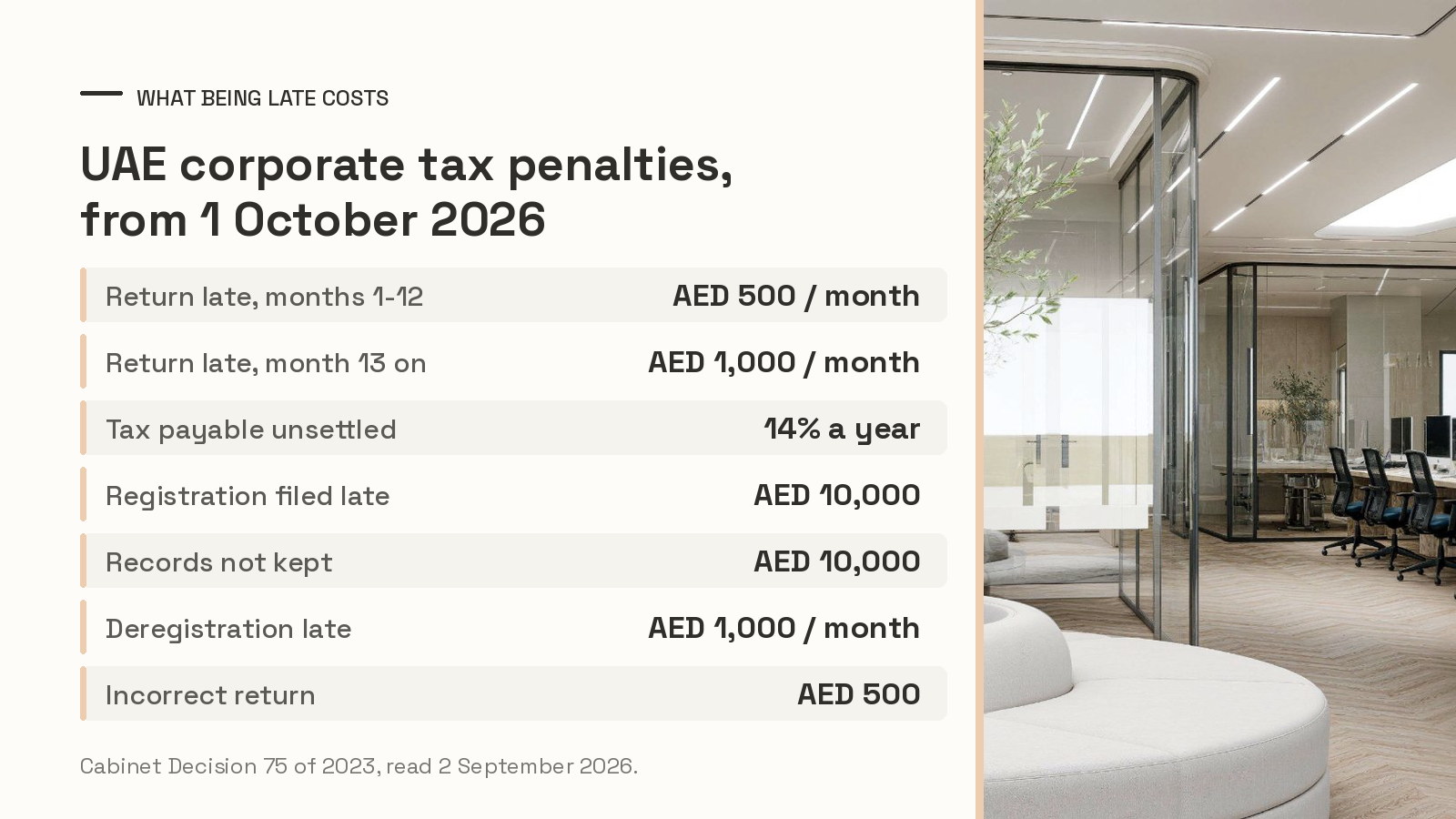
They are fixed, published, and they start on 1 October. Cabinet Decision No. 75 of 2023 sets them out in a table, and the FTA restates the headline figure in its own words: late submission or late payment "will result in an administrative penalty of AED 500 for each month, or part thereof, during the first twelve (12) months, increasing to AED 1,000 for each month, or part thereof, from the thirteenth month onwards".
| What went wrong | Penalty | Note |
|---|---|---|
| Return filed late, months 1–12 | AED 500 a month | "or part thereof" — one day late is one month |
| Return filed late, month 13 onwards | AED 1,000 a month | the meter does not stop on its own |
| Tax payable not settled | 14% a year | calculated monthly on the unpaid amount |
| Registration application not submitted in time | AED 10,000 | one-off |
| Required records not kept | AED 10,000 | AED 20,000 if repeated within 24 months |
| Deregistration application late | AED 1,000 a month | capped at AED 10,000 |
| Incorrect return submitted | AED 500 | waived if corrected before the deadline |
Two details there are worth more than the amounts. "Or part thereof" means the first AED 500 lands on 1 October, not 31 October: a day late and a month late cost the same. And the AED 500 for an incorrect return disappears if you fix it before the deadline — a quiet argument for filing in early September rather than the last week.
Corporate tax is not the only meter running on a calendar. If your company employs 20 people or more, an Emiratisation shortfall on 31 December is billed from January at AED 10,000 a month per unfilled position — the figures, the 14 sectors and the two half-year deadlines are in our guide to the Emiratisation fines a Dubai employer faces in 2026.
Is the seven-month waiver still available?
Not for this return. The FTA's late-registration penalty waiver cancels the AED 10,000 registration penalty for anyone who submits their return "within a period not exceeding seven (7) months from the end of their first Tax Period … instead of nine months" — and the FTA is explicit that it applies to "the first tax period of the taxable person" only.
It was not a small programme: the FTA reported more than 33,900 beneficiaries on 29 July 2025 and said on 14 May 2026 that it expected the figure to pass 91,000. If your 2025 return is your second, that door is shut and the nine-month date is the only one that applies. If 2025 genuinely is your first tax period, the seven-month version already passed on 31 July 2026, and 30 September still stands.
How does a freelancer know if they are in scope at all?
By one number: turnover. The FTA's rule for natural persons is that corporate tax applies where "Total Turnover derived from Business or Business Activities exceeds AED 1 million within the calendar year". Below that, a natural person is not required to register and has no return to file.
Three kinds of income are explicitly outside the test: wages, personal investment income and real estate investment income. A salaried employee in Dubai with a rented-out apartment and a share portfolio does not become a taxable person because of them. What counts is what you invoice for work. This is where the corporate tax question meets the licence question, and if you are still deciding how to hold your activity at all, the freelance visa route in Dubai is the piece to read alongside this one.
One warning that costs people money: the AED 1m turnover test is not the AED 3m relief threshold, and neither is the AED 375,000 profit line. A freelancer invoicing AED 1.4m is in scope, is under AED 3m, and can elect the relief — but only by filing.
What do you need before you open EmaraTax?
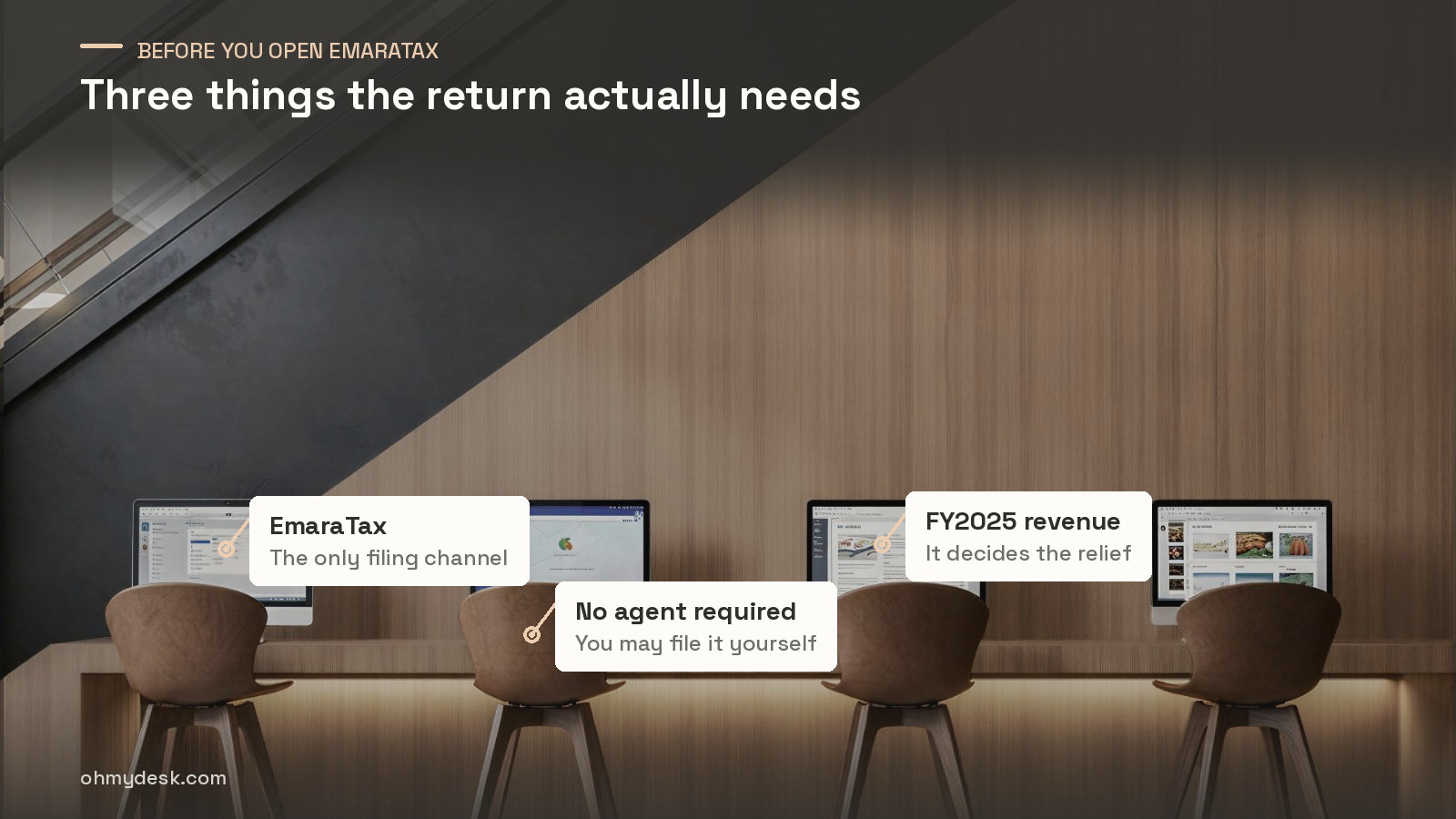
Less than the market implies, if you qualify for the relief. The FTA confirmed on 3 August 2026 that businesses electing Small Business Relief get "a simplified tax return, thereby reducing the amount of information required to be submitted". You are not preparing the same document as a group with subsidiaries.
The short list
An active EmaraTax login and your corporate tax registration number. Your financial statements for the year to 31 December 2025, or at minimum a revenue figure you can stand behind, because that number decides the relief. Your trade licence details. And your revenue figures for every earlier tax period since the regime began, since eligibility depends on all of them, not just this one.
The order that saves a week
Confirm the revenue figure first: it decides whether you file a simplified return or a full one, and the two are different amounts of work. Then check whether any earlier period broke AED 3m. Only then log in. Founders who do it the other way round discover halfway through the form that they needed the 2023 numbers too. And the registration pays off again later: holding a TRN drops the fee for a UAE tax residency certificate from AED 1,800 to AED 550.
How are free zone companies treated?
Differently, and in a way that surprises anyone who assumed a free zone means no tax and no paperwork. A Qualifying Free Zone Person is excluded from Small Business Relief by name — one of the two categories the FTA lists as unable to benefit. Qualifying income in a free zone has its own regime, but the filing obligation does not go away and the nine-month deadline is identical.
Practically: a small free zone company cannot take the simplified route open to a mainland company under AED 3m, and it does have a return due on 30 September 2026 if its year ended in December. If you hold a mainland licence instead, your address and tenancy sit alongside all of this — how Ejari works in Dubai covers that half of the paperwork.
What does any of this have to do with your office?
Three concrete things, and they are the reason a coworking operator writes about tax at all.
First, records. Failing to keep the required records is a AED 10,000 penalty on its own, and it is the one item on the list that has nothing to do with dates. An address where post is received by a person, rather than a box nobody checks, is the difference between seeing an FTA notice and hearing about it later. Our reception is staffed Monday to Friday, 09:00 to 18:00; members' access to the space runs 24/7.
Second, the licence chain. A mainland trade licence is issued against a registered tenancy, which is why the Ejari sits underneath everything else — the tax registration, the return and the bank account all point back to it. Our virtual office with Ejari is 8,000 AED a year, and the Ejari booking page shows what is included.
Third, somewhere to do it. Filing takes an afternoon and a quiet screen, and if the numbers need a conversation, a meeting room beats a WhatsApp thread. Coworking starts at 950 AED a month with one meeting-room hour; a private office starts at 6,000 AED a month with six, and rooms for up to eight people are 120 AED an hour beyond that. Our Business Bay address at Bay Square and our Downtown address at Al Fattan both carry it. Prices exclude VAT, added at checkout.
Corporate tax is also not the only federal deadline moving this year. If you invoice UAE clients, the UAE e-invoicing timetable has its own dates, and being under the VAT threshold does not take you out of it. And if the year the return covers is also the year you start hiring, the premises behind that Ejari matter twice over: MoHRE sets a company's hiring quota partly on the area of its offices, and prices the permit itself at AED 250, AED 1,200 or AED 3,450 depending on the company's classification — what a Dubai work permit really costs sets out both.
FAQ: 10 quick answers
1. When is the UAE corporate tax deadline in 2026? 30 September 2026, if your financial year ended on 31 December 2025. The rule is nine months from the end of your tax period, so a March year end means December and a June year end means the following March. The FTA named the September date explicitly on 3 August 2026 for calendar-year registrants.
2. What is the UAE corporate tax rate? 0% on taxable income up to AED 375,000 and 9% on taxable income above it, confirmed by the Ministry of Finance under Cabinet Decision 116 of 2022. The law applies to financial years beginning on or after 1 June 2023. A qualifying free zone person sits under a separate regime for its qualifying income.
3. What is the penalty for filing corporate tax late in the UAE? AED 500 for each month or part month during the first twelve months, then AED 1,000 a month from the thirteenth. Unpaid tax carries 14% a year, calculated monthly. "Part thereof" matters: one day past 30 September costs the same as a full month.
4. Do I have to file if I owe no corporate tax? Yes. The FTA stated on 3 August 2026 that eligibility for Small Business Relief "does not remove the obligation to file a Corporate Tax return". The relief is elected inside the return, so skipping the return is also skipping the relief.
5. What is the corporate tax registration deadline in the UAE? Registration ran on a schedule set by FTA decision and the ordinary window for existing businesses has passed; a late registration application carries a AED 10,000 penalty. The FTA's waiver cancels it for a first tax period where the return is filed within seven months instead of nine.
6. Who qualifies for Small Business Relief in the UAE? A taxable person with revenue of AED 3,000,000 or less in the current and all previous tax periods. Qualifying free zone persons and members of multinational groups above AED 3.15 billion of consolidated revenue are excluded. It must be elected for each tax period.
7. Does corporate tax apply to freelancers in Dubai? Only above AED 1 million of turnover from business activities in a calendar year, per the FTA's rule for natural persons. Wages, personal investment income and real estate investment income are outside the test. Below the threshold there is no registration requirement and no return.
8. How do I file a corporate tax return in the UAE? Through EmaraTax, the FTA's online platform, using your corporate tax registration number and your financial statements for the period. Businesses electing Small Business Relief file a simplified return with less information required. There is no paper channel.
9. Is Small Business Relief ending? As drafted, yes: Ministerial Decision No. 73 of 2023 applies it only to tax periods ending on or before 31 December 2026. For a calendar-year company that makes the 2026 financial year the last one covered, unless the Ministry extends it. Nothing has been announced either way.
10. What happens if I file but cannot pay by 30 September? Filing and paying are separate obligations with the same deadline and different penalties: a late return runs at AED 500 a month, unpaid tax at 14% a year calculated monthly. Filing on time and paying late is cheaper than doing neither, and the FTA runs a request process for instalments and penalty waivers.
Search Console shows no corporate tax query reaching this site over the 28 days to 1 September 2026 — the subject is new ground for us, so these ten are not drawn from our own traffic. They come from the keywords measured on Semrush's UAE database on 2 September 2026 — "corporate tax uae" (5,400 a month), "corporate tax registration uae" (1,300), "uae corporate tax registration deadline" (590), "uae corporate tax penalty" (390, and up from nothing to its twelve-month peak in the last month), "corporate tax rate uae" (320) and "corporate tax dubai" (260) — and from the questions the FTA's own guidance answers.
The short version of the UAE corporate tax deadline
One date: 30 September 2026, for every UAE business whose financial year ended on 31 December 2025. One rule behind it: nine months from your year end, for the return and the payment together. One thing almost everyone gets wrong: owing nothing does not excuse you, because Small Business Relief is elected inside the return and revenue up to AED 3,000,000 is what unlocks it. One meter that starts on 1 October: AED 500 a month, rising to AED 1,000 after a year, plus 14% a year on tax left unpaid. And one date further out that changes the arithmetic — the relief, as written, covers no tax period ending after 31 December 2026.
Do one thing after reading this: find your 2025 revenue figure and your revenue for every year since 2023, and check them against AED 3,000,000 before you open EmaraTax. It takes ten minutes and it decides which return you are filing. If your licence, address or Ejari is the part that is not settled, come and talk to us — Downtown, Business Bay, and the Design District. The tour is free, Virtual Office + Ejari is 8,000 AED a year, and coworking starts at 950 AED a month.