
Who has to hire an Emirati in 2026, and who does not?
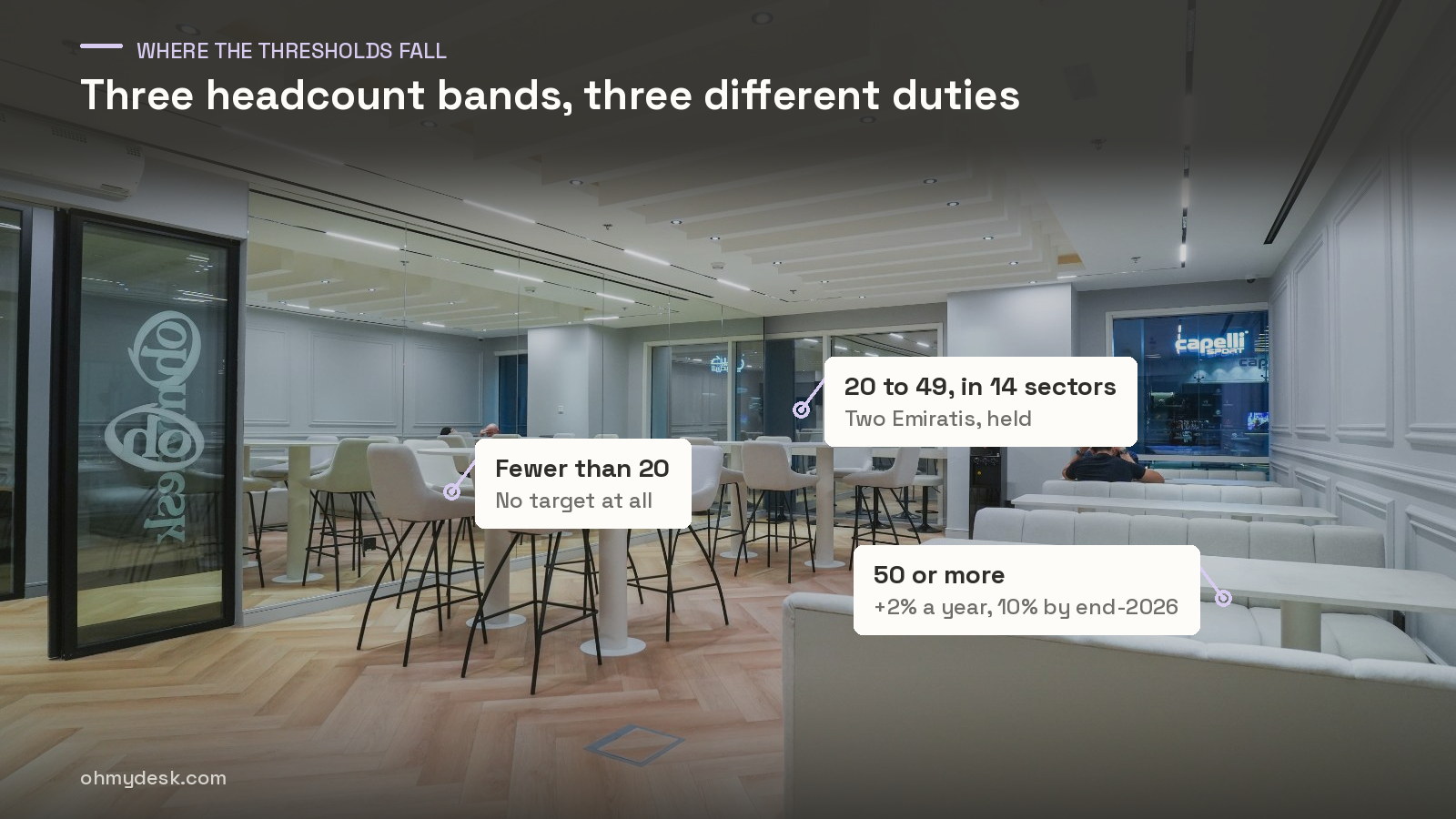
Two groups, and everybody else is outside. Private-sector companies registered with the Ministry of Human Resources and Emiratisation that employ 50 or more people carry a target of 2 % growth a year in Emiratis holding skilled positions, reaching 10 % cumulatively by the end of 2026. Companies with 20 to 49 employees carry a target only if they trade in one of 14 named economic sectors: one Emirati by the end of 2024, a second by the end of 2025, and in 2026 the duty is to keep them.
A nineteen-person company has no target. A company of 30 outside the 14 sectors has no target. A founder alone on a freelance permit in Dubai has no target either. That matters because almost every article on this subject is written for the large-employer case, while the threshold that actually catches people is the small one — it arrives with the twentieth work permit.
The three bands, and what each one owes in 2026
| Employees on MoHRE permits | 2026 obligation | Deadlines |
|---|---|---|
| Fewer than 20 | None | — |
| 20 to 49, in one of 14 sectors | Hold two Emiratis (one from 2024, one from 2025) | 31 December 2026 |
| 20 to 49, any other sector | None | — |
| 50 or more, any sector | +2 % Emiratis in skilled roles, 10 % cumulative | 30 June and 31 December 2026 |
Source: the UAE government portal and the MoHRE guidance page on Emiratisation targets, both read on 23 September 2026.
Which 14 sectors pull a 20-to-49 company into the rules?
Fourteen sectors, and between them they cover most of the economy. The UAE government portal lists them in full; what follows is that list, unabridged, because the usual summary — “information, finance, real estate and others” — makes the rule sound narrower than it is.
| # | Sector | # | Sector |
|---|---|---|---|
| 1 | Information and communications | 8 | Arts and entertainment |
| 2 | Financial and insurance activities | 9 | Mining and quarrying |
| 3 | Real estate activities | 10 | Manufacturing |
| 4 | Professional, scientific and technical activities | 11 | Construction |
| 5 | Administrative and support services | 12 | Wholesale and retail trade |
| 6 | Education | 13 | Transportation and warehousing |
| 7 | Healthcare and social work activities | 14 | Hospitality services |
The 14 sectors listed on u.ae, read 23 September 2026.
A twenty-two-person marketing agency is in sector 4. A recruitment firm is in 5, a clinic in 7, a contractor in 11, an import business in 12. If you are wondering whether your company is on the list, the safer assumption is that it is.
What are the two 2026 deadlines, and when is each one billed?
Two, and the second one is not the important one. Since 2024 the annual 2 % has been split into halves: 1 % by 30 June and 1 % by 31 December. Contributions run from 1 July for a first-half miss and from 1 January for a second-half miss. MoHRE restated the June date on 7 May 2026 and the December date on 27 October 2025.
What is billed, and from when
| Deadline | What must be true on that date | Contribution runs from |
|---|---|---|
| 30 June 2026 | +1 % Emiratis in skilled roles since 31 December 2025 (50+ only) | 1 July 2026 |
| 31 December 2026 | +1 % more, reaching 10 % cumulative (50+); two Emiratis still on payroll (20–49) | 1 January 2027 |
The practical consequence, on 23 September 2026, is that a fifty-person company which missed the June step has already been accruing a monthly charge for nearly three months, and will keep accruing it until the position is filled. December is not the start of the exposure; it is the second of two.
How much is the fine in 2026, and why are three numbers in print?
AED 10,000 a month, or AED 120,000 for a full year, per Emirati not hired. That is the figure for a 2026 shortfall, billed from January 2027. Three different monthly numbers were printed in UAE national media during 2026 alone, and only one of them survives an arithmetic check.
The three figures in circulation, and the one that reconciles
| Published figure | Where, and when read | Verdict |
|---|---|---|
| AED 6,000 a month, AED 72,000 a year | Khaleej Times, 8 May 2026 | The 2023 rate, still in print three years later |
| AED 9,000 a month, AED 108,000 a year | u.ae (as an annual sum), read 23 Sep 2026 | Correct for a 2025 shortfall, billed January 2026 |
| AED 10,000 a month, AED 120,000 a year | Gulf News, 22 June 2026 | Correct for a 2026 shortfall, billed January 2027 |
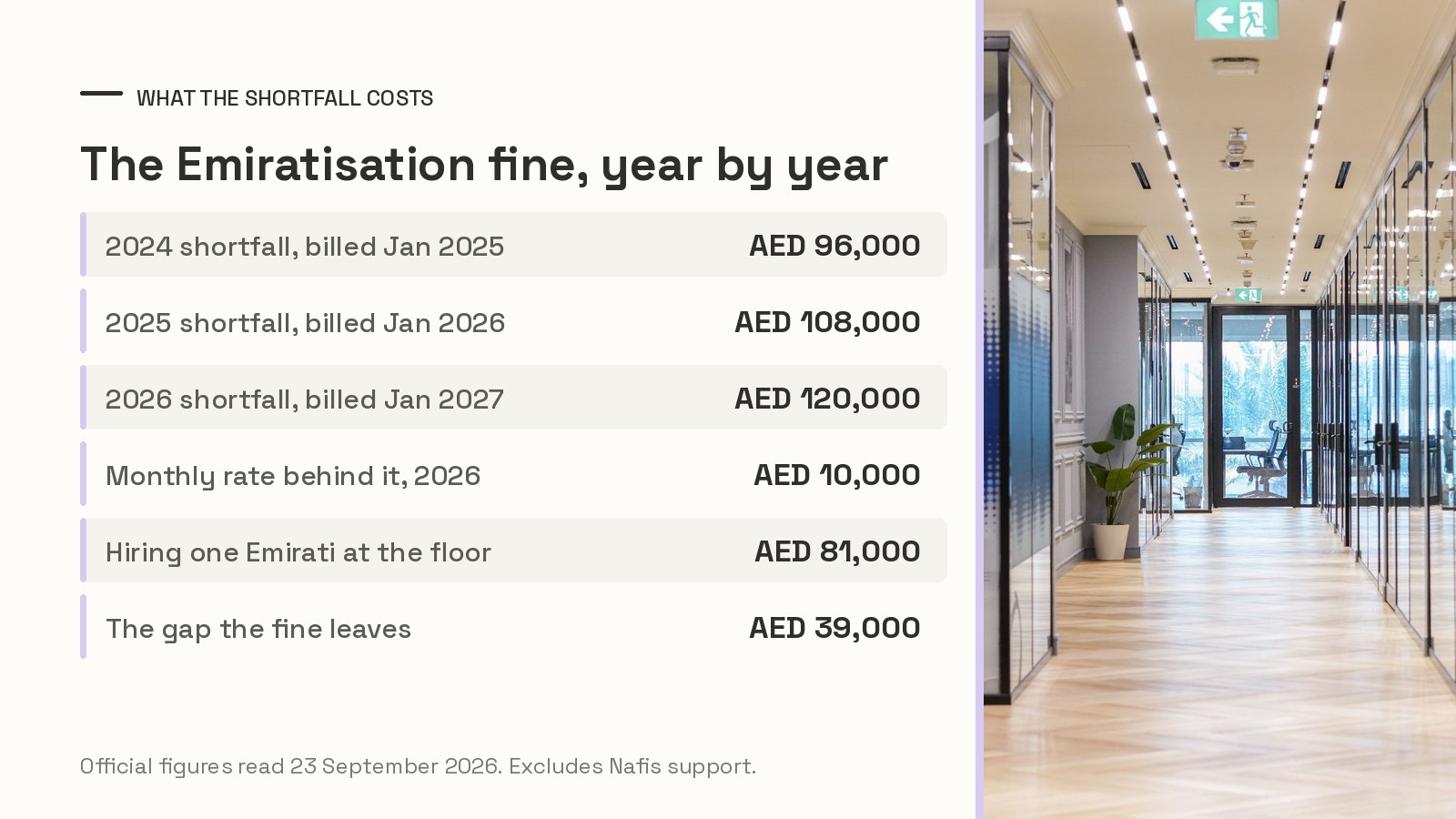
The arbitrator is the government’s own arithmetic. The portal publishes two annual sums for the small-company band — AED 96,000 in January 2025 for failing to hire one Emirati in 2024, and AED 108,000 in January 2026 for failing to hire two in 2025. The gap between them is AED 12,000, which is AED 1,000 a month, which is exactly the annual escalation the same page describes: a contribution that began at AED 6,000 a month and rises by AED 1,000 each year. Divide the two sums by twelve and the ladder falls out to the dirham.
The ladder, year by year
| Shortfall year | Billed from | Per month | Per year | Status |
|---|---|---|---|---|
| 2022 | January 2023 | AED 6,000 | AED 72,000 | Published starting rate |
| 2023 | January 2024 | AED 7,000 | AED 84,000 | Derived from the +1,000 rule |
| 2024 | January 2025 | AED 8,000 | AED 96,000 | Published annual sum |
| 2025 | January 2026 | AED 9,000 | AED 108,000 | Published annual sum |
| 2026 | January 2027 | AED 10,000 | AED 120,000 | Published, June 2026 |
Two of the five annual figures are stated outright by the government portal, one by national press in June 2026, and the remaining two follow from the published AED 1,000 annual step. The column says which is which, because a derived number and a published number are not the same thing.
None of this is academic for a company with fifty skilled staff. Ten per cent of fifty is five Emiratis. Five positions unfilled through 2026 is AED 600,000 for the year.
Does the fine really cost more than the hire?
Yes, and by more each year. Since 1 January 2026 there has been a statutory floor for Emiratis in the private sector: AED 6,000 a month. That gives a compliance cost that can be written out exactly, because the pension contribution is a published percentage rather than a negotiation.
What the employer actually pays, at the floor
| Line | Basis | A year |
|---|---|---|
| Salary at the legal minimum | AED 6,000 × 12 | AED 72,000 |
| Employer pension contribution | 12.5 % of salary | AED 9,000 |
| Employer cost of the hire | — | AED 81,000 |
| Contribution for not hiring, 2026 | AED 10,000 × 12 | AED 120,000 |
| The gap | — | AED 39,000 — the fine is 1.48× the hire |
The pension split is worth keeping in mind because it is the one line where the state pays part of the bill: the total contribution is 20 % of salary, made up of 5 % from the employee, 12.5 % from the employer and 2.5 % from the government. On an AED 72,000 salary that is AED 3,600, AED 9,000 and AED 1,800 respectively.
A year earlier the same comparison was AED 108,000 against AED 81,000 — a gap of AED 27,000, or 1.33 times. The fine has been overtaking the hire steadily, by design. And AED 81,000 is what the employer pays for a person who works, before any Nafis support; AED 120,000 buys an empty chair.
What changed on 1 July 2026 that can erase a company’s compliance?
A salary floor became a counting rule. MoHRE raised the minimum wage for Emiratis in the private sector to AED 6,000 a month with effect from 1 January 2026, and gave companies with Emiratis already on the payroll until 30 June 2026 to adjust. That grace period has now expired. Since 1 July 2026 the ministry applies two measures to establishments that did not adjust:
- the employees whose salaries were not brought up to the floor are excluded from the company’s Emiratisation count;
- the issuing of new work permits to that establishment can be suspended until salaries comply.
Read the first bullet twice. A company in the 20-to-49 band with two Emiratis on AED 5,000 believed itself compliant on 30 June 2026. Since 1 July it counts as having zero, and unless it fixes the salaries it will receive a January 2027 bill for two unfilled positions — AED 240,000 — while both people are still at their desks. The correction costs AED 1,000 a month each.
This is the one part of the file where the deadline has already passed — which is why it comes first in any sensible order of work.
How does MoHRE count your employees, and do free zone staff count?
By work permits, not by desks. The number MoHRE reads is the count of employees registered against your establishment file, which is also the number that decides whether you are in the 20-to-49 band or the 50-plus one. Contractors, agency staff and people on someone else’s permit are not your headcount; a part-time employee on your own MoHRE permit is. We costed a single permit separately in our guide to the cost of a Dubai work permit, where the same two-year document is priced at AED 250, AED 1,200 or AED 3,450 depending on the employer’s classification.
Free zones are the question everyone asks, and the honest answer has an edge on it. Emiratisation targets are addressed to establishments registered with MoHRE, and employment inside a free zone is governed by that free zone authority’s own rules rather than the federal labour law, according to the UAE government portal. That is the general position, not a clearance certificate for your company: groups frequently hold a mainland licence and a free zone one, and only the mainland establishment carries the target. The number to check is not your address, it is how many people sit on your MoHRE establishment file.
The payroll side of the same file — the Wage Protection System and the salary transfers — is a separate machine with its own deadlines, and we keep it on its own page: HR, payroll and WPS in Dubai.
What happens if an Emirati resigns in November?
The position is unfilled from the day it empties, and the contribution is charged per unfilled position per month. For a company in the 20-to-49 band this is the whole of the 2026 exercise. The target did not rise this year: one Emirati was due by the end of 2024, a second by the end of 2025, and for 2026 MoHRE’s own wording is to hire where required and retain the citizens already working for you. Nothing to recruit. Everything to keep.
Which makes November the dangerous month. A resignation on 10 November that is not replaced by 31 December produces the same January 2027 bill as never having hired at all — AED 120,000 for that seat — and a notice period that expires in the last week of December leaves no room to run a recruitment at all. A company with two Emiratis in the 20-to-49 band should treat either of them handing in notice after September as a compliance event, not a staffing one.
The same logic catches a promotion: moving an Emirati onto a commission-heavy package with a basic below AED 6,000 removes that person from the count as effectively as a resignation.
What does “fake Emiratisation” cost, and how often is it caught?
Far more than the fine it is meant to avoid, and it is caught in the hundreds. Registering an Emirati who does not really work for you — or inflating a headcount to sit under a threshold — carries an administrative fine of AED 20,000 to AED 100,000 for each instance, and AED 100,000 to AED 500,000 for circumventing Emiratisation targets, with the penalties multiplied by the number of people fictitiously employed.
| Conduct | Penalty | Multiplied by |
|---|---|---|
| Missing the target | AED 10,000 a month, AED 120,000 a year (2026) | Unfilled positions |
| False Emiratisation, per instance | AED 20,000 – 100,000 | People fictitiously employed |
| Circumventing the targets | AED 100,000 – 500,000 | People fictitiously employed |
The enforcement is not theoretical. MoHRE detected 377 cases of fake Emiratisation at 266 private companies in the first half of 2026, a figure reported on 22 September 2026 — an average of 1.42 cases per company caught. Set the columns side by side and the shortcut is the dearer option in every scenario: one fictitious registration at the top of its band costs AED 100,000 and leaves the target still unmet.
What does Nafis actually give an employer?
Money towards the salary, and we are not going to put a number on it here. Nafis is the federal programme that subsidises Emirati employment in the private sector; the UAE government portal states that AED 24 billion was allocated to it and that the target is 75,000 Emiratis in private sector jobs. Those two figures are published and we are happy to repeat them.
The amounts that would actually change an employer’s arithmetic — the monthly salary support by education level, how long it runs, the pension top-up — live on nafis.gov.ae, and that site blocks automated reading through its robots.txt. We could not read it on 23 September 2026, so we name the gap instead of guessing at it. The practical effect is that the AED 81,000 above is an upper bound on the cost of the hire, which only widens the gap against the AED 120,000 fine.
What does one missed hire cost, measured in office rent?
Twenty months of a private office. A three-person private office at Oh My Desk Business Bay starts at AED 6,000 a month, so the AED 120,000 contribution for a single unfilled Emirati position equals 20 months of that office, or 1.67 years of its rent. Our 470 sq ft block for a 15-to-20-person team is AED 21,000 a month, which makes one missed hire worth 5.71 months of the room the whole team sits in — about 48 % of a year’s rent.
| What AED 120,000 buys instead | Monthly | What the fine equals |
|---|---|---|
| Private office, 3 people, Business Bay | AED 6,000 | 20 months |
| Team block, 470 sq ft, 15–20 people | AED 21,000 | 5.71 months |
| Hot desk membership | AED 950 | 126 months |
Oh My Desk published rates, excluding 5 % VAT, added at checkout. The team block works out at AED 1,050 a person at twenty people.
The comparison is a sense of scale, not a sales argument: an administrative line item nobody has diarised is the same size as the room. For the wider market we keep a separate breakdown of what a private office costs in Dubai.
How did we check these numbers?
Every rule and every figure on this page was read on an official or primary source on 23 September 2026. The bands, the 14 sectors, the 2 % and the 10 % cumulative target, the AED 96,000 and AED 108,000 annual sums and the 20 % pension split come from the UAE government portal and MoHRE’s Emiratisation targets page. The 31 December mechanism and the retention wording come from MoHRE’s notice of 27 October 2025; the minimum wage, the 30 June grace period and the measures applied from 1 July from MoHRE’s announcement of 31 December 2025 and Khaleej Times of the same day. The AED 10,000 and AED 120,000 figures and the 1 % half-year mechanism come from Gulf News of 22 June 2026, the enforcement statistics from Gulf News of 22 September 2026.
One note on the FAQ below. Google Search Console records no search traffic at all to this site on this vocabulary — zero impressions for “emirati”, “nafis” and “hiring” across two consecutive 28-day periods. The ten questions are therefore drawn from measured Semrush keyword demand in the UAE database and from the sections above, rather than from our own search data, and we say so rather than inventing the provenance.
And one thing we deliberately do not do: we are not your lawyer. The thresholds are clear, their application to one particular establishment file is not, and a company within a few heads of twenty should get that confirmed rather than inferred.
FAQ: 10 quick answers
1. What is the Emiratisation fine in 2026? AED 10,000 a month for every Emirati a covered company has not hired against its target, or AED 120,000 for a full year, billed from January 2027 for a 2026 shortfall. That figure was published by Gulf News on 22 June 2026, and it is the one that reconciles with the two annual sums the government itself publishes: AED 96,000 for a 2024 shortfall, AED 108,000 for a 2025 one.
2. Which companies have to meet Emiratisation targets? Private-sector companies registered with the Ministry of Human Resources and Emiratisation that have 50 or more employees, plus companies with 20 to 49 employees in one of 14 named economic sectors. A company with 19 employees has no target. A sole trader on a freelance permit has no target. Everything below 20 people sits outside the regime entirely.
3. What is the Emiratisation target for 2026? A 2 % increase a year in Emiratis in skilled positions for companies with 50 or more employees, reaching 10 % cumulatively by the end of 2026. The 2 % is split into two halves of 1 %, due by 30 June and 31 December. Companies with 20 to 49 employees in the 14 listed sectors had to hire one Emirati by the end of 2024 and a second by the end of 2025; in 2026 their duty is to keep them.
4. When is the Emiratisation deadline? Twice a year: 30 June and 31 December. Financial contributions run from 1 July for a first-half miss and from 1 January for a second-half miss. Most guides print only the December date, which is how a company can be six months into a bill it has not noticed. MoHRE restated the June deadline publicly on 7 May 2026 and the December deadline on 27 October 2025.
5. Is there a minimum salary for an Emirati employee in the UAE? Yes, AED 6,000 a month since 1 January 2026, for Emiratis in the private sector. MoHRE gave companies with Emiratis already on the payroll until 30 June 2026 to adjust. From 1 July 2026, an Emirati paid below that floor is excluded from the company’s Emiratisation count and the ministry can suspend the issuing of new work permits until salaries comply.
6. Do free zone companies have to meet Emiratisation targets? The targets apply to establishments registered with MoHRE, and free zone employment is governed by each free zone authority’s own employment rules rather than the federal labour law, according to the UAE government portal. That is the general position and not a substitute for checking your own establishment file: some groups hold both a mainland licence and a free zone one, and only the mainland establishment carries a target.
7. How much does it cost to employ an Emirati at the legal minimum? AED 81,000 a year to the employer at the floor: AED 6,000 a month of salary, so AED 72,000, plus the employer’s 12.5 % pension contribution of AED 9,000. The full pension contribution is 20 % of salary: 5 % employee, 12.5 % employer, 2.5 % government. Nafis support reduces the employer’s share further.
8. What is fake Emiratisation and what is the penalty? Registering an Emirati who does not really work for you, or inflating headcount to dodge a target. The administrative fine is AED 20,000 to AED 100,000 for each instance and AED 100,000 to AED 500,000 for circumventing Emiratisation targets, and the penalties multiply by the number of people fictitiously employed. MoHRE detected 377 such cases at 266 private companies in the first half of 2026 alone.
9. What happens if an Emirati employee resigns before the deadline? The position counts as unfilled from the moment it is empty, and the contribution is charged per unfilled position per month. For a company in the 20-to-49 band the 2026 duty is retention, not recruitment, so a November resignation that is not replaced by 31 December produces exactly the same January bill as never having hired at all.
10. Does Emiratisation apply to a company in a Dubai coworking space? Only if it has 20 or more employees on MoHRE work permits and sits in one of the 14 listed sectors, or 50 or more employees in any sector. The desk count is irrelevant; the work-permit count is what MoHRE reads. The threshold arrives with the twentieth work permit, not with the twentieth chair.
What to do next
Three things, in order, and the first one is not the December deadline. Check today whether every Emirati on your payroll is paid at least AED 6,000 a month: since 1 July 2026 anyone below that floor has stopped counting, and that is the only part of this file where the damage is already accruing. Second, count your MoHRE work permits rather than your desks, and check your sector against the list of 14 above — if you are between 18 and 22 people in one of them, the question is when, not whether. Third, if you are in the 20-to-49 band, treat a resignation after September as a compliance event: a November departure and a January bill are the same fact, seen twice.
And if your company is about to cross a threshold, it is usually about to cross a room as well. A private office at Oh My Desk starts at AED 6,000 a month in Business Bay, furnished and connected, with six hours of meeting room a month included; a hot desk is AED 950 a month and a day pass AED 120. Book a free tour at Downtown or Business Bay — and our private offices in Dubai Design District open on 1 October 2026.