
How is UAE gratuity calculated in 2026?
Twenty-one days of your last basic wage for each of the first five years of service, then thirty days for each year after that — and the total can never exceed two years’ wage. That is the whole of Article 51 of Federal Decree-Law No. 33 of 2021. Everything else you will read about UAE end-of-service benefits follows from those three numbers.
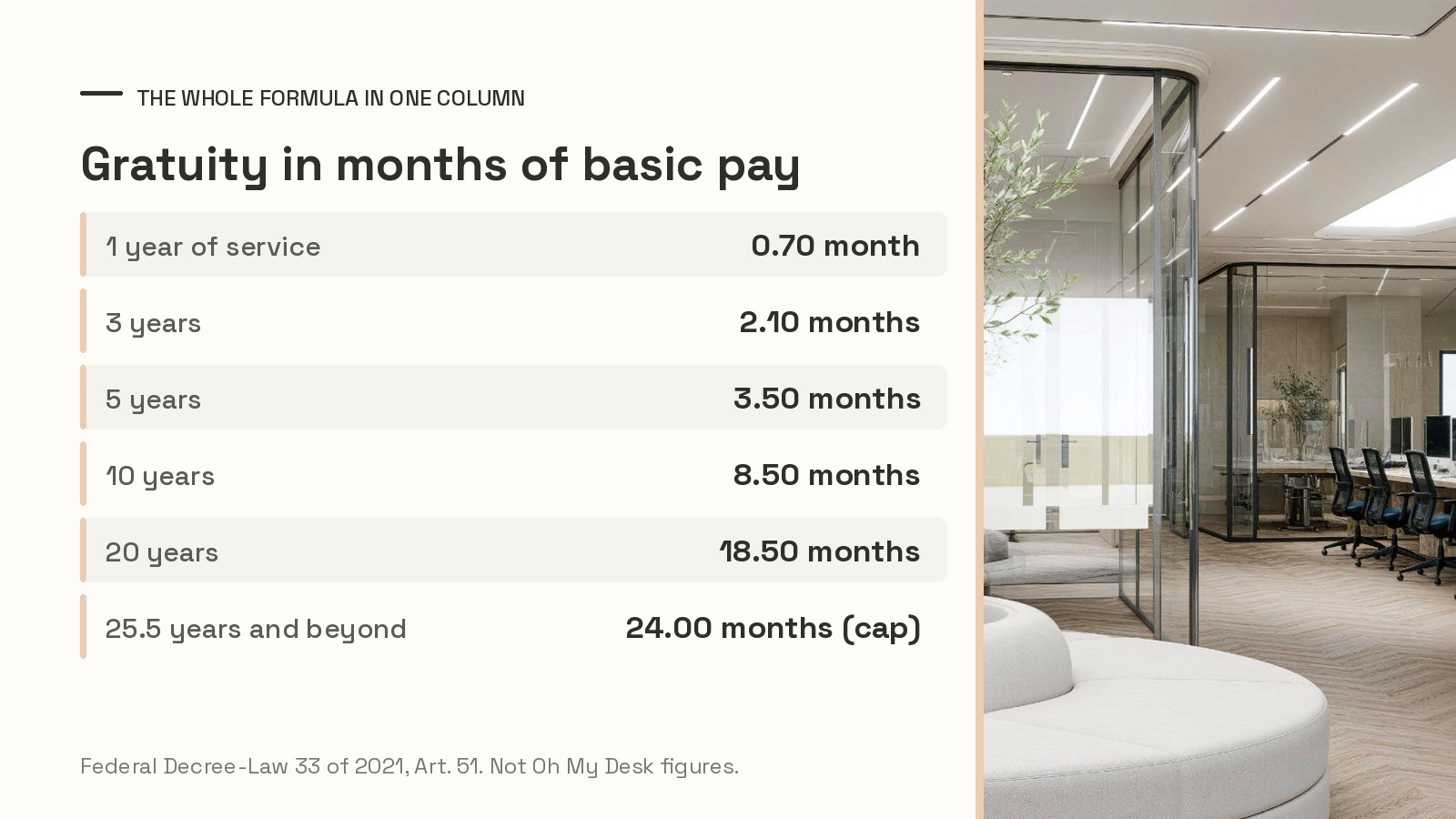
The formula is written in days, which is why it is so easy to get wrong. Converted into months of basic pay, it is far simpler than it looks.
| Period of service | What Article 51 says | Same thing, in months of basic pay |
|---|---|---|
| Under 1 year | No entitlement | 0 |
| Each of years 1 to 5 | 21 days of basic wage | 0.70 month per year |
| Each year after year 5 | 30 days of basic wage | 1.00 month per year |
| Ceiling, all service combined | “Two years’ wage” | 24 months |
Five full years earn 3.5 months of basic pay, ten years 8.5, twenty years 18.5. Worked, on a basic of AED 10,000 a month: the daily basic wage is AED 333.33, three years is 63 days, and 63 × 333.33 is AED 21,000 — 2.1 months, exactly as the table says.
| Monthly basic wage | 3 years | 5 years | 7 years | 10 years |
|---|---|---|---|---|
| AED 6,000 | AED 12,600 | AED 21,000 | AED 33,000 | AED 51,000 |
| AED 10,000 | AED 21,000 | AED 35,000 | AED 55,000 | AED 85,000 |
| AED 15,000 | AED 31,500 | AED 52,500 | AED 82,500 | AED 127,500 |
| AED 25,000 | AED 52,500 | AED 87,500 | AED 137,500 | AED 212,500 |
Watch the columns between five and seven years. Two extra years add AED 20,000 on a basic of AED 10,000, against AED 14,000 for the two before them. The step from 21 days to 30 is a 43% rise on every subsequent year of service — the biggest cliff edge in the calculation.
Is the daily wage your basic salary divided by 30, or by 365?
By 30. Article 51 counts in days and never defines one; neither does the federal portal’s end-of-service page. The proof sits in a different government document entirely, and almost nobody puts the two side by side.
What 5.83% and 8.33% actually are
Since November 2023 the UAE has run a second, voluntary end-of-service system: the Savings Scheme, created by Cabinet Resolution No. 96 of 2023. An employer who joins stops accruing gratuity for the enrolled staff and pays a monthly subscription into an approved fund instead. The rates are published: 5.83% of basic monthly salary under five years of service, 8.33% at five years or more.
Those are not round numbers chosen by a committee. 21 ÷ 360 is 5.8333%; 30 ÷ 360 is 8.3333%. The subscription rates are Article 51, re-expressed as a percentage on a year of twelve thirty-day months. Had the drafters meant a calendar year, they would read 5.75% and 8.22%.
| Divisor used | Daily basic on AED 10,000 | Five years of service | Difference |
|---|---|---|---|
| Monthly basic ÷ 30 (the scheme’s arithmetic) | AED 333.33 | AED 35,000 | — |
| Annual basic ÷ 365 | AED 328.77 | AED 34,521 | − AED 479 |
| Annual basic ÷ 366 (leap year) | AED 327.87 | AED 34,426 | − AED 574 |
Four hundred and seventy-nine dirhams on a five-year claim is not life-changing, but it is the kind of number that turns a settlement meeting into an argument. The 30-day convention is the one the market uses, the one the government’s own alternative scheme is calibrated on, and the one the mainstream UAE guides apply.
When does the two-year cap stop your gratuity growing?
At twenty-five years and six months. Twenty-four months of basic pay is the ceiling; the first five years deliver 3.5 of them and every later year one, so 20.5 more years exhaust it. Service beyond that adds nothing, and we found no UAE guide that works the figure out.
| Years of service | Months of basic pay accrued | Still growing? |
|---|---|---|
| 5 | 3.50 | Yes |
| 10 | 8.50 | Yes |
| 20 | 18.50 | Yes |
| 25 | 23.50 | Yes, 0.5 month left |
| 25.5 | 24.00 | Ceiling reached |
| 30 | 24.00 (28.50 before the cap) | No |
One ambiguity is worth naming. Article 51 calculates on the basic wage, but the cap reads “two years’ wage”, and “wage” elsewhere in the law means full remuneration. Read against total pay, the ceiling would move out past forty years. We have used basic wage — the less favourable reading, and the one worth planning around.
Does resigning — or being dismissed — cut your gratuity?
No, on both counts, and this is the single most widely repeated error about UAE employment law. Federal Decree-Law No. 33 of 2021 contains no clause that reduces or forfeits end-of-service benefits because a worker resigned. It contains no clause that forfeits them on dismissal either.
The rule people remember is real, but it belonged to the repealed Federal Law No. 8 of 1980, under which a worker on an unlimited contract who resigned before five years lost one third or two thirds of the entitlement. That regime disappeared with the unlimited contract itself: every private-sector contract in the UAE is now fixed-term, and the sliding scale went with it.
Article 44 lists the ten grounds for dismissal without notice and says nothing about end-of-service benefits. Article 45 runs the other way: a worker who walks out without notice in defined circumstances — grave danger, a breach by the employer — keeps the full entitlement. The only reductions in Article 51 are mechanical: unpaid absence does not count towards service, the ceiling applies, and the employer may deduct sums owed under a law or a judgment.
What counts as “basic wage”, and what does not?
Basic wage is the salary line in the contract, before every allowance. Housing, transport, telephone, schooling and any other allowance sit outside it, and gratuity is calculated on the basic line alone — on the last one the worker was entitled to, not an average of the years worked.
This is where two people on the same package end up with very different cheques. Two colleagues, each on AED 20,000 a month all-in, each leaving after seven years: one on a 60/40 split between basic and allowances, the other 40/60. Gratuity is 5.5 months of basic — AED 66,000 and AED 44,000. Identical cost to the employer for seven years, AED 22,000 apart on the last day.
The flip side matters for employers: a package weighted towards allowances is cheaper to exit. And because the benefit is indexed to the final basic wage, a raise in the last month re-prices every year of service behind it — a late promotion is expensive in a way a late bonus is not.
How long must you work before anything is owed?
One full year of continuous service. Below that the entitlement is zero — not pro-rated, zero. Past the first completed year it accrues pro rata, so eighteen months earns 1.05 months of basic pay rather than being rounded down.
Two details decide the exact length. Days of absence without pay are excluded, explicitly, so an unpaid sabbatical quietly shortens the count. And the clock runs on the contract, not the visa: a transfer within the same company keeps the accrued service, a resignation followed by a fresh contract restarts it.
How is gratuity worked out on a part-time contract?
As a straight percentage of the full-time entitlement, set by the hours in the contract. Article 30 of Cabinet Resolution No. 1 of 2022 divides the annual working hours written into the part-time contract by the annual hours of a comparable full-time contract, multiplies by 100, and applies the resulting percentage to the gratuity a full-time worker would have earned over the same period.
A contract of 1,000 hours a year against a full-time 2,080 gives 48.08%. Four such years, on a notional full-time basic of AED 10,000, produce 2.8 months × 48.08% — about AED 13,462. The percentage comes from the contract, not the hours actually worked: overtime does not raise it, a quiet quarter does not lower it.
It is also worth knowing what sits next to it. The freelance visa route in Dubai and what a flexi desk actually is both carry no gratuity at all: there is no employer to owe it.
What is the Savings Scheme, and what does it charge?
A voluntary alternative to gratuity, created by Cabinet Resolution No. 96 of 2023 on 10 October 2023, in which the employer pays a monthly subscription into a fund approved by the Securities and Commodities Authority instead of carrying the liability on its own books. The Ministry of Human Resources and Emiratisation runs enrolment: the employer applies and picks which employees go in. An employee cannot join alone.
| Article 51 gratuity | Savings Scheme | |
|---|---|---|
| Rate, under 5 years | 21 days a year | 5.83% of basic, monthly |
| Rate, 5 years and over | 30 days a year | 8.33% of basic, monthly |
| Which wage it is applied to | The last basic wage | Each month’s basic wage |
| Who holds the money until you leave | The employer | An SCA-approved fund |
| Investment return | None | Yours, for better or worse |
| Employee top-ups | Not possible | Up to 25% of total salary |
| Payment after you leave | Within 14 days | Within 14 days |
| Employer transfer deadline | — | Within 15 days of each month |
It reaches further than the Labour Law does — self-employed people, freelance permit holders, non-citizen government staff and UAE nationals in both sectors can all be covered. Voluntary employee top-ups are withdrawable at any time; the employer’s share is not.
Why does the Savings Scheme start behind the law?
Because the two systems apply the same percentages to a different wage. The law multiplies every year of service by your final basic wage; the scheme pays a percentage of each month’s wage as that month goes by. If your pay never moves, the two are indistinguishable. If it rises, the law re-prices your whole career at the end and the scheme does not. Take an employee whose basic rises in equal annual steps from AED 10,000 to AED 15,000 over five years.
| Five years, basic rising AED 10,000 → 15,000 | Amount |
|---|---|
| Article 51: 3.5 months × final basic of AED 15,000 | AED 52,500 |
| Savings Scheme: 5.83% of each month’s basic | AED 43,725 |
| Shortfall at the moment of leaving | AED 8,775, or 16.7% less |
| Return the fund must earn over the period to match | +20.1% |
| Same employee, basic frozen at AED 10,000 | AED 35,000 vs AED 34,980 — a AED 20 gap |
Keep that last line. On a flat salary the two systems differ by twenty dirhams over five years. The entire difference between them is your pay rises — and whether the fund earns them back. Nobody can tell you in advance which fund you got.
There is a second freeze the marketing does not lead with. MoHRE’s November 2025 guidance confirms that gratuity accrued before enrolment is preserved — but calculated as at the enrolment date, on the basic salary at that date. An employee with eight years of service who joins on a basic of AED 12,000 locks that slice in at AED 12,000 for ever, even if they leave ten years later on AED 25,000. The scheme is not a bad deal; it is a different one, and the difference is not in the headline percentages.
When must the money be paid, and what happens if it is not?
Within fourteen days of the contract end date. Article 53 is blunt: the employer pays wages and all other entitlements within fourteen days of the end of the term. The Savings Scheme carries the same deadline, so switching system buys no one time.
What the law does not contain is a penalty aimed specifically at late gratuity: no daily interest, no multiplier. Two broader provisions do the work. Article 60(4) fines an employer AED 50,000 to AED 200,000 for closing or suspending an establishment without settling its workers’ rights — the clause that bites when a company simply disappears. Article 63 sets a general fine of AED 5,000 to AED 1,000,000 for any breach carrying no penalty of its own, which is where a flat refusal to pay lands.
In practice the route is a labour complaint to MoHRE, and the pressure is administrative long before it is financial: a company with unresolved claims runs into the same ministry it depends on for every work permit it issues and its Emiratisation obligations.
What else is owed on the last day besides gratuity?
Notice, accrued leave, and whatever the contract adds. Gratuity is the line everyone counts; it is rarely the only one.
Notice. Article 43 sets the notice period at not less than thirty days and not more than ninety, whichever way the termination runs. It is worked or paid, and pay in lieu is calculated on the wage the period would have earned.
Probation. Article 9 caps probation at six months from the first day of work, and an employer terminating during it must give at least fourteen days’ written notice — a shorter clock than the thirty-day floor that applies afterwards.
Accrued annual leave. Article 29(9) pays a worker who leaves before taking their leave for the accrued days, on the basic wage. The public holidays that fall inside the leave year follow their own rules.
And one piece of paper that costs money rather than earns it: if your next employer asks for a degree, the certificate behind it usually has to be attested before the new permit is issued — a bill that lands in the same month as the last payslip.
Where do these numbers come from, and what could not be read?
Every figure above was read on 14 October 2026: the English text of Federal Decree-Law No. 33 of 2021, the federal portal’s end-of-service benefits page, its pages on terminating contracts, on contract duration and models and on employment laws and regulations, and the Ministry’s Savings Scheme page.
Three things about those sources are worth reporting.
The federal portal’s end-of-service page does not publish the formula. It gives the one-year minimum, the exclusion of unpaid absence, the two-year ceiling and a pointer to Article 30 of Cabinet Resolution No. 1 of 2022 — and never states 21 days or 30 days. The government’s beta portal, serving the same article, publishes both day counts. Two versions of one official page, and only the one nobody reads carries the number everybody wants.
The Ministry publishes the scheme’s rates nowhere we could reach. Its awareness page describes the scheme without a single percentage, and its FAQ and hosted fund brochures are closed to automated reading. The 5.83% and 8.33% here are the rates published by the authorised fund managers and reported in the Ministry’s November 2025 guidance — confirmed, independently, by the arithmetic of Article 51 itself.
And no search query reaching this site carries this vocabulary. Across two consecutive 28-day periods, “gratuity”, “end of service”, “severance”, “termination”, “probation” and “salary” returned zero impressions on ohmydesk.com, against thousands on a control term. The questions below therefore come from measured demand — eight keywords checked on 14 October 2026, led by how to calculate gratuity in uae at 3,600 searches a month — not from our own traffic.
FAQ: 10 quick answers
1. How do you calculate gratuity in the UAE? Take the last basic monthly wage, divide by 30, multiply by 21 for each of the first five years and by 30 for every year after. In months of basic pay that is 0.7 a year to five years, then one a year. The total is capped at two years’ wage, and nothing is owed below one year.
2. Is gratuity calculated on basic salary or total salary? On basic salary alone. Housing, transport, telephone and every other allowance are excluded, and the figure used is the last basic wage the worker was entitled to, not an average. Two colleagues on identical total packages can therefore receive very different amounts, depending on how their contracts split basic pay from allowances.
3. Do I lose gratuity if I resign? No. Federal Decree-Law No. 33 of 2021 contains no reduction for resignation. The one-third and two-third forfeitures people remember came from the repealed Federal Law No. 8 of 1980 and applied to unlimited contracts, which no longer exist here. A resignation after three years is worth what a dismissal after three years is worth.
4. How much gratuity do I get after 5 years in the UAE? Three and a half months of your last basic wage — 105 days. On a basic of AED 10,000 that is AED 35,000; on AED 15,000 it is AED 52,500. Year six is where the rate rises from 21 days to 30, which is a 43% increase on every year of service from that point on.
5. Is there a maximum gratuity in the UAE? Yes: total end-of-service benefits may not exceed two years’ wage. Measured against basic pay, that ceiling is reached after 25 years and 6 months of service, after which further service adds nothing. The law does not spell out whether “two years’ wage” means basic or total pay, so the conservative reading is basic.
6. When must gratuity be paid after leaving a job? Within 14 days of the contract end date, under Article 53, and the Savings Scheme uses the same deadline. No penalty is written specifically for late gratuity, but Article 63 allows a general fine of AED 5,000 to AED 1,000,000, and Article 60(4) fines an employer AED 50,000 to AED 200,000 for shutting down without settling workers’ rights.
7. What is the UAE Savings Scheme and should my employer join it? It is a voluntary alternative to gratuity under Cabinet Resolution No. 96 of 2023: the employer pays 5.83% or 8.33% of basic salary monthly into an SCA-approved fund instead of accruing a liability. It suits employers who want the cost smoothed, and it is worse than the law for anyone whose basic pay rises sharply.
8. Does gratuity accrued before joining the Savings Scheme disappear? No. Entitlement earned under the Labour Law before enrolment is preserved and remains payable by the employer. It is calculated as at the enrolment date, on the basic salary at that date, and no retroactive contributions are required — which means that slice stops being re-priced by later pay rises.
9. Does unpaid leave reduce my gratuity? Yes. Article 51 excludes days of absence without pay from the service period, so an unpaid sabbatical shortens the length of service the calculation runs on. Paid annual leave, sick leave on pay and public holidays do not. Any accrued but untaken annual leave is paid separately, on the basic wage, under Article 29.
10. How is gratuity calculated for part-time workers in the UAE? By percentage. Article 30 of Cabinet Resolution No. 1 of 2022 divides the annual hours in the part-time contract by the annual hours of a comparable full-time contract and applies that percentage to the full-time entitlement. A 1,000-hour contract against a 2,080-hour full-time year earns 48.08% of what a full-timer would have accrued over the same period.
What to do next
For an employer, the useful exercise is one spreadsheet column: each employee’s basic wage × 0.7 a year to five years, then × 1 a year. That is a real liability on your books today, and it grows every time you approve a raise. For an employee, the figure to write down is the basic line on your contract — not the total — because it is the only one the law looks at on your last day.
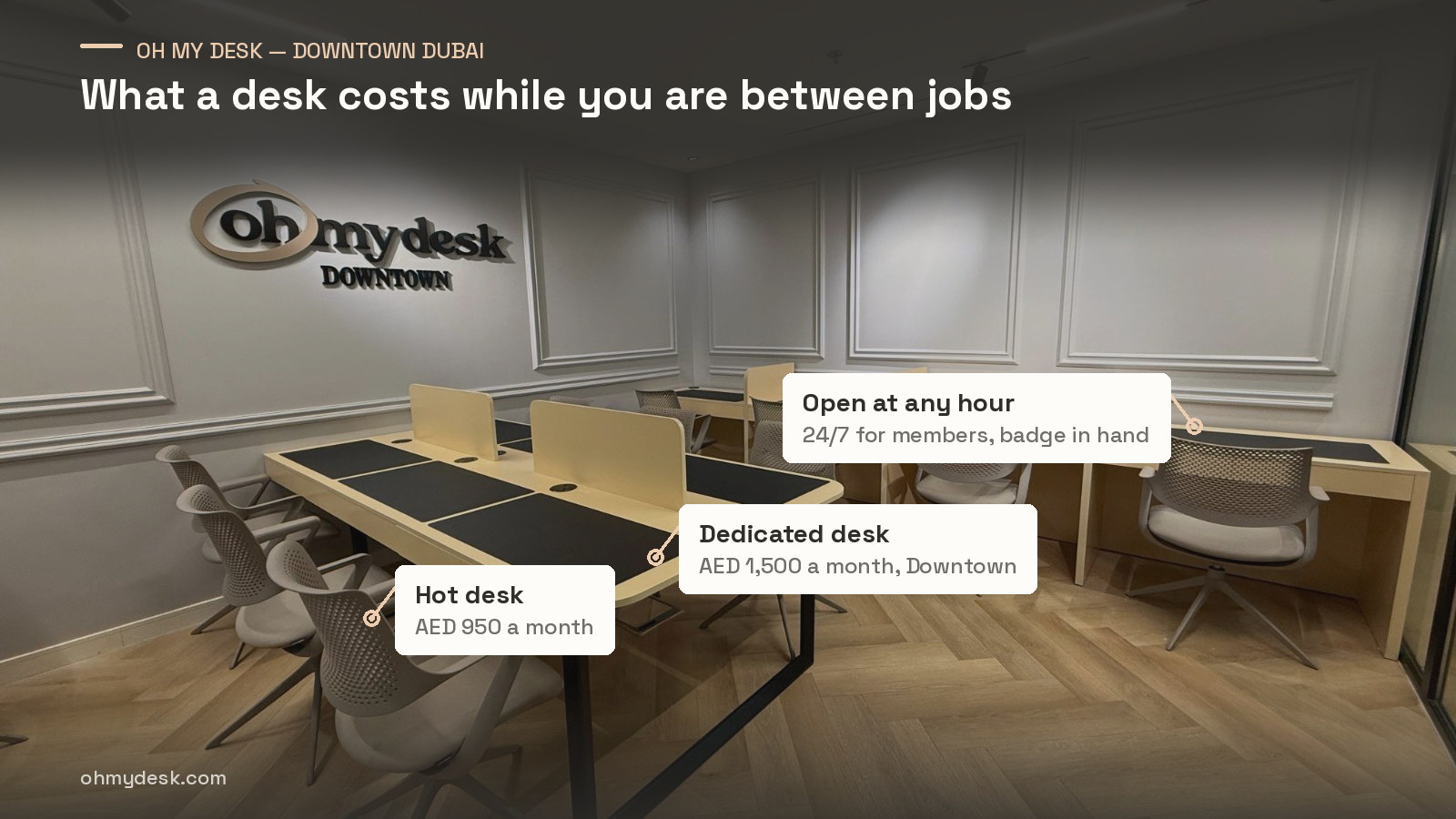
And if what you need is somewhere to work from while the paperwork settles, we run three Dubai addresses with no notice period of their own. A hot desk is AED 950 a month, a dedicated desk AED 1,500 in Downtown, a private office from AED 6,000 — all inclusive, members in at any hour, reception Monday to Friday 9am to 6pm. Book a free tour at Downtown, Business Bay or Dubai Design District.