

What does a UAE tax residency certificate cost in 2026?
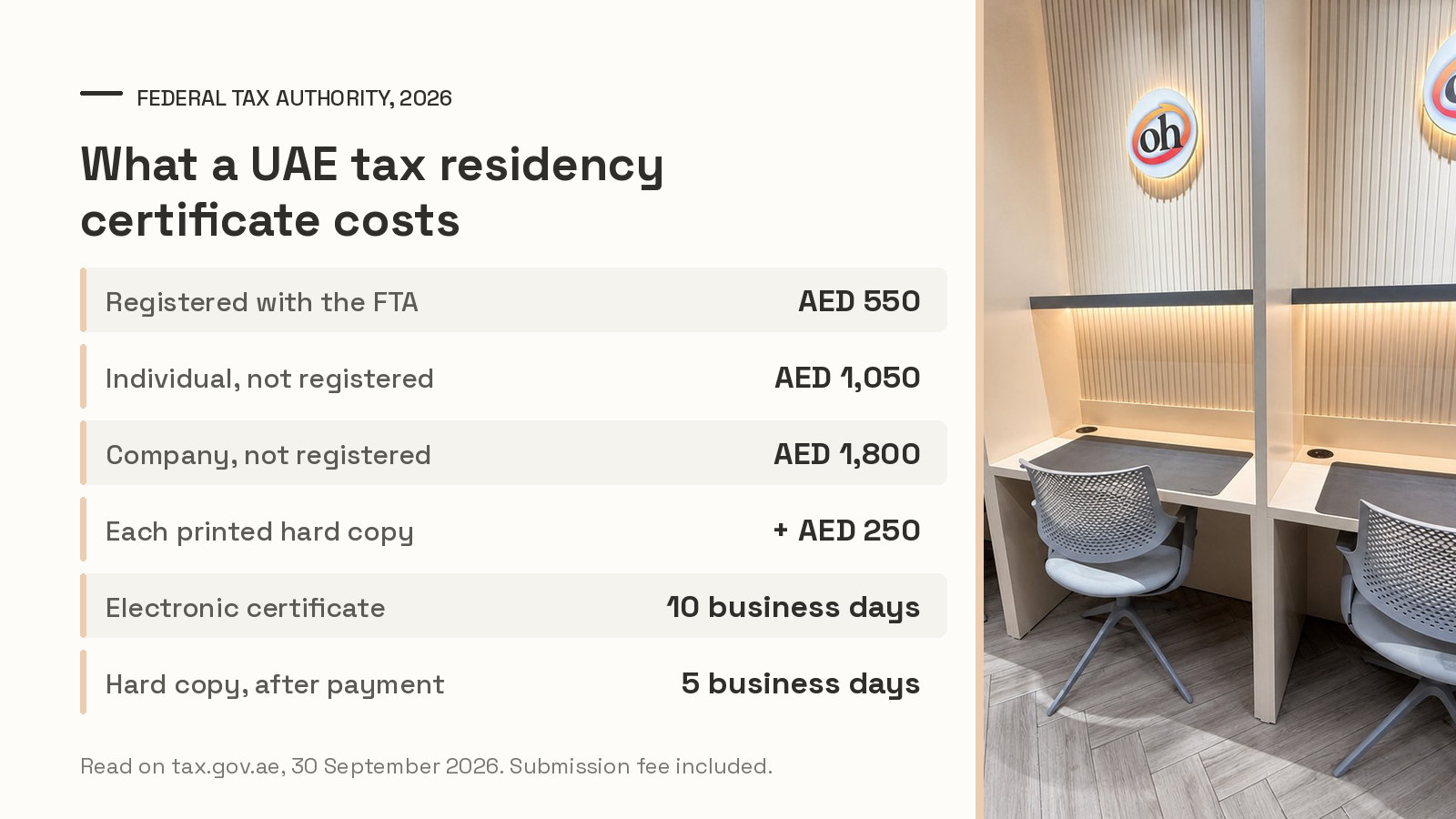
Three totals, published by the Federal Tax Authority and read on its service page on 30 September 2026. Every application pays a AED 50 submission fee; what sits on top depends on one thing only — whether the applicant is already a registrant.
| Who is applying | Submission | Review & issuance | Total |
|---|---|---|---|
| Anyone registered with the FTA | AED 50 | AED 500 | AED 550 |
| Individual not registered with the FTA | AED 50 | AED 1,000 | AED 1,050 |
| Company not registered with the FTA | AED 50 | AED 1,750 | AED 1,800 |
| Printed hard copy, each, on top of any of the above | — | AED 250 | + AED 250 |
The spread between the cheapest and dearest version of the identical certificate is 3.3 times: 1,800 ÷ 550. Add a stamped paper copy and the range becomes AED 800 to AED 2,050. The amounts rest on Cabinet Decision No. 65 of 2020, cited by the Authority on the same page.
Why does the same certificate cost AED 550, AED 1,050 or AED 1,800?
Because the fee is priced on the Authority’s workload, not on the paper. For a registrant the FTA already holds the file and the review is a check; for a non-registrant it builds that file from scratch: AED 1,000 for an individual, AED 1,750 for a company.
The AED 1,250 that is really a registration gap
That gap is the one worth planning around. A company holding a tax registration number pays the low rate; one that does not pays AED 1,250 more, on a certificate it usually needs precisely because it is trading across a border. Whether a given entity should already hold a TRN is a separate subject — our guide to the UAE corporate tax filing deadline covers it. The point here is a pricing one: sort the registration out first and the identical PDF arrives for AED 550.
One nuance: the Authority’s wording is “a Registrant with the FTA”, not specifically a corporate tax registrant.
Is a tax domicile certificate the same thing?
Yes — it is the old name for the same document. Before the Federal Tax Authority took the service over, the Ministry of Finance issued what everyone called a tax domicile certificate. The name survives on letterheads, on foreign tax offices’ checklists and in what people type into search engines: in Semrush’s UAE database on 30 September 2026, “tax domicile certificate uae” and “tax residency certificate uae” each measured 1,000 searches a month.
Tax domicile certificate, tax residence certificate, TRC: all three point at one service, which the FTA publishes as “Issuance of Tax Certificates for Tax Residency”.
Which certificate do you need: domestic or treaty?
People get this choice wrong, and it changes the evidence you have to produce.
The domestic certificate
Issued under Cabinet Decision No. 85 of 2022, in force since 1 March 2023. It says you are a UAE tax resident under UAE law, full stop, and the day-count tests below are the ones that apply. This is the version a UAE bank or a local counterparty normally wants.
The treaty certificate
Issued under Ministerial Decision No. 247 of 2023, also in force since 1 March 2023, it certifies residence for one particular double taxation agreement — and here is the part almost nobody writes down. That decision runs to three short articles and sets no day threshold of its own. Article 2 lets a person “who meets the conditions of tax residency in the State pursuant to the relevant International Agreement” apply. The conditions live in the treaty, not in UAE law.
The Ministry of Finance states the UAE has concluded 137 double taxation agreements with most of its major trading partners. So “how many days do I need for a treaty certificate?” has up to 137 answers, and the honest one is: read the treaty with the country asking. The FTA’s document list says as much — the passport, always mandatory here, then “any additional evidence required under the relevant Double Taxation Agreement”.
How many days in the UAE does it take to qualify?
For the domestic certificate, Cabinet Decision No. 85 of 2022 gives an individual three separate routes, and meeting any one of them is enough.
| Route | Days in the UAE | What else is required |
|---|---|---|
| Centre of life | No day count | Usual or primary place of residence and centre of financial and personal interests both in the UAE |
| 183 days | 183 or more in the relevant 12 consecutive months | Nothing else in the Decision — no nationality or permit condition |
| 90 days | 90 or more in the relevant 12 consecutive months | UAE or GCC national, or holder of a valid UAE residence permit — plus either a permanent place of residence in the UAE, or employment or a business here |
The 183-day route is the blunt one: a fraction over half a calendar year, with nothing further attached. The 90-day route — under a quarter of a year — is built for people who split their time and asks for more than a plane ticket: a status, plus an address or an economic tie. A Dubai company director on a residence permit who keeps a flat here and spends four months in the country sits squarely inside it; for founders with no employer sponsoring that permit, the freelance visa route in Dubai is the usual way it is obtained.
Note what the Decision does not say about the 183-day route: no nationality, no residence permit. The FTA still has to identify you, and asks for the “Emirates ID and or passport with an official entry/exit report” — that immigration report is what proves the count.
What counts as a day, and what is a “permanent place of residence”?
Both are defined, and both are more generous than people assume. Ministerial Decision No. 27 of 2023 settles the day rule in one sentence: “All days or parts of a day on which a natural person is physically present in the State count towards the total number of days”, and those days do not need to be consecutive. Read it literally — a two-hour stop on the way somewhere else is a day; a flight landing at 23:40 and one leaving at 06:15 are two.
The dwelling, not the deed
Ministerial Decision 27 defines the permanent place of residence as “a furnished house, apartment, room or any other form of dwelling, made continuously available” with a “continuous right of occupation therein at all times and on a regular basis”.
The Ministry of Finance drew the practical consequence in its own announcement: an individual “does not need to own his ‘permanent place of residence’, but such place must be continuously available to them”. Renting is fine. A room is fine. A place you can use only part of the year is not: availability is the test, ownership is not. If it is a Dubai rental, the tenancy behind it has to be registered — how Ejari works in Dubai covers that step.
Why can a company under 12 months old not apply?
Because the FTA requires a juridical person to have been “already incorporated or established for at least 12 months” before applying. It is a hard gate, it sits on the Authority’s own eligibility list, and it catches founders constantly.
The sequence that goes wrong is familiar. A company licensed in Dubai in March signs its first cross-border contract in June; in July the client’s finance team asks for a residency certificate to avoid withholding tax at source — and there is nothing to send until the following March. No fee, no expediting and no free zone shortens it: the condition is the age of the entity, not the speed of the application.
One thing to check before assuming you are blocked: the clock runs from incorporation, not from the first invoice or a licence renewal. And the natural-person routes have no waiting period at all — a founder can often certify their own residence a year before the company can.
Which documents does the FTA ask for?
Two lists, and they have almost nothing in common. Here is what the Authority publishes for each applicant type.
| Individual | Company |
|---|---|
| Emirates ID and/or passport with an official entry/exit report | Valid trade licence |
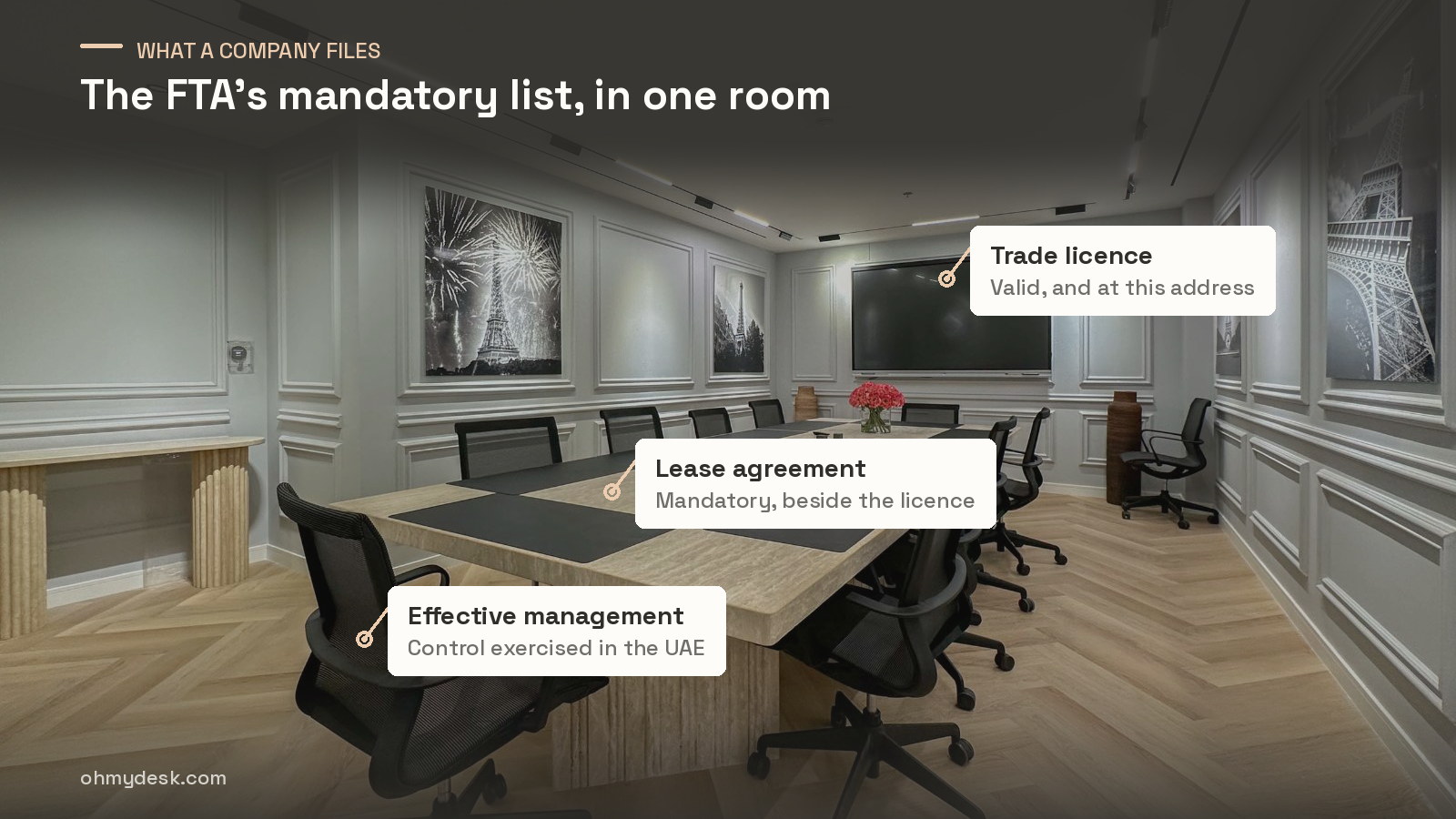
| Proof of UAE income or salary, if applicable | Lease agreement |
| Proof of employment or business, on the 90-day route | Certificate of incorporation |
| Proof of residence, on the 90-day route | Certified memorandum of association |
| Evidence of financial and personal interests, on the centre-of-life route | Corporate tax TRN, if available |
| Passport, always mandatory for a treaty certificate | Authorised signatory’s Emirates ID and passport, with proof of authorisation |
| Any further evidence the relevant treaty requires | Proof of effective management and control in the UAE, where applicable |
The line that surprises people is the second on the right. A lease agreement is on the mandatory list for a company, beside the licence and the certificate of incorporation — not an optional supporting document. The Authority wants to see the premises the entity operates from, so a licence carrying an address with no registered tenancy behind it is a problem here, and again at renewal. If the address changed recently, licence and tax records both have to catch up first; our guide to what a Dubai office move costs sets out that sequence.
Which is the quiet commercial reason a serviced address matters. A Virtual Office with Ejari at AED 8,000 a year gives a licence a real Dubai address with a registered tenancy behind it; a private office from AED 6,000 a month gives the same with people in it. Neither makes you a tax resident — nothing on a price list does — but both answer the document the FTA asks for.
How long does the Authority say it takes?
Longer than the market says, and the Authority publishes its own clock. Three separate timeframes, all quoted in business days.
| Step | FTA published timeframe | Counted from |
|---|---|---|
| Electronic certificate | 10 business days | The date the completed application was received |
| Printed hard copy | 5 business days | The date the relevant fee payment is completed |
| Attestation of an international form | 10 business days | The date the completed form is received |
They stack. A stamped paper certificate is 10 + 5 = 15 business days on the published path, and the UAE working week has run Monday to Friday since 2022 — so that is three clear working weeks before any public holiday, and before the courier. A foreign office insisting on its own national form adds another 10 business days. Plan a calendar month, not a fortnight: nothing in the fee schedule buys speed, and there is no expedited tier.
Can you certify a year that has not finished?
No, and the Authority says so in one line: “A Tax Residency Certificate cannot be issued to cover a future period.” The certificate covers “a Tax Period, or any other 12-months period, selected by the applicant” — you choose the window, but it has to be a window that has already run.
This is the rule that breaks plans, because tax residence is exactly what people want settled before the money moves. It cannot be pre-cleared. Someone relocating to Dubai in January and wanting a certificate for that year waits until the following January at the earliest, with the 183 days genuinely behind them and evidenced by an entry and exit report, not projected.
Nor is there automatic renewal: each year means a fresh application, fee and documents, so the AED 550 or AED 1,800 above is an annual cost.
What do the guides get wrong about the fees?
We read three widely cited advisory pages on 30 September 2026 against the Authority’s own page, read the same day. Two of the three reproduce the fee table correctly. All three publish a turnaround the Authority does not.
| Source, read 30 Sept 2026 | Hard copy | Company, not registered | Turnaround published |
|---|---|---|---|
| Federal Tax Authority | AED 250 | AED 1,750 | 10 business days |
| ClearTax | AED 250 | AED 1,750 | 4–5 days, delivered in 5–7 working days |
| Meydan Free Zone | AED 1,000 | not published | 5–7 working days, up to 8 for companies |
| Shuraa Tax | AED 250 | AED 1,750 | not published |
Two things fall out. One page prices the stamped copy at AED 1,000 where the Authority prices it at AED 250 — four times over — and never mentions the AED 1,750 rate. Follow it and you budget 50 + 500 + 1,000 = AED 1,550 for a stamped certificate the FTA prices at AED 800 for a registrant and AED 2,050 for an unregistered company: too much in one case, too little in the other. More useful still: every turnaround we found was faster than the Authority’s own 10 business days. The three pages do not merely disagree with each other, they all lean the same way.
The bigger omission is higher up. The UAE federal portal’s taxation page opens with “the UAE does not levy income tax on individuals”, then covers VAT, excise and corporate tax. It never mentions tax residency, the certificate or the day-count tests: someone preparing a move to Dubai from the government’s own front door will not learn this document exists.
How did we check these numbers?
Every amount, threshold and deadline above was read on 30 September 2026, on the page that sets it. Fees, eligibility, document lists, timeframes and the future-period rule come from the Federal Tax Authority’s service page. The residency tests and the permanent place of residence come from Cabinet Decision No. 85 of 2022 and Ministerial Decision No. 27 of 2023; the treaty rule from Ministerial Decision No. 247 of 2023; the ownership point from the Ministry of Finance’s announcement; the treaty count from its agreements page; and the omission above from the federal portal’s taxation page.
Two official documents are named and excluded. The FTA’s tax procedures guide on tax residency and its TRC applicant user manual are both PDFs whose directory blocks automated reading, so nothing here is taken from either; where they and the service page might differ, the service page is what we quote.
On search data, this is untouched ground for us: across two consecutive 28-day periods to 29 September 2026 our site recorded zero impressions on “domicile” and “liquidation” and four on “residency”. There are no real queries of ours behind the ten answers below; they come from keywords measured in Semrush’s UAE database on 30 September 2026.
FAQ: 10 quick answers
1. How much does a UAE tax residency certificate cost in 2026? AED 550, AED 1,050 or AED 1,800, depending on who applies. Every application pays AED 50 to submit. The Federal Tax Authority then charges AED 500 to a registrant, AED 1,000 to an individual not registered with it and AED 1,750 to a company not registered with it. Each printed hard copy is a further AED 250.
2. How do you get a tax residency certificate in the UAE? You apply to the Federal Tax Authority for a 12-month period that has already ended. An individual files an Emirates ID and/or passport with an official entry/exit report, plus evidence for the route being used. A company files its trade licence, a lease agreement, its certificate of incorporation and a certified memorandum of association. The published turnaround is 10 business days.
3. Is a tax domicile certificate the same as a tax residency certificate? Yes. Tax domicile certificate is the older name for the same document, from when the Ministry of Finance issued it rather than the Federal Tax Authority. There is no separate product, form or fee. TRC, tax residence certificate and tax domicile certificate all point at the same service.
4. How many days do you need to be in the UAE to be a tax resident? 183 days in any relevant 12 consecutive months, with no further condition attached. Cabinet Decision No. 85 of 2022 also allows 90 days for a UAE or GCC national, or a valid residence permit holder, who has a permanent place of residence or a job or business here — and a third route with no day count for someone whose life is centred in the country.
5. Can a new company get a UAE tax residency certificate? No. The Federal Tax Authority requires a juridical person to have been incorporated or established for at least 12 months before applying. A Dubai company licensed in March cannot obtain one until the following March, whatever it pays. The clock runs from incorporation, not the first invoice. The individuals behind it face no such wait.
6. How long does the FTA take to issue a tax residency certificate? 10 business days for the electronic certificate, from the date the completed application was received. A printed hard copy adds 5 business days from the date the fee is paid, so stamped paper is 15 business days — three clear working weeks on a Monday-to-Friday week. Attesting a foreign form is another 10 business days.
7. Do you need a tenancy contract or Ejari for a tax residency certificate? A company does: a lease agreement sits on the Authority’s mandatory document list, beside the trade licence and the certificate of incorporation. An individual only needs a residence on the 90-day route, where a permanent place of residence is one of two alternative conditions. A Dubai tenancy behind either has to be registered with Ejari.
8. Can you get a UAE tax residency certificate without a residence visa? On the 183-day route, Cabinet Decision No. 85 of 2022 sets no nationality or residence permit condition — physical presence of 183 days or more in the relevant 12 consecutive months is the whole test. The 90-day route is different and does require UAE or GCC nationality or a valid residence permit. Either way the Authority wants an official entry and exit report.
9. How long is a UAE tax residency certificate valid? It covers one 12-month period chosen by the applicant, and it cannot cover a future period. There is no automatic renewal, so each year means a fresh application, a fresh fee and fresh documents. For anyone who needs it annually, the AED 550 to AED 1,800 above is a recurring cost rather than a one-off.
10. What is a TRC in the UAE? TRC is the everyday abbreviation for the tax residency certificate issued by the Federal Tax Authority. It comes in two versions: a domestic one under Cabinet Decision No. 85 of 2022, and one for a specific double taxation agreement under Ministerial Decision No. 247 of 2023. The Ministry of Finance states the UAE has concluded 137 such agreements.
What to do next
Three moves, in order. Check the date your entity was incorporated: under 12 months and nothing else here applies yet, so what you give the overseas client is a date, not a form. Check whether you are registered with the Federal Tax Authority before you pay — AED 1,250 is a lot for a gap you could close first. Then count backwards from the day someone abroad needs the paper: 10 business days electronic, 15 if it must be stamped, and the period you are certifying has to have ended before you start.
If the lease agreement on the Authority’s list is the line that stops you, that part we can help with. A Virtual Office with Ejari is AED 8,000 a year and gives a licence a Dubai address with a registered tenancy behind it; a private office starts at AED 6,000 a month with six hours of meeting room; a hot desk is AED 950 a month with one. Book a free tour in Downtown or Business Bay — and our Dubai Design District address opens on 1 October 2026.