
What does Civil Defence approval in Dubai actually cost?
Nobody with the authority to charge it publishes the number. The framework is federal and public: Cabinet Resolution No. (24) of 2012 imposes its Schedule No. (1) fees “on all Buildings and Establishments, each according to its activity or the service provided”, calculated from the engineering plans “on the basis of the total utilized area” (Article 8(2)). What it charges your activity is the part that did not come back legible, and Dubai Civil Defence's service pages refuse automated reading outright.
So the honest answer is a shape, not a price: the readable part of Schedule No. (1) is a list of activities each carrying an amount between AED 200 and AED 7,000, with lines as specific as “Hotel 1000” and “Cafe 500”. A two-to-four-figure sum, set by your activity and your floor area. Every larger number on this subject belongs to a consultant, a contractor or an installer — not to the authority.
Is DCD approval the same thing as a fire safety certificate?
One approval, two names. DCD is Dubai Civil Defence, the emirate's arm of the service the federal texts call the civil defence: the federal instruments create the requirement, the emirate issues the paper. Worth knowing before comparing two quotes that use different words for one document.
Why is the certificate annual and not a one-off?
Because the Resolution says so in one line. Article 3(b): the certificate is valid “for one Gregorian year and shall be renewed annually”. Not for the life of the fit-out, not until the layout changes, not until an inspector comes back.
That line reshapes the subject, and it is what the commercial guides get least right. Read five of them and you get one story: lease signed, drawings in, systems installed, inspector visits, certificate out, doors open. All true — and all of it the first year of something that recurs.
And it is not a loop you can let slide. Article 3(a)(1) forbids departments from “licensing or renewing the license of Establishments” without a valid certificate of fire safety requirements. The fire file and the trade licence run on one clock, and the fire file gates the other.
What does the certificate unlock, and what does it block?
Three counters, in three industries, all asking for one piece of paper. The Resolution writes each as a prohibition on somebody else rather than a duty on you — which is why none feels like a fire rule when you hit it.
| What it gates | Who is forbidden to act without it | Where it is written |
|---|---|---|
| Issuing or renewing a trade licence | Federal and local licensing departments | Cabinet Res. 24/2012, Art. 3(a)(1) |
| Granting a building completion certificate | The same departments | Cabinet Res. 24/2012, Art. 3(a)(2) |
| Issuing an insurance policy | The insurer | Cabinet Res. 24/2012, Art. 4 |
| Issuing “such licenses” at all | Licensing authorities, unless an official certificate from the civil defence department is submitted | Federal Law 23/2006, Art. 21 |
The insurance line is the one nobody budgets for. A business whose certificate lapses has, on the face of Article 4, made itself uninsurable until the paper is back — a lease problem, for a tenant whose landlord wants proof of cover, before it is ever a fire problem.
Who does the law make responsible, the owner or the tenant?
The law names the owner, three times. Article 6(1) obliges “the owners of all Establishments and Buildings” to carry out periodic maintenance of the preventive safety systems through companies “licensed and accredited by the General Directorate”. Article 7(2) adds that owners “shall bear the costs of installing and maintaining the System”. Article 19 makes owners or their representatives let inspectors in.
Nothing readable puts maintenance on an occupier. Neither text defines “owner”, so a lease is free to allocate the bill differently — and leases routinely do. But the default runs opposite to the one the market assumes, which is worth reading your lease for.
It also reframes what you buy when you take space already fitted out. Whoever filed the drawings took on the annual file that follows them; a tenant moving onto a finished floor did not. That is the real difference between building an office out at a cost per square foot and taking a private office that already stands — a difference in recurring obligations, not just capital.
What does being late actually cost?
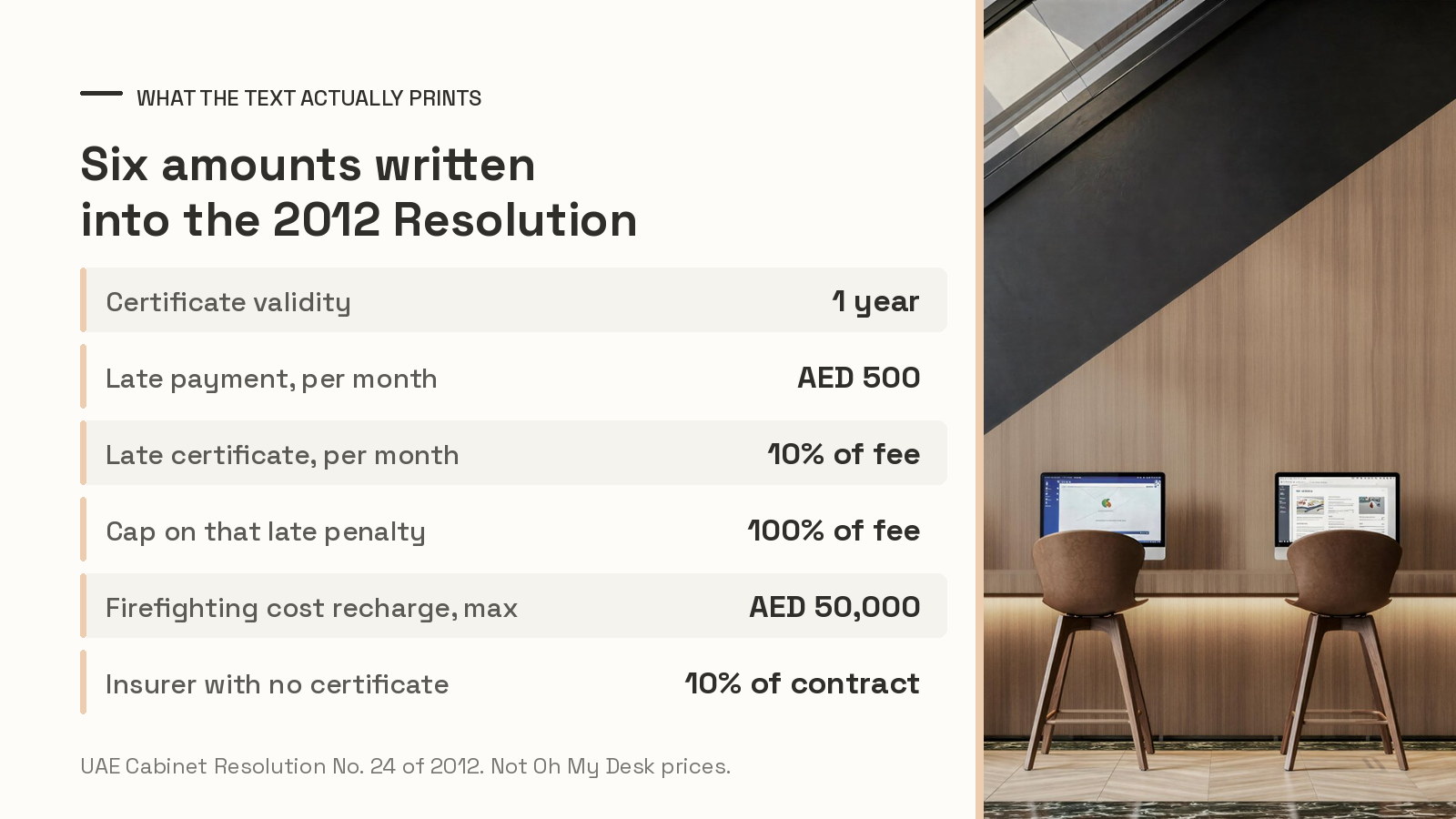
Here the Resolution does print numbers, and they are small, specific and checkable. Article 13 gives a violator “a period not exceeding one month from the date of notification” to pay, then adds “an additional fine of AED 500 (five hundred dirhams) for each month or part thereof”. A late certificate is handled separately at Article 14(1): 10% of the value of the fee per month of delay, “provided that it does not exceed the value of the prescribed fee”.
That cap does something quietly useful. The penalty is a tenth of the fee a month and stops at the fee itself, so ten months late costs exactly as much as twenty: the most a delay can do is double the certificate. The expensive consequence of lapsing is in Article 3(a)(1), where the licence renewal stops.
| What | Amount, as written | Article |
|---|---|---|
| Certificate validity | One Gregorian year, renewed annually | 3(b) |
| Late payment, after one month's notice | AED 500 for each month or part thereof | 13 |
| Late certificate, per month of delay | 10% of the value of the fee | 14(1) |
| Ceiling on that late penalty | Not more than the value of the prescribed fee | 14(1) |
| Firefighting cost recharged to a violator | Not more than AED 50,000 | 9(1) |
| Insurer issuing a policy without a certificate | 10% of the value of the contract | 15 |
| Removal of an urgent violation | At the violator's expense, plus all fines due | 20 |
One line there is not a fine and is constantly quoted as one. Article 9(1) lets the General Directorate recharge the cost of fighting a fire, “provided that the value of such costs does not exceed (50,000) dirhams”: a capped invoice for the fire engines, which exists only once there has been a fire.
Is “AED 500 to AED 50,000” a real fine band?
No — though both numbers in it are real, which is what makes it convincing. One Dubai consultancy page, read on 9 November 2026, warns of “heavy fines ranging from AED 500 – AED 50,000”. AED 500 is Article 13's monthly surcharge for paying late. AED 50,000 is Article 9(1)'s ceiling on recharged firefighting costs. Two genuine figures, from two unrelated articles, welded into a band that appears nowhere in the Resolution. A second page, read the same day, says the fine for operating without a completion certificate “starts from AED 5,000” and cites nothing.
The Resolution's own fine schedule is referred to twice, at Articles 10 and 13, as Schedule No. (2), and it is the part that did not come back in the fetched text. Named here and excluded: no figure from it appears below. What is readable is the federal statute.
| Provision | What it says | Article |
|---|---|---|
| General breach | Imprisonment for not more than six months, or the fine set in the table issued by the Cabinet | Federal Law 23/2006, Art. 29 |
| In cases of disasters | Imprisonment of not less than two months and a fine of not less than AED 20,000, running to AED 250,000, or either penalty | Art. 29 |
| Hindering civil defence equipment | The same penalty, plus the cost of the damaged machines or of reinstallation | Art. 30 |
| Other laws | These penalties do not affect any more severe penalty in any other law | Art. 31 |
| Closure | After exhausting the methods for removing the violation, a decision to close the violating establishment until it is rectified | Cabinet Res. 24/2012, Art. 11 |
Imprisonment is real, and it sits in the statute rather than on a marketing page. The flat dirham band does not. And the power that would actually stop a business — closure until the violation is rectified — is the one none of the five pages leads with.
What is the UAE Fire and Life Safety Code of Practice?
It is the technical rulebook under everything above, and it is the document this article could not read. Dubai Civil Defence's own page calls it the “First Code of Practice”, for contracting companies and consultants' offices to use “as a standard reference to ensure Civil Defence safety requirements are properly implemented”. That sentence is all a machine can get from the site: the page stating the edition in force, and the FAQ saying whether the Code reaches back to existing buildings, both refuse automated fetching.
That gap matters. Whether a code applies retroactively is the difference between the landlord's problem in 2012 and yours this year, and it is exactly what the readable page does not answer. Nothing here quotes an exit width, a travel distance, an occupant load or a sprinkler threshold: those live in the Code, and the Code was not read.
What about emergency exit signs?
Exit signage is the piece of fire safety people search for most, and it is a Code question, so the same limit applies. It is also a permit question in its own right — different authority, different application, different price. Those rules belong in the guide to Dubai's signage permits, and no sign price is published here.
Which fire extinguisher may you legally install in Dubai?
One from a source Civil Defence recognises — and unlike almost everything else here, that list is public, dated and downloadable. The Ministry of Interior's Civil Defence G.H.Q publishes the list of approved international testing labs and certification bodies. The copy read on 9 November 2026 carries a footer dated 24/06/2026 and an index numbered 1 to 74, from a testing house in Dubai to a research institute in Sweden, every entry under a heading reading “products acceptable to civil defence”.
That answers a question most people ask the wrong way round. “Which extinguisher should I buy” is really “whose certificate does Civil Defence accept”, and the answer is a 74-line federal list, refreshed five months ago, that not one of the five commercial guides mentions.
If a supplier cannot name the lab that certified what he is selling you, that list is where you check him.
Who may do the work, and what does “approved” mean here?
Not whoever quotes cheapest. The Resolution requires maintenance by companies “licensed and accredited by the General Directorate” (Article 6(1)), and Article 6(2) makes providers present their maintenance contracts “to the General Directorate for its approval”. The contract is something the authority sees, not a private arrangement.
How closely does the authority actually watch?
Closely, in the one trade whose rules were written out in public. A March 2023 circular from the General Command of Civil Defence on passive firestopping — the sealing of every hole a cable or pipe makes through a fire-rated wall or floor — sets a hold-point schedule that surprises anyone who thinks of this as paperwork.
| Requirement, as written | What it means on site |
|---|---|
| Progress inspections “at 20%, 40%, 60%, 80% and 100%” | Five hold points, not one final visit |
| Civil Defence inspection “two times within project cycle” | The authority itself attends twice |
| “Only tested and Civil Defence listed systems shall be used” | No substitution on site |
| Warranty “for minimum of 10 years” from the manufacturer or installer | Outlasts most leases |
| Inspector with “3 years experience in Firestopping inspections”; designer with 5 | Named competence, not a signature |
| Accreditation to “ISO/IEC 17020” or “IAS AC 291” | The inspector is himself accredited |
Five hold points and a ten-year warranty, for the part of a fit-out that becomes invisible the moment the ceiling closes.
What does the authority that does publish its price charge?
For contrast, an authority that does publish. The Dubai Development Authority, which covers Dubai Design District among other districts, prices its fit-out permit to the fils and states its turnaround in a line.
| Published by DDA | Figure, as written |
|---|---|
| Service fee | AED 0.90 per ft2, minimum AED 200, maximum AED 10,000 |
| Surcharges | AED 10 Knowledge Dirham and AED 10 Innovation Dirham per transaction |
| Estimated time to deliver | 2 working days |
| Permit validity | 6 months |
| Who applies | The contractor — the tenant appears only as a document supplier |
| Civil defence | “Dubai Civil Defense Completion Certificate is required prior to obtaining Fit-Out Completion Certificate” |
| Penalty for working without a permit | Not published |
Two things stand out. DDA names the civil defence certificate as a prerequisite to its own completion certificate, so the annual document gates a second authority's paperwork too. And the applicant is the contractor: the tenant appears only as the person supplying the Ejari and a no-objection letter from the owner. If nobody can tell you the price, it is partly because the payer is rarely the person asking — the gap a PRO or document-clearing agent fills.
What do five commercial guides say, and where do they disagree?
Five commercial pages were read on 9 November 2026. All five publish something; none sources its specification claims; and on the one line a tenant asks about — what the civil defence step costs for an office — the top of one range is eight times the bottom of another.
| Page, read 9 Nov 2026 | Office civil defence fee, as published | Office timeline | Penalty claimed |
|---|---|---|---|
| Dar Al Naseeb, civil defence guide | AED 500–1,500 under 500 sq ft; AED 1,500–4,000 for 500–2,000 sq ft, “authority fees only” | 2–4 weeks from drawing submission | “starts from AED 5,000” |
| Dar Al Naseeb, DDA fit-out guide | AED 1,500–8,000 for the civil defence NOC | 10–21 working days | none |
| Atech Interiors | The same bands, plus AED 0.50 per m2 for drawing approval | 7–15 working days standard, 15–30 complex | AED 500–50,000 plus imprisonment |
| Dubai South Business Hub | AED 1,500–5,000 total government fees for a 100–200 m2 office | 3–6 weeks, 2–6 weeks and 4–8 weeks, on the same page | none |
| Dar Al Naseeb, multi-authority guide | AED 1,000–5,000 “where fire systems are affected” | not given separately | none |
They do not even agree on the unit: per square foot, per square metre of drawing, or a flat total for an area in metres. Reconciling two of them compares measurement systems, not quotes — and one page contradicts itself three ways on its own timeline.
The specification claims are the part worth refusing to repeat. The same pages assert, citing nothing, that smart alarm monitoring is now mandatory for all commercial premises, that three hours of emergency-lighting backup is required, and that voice alarms are required above an occupancy of 1,000. The federal portal, on its fire safety page updated on 1 October 2026, says only that commercial buildings and residential apartments are monitored by the Hassantuk solution, launched in 2018 under the Ministry of Interior. It sets no backup duration and no occupancy threshold. None of the three is repeated here.
How did we check these numbers?
Everything above was read on 9 November 2026. Read in full: Federal Law No. 23 of 2006 concerning the civil defence, Articles 1 to 37; Cabinet Resolution No. (24) of 2012, Articles 1 to 31 and Schedule No. (1) entries 1 to 410; the approved testing laboratories list; the 2023 firestopping circular; the DDA fit-out permit page; the federal fire-safety page; the Civil Defence page on the Code of Practice; and five commercial guides, one of which is here.
Named and excluded, because they could not be read: every Dubai Civil Defence service page — licensing, company approval, Hassantuk — which the site refuses to automated fetching; the Code of Practice FAQ and edition pages, same refusal; Schedule No. (2), the fine schedule, which stopped short in the fetched text; and Schedule No. (1) past entry 410, including the per-square-metre drawing fee two commercial pages quote at AED 0.50 — reported above as their number, never as the Resolution's.
One omission deserves its own line, because it is what sends people to commercial guides. The federal portal's fire-safety page places exactly one mandatory obligation on anyone: house owners must install fire detecting devices and subscribe to the civil defence eSystem. For a commercial occupier it sets out nothing — no extinguishers, no exits, no drills, no certificate, no fine, no cost. A founder preparing an office from the government's portal learns what his apartment needs and nothing about his office.
FAQ: 10 quick answers
Answer first, source second. Every figure below comes from the text named beside it.
1. Do I need Civil Defence approval for an office in Dubai? Yes. Cabinet Resolution No. (24) of 2012 covers “all existing or to be constructed Buildings and Establishments” and exempts only private standalone residential houses. An establishment is any company licensed to practise an economic or professional activity — every office in the city. There is no carve-out for small units.
2. How long is a Dubai fire safety certificate valid? One Gregorian year, renewed annually — Article 3(b), in those words. It is the most misread point of the subject: the guides present it as the last step of a fit-out, while the Resolution writes it as a yearly condition for as long as anyone occupies the room.
3. What happens if the certificate lapses? Two separate things. Article 14(1) adds 10% of the value of the fee for each month of delay, capped so it “does not exceed the value of the prescribed fee”. Article 3(a)(1) separately stops departments renewing the licence of an establishment without a valid certificate — the expensive half.
4. Is DCD approval the same thing as a fire safety certificate? One approval, two names. DCD is Dubai Civil Defence, the emirate's arm of the service the federal texts call the civil defence: the federal instruments create the requirement, the emirate issues the paper. A page pricing “DCD approval” and a text writing “certificate of fire safety requirements” mean one document.
5. Who pays to maintain the fire systems, the landlord or the tenant? The law names the owner. Article 6(1) obliges “the owners of all Establishments and Buildings” to maintain the preventive safety systems through accredited companies, and Article 7(2) says owners “shall bear the costs of installing and maintaining the System”. No article puts that duty on an occupier.
6. Can Civil Defence close my office? Yes. Article 11 lets the General Directorate, after exhausting the methods for removing the violation, close the violating establishment until it is rectified. The text sets no time limit and does not frame closure as a penalty, so it sits alongside any fine rather than instead of one.
7. How much is the fine for operating without a certificate? The Resolution does not print it in the readable part: Articles 10 and 13 refer fines to a Schedule No. (2) that did not come back. Federal Law No. 23 of 2006, Article 29, is readable: up to six months' imprisonment or the Cabinet's table, and in disasters not less than AED 20,000.
8. Does my insurer need the certificate too? Yes, and the penalty falls on the insurer. Article 4 stops an insurer issuing a policy without a valid certificate, and Article 15 fines a breaching insurer 10% of the value of the contract. It is the only percentage penalty in the Resolution, and it is aimed at the insurance company.
9. Which fire extinguishers are legal to install in Dubai? Ones from a source Civil Defence recognises, and the list is public: the Ministry of Interior Civil Defence G.H.Q publishes a list of approved international testing labs and certification bodies, indexed 1 to 74, each entry headed “products acceptable to civil defence”. The copy read today is dated 24/06/2026.
10. Does a coworking member need their own certificate? A member renting a desk is not the party filing fire drawings or signing the maintenance contract: the Resolution attaches both to the owner of the establishment. One Dubai free-zone operator states in its own guide, read today, that flexi-desk businesses are covered by the operator's certificate — its wording, not the Resolution's.
The bottom line
The number to carry away is not a fee. It is one year: the life of a Dubai fire safety certificate, after which it is renewed or your trade licence renewal stops at the counter. Around it sit four amounts you can check yourself — AED 500 a month for paying late; 10% of the fee a month for a late certificate, capped at the fee; AED 50,000 as the ceiling on recharged firefighting costs; 10% of the contract if an insurer writes a policy without sight of the paper — and one duty the market inverts: the Resolution puts installation and maintenance on the owner.
Which is the argument for not owning the problem. A fit-out buys a layout and a recurring file: drawings, listed products, an approved maintenance contract, an annual renewal. A desk on a floor that already stands buys only the layout. At Oh My Desk that is a coworking desk from 950 AED a month with one hour of meeting room included, a dedicated desk at 1,500 AED a month at Downtown with four hours, or a private office from 6,000 AED a month with six — members in 24/7, reception Monday to Friday 9am to 6pm, prices before the 5% VAT added at checkout. If what you need is a licensed address rather than a room, that is Virtual Office + Ejari at 8,000 AED a year.
Weighing the two with a renewal coming up? Tell us the date and the activity. One rung down, what a flexi desk permits answers it for one person, and Dubai's CCTV rules cover the other regulator with an opinion about your ceiling.