What does a PRO service actually cost in Dubai in 2026?
Between AED 729 and AED 5,000 a month for a company of fewer than ten people, depending entirely on which provider you ask. That is not an estimate: it is the span of every published monthly figure we could read on 4 November 2026, from pages a search apart. Nobody regulates the price, and almost nobody publishes it. What is published, down to the dirham, is what the government charges at the counter the PRO walks up to.
| Published figure, read 4 November 2026 | What it covers | Price as published |
|---|---|---|
| Rate card, up to 5 employees | monthly retainer | AED 729 |
| Rate card, up to 10 employees | monthly retainer | AED 1,042 |
| Rate card, up to 25 employees | monthly retainer | AED 1,896 |
| Rate card, up to 105 employees | monthly retainer | AED 7,656 |
| Rate card, up to 205 employees | monthly retainer | AED 14,008 |
| Market range, “basic” retainer | monthly, provider unnamed | AED 1,000 – 2,000 |
| Market range, 1 to 5 employees | monthly, provider unnamed | AED 1,500 – 2,500 |
| Market range, “comprehensive” | monthly, provider unnamed | AED 2,500 – 5,000 |
| Market range, “corporate” | monthly, provider unnamed | AED 8,000 – 35,000 |
| Broadest span one page admits | monthly, across providers | AED 800 – 30,000 |
| Annual package, entry to premium | one year | AED 4,595 – 14,995 |
| In-house PRO, standard | salary, all-in, per month | AED 6,000 – 12,000 |
Read the first column before the third. Only the top five lines are a company’s own rate card; everything below is a range printed about an unnamed market, and a range about other people is not a price. Four of the six sources we read publish only the second kind.
Does anyone actually publish a PRO price?
One of the six pages we read publishes its own rate card. The other five do not. Three print market ranges and send you to a quote form (one, two, three); one says only that cost “depends”; one writes the finding out loud: “No authority publishes PRO service prices, so every quote is the provider’s own.” The sixth publishes a scale by headcount.
That sentence is accurate, and it is the reason the spread is 6.9 times: no tariff to anchor against, no regulator approving a scale, no published average. The dispersion is the service fee, because the government part of the bill is identical for everyone.
One more thing in that single rate card: it moves from AED 729 for five employees to AED 14,008 for 205. That is 41 times the headcount for 19.2 times the price — AED 145.80 per head at the bottom, AED 68.33 at the top. The work scales with transactions, not with people, and most transactions happen once a year per employee.
What is a PRO, and is it a regulated profession?
A PRO — public relations officer, in the UAE sense — is the person who carries your company’s files between government counters. Licence amendments, labour contracts, residence files, attestations, renewals. It is a job description, not a protected title: no exam, no register of individuals, no licence attached to a person. What is licensed is the company that sells the service to others — in Dubai, the “documents clearing services” activity, issued by the Department of Economy and Tourism.
And since the Commercial Companies Law was amended, the ownership question that used to decide this market has largely gone: the federal portal states plainly that foreign investors’ share “can be as much as 100 per cent”, that the law “abolishes the requirement for a majority Emirati shareholder or local partner”, and that “the obligation for branches of foreign companies to appoint a UAE national service agent has been eliminated”. Anyone can own a document-clearing company.
That is the surprise, and it sets up the next one. The activity is open. The counter is not.
Who is allowed to run the counter your file goes through?
The Ministry of Human Resources and Emiratisation licenses the service centres that handle labour transactions on its behalf, and its published application asks for a document only a UAE national holds: the family book. The service is named “Service centers (Tas’heel) license issuance”, and the ministry describes it in one line as “Issuing license for centers that will provide services on behalf of the Ministry of Labour”.
| What the application asks for | As published by the ministry, 4 November 2026 |
|---|---|
| Document 2 of 6 | “Passport copy and family book” |
| Premises | “Shouldn’t be less than 5,000 square feet” |
| Standard | “Prior experience in providing ministry services” |
| Standard | “Experience in management and operation” |
| Standard | “No violations record” |
| Also required | applicant profile, trade licence copy, location map, interior design, landlord agreement |
| Fee | not published — the payment section is blank |
| Processing time | not published — the timing section is blank |
Read the two blanks. The page governing who may stand between an employer and the labour ministry publishes neither a fee nor a deadline, while publishing a floor area to the square foot. That ordering tells you which constraint the ministry actually cares about.
Why does a service centre need 5,000 square feet?
Because it is a waiting room, and waiting rooms are sized for queues. Five thousand square feet is more than ten times the largest private office we publish — our biggest Business Bay unit is 470 square feet — and no small company would rent that much space to file its own paperwork. The floor area is the barrier to entry, and the reason the channel consolidates into a handful of licensed halls serving everyone else.
For a founder that matters in one practical way. You are not paying a PRO for access you could not otherwise get — most transactions now start online — you are paying for somebody else’s hour in that hall.
Why does signing on paper cost three times signing online?
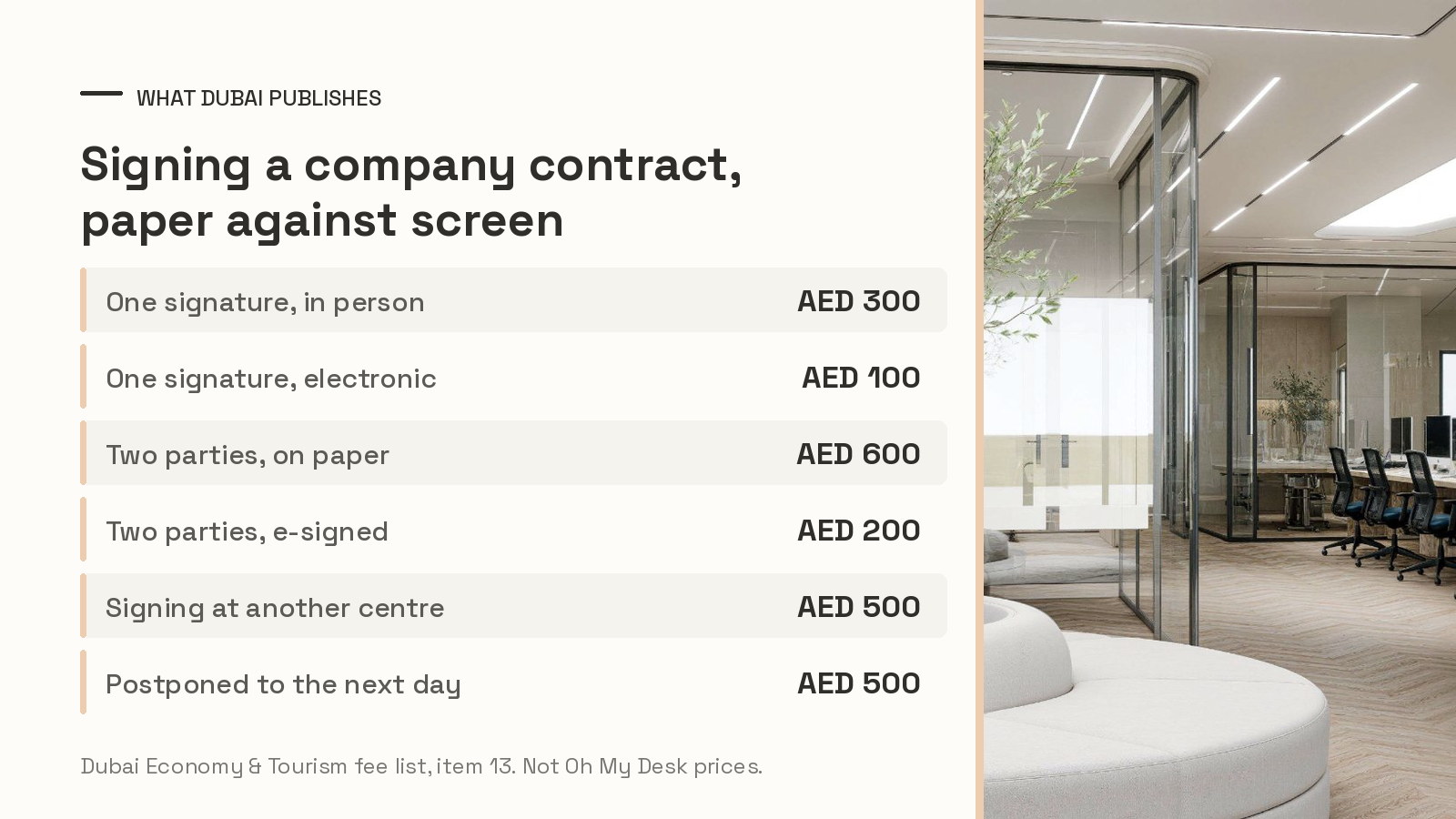
This is the one number in the whole trade that is published, exact, and almost never quoted. Item 13 of the Department of Economy and Tourism’s fee list for issuing a trade licence covers the attestation of establishment and service-agent contracts, and it reads as follows.
| Item 13, as published | Fee |
|---|---|
| “AED 300 for each party’s signature on the document for attestation of signatures on a document valued less than AED 100,000” | AED 300 per party |
| “%0.5 of the document value with a maximum of AED 15.000 for attestation of signatures” | 0.5%, capped |
| “AED 500 to postpone completion of the transaction after registration” | AED 500 |
| “AED 500 for signature by one of the parties in a different services center” | AED 500 |
| “AED 100 for the e-signature of each concerned party” | AED 100 per party |
Three hundred dirhams to sign in the room, one hundred to sign from anywhere. Same document, same registration, same legal effect; the only variable is whether a human being turned up. On a two-party contract that is AED 600 against AED 200 — AED 400 of pure channel.
Two of those lines deserve their own paragraph. AED 500 to postpone completion to the following day means a signature that slips is charged more than one that does not. AED 500 for one party to sign at a different service centre means geography is billable: two partners in two parts of Dubai pay a fee for being in two parts of Dubai. Add both and a contract that slips a day and splits across town costs AED 1,000 more — almost exactly a month of the cheapest published retainer.
Then the percentage line. Above AED 100,000 of document value the flat fee gives way to 0.5% of the value, with a maximum of AED 15,000, and the cap is worth the arithmetic: AED 15,000 is 0.5% of AED 3,000,000, so every contract above three million dirhams pays the same attestation fee. One last detail, because we read the page twice and it was still there: the published list letters two different items “D)”. It changes nothing you pay. It is a reminder that the only authoritative price list in this market is a page with a typo in it, which is still infinitely more than the private market publishes.
Why is the VAT line on a PRO invoice the most expensive thing on it?
Because a government fee can arrive on your invoice in two completely different legal shapes, and one of them carries 5% VAT while the other carries none. The Federal Tax Authority settled this in a public clarification on disbursements and reimbursements, and the test is not what the fee is — it is whose name the supplier’s invoice is in.
| Disbursement | Reimbursement | |
|---|---|---|
| The PRO acted as | your agent | a principal, in its own name |
| Who received the service | you did | the PRO did |
| Invoice from the authority is in the name of | you | the PRO |
| Amount recovered | exactly, with no mark-up | may be marked up |
| Shown on the invoice | separately | inside the fee |
| VAT | “not subject to VAT” | follows the main supply — 5% |
The clarification is explicit at both ends: “A disbursement does not constitute a supply and is, therefore, not subject to VAT,” while a reimbursement “follows the same VAT treatment as the main supply”. So the same government fee, passed on by two differently organised providers, costs you 5% more at one of them — and over a year of licence, visa and labour transactions that 5% sits on a far larger base than the retainer.
Which is why one line on the single rate card we found matters more than its figures: government fees are “billed separately at actual cost, with receipts”. That is almost word for word the authority’s own description of a disbursement. Ask for that sentence in writing before you ask for a discount.
What can you file yourself, without a PRO at all?
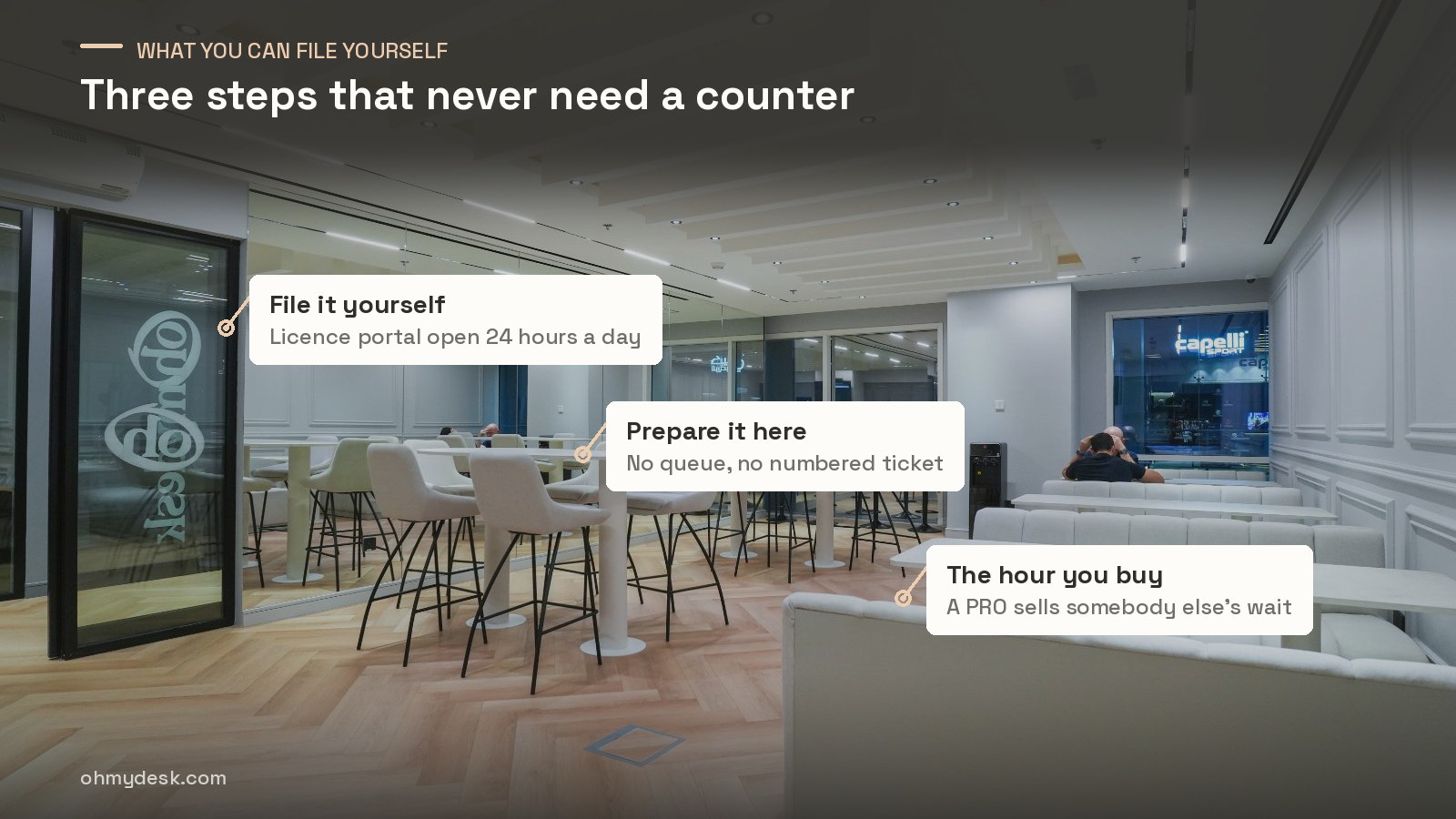
More than the market suggests, and the authorities say so on their own service pages. The trade licence service lists its channels as website or application, 24 hours a day, 7 days a week, or service centres — online first, not as an alternative. The e-signature fee exists precisely because the signature is expected to happen remotely.
A reasonable division of labour under ten people: do yourself anything with a portal and a fixed fee — licence renewal, address changes, a contract signed electronically, status checks — and pay for anything that needs a physical queue, a translated document or a numbered ticket. The second list is shorter every year, and the retainer you are quoted is usually priced on the old one.
Two caveats, both real. Time: an hour of a founder’s week on a portal is not free, and at the bottom of the published scale a retainer costs roughly AED 145 per employee per month. Error: a rejected file costs a resubmission and a delay, and one page we read puts a resubmission charge of AED 200 to 500 on its own list. Doing it yourself is cheaper only while it works.
When is an in-house PRO cheaper than an agency?
Later than most founders think. The only in-house figures published on the pages we read put a standard PRO at AED 6,000 to 12,000 a month, all-in, and a senior one at AED 12,000 to 20,000. On the published rate card, AED 7,656 buys the tier for up to 105 employees — so the two meet at around a hundred people.
Below that, the arithmetic is not close. A company of ten pays AED 1,042 a month on the published scale; the cheapest in-house salary quoted is roughly six times that, before a visa, a work permit and a desk. In-house is a volume decision, not a control decision. If what you want is control, buy the receipts, not the employee.
What should a PRO quote contain before you sign it?
Five lines, none of them a price negotiation.
1. Government fees billed at actual cost, with receipts
The disbursement wording. Without it you are paying 5% VAT on fees that need not carry it, and you cannot tell a mark-up from a tariff.
2. Which transactions are included, counted per year
A retainer priced per headcount is priced on an assumption about transactions. Write the assumption down: renewals, new hires, cancellations, amendments.
3. What a resubmission costs
Rejections are the only unpredictable item in the process, and at least one provider prices them separately. If yours does not, say so in the contract.
4. Who signs, where, and how
At AED 300 against AED 100 per signature, the channel is a cost line. A provider who defaults to paper is choosing the expensive route on your behalf.
5. The exit
Your company file, passwords and portal access belong to the company. Agree how they come back before you need them back.
What can a PRO not do for you?
It cannot make an authority faster than it publishes, it cannot obtain a document whose preconditions you do not meet, and it cannot stand in for an address: a mainland licence needs premises with a registered tenancy. That is the one step a founder cannot outsource, because it is the step everything else attaches to.
It also cannot change published prices. Licence fees, attestation fees and the labour and residence tariffs are the same whoever walks them to the counter. A quote that is cheaper because “we get better rates” is describing its own margin, not the government’s.
Why does the federal portal not name the channel everyone uses?
Here is the oddity we could not resolve. The federal government portal’s page on ministry service centres says the ministry “approved the following centres to provide its services to workers and employers” and lists three categories: “Business services and guidance centres”, “Domestic workers’ services centres” and “Tawseel service providers”. It gives no fees, no counts, and — on the page itself — it does not use the word Tas’heel at all, although the ministry’s own licensing page does.
We could not read further: the ministry’s list of approved business services centres is blocked to automated reading, so we cannot tell you how many licensed centres exist, and we are not going to guess. Named and excluded, like the fee and the processing time the licensing page leaves blank. The pattern across this whole subject is the same: the rules are public, the quantities are not.
What to do next
Start with the two numbers that are published rather than the one that is not. Sign electronically wherever the authority allows it: AED 100 against AED 300 per party is a third of the price for the same legal act. Then ask any provider for one sentence in writing — government fees at actual cost, with receipts — because that line decides whether 5% VAT rides on every tariff you pay for a year. Compare retainers only after those two, and ask the four providers without a rate card why they do not have one.
And settle the address before the paperwork, not after. A licence needs premises: a virtual office with Ejari is AED 8,000 a year, registered through our Ejari booking page, with the mechanics set out in the Ejari guide. When the team needs somewhere to sit, a hot desk is AED 950 a month with one hour of meeting room included, all prices excluding VAT, members in at any hour and reception Monday to Friday from 9am to 6pm. Founders arriving alone usually weigh the freelance visa route in Dubai first; those hiring will find the ministry’s own published tariffs in the work permit guide, the certificates a new file needs in the attestation guide and the police clearance guide. If the paperwork in question is a new online business, the licence figures are in the e-commerce licence guide; if it is the end of one, in the company liquidation guide. Book a free tour at Downtown, Business Bay or Dubai Design District.
FAQ: 10 quick answers
Our own search data carries no query on this vocabulary — zero impressions on “pro services”, “clearing” and “translation” across two consecutive 28-day periods — so these ten questions come from the keywords actually measured for the UAE market on 4 November 2026, not from invented ones.
1. How much do PRO services cost in Dubai? Between AED 729 and AED 5,000 a month for a company under ten people, across every published figure we could read on 4 November 2026. Only one of those figures is a provider’s own rate card; the rest are ranges about an unnamed market. Annual packages run AED 4,595 to 14,995. No authority sets or approves any of it.
2. What does PRO stand for in the UAE? Public relations officer — the person who files a company’s documents with government departments. It is a job description rather than a protected title: there is no exam, no individual register and no licence attached to the person. What is licensed is the company selling the service, under the documents clearing services activity.
3. Do I need a PRO to set up a company in Dubai? No. The licensing authority lists its own channels as website or application, 24 hours a day, and prices an electronic signature at AED 100 per party against AED 300 in person. A PRO buys somebody else’s time in a queue, not access you would otherwise be refused.
4. Can a foreigner own a document clearing company in Dubai? Yes. The federal portal states that foreign investors’ share “can be as much as 100 per cent” and that the law “abolishes the requirement for a majority Emirati shareholder or local partner”. The restricted-activity list it publishes covers security and defence, telecommunications, banking and insurance, commercial agencies, Hajj and Umrah, Quran institutes and marine catching — document clearing is not among them.
5. Who is allowed to run a Tas’heel centre? In practice, a UAE national: the ministry’s published application for a service centre licence asks for a “passport copy and family book”, and a family book is issued only to nationals. The premises “shouldn’t be less than 5,000 square feet”, and the applicant must show prior experience in providing ministry services. Neither a fee nor a processing time is published.
6. What does it cost to attest a company contract in Dubai? AED 300 for each party’s signature on a document valued under AED 100,000, or 0.5% of the value above that, capped at AED 15,000. An electronic signature costs AED 100 per party. Postponing completion to the following day costs AED 500, and one party signing at a different service centre costs AED 500.
7. Should government fees be shown separately on a PRO invoice? Yes, if you want them free of VAT. The tax authority treats a fee recovered as an agent, in your name, shown separately and with no mark-up, as a disbursement that “does not constitute a supply and is, therefore, not subject to VAT”. Recovered in the provider’s own name it is a reimbursement that “follows the same VAT treatment as the main supply”, so 5% applies.
8. Is an in-house PRO cheaper than an agency? Only at scale. The published in-house salaries we read run AED 6,000 to 12,000 a month all-in for a standard PRO, while the one published retainer scale reaches 105 employees at AED 7,656. Below roughly a hundred people the agency is cheaper on every published figure; above it, the two converge.
9. What is document clearing in Dubai? The activity of preparing, submitting and collecting government documents on behalf of another company — licence amendments, labour files, residence files, attestations. It is a licensed professional activity issued by the Department of Economy and Tourism, and it is what “PRO services” actually means on a licence.
10. How many approved service centres are there in Dubai? We cannot tell you, and we are not going to estimate. The federal portal names three categories of approved centre — business services and guidance centres, domestic workers’ services centres and Tawseel service providers — without a count, and the ministry’s own list is closed to automated reading.