What does a courier actually cost in Dubai in 2026?
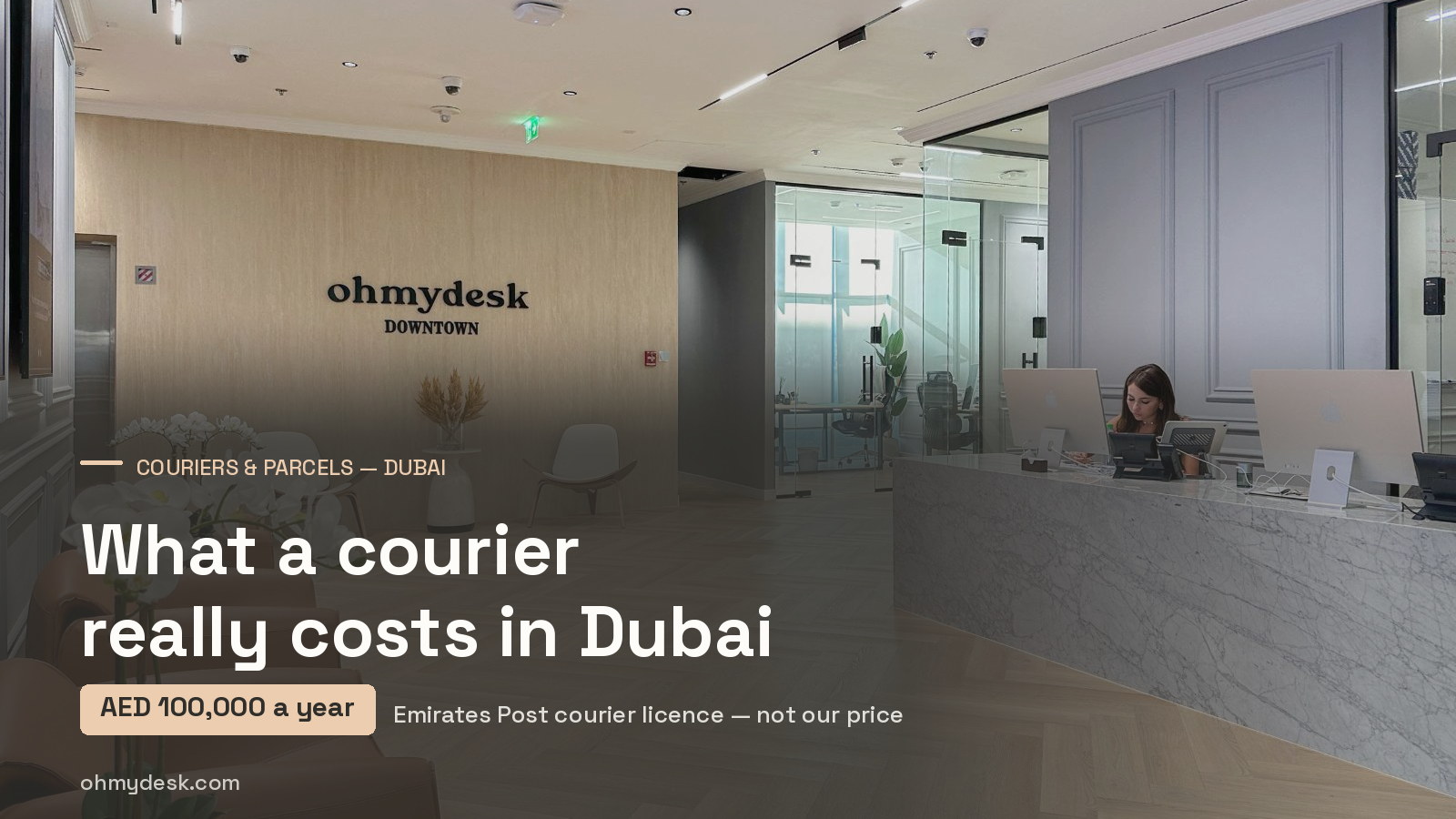
Where a rate is published, a next-day parcel inside one emirate costs AED 35 before tax at Quiqup and AED 43.20 at FedEx — but five of the seven operators we opened on 2 November 2026 publish no domestic rate at all, the national operator included. Behind every quote sits a fee the customer never sees: a courier may not carry a document, a letter or a parcel of 30 kg or less in the UAE without a postal licence from Emirates Post Group, and that licence starts at AED 100,000 a year.
That is the unusual shape of this market: the incumbent postal operator licenses its own competitors and takes a share of their revenue. None of the commercial guides we read mentions it, though it is published in plain English on the group's regulatory site.
Why does AED 100,000 come before the first parcel?
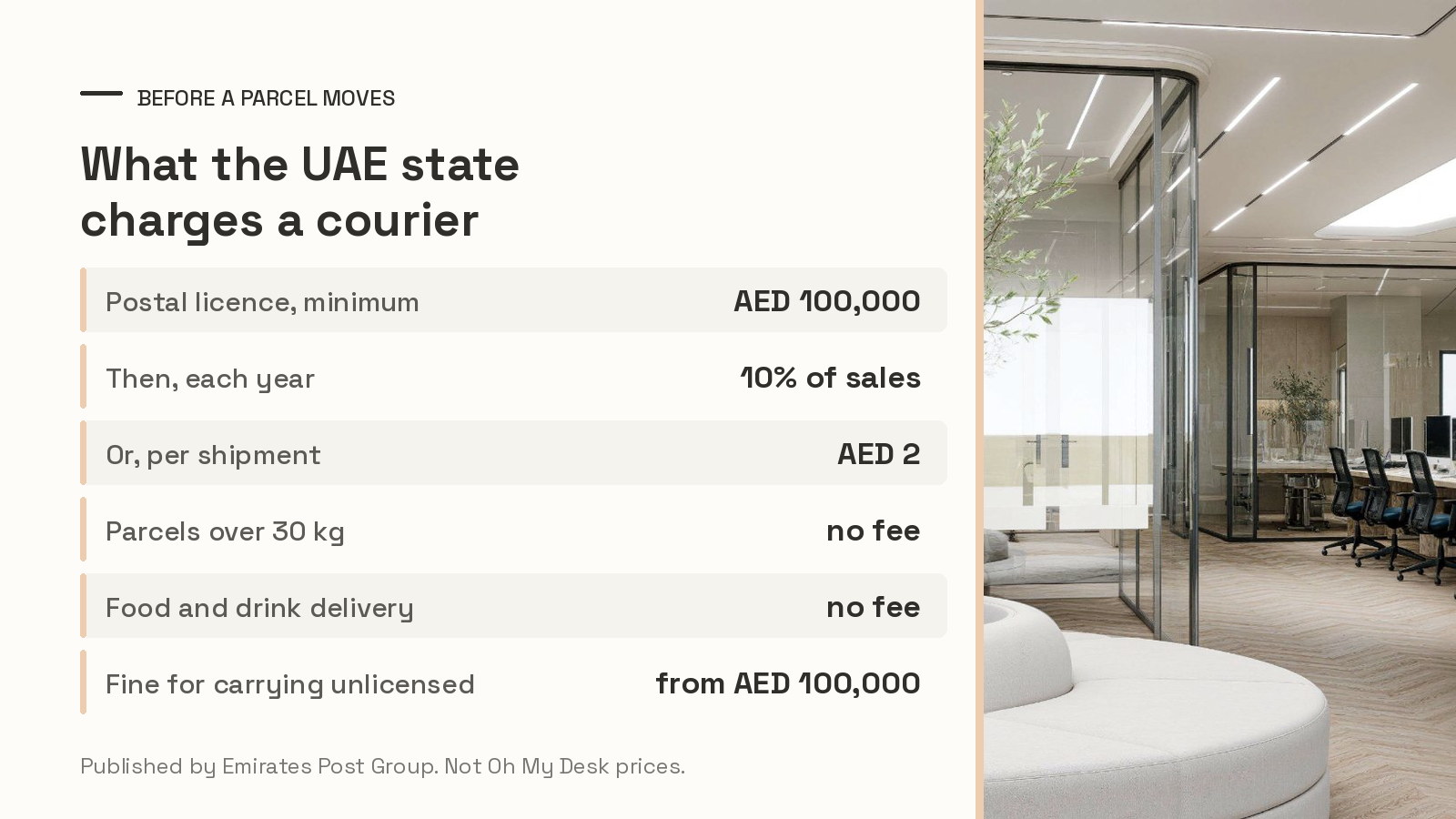
The Postal Activity Licence is issued by Emirates Post Group for “the transport of documents, letters, and parcels with weight of thirty kilograms or less per each”. Its price is not a flat fee. The group's own licensing FAQ sets an annual postal fee of 10% of the revenue of licensed local and international services, or AED 2 per shipment, whichever is higher, with a minimum of AED 100,000 paid in advance when the licence is granted or renewed.
Three details make that minimum heavier than it looks. It cannot be paid in instalments and cannot be deferred. A quarterly declaration — Form 9 — must be filed even when there is no fee-liable revenue, approved by an external auditor. And a licensed company may not subcontract delivery to an unlicensed one, so the rider who takes your envelope sits inside somebody's licence.
And the fine starts at exactly the price of the licence
Article 15 of Federal Decree-Law No. (21) of 2019 is a criminal provision, not an administrative one: “imprisonment for a period not less than one year and not more than two years and/or a fine” of “not less than one hundred thousand (100,000) dirhams and not more than five hundred thousand (500,000) dirhams”, and “in all cases, the items subject of the crime shall be confiscated”.
Put the two figures side by side and the design is visible: the minimum fine is exactly the minimum licence fee, the maximum is five times it, and the parcels themselves are forfeit.
What is reserved to Emirates Post, and where does 30 kg come from?
Thirty kilograms is the line between a regulated postal item and an ordinary freight job, and it is the operator's FAQ that draws it, not the law. Asked what may be shipped without a licence, Emirates Post answers: “foodstuffs and parcels over 30 kg”. Asked whether a company may deliver a parcel heavier than 30 kg, it answers yes, “with no fees, provided other official authorities agree”. So the fee falls on the small parcel and spares the big one: a 29 kg box costs its carrier AED 2 or a tenth of the fare, a 31 kg box costs it nothing.
The 2019 Decree-Law itself never uses the word exclusive. It defines a Postal Item as “letters, publications, postal cards, packs, packages, post parcels, publications for the blind” and sets no weight limit at all. The exclusivity is asserted by the operator and enforced through Article 15; the 30 kg ceiling lives in the licence, not in the statute.
One more line of that law explains a daily annoyance. Article 10 tasks the Post Sector Regulation Committee with proposing a postal coding system to the Cabinet. Seven years on there is still no postcode to write on a parcel, which is why couriers ask for a phone number and a landmark — and what that means for a company address is the subject of our guide to what a company P.O. Box costs in Dubai.
| What is carried | Permission needed | Price | Stated turnaround |
|---|---|---|---|
| Documents, letters, parcels up to 30 kg | Postal Activity Licence, Emirates Post Group | AED 100,000 minimum, in advance | 1 or 20 working days — see below |
| The same, every year after that | Annual postal fee | 10% of licensed sales or AED 2 a shipment, whichever is higher | quarterly Form 9 |
| Parcels over 30 kg | None from Emirates Post | no fee | — |
| Food and beverage | No-objection certificate + an economic department permit | no fee | 1 working day |
| Sources: the Postal Activity Licence page and the licensing FAQ, epgl.ae, read 2 November 2026. | |||
Why is food delivery free and a document AED 100,000?
Because the two are licensed at different counters, by the same group, and only one of them has a price. Emirates Post also issues a no-objection certificate stating that it has “no objection to engage in the food delivery activity in the country”. Service fee: No Fees. Delivery time: one working day. Its licensing FAQ draws the boundary in one sentence — the delivery permits issued by the Departments of Economic Development are “limited to food and beverage delivery”.
Two riders on the same street, under two regimes. The one carrying a biryani needs a free certificate; the one carrying a signed contract needs a licence starting at AED 100,000, and his employer owes AED 2 or 10% on the trip.
Do Emirates Post's own two pages agree on the licence?
No, and they disagree on three things at once: the tax, the lead time and who may own the company. The group's regulatory site and its commercial courier licence page describe the same licence, and we read both on 2 November 2026.
The regulatory site says VAT is not calculated on postal fees; the commercial site prices the licence at “AED 100,000 + 5% VAT”, which is AED 105,000. The regulatory site promises one working day; the commercial site says 20 working days. The regulatory FAQ states that “a citizen is not required in the trade licence”; the commercial page says the owner must be a UAE national and asks for a family book copy. And the variable part of the fee appears on only one of the two.
We are reporting the contradiction, not resolving it: an applicant budgeting from the wrong page is out by AED 5,000 and nineteen working days.
| Question | Regulatory site (epgl.ae) | Commercial site (emiratespost.ae) |
|---|---|---|
| Price | AED 100,000 minimum in advance, then 10% of sales or AED 2 a shipment | “AED 100,000 + 5% VAT per license” |
| VAT | “not calculated on postal fees” | 5%, i.e. AED 5,000 |
| Turnaround | One Working Day | 20 working days |
| Owner | “a citizen is not required in the trade licence” | owner must be a UAE national; family book copy required |
| Variable fee | 10% of sales or AED 2 a shipment | not mentioned |
| Difference between the two prices: AED 5,000. Difference between the two turnarounds: nineteen working days. | ||
Which operators publish a price, and which ask you to call?
Two out of seven — and one of those two rate cards is dated January 2020. We opened the public pages of seven operators serving the UAE on 2 November 2026 and asked one question of each: can a visitor read a domestic price without an account or a quote request?
The answer is no for the national operator. Emirates Post's domestic shipment page describes Standard, Express “within 1-2 business days” and Premium same-day under a “Service Fees” heading with no amounts beneath it. Its developer documentation exposes a rate calculator instead, and the sample response there shows a VAT percentage of 0 next to a VAT amount of 7.50 — two fields of the same object that cannot both be right.
| Operator | What the public page shows | Readable price? |
|---|---|---|
| Emirates Post | Standard, Express and Premium described; a “Service Fees” heading with no amounts | No |
| DHL Express UAE | online quote form | No |
| Zajel | rate calculator and quote form; publishes limits only — 10 kg by motorbike, 30 kg by van | No |
| Aramex | rate calculator returned a server error on every attempt from our container | Could not be read |
| Jeebly | “starting rates” of AED 17.36 next-day and AED 28.56 same-day; AED 17.31 for the same service lower on the page | Partly |
| FedEx | full domestic rate card in AED, effective 6 January 2020 | Yes |
| Quiqup | full self-service fee schedule dated 21 January 2025 | Yes |
| Two rate cards out of seven operators, and the older of the two has been current for six years and ten months. | ||
What does a next-day parcel inside one emirate actually cost?
Between AED 17.36 and AED 43.20 before tax for the same errand — a spread of two and a half times. The cheapest of the three published figures is a “starting rate”, and the page carrying it also prints AED 17.31 for the same service lower down, without explaining the difference.
The surcharge list underneath a rate card tells you more than the rate. FedEx's domestic card carries an address correction fee of AED 1.00 a shipment — a charge that exists because there is no postcode to get right in the first place. Quiqup's schedule prices a failed collection, a return and a cancelled order at the full delivery fee, allows three attempts on next-day service but one on its four-hour service, and gives couriers a ten-minute maximum wait at collection.
| Service | Published price | What the price covers |
|---|---|---|
| Next day, same emirate (Quiqup) | AED 35 | 3 delivery attempts |
| Next day, other emirate (Quiqup) | AED 35 | 3 attempts; subject to revision |
| Four hours, same emirate (Quiqup) | AED 50 for 37 km, then AED 1 a km | 1 attempt only |
| Overnight envelope or pak, 0.5–1 kg (FedEx) | AED 43.20 | excludes surcharges, duties and taxes |
| Next day, up to 5 kg (Jeebly) | from AED 17.36 | starting rate, quote required |
| Over 5 kg (Quiqup) | + AED 2 a kg | on combined weight above the first 5 kg |
| Extra parcel in the same order (Quiqup) | + AED 5 | maximum 8 parcels |
| Cash on delivery (Quiqup) | 2.5% of the amount collected | cash and card |
| Address correction (FedEx) | AED 1.00 a shipment | per published surcharge list |
| Cheapest published figure to dearest, same errand: AED 17.36 to AED 43.20, a factor of 2.5. | ||
At what price per parcel does the AED 2 levy beat the 10%?
At AED 20. Below that price the flat AED 2 is the higher of the two, so the cheapest deliveries carry the heaviest state levy as a share of the fare. Ten per cent of AED 20 is AED 2, so any parcel sold under AED 20 pays more than a tenth of its price in postal fee — AED 2 on a AED 17.36 delivery is 11.5%.
The same rule decides how long the advance lasts. A courier whose average ticket is AED 35 pays the 10% route and works the AED 100,000 off after AED 1,000,000 of licensed revenue, about 28,572 parcels or 78 a day. At AED 17.36 a parcel the AED 2 route applies and it takes 50,000 parcels, about 137 a day. Same AED 100,000, 75% more parcels, purely because the service is cheaper.
What changed on 3 August 2026 for a parcel arriving in Dubai?
The customs duty exemption on a cross-border e-commerce parcel went from AED 300 to AED 1,000, and the 5% import VAT did not move. Customs Notice No. (16/2026), amending Notice No. (15/2021) of 20 December 2021, says in its Article 1(a) that “goods and products with a value not exceeding AED 1,000 shall be exempt from customs duties”, and sets its effective date at 03/08/2026.
The exemption does not cover tobacco and tobacco products, electronic smoking devices and their accessories, liquids containing nicotine, alcoholic beverages or food containing alcohol. Returned goods on which duty has already been paid are exempt if they come back within 60 days of the date they left. In money: a parcel with a customs value of AED 900 carried AED 45 of duty before 3 August and carries none now — but the 5% import VAT is untouched, so a duty-free parcel is not a tax-free parcel.
The English and the Arabic texts do not say the same thing
The return clause contradicts itself across the notice's own two languages. The English text limits it to goods “returned via companies for B2C”; the Arabic text describes goods returned for personal purposes. Those are not the same set of parcels, and if your returns sit in the gap, the version that binds is a question for Dubai Customs rather than for a guide.
| Until 2 August 2026 | From 3 August 2026 | |
|---|---|---|
| Duty-free threshold | AED 300 | AED 1,000 |
| Customs duty on a parcel worth AED 900 | AED 45 (5% of value) | AED 0 |
| Import VAT | 5% | 5%, unchanged |
| Goods excluded from the exemption | — | tobacco and tobacco products; electronic smoking devices and accessories; nicotine liquids; alcoholic drinks; food containing alcohol |
| Returned goods already taxed | — | exempt if returned within 60 days of exit |
| Source: Customs Notice No. (16/2026) amending Notice No. (15/2021), article 1, effective 03/08/2026. | ||
What does Dubai Customs charge to clear a courier parcel?
The one declaration a courier files on every parcel is the one with no published fee. The Dubai Customs Customer Guide says at section 15.22 that courier goods valued at AED 1,000 and below move on Courier Import, Export or Transit Declarations — and states no price for any of the three. The Service Guide, version 9, does not list the courier declarations at all, while every ordinary declaration in it is priced between AED 15 and AED 100.
If you are importing stock rather than receiving the occasional envelope, the licence covering the selling side is a separate budget line; we costed it in our guide to what an e-commerce licence costs in Dubai.
| Item | Published amount |
|---|---|
| Courier Import, Export or Transit Declaration (AED 1,000 and below) | no fee published |
| Ordinary import or export declaration | AED 15 to AED 100 |
| Ordinary transit declaration | AED 15 to AED 80 |
| Business registration | AED 100 |
| Knowledge fee | AED 20 |
| Innovation fee, on any transaction whose fee exceeds AED 50 | AED 10 |
| Inspection charge / inspection seal | AED 150 / AED 20 |
| Declaration amendment or cancellation | AED 25 each |
| Late document submission, after a 14-day grace period | AED 50 a day, up to 90 days |
| Every declaration type in the Service Guide carries a price except the three courier ones, which the Service Guide does not list at all. | |
Who signs for your parcel when your office is a desk?
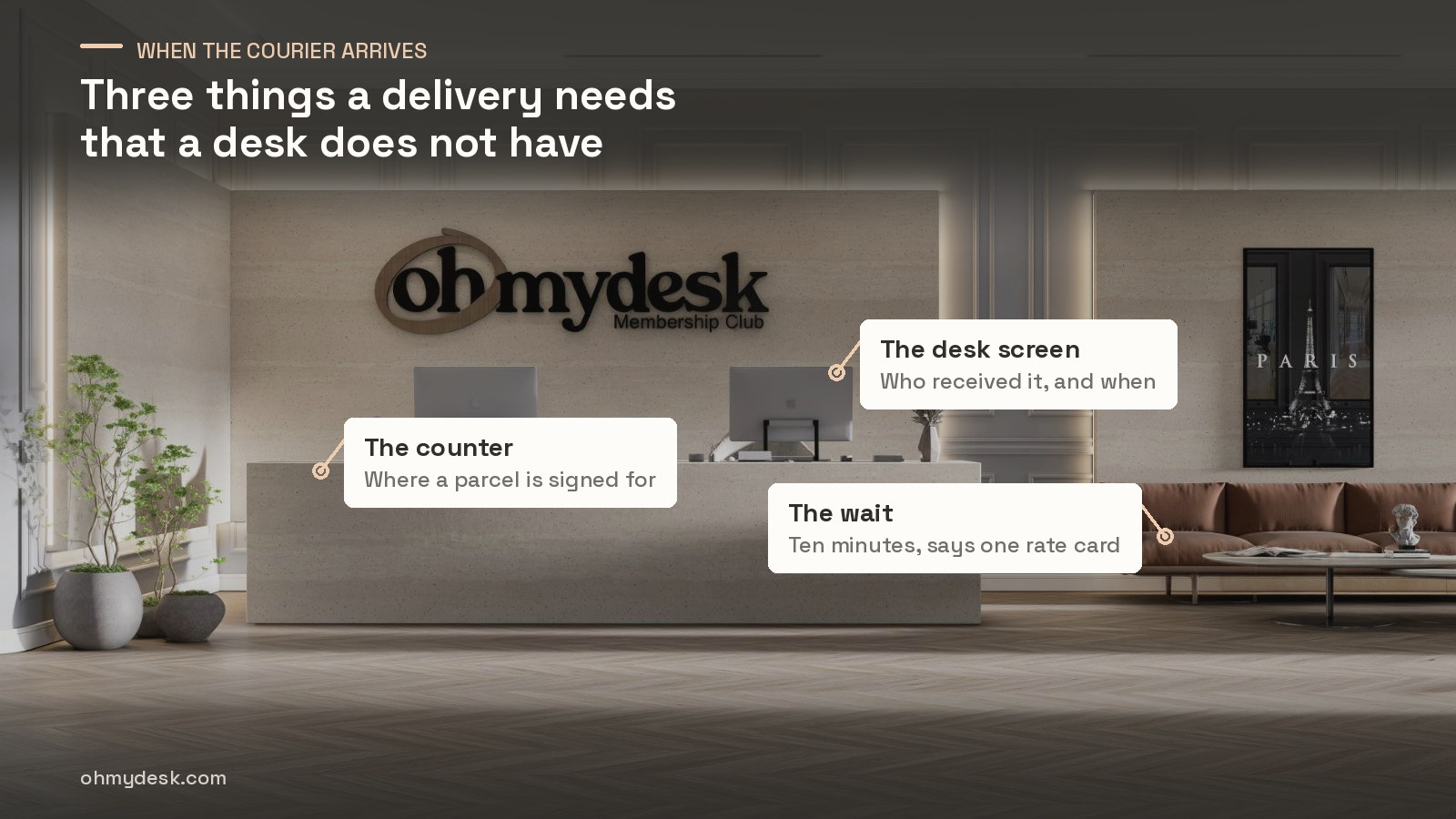
Somebody has to be standing there, and that is the part of the delivery nobody prices. A courier with a ten-minute waiting limit will not come back on your schedule: a parcel that arrives while the team is out goes back to a depot and returns as a second charge.
At Oh My Desk Downtown and at our other Dubai addresses the front desk is staffed Monday to Friday, 9am to 6pm — 45 hours of the week — while members have their own access 24 hours a day, 7 days a week. We will not pretend that covers a Saturday delivery: it does not. It covers the working week, which is when couriers run.
The rest is the address itself. A company that needs a registered address with an Ejari certificate rather than a desk can take Virtual Office + Ejari at AED 8,000 a year and book it online; a company that wants people in the room can take coworking at AED 950 a month, the arrangement behind what a flexi desk actually is. Both are quoted before tax, with 5% VAT added at checkout, and how Ejari works in Dubai covers which document comes first.
How did we check these numbers?
Every figure above was read on 2 November 2026 on the page of the body that charges it: the Emirates Post licensing and commercial sites, the Federal Decree-Law, the Dubai Customs notice and Customer Guide, and the operators' own rate cards. The federal portal's mail services page names the Postal Sector Regulatory Committee and says that providing postal or delivery services without a licence is prohibited; it gives no weight threshold, no fee and no price.
Three things we could not read, and did not estimate. The register of licensed postal companies loads its list dynamically and returned no company at all, so we publish no count of licensed couriers. The Aramex rate calculator returned a server error on every attempt, so Aramex is named and left out of the price table. And Emirates Post's commercial site refuses plain requests with a 403 while serving the same page to a browser-style fetch — we read it, we quote it, and we say how. Two sets of prices we deliberately left where they belong: the P.O. Box tariffs, and the security system fees in our guide to Dubai's CCTV rules.
FAQ: 10 quick answers
1. Do you need a licence to deliver parcels in Dubai? Yes, for anything up to 30 kg. Carrying documents, letters or parcels of thirty kilograms or less is reserved to Emirates Post Group, which issues a Postal Activity Licence to every company that wants to do it. Food and beverage delivery is the exception, and parcels above 30 kg fall outside the postal fee entirely.
2. How much does a courier licence cost in the UAE? AED 100,000 as a minimum, paid in advance when the licence is granted or renewed. On top of that the annual postal fee is 10% of the revenue of licensed local and international services, or AED 2 per shipment, whichever is higher. The group's commercial page prices the licence at AED 100,000 plus 5% VAT, while its regulatory FAQ says VAT is not calculated on postal fees.
3. Why is food delivery exempt from the courier licence? Because food and beverage delivery is permitted by the Departments of Economic Development, not by Emirates Post. The group issues a no-objection certificate for food delivery with no fee and a stated one-working-day turnaround, while a document or parcel service needs the full postal licence.
4. What happens if a company delivers parcels without a licence? Article 15 of Federal Decree-Law No. (21) of 2019 provides for imprisonment of one to two years and/or a fine of AED 100,000 to AED 500,000, and the items carried are confiscated in all cases. The minimum fine is exactly the minimum price of the licence.
5. What does a next-day courier cost inside Dubai? Where a rate is published, AED 35 before tax for next-day delivery inside one emirate at Quiqup and AED 43.20 for an overnight envelope up to 1 kg on FedEx's domestic card. One operator advertises a starting rate of AED 17.36. Most operators publish no domestic price at all.
6. Is there a customs duty on parcels sent to Dubai? Not below AED 1,000 since 3 August 2026. Dubai Customs Notice No. (16/2026) exempts cross-border e-commerce goods valued at no more than AED 1,000 from customs duty, up from AED 300. Tobacco, electronic smoking devices, nicotine liquids and alcohol are excluded, and the 5% import VAT still applies.
7. How long do I have to send a parcel back duty-free? Sixty days from the date the goods left, on goods for which customs duty has already been paid. The clause sits in Article 1(c) of the 2026 notice, and its English and Arabic versions describe different sets of parcels, so check with Dubai Customs before relying on it.
8. Why do couriers in the UAE ask for a phone number instead of a postcode? Because there is no postcode. The 2019 Decree-Law asks the Post Sector Regulation Committee to propose a postal coding system to the Cabinet, and none has been published. Couriers route on a phone call and a landmark, and at least one published rate card charges a fee for correcting an address.
9. Can a coworking space receive parcels for my company? Yes, within reception hours. At Oh My Desk the front desk is staffed Monday to Friday from 9am to 6pm, which is 45 hours of the week, while members have their own access 24 hours a day. A weekend delivery still finds a closed counter, so time anything signature-bound for the working week.
10. Is a P.O. Box enough to receive a courier parcel? Not on its own. A P.O. Box is an address for mail, not a doorstep, and a courier delivering against a signature needs a physical address and somebody present. The two serve different purposes, which is why most companies end up holding both an address and a place where a person can sign.
The bottom line
A courier price in Dubai is three layers deep. On top, a delivery fee that two operators out of seven will show you without asking for your details. Under it, a state levy of AED 2 a shipment or 10% of the fare, whichever is higher, falling hardest on the cheapest deliveries and on nothing above 30 kg. Under that, a licence of AED 100,000 a year held with the incumbent postal operator, whose minimum fine for going without is the same number.
At the receiving end it is simpler: since 3 August 2026 a parcel worth no more than AED 1,000 arrives in Dubai without duty, though not without VAT, and the chain still ends with somebody signing for it at a counter.
If that counter is the part you are missing, that is the part we rent. Coworking at Oh My Desk is AED 950 a month, a dedicated desk in Downtown is AED 1,500 a month, and private offices start at AED 6,000 a month, all before tax, with a staffed front desk Monday to Friday and member access around the clock. Tell us what you need delivered, and where.