
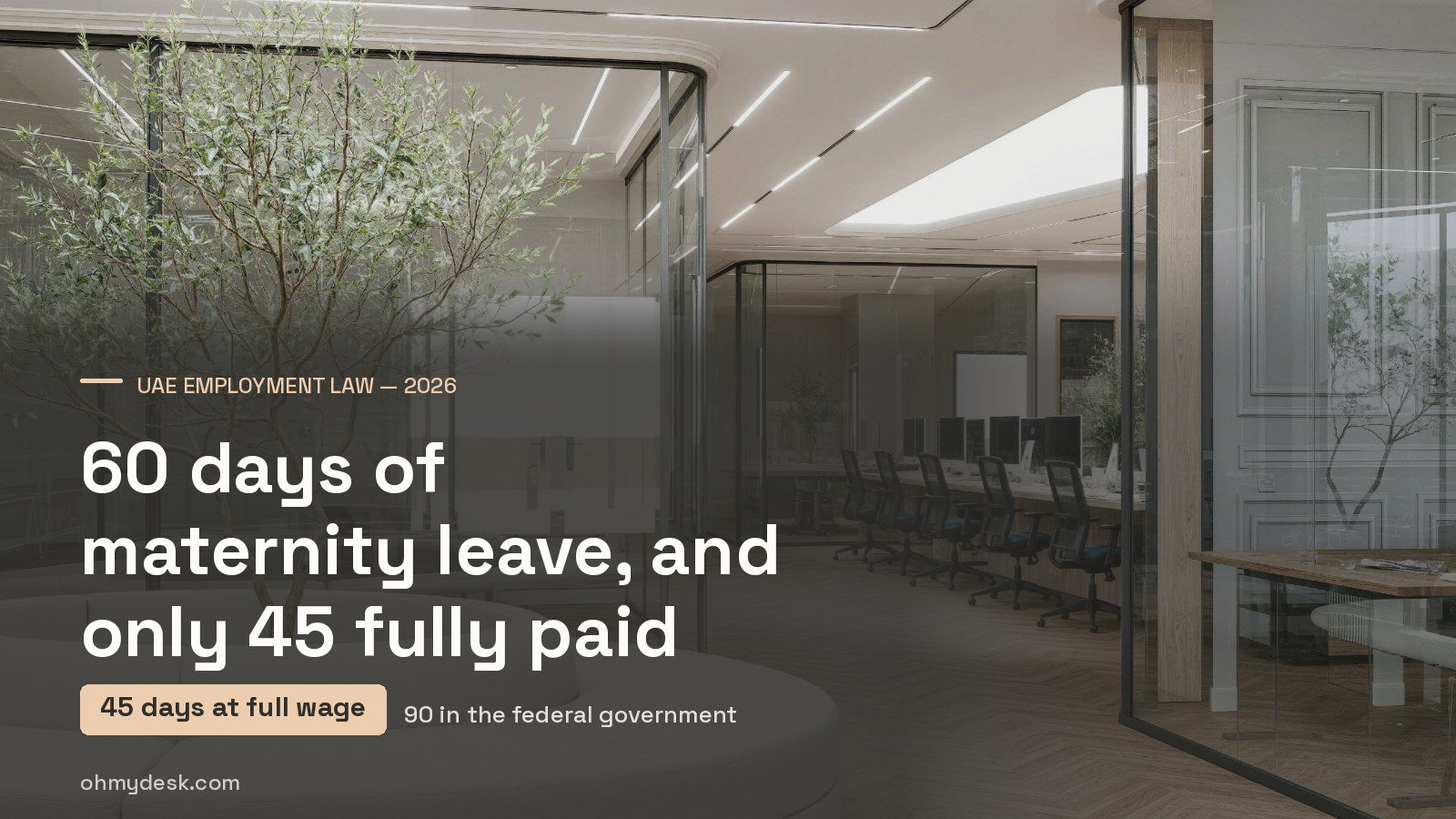
How many days of maternity leave does the UAE private sector give?
Sixty days. Article 30(1) of Federal Decree-Law No. 33 of 2021 grants a « maternity leave of (60) sixty days »: « The first (45) forty-five days with full wage » and « The following (15) fifteen days with half wage ». There is no length-of-service condition — a woman who gave birth in her second week on the job gets the same 45 fully paid days as one with ten years behind her.
The leave may begin up to 30 days before the expected delivery date, and Article 30(3) attaches the entitlement to the pregnancy reaching six months rather than to a live birth — a distinction the summaries skip, and the one that matters most to the people it covers.
These are calendar days, not working days — the single word where most of the confusion in this subject lives.
Is 60 days the maximum, or the starting point?
It is the starting point. Three further blocks sit on top, and almost no one adds them up.
Article 30(2) allows up to 45 further days, unpaid, where mother or child is ill as a result of the pregnancy or birth. The sting is in the clause's last line: that period does not count towards her service term. Taking it in full shortens the service record every later calculation leans on.
Article 30(4) surprises people. If the child is sick or is a person of determination, the mother has « the right to a leave of thirty (30) days with full pay » once maternity leave ends, extendable by 30 more unpaid. So a sick newborn earns 30 fully paid days, while the second half of ordinary maternity leave earns 15 half-paid ones — and the full stack reaches 165 days, of which only 75 carry a full salary.
| Block (private sector) | Article | Days | Pay |
|---|---|---|---|
| Maternity leave, first part | 30(1) | 45 | Full wage |
| Maternity leave, second part | 30(1) | 15 | Half wage |
| Illness from pregnancy or birth | 30(2) | 45 | Unpaid, and not counted in service term |
| Child sick or person of determination | 30(4) | 30 | Full wage |
| Same, extended | 30(4) | 30 | Unpaid |
| Maximum stack | — | 165 | 75 full · 15 half · 75 unpaid |
Source: Federal Decree-Law No. 33 of 2021, Article 30, read 18 November 2026.
Why does a federal government employee get twice the fully paid days?
Because she is under a different law. Federal Decree-Law No. 49 of 2022 on Human Resources in the Federal Government grants, at Article 19, 90 days of maternity leave with full pay to an employee in a permanent position. No half-pay tier.
Set the two side by side and the arithmetic is uncomfortably round: 45 fully paid days against 90, exactly half. The portal publishes both — the private-sector page updated on 14 October 2026, the government page on 12 August 2026 — and neither mentions the other. A reader has to already suspect the gap to go looking for it.
The gap is a choice of instrument, not an oversight. But it means the sentence « maternity leave in the UAE is 60 days » is right for the private sector and wrong for everyone on a government payroll.
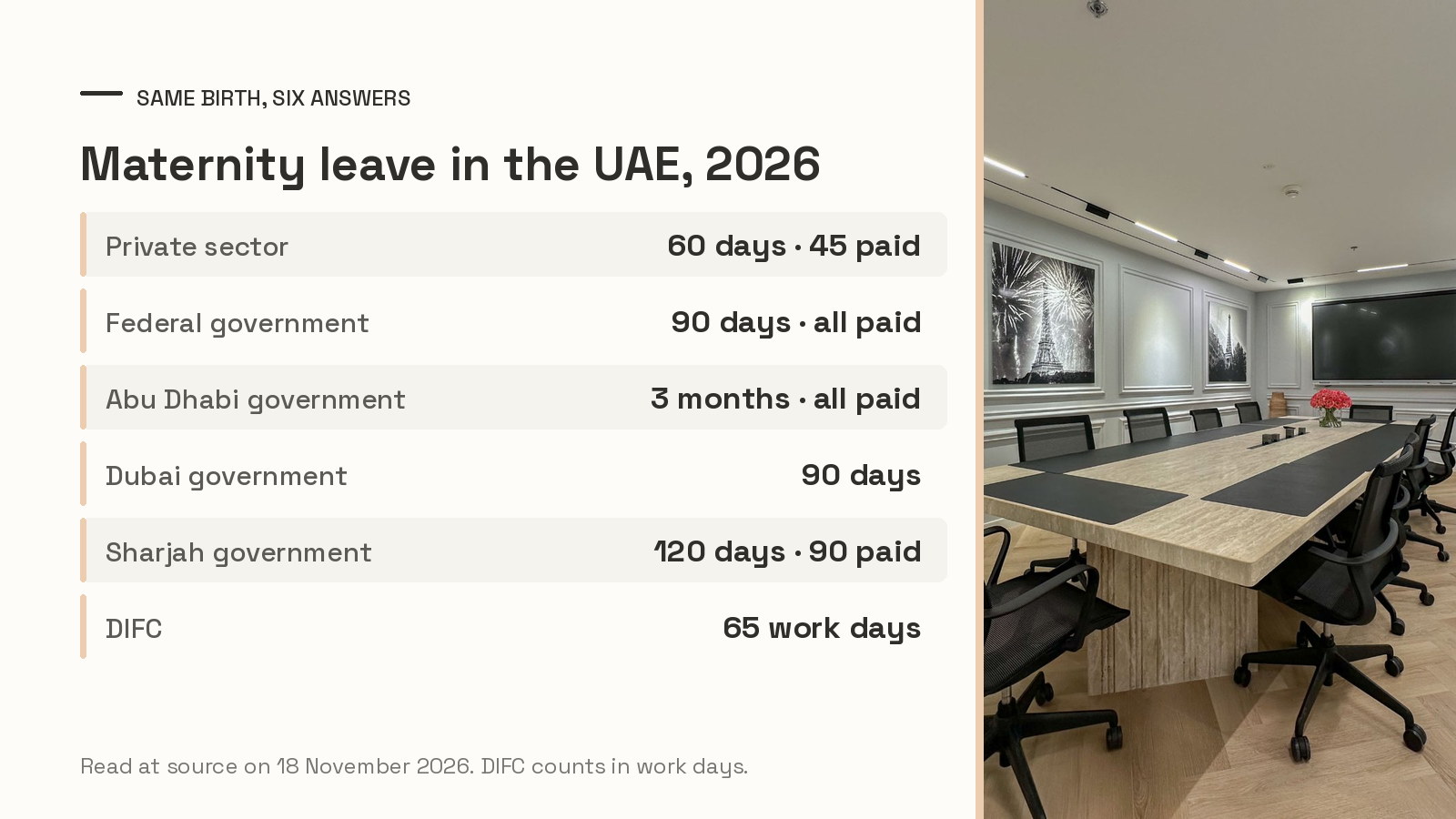
How many maternity days does each emirate's government give?
Four local governments publish their own rules on that same federal page, and no two measure the same thing. Abu Dhabi grants « three months » fully paid and never converts it into days. Dubai grants 90 days from the delivery date under Decree No. 14 of 2017 and does not publish the pay attached to them — the one number a reader needs. Sharjah publishes 120 days, 90 of them paid; Ras Al Khaimah 90 paid days since November 2016.
Two « 120s » appear on that page and they are not the same object: Dubai's is 90 days with the employee's own annual and unpaid leave bolted on, while Sharjah's is a single entitlement of which 30 days are unpaid. Comparing the headline numbers across these four lines gives the wrong answer every time.
| Employer | Maternity | Fully paid | Nursing break | For how long | Paternity |
|---|---|---|---|---|---|
| Private sector (Decree-Law 33/2021) | 60 days | 45 days | 1 hour/day | 6 months | 5 working days |
| Federal government (Decree-Law 49/2022) | 90 days | 90 days | 2 hours/day | 6 months | 5 working days |
| Abu Dhabi government | 3 months | All of it | 2 hours/day | 1 year | 3 days |
| Dubai government (Decree 14/2017) | 90 days (120 with leave added) | Not published | 2 hours/day | 1 year, none in Ramadan | 3 days |
| Sharjah government (2016 decree) | 120 days | 90 days | 2 hours/day | 6 months | Not published |
| Ras Al Khaimah government | 90 days | 90 days | Not published | 1 year | Not published |
| DIFC (DIFC Law 2/2019) | 65 Work Days | 33 Work Days | 1 hour/Work Day | 6 months | 5 Work Days |
All figures read at source on 18 November 2026. The DIFC row is in Work Days, a different unit.
Is a DIFC employer more generous, or just counting differently?
This is the finding that undoes most of what is written about UAE leave. The DIFC has its own employment law — DIFC Law No. 2 of 2019, consolidated version 5 of July 2025 — and it does not count in the same unit. Schedule 1 says a « day » means a calendar day « unless expressly stated otherwise », then defines a Work Day as every calendar day that is not a weekend or a public holiday. The leave articles are written in Work Days; the federal law in plain days. Nobody converts, and the two scales are roughly 1.4 to 1.
Convert at five work days a week and three of the four comparisons collapse. Annual leave, 30 days against 20 Work Days, is really about 30 against 28. Sick leave, 90 against 60, is about 90 against 84. But maternity leave, which looks like a five-day difference, is about 60 calendar days against 91 — a month apart, and the only line where the two regimes truly diverge. The half-pay tiers show it most: the mainland gives 15 half-paid days, the DIFC about 45.
| Entitlement | Mainland, calendar days | DIFC, Work Days | DIFC converted | Real gap |
|---|---|---|---|---|
| Annual leave | 30 | 20 | ≈ 28 days | About 2 days |
| Sick leave, total | 90 | 60 | ≈ 84 days | About 6 days |
| Sick leave, fully paid | 15 | 10 | ≈ 14 days | About 1 day |
| Maternity, total | 60 | 65 | ≈ 91 days | About 31 days |
| Maternity, fully paid | 45 | 33 | ≈ 46 days | About 1 day |
| Maternity, half paid | 15 | 32 | ≈ 45 days | Three times |
Converted at five work days a week, ignoring public holidays. A floor, not a precise count.
What happens to a woman in her first year on the job?
Here the ranking flips. The federal law attaches no service condition to maternity pay. The DIFC attaches four. Article 37(2) grants maternity pay only to an employee « continuously employed by her Employer for at least twelve (12) months » before the expected week of childbirth, who notifies her employer in writing at least eight weeks beforehand, produces a medical certificate, and gives 21 days' notice of her start date.
Those conditions govern the pay, not the leave: Article 37(1) grants the 65 Work Days on its own terms. The result is stark. A woman who gives birth in month eleven of a mainland job is entitled to 45 fully paid days. The same woman, the same month, in a DIFC company, is entitled to a longer leave and no maternity pay at all. Eight weeks before the expected week is roughly the start of the third trimester — earlier than many people choose to tell an employer.
How long is the paid nursing break, and who gets two hours?
Article 30(9) gives a private-sector mother, on her return, « one or two breaks per day to breastfeed her child, provided that the two breaks do not exceed an hour », for up to six months from the date of delivery. The breaks are paid.
Every government employer on the same portal gives two hours, counted as paid working time; Abu Dhabi, Dubai and Ras Al Khaimah run theirs for a full year. So the private-sector entitlement is half the daily time for half the duration — a quarter of the total an Abu Dhabi or Dubai government employee receives. Dubai publishes one more line no guide repeats: there is no nursing break during Ramadan. In the DIFC, Article 26(2) gives at least one hour per Work Day for six months, but only where working time exceeds six hours.
How many days of paternity leave does a father actually get?
Five working days — the one line where the private sector is not the floor. Article 32(1)(b) gives five working days of parental leave to either parent of a newborn, within six months of the birth, and the federal government matches it under Article 20 of Decree-Law No. 49 of 2022.
Abu Dhabi and Dubai give three. Dubai's are fully paid and must be taken within one month of the birth; Sharjah and Ras Al Khaimah publish no figure at all. So a father in a Dubai government job gets two days fewer, and a shorter window, than one in a private company down the road. The DIFC also gives five Work Days, under the same twelve-month service condition and eight-week notice.
How much sick leave is paid, and why does probation have none?
Ninety days a year, and fifteen of them carry a full salary. Article 31(3) caps it at « not more than (90) ninety continuous or intermittent days per year » and tiers the pay: the first 15 at full pay, the next 30 at half pay, « The following period unpaid ». Full pay covers one sixth of the entitlement. The worker must notify the employer within three working days with a medical report.
Probation carries no paid sick leave at all
Article 31(2) says it in one line: a worker « shall not be entitled to a paid sick leave during the probationary period ». Probation runs up to six months under Article 9(1), so an employee can be five months in, fully productive, and hold zero paid sick days.
And leaving during probation is not symmetrical
An employer ending probation owes fourteen days' written notice; a worker leaving the country owes fourteen. But a worker moving to another UAE employer owes not less than one month, and the new employer « shall compensate the original employer for the costs of recruitment ». Put plainly: leaving the UAE takes half the notice of changing jobs inside it.
| Tier | Mainland, Article 31(3) | DIFC, Article 35(1) |
|---|---|---|
| Full pay | First 15 days | First 10 Work Days |
| Half pay | Next 30 days | Next 20 Work Days |
| Unpaid | Remaining 45 days | Nothing beyond the 30 |
| Annual ceiling | 90 days | 60 Work Days, then termination permitted |
| During probation | No paid sick leave at all | No probation condition in the article |
| Who ends it, and how | Notice owed | Who pays recruitment costs |
|---|---|---|
| Employer ends probation | 14 days, in writing | — |
| Worker leaves the UAE | 14 days | — |
| Worker moves to another UAE employer | Not less than 1 month | The new employer |
| Worker returns within 3 months of leaving | — | The new employer |
| Either party ignores the article | — | Compensation equal to the notice-period wages |
Federal Decree-Law No. 33 of 2021, Article 9. Probation may not exceed six months.
What about annual leave, bereavement, study and Hajj?
Annual leave is thirty days a year under Article 29(1), and two days a month where service runs between six and twelve months. Below six months, nothing accrues. Article 29(8) is the clause to quote in a disagreement: the employer « may not prevent the worker from benefiting from his annual leave accrued for more than two years ». Article 29(9) turns the balance into money on the way out, which is why unused leave is a liability, not a soft benefit; it sits beside the end-of-service arithmetic we have already set out.
Three more entitlements, each narrowed by a condition
Bereavement, Article 32(1)(a): five days for a husband or wife, three for « the mother, father, son, brother, sister, grandson, grandfather or grandmother ». The list is closed — a parent-in-law, an aunt or a cousin carries nothing. Study, Article 32(2): ten working days a year to sit examinations, after two years' service; here the portal calls it « a paid leave » and the article itself does not say whether it is paid. Hajj is not in the decree-law at all — unpaid, capped at 30 days, and granted « only once » per employer, a condition that resets with each change of job.
| Leave | Article | Days | Pay | Condition |
|---|---|---|---|---|
| Parental, newborn | 32(1)(b) | 5 working days | Paid | Either parent, within 6 months of the birth |
| Bereavement, spouse | 32(1)(a) | 5 days | Paid | From the date of death |
| Bereavement, close relative | 32(1)(a) | 3 days | Paid | Closed list of eight relatives |
| Study | 32(2) | 10 working days | Not stated in the article | Approved institution, 2 years' service |
| Hajj | Not in the decree-law | Up to 30 days | Unpaid | Once per employer |
What does it cost an employer to get this wrong?
The law answers in two registers. The financial one is Article 63: where no specific penalty is set, a fine of not less than AED 5,000 and not more than AED 1,000,000. Article 60 sets AED 50,000 to AED 200,000 for listed breaches, Article 62 scales with the number of workers up to AED 10,000,000, and Article 64 doubles it for a repeat within a year. Denying a statutory leave falls in the residual band — which starts at five thousand dirhams and has six more zeros above it.
The structural one is shorter and sharper. Article 30(8): « It is not permissible to terminate the service of the female worker or notify her of the same because of the pregnancy ». Not the leave — the pregnancy. In the DIFC the same ground appears twice, at Article 40(1) and at Article 59(1)(f), with a right under Article 40(2) to return to « the same or a substantially similar role ». For a small company the real exposure is rarely the fine: it is covering a 60-day absence with no spare person on the team.
Where do these numbers come from, and what could not be read?
Everything above was read at source on 18 November 2026. The private-sector figures come from Federal Decree-Law No. 33 of 2021 on the UAE government's own asset domain, cross-checked against the portal's « Types of leaves » page, updated 14 October 2026; that copy is watermarked as an unofficial translation, and where the two disagreed we quoted the law. The government figures come from the portal's maternity and paternity page, updated 12 August 2026, and the DIFC figures from DIFC Law No. 2 of 2019.
Not read: the Ministry of Human Resources and Emiratisation blocks automated access to its consolidated PDF and its service pages, so nothing here is sourced from it. The DIFC conversions assume a five-day week and ignore public holidays, which would push that column higher, not lower. Our own guide to nurseries in Business Bay published the 45/15 split in October; this is where it is set out.
One thing we could not do is ask our readers: the queries reaching this site carry no maternity, paternity, sick-leave or probation terms at all — zero impressions across two consecutive 28-day periods. The questions below were built from the nine measured search terms in the cluster rather than from our own data, and we say so rather than pretend otherwise.
FAQ: 10 quick answers
1. How many days is maternity leave in the UAE? Sixty calendar days in the private sector, under Article 30 of Federal Decree-Law No. 33 of 2021: 45 at full wage and 15 at half wage. There is no minimum length of service, and the leave may start up to 30 days before the expected delivery date. Federal government employees get 90 fully paid days.
2. Is UAE maternity leave fully paid? Only the first 45 days. Article 30(1) pays 45 days at full wage and the following 15 at half wage, so three quarters of the 60-day entitlement carries a full salary. Federal government employees are paid in full for all 90 of their days, which is why the headline figures do not compare.
3. Can you take more than 60 days of maternity leave in the UAE? Yes, up to 165 days, but most of the extra is unpaid. Article 30(2) adds up to 45 unpaid days where mother or child is ill from the pregnancy or birth, and those do not count towards her service term. Article 30(4) adds 30 paid days, extendable by 30 unpaid, if the child is sick.
4. How much maternity leave does a Dubai government employee get? Ninety days from the delivery date under Dubai Decree No. 14 of 2017, with annual and unpaid leave addable to a maximum of 120. The emirate publishes the day count but not the pay attached to it. Abu Dhabi grants three months fully paid, Sharjah 120 days of which 90 are paid.
5. How many days of paternity leave are there in the UAE? Five working days in the private sector, under Article 32(1)(b), which calls it parental leave and gives it to either parent within six months of the birth. The federal government matches the five days. Abu Dhabi and Dubai government employers give three, and Dubai’s must be taken within one month.
6. How much sick leave are you entitled to in the UAE? Ninety days a year, of which only the first 15 are at full pay. Article 31(3) pays the next 30 at half pay and leaves the final 45 unpaid. The worker must notify the employer within three working days with a medical report, and nothing is due where the illness resulted from their own misconduct.
7. Do you get paid sick leave during probation in the UAE? No. Article 31(2) states that a worker is not entitled to paid sick leave during the probationary period, which runs up to six months under Article 9(1). Unpaid leave may be granted on a medical report, but nothing is owed. It is the largest gap between the headline entitlement and reality.
8. How long is the probation period in the UAE, and what notice applies? Up to six months, and the notice depends on where you are going. An employer ending probation gives 14 days’ written notice, and so does a worker leaving the country. A worker moving to another UAE employer owes at least one month, and the new employer pays the original’s recruitment costs.
9. How much annual leave do you get in the UAE? Thirty days for each full year of service, and two days a month where service runs between six and twelve months. Leave carries forward with the employer’s approval, but Article 29(8) stops an employer blocking leave accrued for more than two years, and unused days are paid out on departure.
10. Is maternity leave in the DIFC the same as the rest of Dubai? No, and the gap is wider than it looks. The DIFC grants 65 Work Days rather than 60 calendar days — about 91 calendar days at five days a week. But DIFC maternity pay requires twelve months of continuous service and eight weeks’ written notice, conditions the federal law does not impose.
What to do next
If you employ people in Dubai, the useful exercise is not reading the ceiling but costing the floor: a 60-day absence, 45 of them fully paid, with no service condition to lean on. If you are the one taking the leave, two dates are worth putting in writing early — the 30 days before delivery when it may start, and, in the DIFC, the eight weeks before the expected week when the pay condition closes.
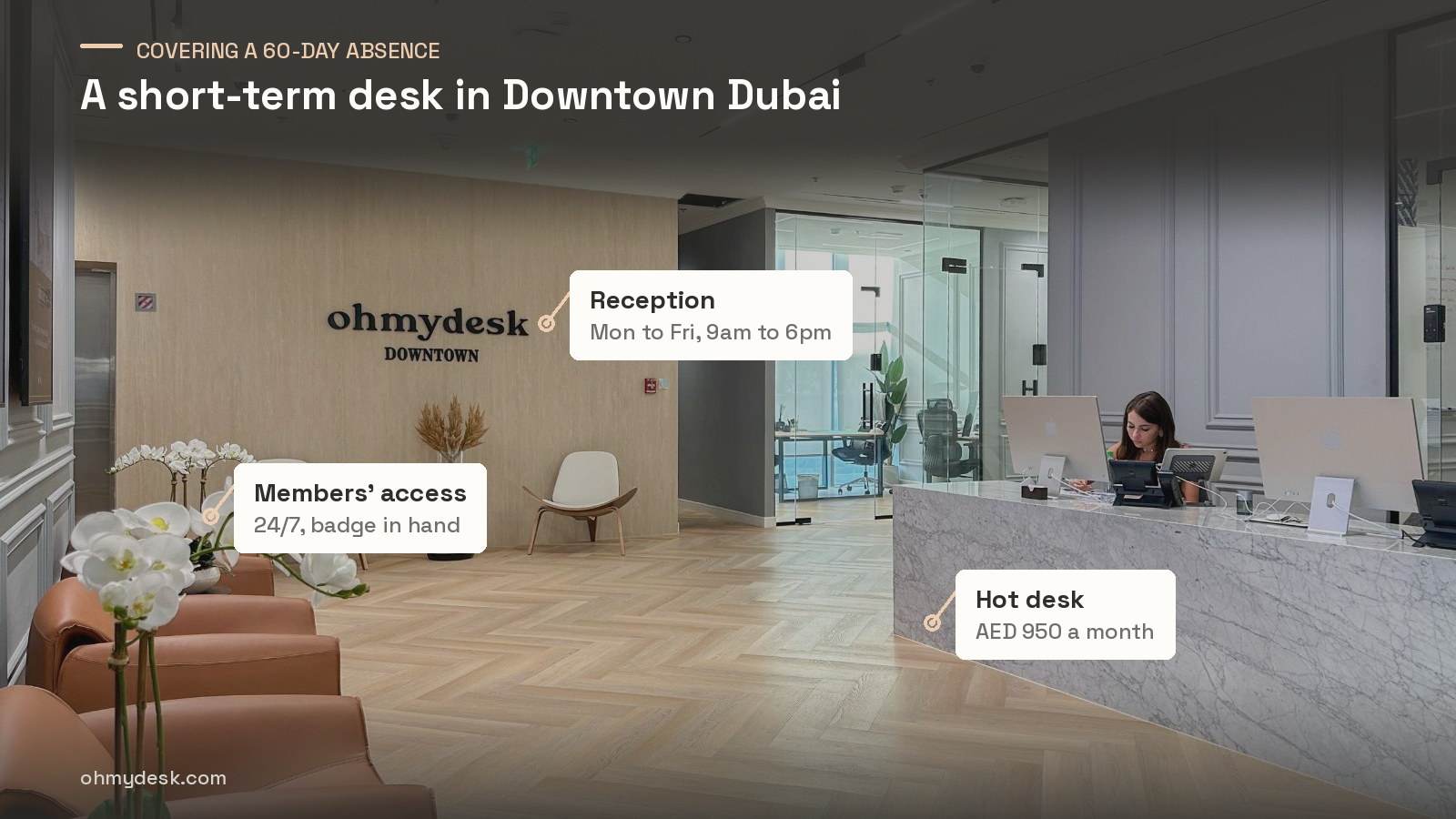
Neither is a reason to carry an office you only half use. A hot desk is AED 950 a month and a dedicated desk AED 1,500 in Downtown, both with 24/7 access for members and reception Monday to Friday, 9am to 6pm; a private office starts at AED 6,000. If the licence behind the team needs an address rather than a room, a Virtual Office with Ejari is AED 8,000 a year, and this guide explains how Ejari works. Upstream sit what a work permit costs, the Emiratisation contribution and the freelance visa route in Dubai. Public holidays are listed here.
Book a free tour at Downtown, Business Bay or Dubai Design District, and the team will answer within two working hours.