
What does a salary certificate cost in the UAE in 2026?
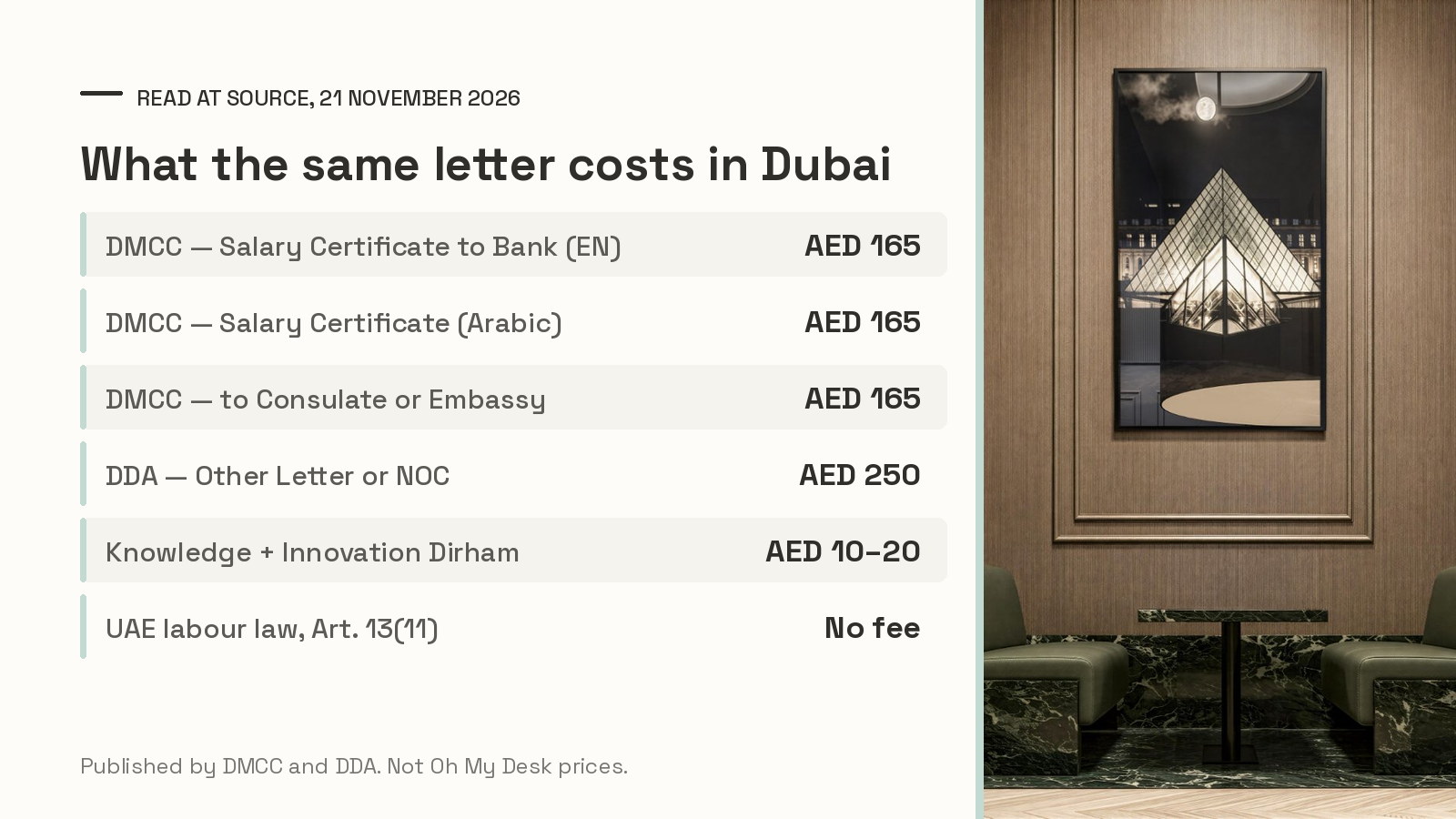
Between nothing and AED 270, depending entirely on who licensed your employer. A mainland company types the letter itself and normally charges nothing. A DMCC company orders it from a member portal at AED 165. A company licensed by the Dubai Development Authority — Dubai Design District, Dubai Internet City, Dubai Media City — has no salary-certificate service at all and buys a generic AED 250 letter. Both free zones add a government surcharge, and neither page mentions VAT. The table is what their own fee pages printed on 21 November 2026.
| Issuer | What it is called there | Price as printed | Surcharge | Delivery |
|---|---|---|---|---|
| Mainland employer | no official name | nothing published | — | at the employer’s discretion |
| DMCC | Salary Certificate to Bank (English) | AED 165 | AED 20 Knowledge and Innovation Dirham, per the schedule’s general conditions | 1 working day |
| DMCC | Salary Certificate (Arabic) | AED 165 | ||
| DMCC | Salary Certificate to Consulate/Embassy (English) | AED 165 | ||
| DMCC | Salary Certificate to Consulate/Embassy (Arabic) | AED 165 | ||
| Dubai Development Authority | Other Letter or NOC | AED 250 per letter/certificate | AED 10 Knowledge Dirham + AED 10 Innovation Dirham per transaction | 2 working days |
| UAE labour law | certificate of experience | “without fees” | none | on request, when the contract ends |
So the same half-page of facts costs AED 185 all-in at DMCC and AED 270 at the DDA — a 46% spread between two Dubai free zones, and only the cheaper one has bothered to name the product.
Does any UAE law require your employer to give you one?
No. We read Articles 8, 13, 16 and 22 to 30 of Federal Decree-Law No. 33 of 2021 on the Regulation of Employment Relationship word by word. There is one certificate in the text, and it is not this one. Nor is there any obligation in those articles to give an employee a payslip, a wage statement or a receipt — not monthly, not ever.
Article 22 settles only where the number lives: the wage “shall be specified in the employment contract” and “shall be paid in UAE Dirham” on the due dates set by the Ministry. Article 8(2) is the quiet admission that follows: a worker “may prove by all possible means of proof the employment contract, the amount of the wage”. A law that lets you prove your salary by any means is a law that assumes you may hold no document proving it.
Where an official list does ask for one
In exactly one place we could find. The virtual work visa requirements on the federal portal, updated 7 August 2026, list four items, and the fourth is a “salary certificate” above a minimum figure. The page does not say who must issue it, in what language, or whether it must be attested — it assumes the document exists. We costed the two remote-work visa routes separately and do not repeat their thresholds here.
What we checked, and what we did not
Articles 31 onward were not read verbatim, and the MOHRE legal FAQ refused automated reading on 21 November 2026. The finding above is stated for the articles named, not for the whole statute. The same decree-law governs maternity, sick and annual leave, whose day counts we do not repeat.
What must the one certificate the law guarantees contain?
Six things, and one of them is your pay. Article 13(11) obliges the employer to give the worker, “as per his request and upon expiry of the employment contract, a certificate of experience, without fees”: start date, expiry date, total term of service, job title or type of work, “the last wage he was receiving”, and the reason the contract ended.
It also carries a limit most people never read: the certificate must not include anything “that may harm the worker’s reputation or limit his chances of finding new job opportunities”.
| Certificate of experience | Salary certificate | |
|---|---|---|
| Legal basis | Art. 13(11), Federal Decree-Law 33 of 2021 | none we could find |
| Price | “without fees” | AED 0 to 250, by licensing authority |
| When you can get it | on request, at the expiry of the contract | any time the issuer agrees |
| Does it state your pay? | yes — “the last wage he was receiving” | yes |
| Addressed to | nobody in particular | a named bank, consulate or embassy |
| Shelf life | not stated | 1 month at DMCC |
The free document already carries the number
That is the problem in one line: the document the state guarantees free of charge contains your salary, and arrives on the day you stop earning it. The last wage also drives the end-of-service calculation, whose arithmetic stays in that guide.
Why does a free zone charge for a letter the law makes free?
Because there the letter is a government document, not a company one. DMCC does not countersign your employer’s draft: it generates the certificate itself. Its service page has the member log into the portal, pick “Employment Services – Letters and certificates Arabic/English – Salary certificate”, upload nothing — “No Required Documents to be uploaded” — and a “System generated salary certificate” comes back in one working day.
The DDA has not built that product. Its published route is “Other Letter or NOC”: AED 250 per letter or certificate, two working days, one required document — a request letter — and the requester named on the page is the General Manager. The same authority charges AED 1,000 for a Certificate of Good Standing. The letter about an employee is the cheap end of a catalogue built for companies.
If the letter then travels abroad, the legalisation chain is its own bill, which we have priced separately. A police clearance certificate, by contrast, carries one published government price nationwide, because the state issues it. A salary certificate is priced by whoever licensed your employer.
Why does DMCC sell four separate salary certificates?
Because it prices by recipient and by language, not by content. The Schedule of Charges carries “Salary Certificate to Bank (English)”, “Salary Certificate (Arabic)” and the same pair addressed to a consulate or embassy as four separate line items at AED 165 each. A member who needs the bank version in both languages pays AED 330 for one set of facts, plus the AED 20 surcharge.
Read the rest of that section and the logic stops being about salaries at all. The same AED 165 buys an “Employment Service Certificate”, a “Letter to Consulate / Embassy”, an NOC for a learner driving permit, and the “No Objection Certificate for Employee to Open a Business”. A letter stating what you earn and a letter permitting you to go and compete with your employer cost exactly the same. A “No Objection Certificate for Family Hold” is AED 60; one for a 10-year visa is AED 2,000 — a 33-fold spread inside one section of one fee schedule.
One month, and no refund
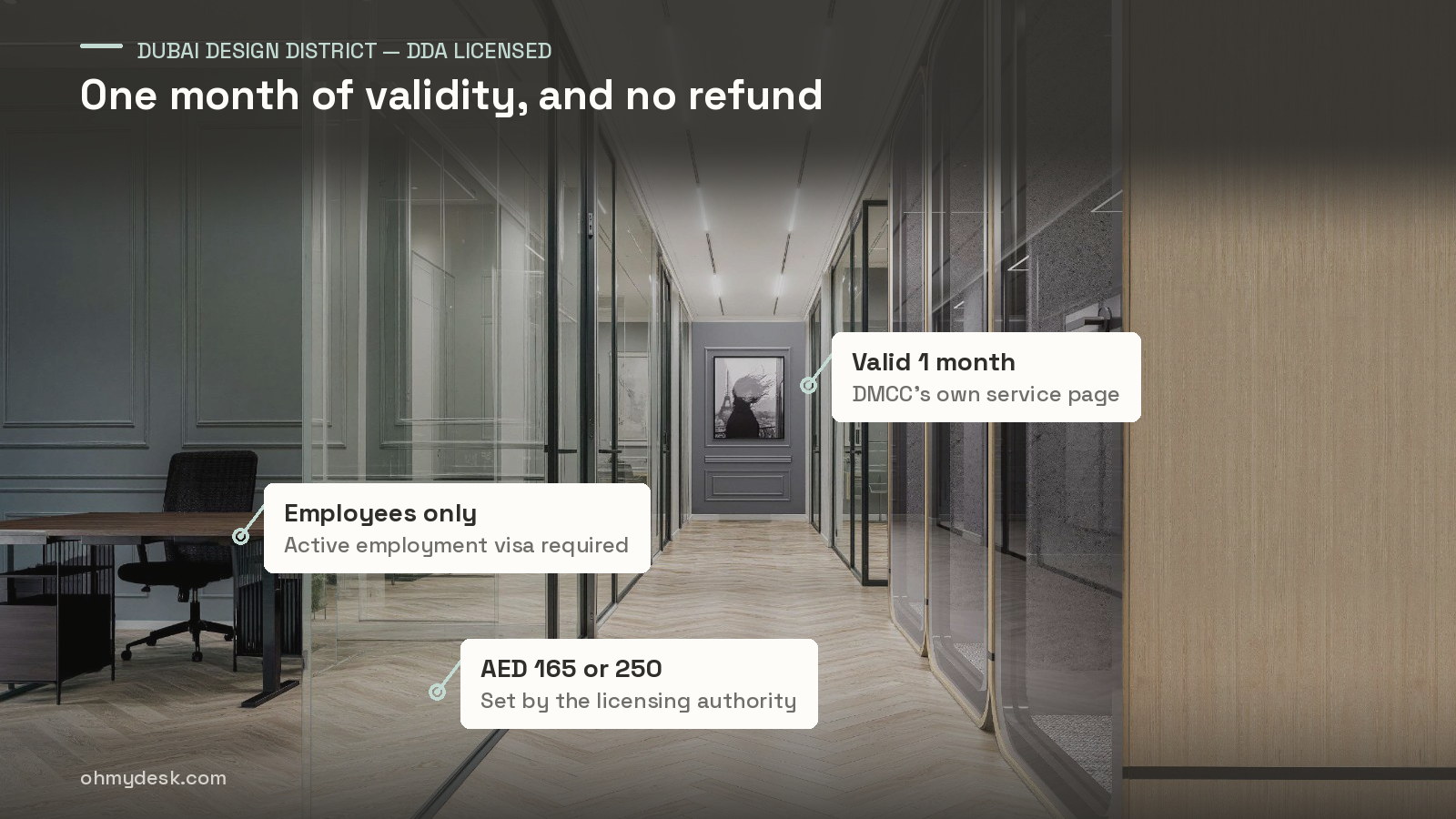
Two conditions on the same page belong together. “The certificate is only valid for 1 month.” And: “The application fee is non-refundable once the application is approved by DMCC.” You pay before you know whether the recipient accepts the wording, and the clock starts at once.
Who is not allowed to request one?
Three groups, all stated rather than implied. DMCC’s eligibility note reads: “Only active employees under employment visa can request for a salary certificate” — which rules out anyone in the company who is not on its payroll. The second condition is collective: “Any imposed sanction on the company account needs to be cleared before applying”, so your personal letter is blocked by your employer’s compliance record. The third is procedural: at the DDA the requester is the General Manager, so the employee cannot start the request at all.
The employment visa, not the employment, is the real gate. We costed the work permit route separately and repeat none of its fees.
What is a salary transfer letter, and why does the bank want that?
Because they do different things. A salary certificate states: this person earns this much. A salary transfer letter undertakes: addressed to one named bank, it commits the employer to routing the salary into an account held there. Evidence against collateral — which is why a file that already holds a certificate still gets asked for the letter.
And nobody mentions this: neither document is named anywhere in the regulation that creates the need for them. Article 2 of Regulation No. 29/2011 of the Central Bank of the UAE defines personal facilities as “repayable from salary, end of service indemnity and/ or other verifiable regular income from a well defined source”, and requires that “the borrowers’ salary and end of service benefits are properly ascertained from the employer”. The duty is on the bank to ascertain. The paperwork is the industry’s answer to that duty, not the regulator’s instruction.
The official summaries do not even agree on what the salary is doing in the deal. The federal portal’s page on loans for individuals, updated 28 October 2026, describes a loan “secured by the borrower’s salary and end of service gratuity”. The regulation it summarises says “repayable from”. Security and source of repayment are not the same idea, and the primary text governs.
How much can a salary certificate actually unlock?
Three published numbers decide it. Regulation No. 29/2011 caps the facility at 20 times salary and total income, repayable within 48 months, and Article 7 caps monthly deductions at 50% of gross salary — across every lender, credit cards included, not per loan.
| Cap | What it limits | Where it is written |
|---|---|---|
| 20 times salary and/or total income | the size of the facility | Art. 2, Regulation No. 29/2011 |
| 48 months | the repayment period | Art. 2, and Art. 7 Clarifications, item 2 |
| 50% of gross salary | monthly instalments, all lenders combined | Art. 7(a) and Clarifications, item 1 |
| 30% of income or pension salary | the deduction, if repayment runs past retirement | Art. 7(b) |
| 120% of the loan or debit balance | the face value of security cheques | Art. 7(c) |
The letter is only half of it. The Al Etihad Credit Bureau adds a check the employer has no part in: financial institutions are “required by Law to obtain consent of the concerned individual or company before accessing their credit information”. We could not read the bureau’s price list on 21 November 2026, so no bureau fee appears here.
Does the 20-times ceiling survive the 48-month rule?
Only just, and only at a cost of credit most borrowers will not get. This is our arithmetic on the three published caps, not a figure anyone publishes.
Borrow the full 20 times your salary and repay it inside 48 months and the principal alone consumes 20 ÷ 48 = 41.67% of gross salary a month. The cap is 50%. That leaves 8.33 percentage points for four years of interest — four months of salary on a loan worth twenty, which is 20% of the principal over four years, or about 5.0% a year flat. Above that, the 50% cap bites first, and the real limit is the deduction rule, not the headline multiple.
| On a gross salary of | AED 10,000 a month | As a share of salary |
|---|---|---|
| Facility ceiling, 20 times | AED 200,000 | 20 months of pay |
| Principal alone, over 48 months | AED 4,166.67 a month | 41.67% |
| Deduction cap, 50% | AED 5,000 a month | 50.00% |
| Room left for interest | AED 833.33 a month | 8.33% |
| Total interest the caps allow | AED 40,000 over 4 years | 4 months of pay |
| Implied maximum cost of credit | 20% of the loan | about 5.0% a year flat |
The ratios do not move with the salary: at AED 5,000 or AED 50,000 the percentages are identical, because all three caps are multiples of pay. And where repayment runs past retirement, the 30% cap in Article 7(b) makes the headline unreachable outright: 30% of salary over 48 months is 14.4 times salary with zero interest at all — 28% below the number everyone quotes.
What if you own the company or work for yourself?
Then there is no issuer. The free zone will not sell you the letter, because you are not on its payroll. Your own company can write one, but a letter you signed about yourself is the thing the certificate exists to avoid. And the law’s free certificate needs a contract to expire, which a shareholder does not have.
The regulation has one open phrase for this: the bank may lend where “the borrower has produced documentary evidence of such income”. In practice the trade licence, the company bank statements and the audited accounts do the work the letter would have done. Building that file from scratch starts earlier: the freelance visa route in Dubai makes the income lawful, and how Ejari works in Dubai makes the licence possible. Our Virtual Office with Ejari is 8,000 AED a year; the Ejari booking page lists what the file needs.
Does the government already know what you earn?
To the day, for every private-sector employee in the country. The federal portal’s page on payment of salaries and wages, updated 14 October 2026, states that “all establishments registered with Ministry of Human Resources and Emiratisation (MoHRE) must pay their employees’ wages on the due date through the ministry’s Wage Protection System (WPS)”, and that salaries for the previous month “are due on the first day of each Gregorian month”. At least 85% of total wages must land on time.
What follows a missed payment is a published timetable, under Ministerial Resolution No. 340 of 2026.
| Day after the due date | What MOHRE does |
|---|---|
| Day 1 | electronic monitoring of all establishments |
| Day 2 | notifications and alerts to non-compliant establishments |
| Day 5 | new work permits suspended for the establishment |
| Day 11 | administrative fine under Cabinet Resolution No. 21 of 2020, and reclassification into the Third Category |
| Day 16 | labour disputes registered automatically for the affected workers |
| Day 21 | executive instrument for payment, precautionary attachment, travel ban on the person in charge, referral to the Public Prosecution |
Read that list next to the AED 165 invoice. The state keeps a monthly, bank-verified record of what every registered employee was paid, and escalates to a travel ban inside three weeks if the money does not move — yet issues the employee nothing. No WPS statement, no portal printout, no extract. The one party that can prove your salary without asking anyone is the one party that never puts it in writing for you. Domestic workers, whose route we costed separately, are paid through the same monitored channel and get no certificate from it either.
What does the DIFC guarantee instead?
The mirror image, almost exactly. Under DIFC Law No. 2 of 2019, consolidated version No. 5 of July 2025, Article 15(1) requires “a written itemised pay statement in respect of each Pay Period”, showing the remuneration payable and “the amount of any deduction from that amount and the purpose for which it is made”. Article 16(2)(c) keeps payroll records six years after termination, and Article 19(1) requires all remuneration to be paid “within fourteen (14) days after the Termination Date”, with a penalty of a daily wage for each day late. What we did not find in the text read verbatim is any duty to issue a certificate of service.
| Federal (mainland and most free zones) | DIFC | |
|---|---|---|
| Monthly itemised payslip | not required in Art. 8, 13, 16 or 22–30 | required, each Pay Period (Art. 15) |
| Certificate at the end | required, free of charge (Art. 13(11)) | not found in the text read |
| Deadline for final pay | not fixed in the articles read | 14 days from the Termination Date (Art. 19(1)) |
| Penalty for paying late | WPS escalation, day 2 to day 21 | a daily wage for each day in arrears (Art. 19(2)) |
| How long records are kept | at least two years after end of service (Art. 13(1)) | six years after the Termination Date (Art. 16(2)(c)) |
A federal-side employee has a right to one document, once, on the way out. A DIFC employee has a right to twelve a year and nothing at the end. Neither has a right to the document a bank asks for.
FAQ: 10 quick answers
Search Console shows zero queries on this vocabulary reaching the site over two 28-day periods, so none of these comes from our traffic. They are built from the seven keywords measured on Semrush for the UAE on 21 November 2026: salary certificate, salary certificate uae, salary certificate format, salary transfer letter, employment certificate uae, experience certificate uae and no objection certificate uae.
1. What is a salary certificate in the UAE? It is a letter from your employer stating your job title, your start date and what you are paid, addressed to whoever asked for it. No article of UAE labour law defines it, sets its contents or fixes its price. It exists because banks, consulates and schools ask for it.
2. Is a salary certificate free in the UAE? From a mainland employer, usually yes: nothing obliges them to charge, and nothing obliges them to issue one either. In a free zone it is a priced service: AED 165 at DMCC, AED 250 at the Dubai Development Authority, both before the Knowledge and Innovation Dirham surcharges.
3. How much does a salary certificate cost at DMCC? AED 165, per the DMCC Schedule of Charges read on 21 November 2026, for each of four separate products: to a bank in English, in Arabic, and to a consulate or embassy in either language. The general conditions add AED 20, and the fee is non-refundable once DMCC approves it.
4. What is the difference between a salary certificate and a salary transfer letter? A salary certificate states what you earn; a salary transfer letter undertakes something. It is addressed to one named bank and commits the employer to routing the salary into an account there. Banks ask for the second when the loan depends on seeing the money arrive.
5. How long is a UAE salary certificate valid? DMCC publishes one month: “The certificate is only valid for 1 month.” No federal rule sets a validity period, so elsewhere it is whatever the recipient accepts. Request the letter after the bank or consulate has told you what it needs, not before.
6. What must a UAE experience certificate contain? Article 13(11) of Federal Decree-Law No. 33 of 2021 lists the start date, the expiry date, the total term of service, the job title, the last wage received and the reason the contract ended. It must not include anything “that may harm the worker’s reputation”.
7. Can I get a salary certificate if I own the company? Not from the free zone, if you are not on its payroll. DMCC states that “only active employees under employment visa can request for a salary certificate,” and the DDA letter is requested by the General Manager. Owners fall back on documentary evidence of income.
8. Do UAE employers have to give a payslip? Not under the federal labour law. Articles 8, 13, 16 and 22 to 30 of Federal Decree-Law No. 33 of 2021 contain no such obligation. DIFC is the exception: Article 15 of DIFC Law No. 2 of 2019 requires “a written itemised pay statement in respect of each Pay Period”.
9. How much can I borrow against my salary in the UAE? Regulation No. 29/2011 of the Central Bank caps personal facilities at 20 times salary and total income, repayable within 48 months, with deductions across all lenders capped at 50% of gross salary — 30% if repayment runs past retirement.
10. Who issues a salary certificate on the Dubai mainland? Your employer, on its own letterhead, with its own stamp. No mainland authority issues one for you and no mainland fee is published: MOHRE runs the Wage Protection System that records the payment, but issues the employee no certificate.
The bottom line
Four things follow. Ask the recipient first what wording and language it needs: at DMCC the wrong version costs another AED 165 and the fee is non-refundable. Order the letter last, not first — it dies after a month. If you are leaving anyway, ask for the Article 13(11) certificate of experience instead: it is free, it carries your last wage, and nothing in it may damage you. And if you own the business, stop looking for a letter and build what the regulation actually describes: documentary evidence of income.
We write these guides because members ask them between meetings, not because we issue certificates. What we run is the address and the desk at the other end of the paperwork: a Virtual Office with Ejari at 8,000 AED a year for the licence file, coworking from 950 AED a month, and a private office from 6,000 AED. Prices are before VAT; members hold a badge 24/7 and reception is open Monday to Friday, 9am to 6pm, at Downtown, Business Bay and Dubai Design District. Tell us where you have got to and we will tell you which document you need first.